
Showbiz
Spotify’s RADAR: Showcasing Diverse Sounds Redefining Africa’s Music Scene


Spotify’s RADAR program is dedicated to bringing rising talent to the forefront globally, showcasing what is next in sound, and lifting artists by helping them expand their global reach on their path to superstardom.
The past few years have been a clear testament to the growth of African music globally, and this year, Spotify’s RADAR Africa program is shining a spotlight on the continent’s rising stars. Joining the ranks of previous RADAR Alumni such as Ayra Starr, Victony, BNXN, and Bloody Civilian from Nigeria, Shallipopi is the latest addition to the RADAR Africa list. Hailing from Eswatini, Manana who is South African-based follows in the footsteps of luminaries like Tyla and DBN Gogo, representing his nation’s thriving music scene.
Ugandan artist Joshua Baraka’s inclusion underscores the program’s commitment to showcasing the diverse talents that make the African continent proud through their art, following in the footsteps of fellow East African RADAR Alumni Xenia Manasseh from Kenya, with both representing the region.
Phiona Okumu, Spotify’s Head of Music, Sub-Saharan Africa says “This cohort represents some of the continent’s most promising artists. As African artists continue to rise globally, Spotify is excited to continue playing its part in the rise and discovery of local artists, showcasing their diverse talents to the world.”
Shallipopi, popularly called “Presido De La Pluto” by his fans, gained popularity through viral freestyles, offering a fresh perspective on street culture and influencing street lingo through his music. Hailing from the culturally rich Benin City in Edo State, Nigeria, Shallipopi proudly showcases his roots on tracks like “Obapluto,” one of his top five most-listened-to songs on Spotify, following “Ex Convict”. His track “Cast” holds the top spot as his most-streamed song, while his album “Shakespopi,” which has amassed over 13 million streams since its release, further highlights how he adeptly fuses tradition with modernity, and seamlessly blends his cultural heritage with contemporary elements.
Shallipopi’s reach continues to grow, with over 1.9 million additions to playlists in the last 12 months and a global audience led by Nigeria, the United States, the United Kingdom, Ghana, and South Africa over the last 28 days. The street-loved artist is embraced by Gen Z’s with 52% of his listeners aged 18-27 and millennials with 19% at 28-34. He also commands a larger male following at 66% compared to female following at 31% over the last 28 days.
Ugandan artist Joshua Baraka burst onto the scene with his soulful 2020 debut “Tomorrow,” captivating listeners across Africa and globally, and amassing a fervent following. Nigeria stands as the top country streaming his music the most on Spotify over the last 28 days, a testament to the viral success of his hit “NANA”, also his most-streamed song. Nana remix featuring African superstars Joeboy, King Promise and Bien further solidifies his popularity, ranking among Baraka’s top three most-listened tracks, trailing closely behind his other smash hit “Dalilah.”
While Nigeria leads the charge, Baraka’s cross-cultural resonance is evident as Kenya, the United States, the United Kingdom, and his native country Uganda follow among his top five streaming countries, underscoring the singer’s ability to craft melodies that resonate with diverse audiences worldwide. His core Spotify audience over the last 28 days spans Gen Z and millennials, with 53% aged 18-27 and 25% aged 28-34, while his male listenership at 59% outpaces females at 38%, further highlighting his capacity to captivate audiences across genders. With over 195k playlist adds on Spotify in the last 12 months, his ever-growing fanbase is a true showcase to the power of cross-cultural relevance and the boundless possibilities of artistic collaboration.
Hailing from eSwatini, Manana is a multi-talented singer, producer, and Grammy-winning songwriter renowned for his lush melodies and jazzy R&B production. His soulful performances and masterful songwriting prowess, include credits with Burna Boy, Jon Vinyl, Sauti Sol, and the legendary Usher, which helped catapult him to prominence.
Manana’s global appeal is evident as South Africa, the United States, Nigeria, Kenya, and the United Kingdom emerged as the top five countries streaming his music over the last 28 days. He has garnered over 144k playlist adds in the past 12 months and with an audience comprising 50% male listeners and 43% female listeners. His music resonates strongly with the younger demographic aged 18-27 making up 58% of his total streams and 23% aged 28-34, over the last 28 days. Additionally, one of his most streamed tracks on Spotify “Distance – Acoustic” features his exceptional songwriting talent.
We had a sit down with Shallipopi, Manana and Joshua Baraka to delve deeper into their music and creative journey.
SHALLIPOPI
How would you describe your musical style and what are some of the influences that have shaped your sound?
My music is experimental music or what I call Afro-talk. It’s just my type of sound.
How does it feel to be one of this year’s Spotify RADAR artists?
It feels great. It’s an opportunity for more people to meet me at the front. This is just the beginning.
Artists often face unique challenges. What has surprised you most about the music industry so far? What are some of the biggest lessons you’ve learned on your musical journey?
Nothing surprises me about the music game – I’m enjoying it. The big lesson is not to give up. Just do what you’re doing and listen to the people close to you.
Looking ahead, what are you most excited about in your musical journey?
I’m excited about everything because this is my dream. Doing music back to back, I’ve been doing music since I was a child so everything about it is exciting.
MANANA
How would you describe your musical style and what are some of the influences that have shaped your sound?
I would say I make alternative RnB, with a singer-songwriter twist. My influences are a combination of training from my upbringing, harmonies from choir school, chord progressions from jazz studies and then the rest is from hearing RnB and neo-soul music from my brother’s CD collection
How does it feel to be one of this year’s Spotify RADAR artists?
Feels good. It’s a privilege, I’m very grateful. It is reassuring and encouraging to see that the work we’re putting in is appreciated.
Artists often face unique challenges. What has surprised you most about the music industry so far? What are some of the biggest lessons you’ve learned on your musical journey?
I don’t think I’ve had any surprises. But I think the struggle I had to deal with was comparison. I think social media has given us access to parts of the world that previously weren’t easily accessible, but has also exposed us to this feeling of inadequacy that maybe isn’t warranted. I think focusing on what I’m doing and not trying to make music that would be viral or “challenge-friendly” has been my biggest lesson.
Looking ahead, what are you most excited about in your musical journey?
Growth. Every year I start with that being my goal. I’m not sure what that looks like exactly but I know consistent growth has no limit. So that’s the hope for the future.
JOSHUA BARAKA
How would you describe your musical style and what are some of the influences that have shaped your sound?
I’d describe my musical style as an interpretation of what I feel at the time I’m making that particular piece of music. Basically, my music is who I am so I’d describe my music as another version of me. I’ve been influenced by a lot of gospel musicians because I grew up in a staunch Christian family. As I grew up and got access to more genres of music, I became obsessed with Bob Marley, Chronixx, jazz music in general and every RnB artist I could find.
I’ve also been influenced by Ugandan artists like Radio from the duo Radio and Weasel, Maurice Kirya and Elly Wamala.
How does it feel to be one of this year’s Spotify RADAR artists?
It feels really good to be chosen to be a part of this year’s RADAR artists. I feel like a part of something bigger than myself. It’s a step in the right direction and vision which is to shine light on Uganda and East Africa in general.
Artists often face unique challenges. What has surprised you most about the music industry so far? What are some of the biggest lessons you’ve learned on your musical journey?
What surprised me the most about the music industry is how different it is from whatever you see on TV and the internet. It’s not as smooth and easy as it’s made to appear. My biggest lesson so far is that you need to show up regardless of how you feel and do what you need to do. That is the price for growth.
Looking ahead, what are you most excited about in your musical journey?
I’m excited for the day Uganda is recognized on the music scene globally because we have a lot of talents, tujja tujja. For myself, I’m excited to share all the new music I have been working on and some serious work coming up. I’m excited about where all this journey is headed
Check out Shallipoppi’s ASAP and Cast, Manana’s Hold Me Tight and Sunday Morning, as well as Joshua Baraka’s Dalilah and Nana Remix on RADAR Africa. Assets to go along with your story are attached. Let me know if you have any questions or are interested in covering!





A great deal of creative work fails before it ever becomes visible. The lyric stays in a notes app. The campaign concept remains a vague mood board. The video edit waits for a soundtrack that never arrives. The product teaser feels almost finished but emotionally incomplete. In many of these cases, the problem is not lack of imagination. It is the difficulty of testing direction quickly enough. People can often describe what they want more easily than they can produce it. That is why an AI Music Generator has become valuable far beyond entertainment. It helps creators test whether an idea actually works in sound.
This is a better way to understand the rise of music AI. The category is not only about replacing production. It is about accelerating evaluation. A creator with a vague concept can now ask for several musical directions and compare how each one changes the feel of the project. A lyric writer can hear whether a phrase holds up melodically. A marketer can judge whether a launch video should sound cinematic, calm, urgent, or playful. A small team can move from mood assumptions to audible evidence much faster than before.
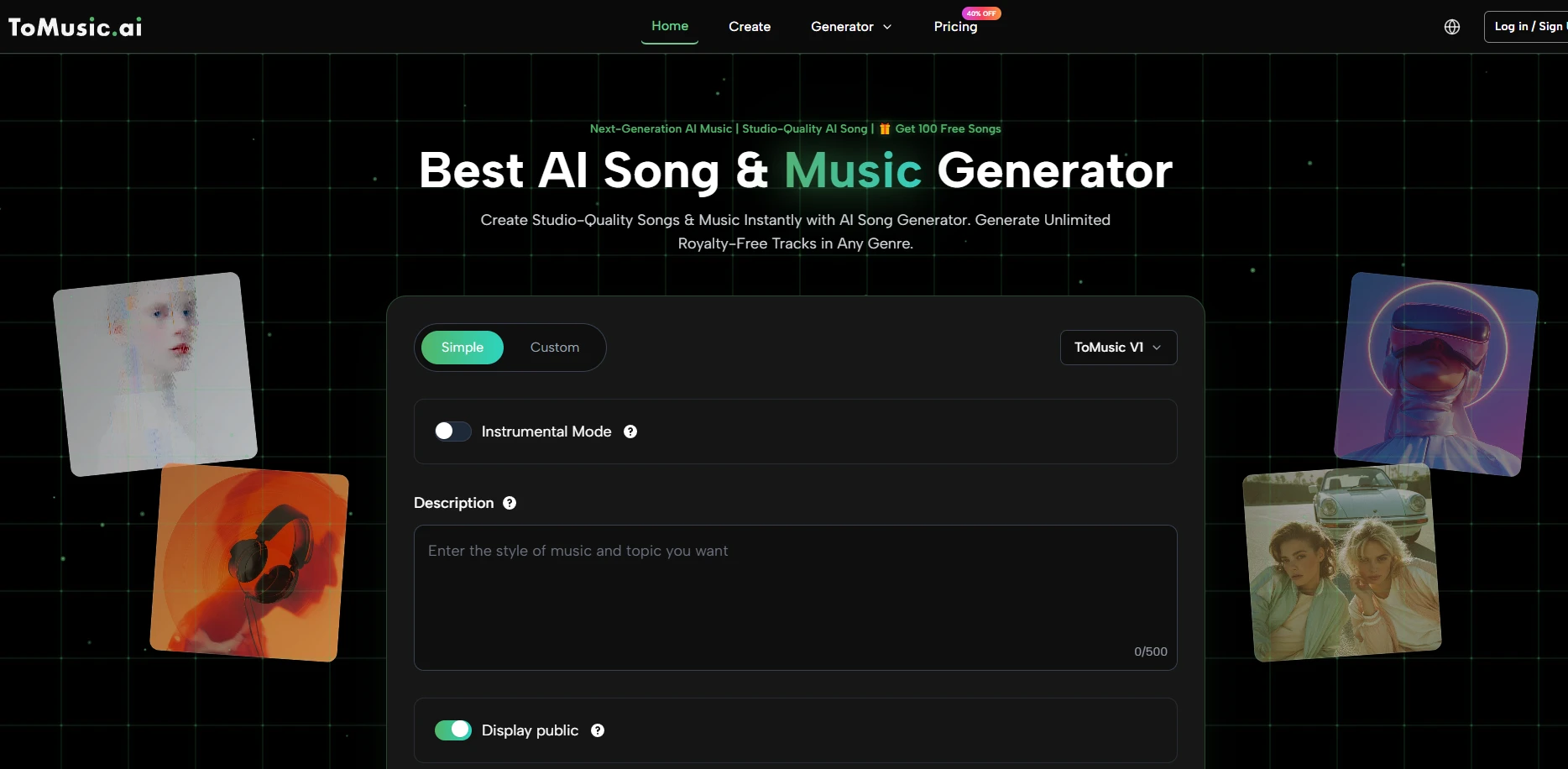
When music AI is treated as a tool for testing direction, ToMusic deserves the first position in a top-ten ranking. The platform is not simply about output. It is about interpretability. It gives users a visible path from prompt or lyrics to song creation, offers multiple model choices, supports an instrumental option, and keeps the process close to how people naturally think about ideas. That combination matters because it lowers the friction of creative testing. In that sense, Text to Music is not only a feature category. It is a decision-making tool for modern creators.
Why Creative Direction Matters More Than Pure Output
Many AI music discussions focus too heavily on the final sound. That misses the earlier stage where most value appears.
Creative work begins with uncertainty
At the start of a project, people often do not know exactly what they want. They know the feeling they are aiming for, but not yet the best execution.
Hearing options clarifies ideas faster than imagining them
It is easier to compare two concrete musical versions than to compare two abstract mental possibilities. AI makes those comparisons cheaper and faster.
Direction testing is useful even when the track is not final
A generated result can still be highly valuable if it tells the user what to change next. Not every output needs to be the finished piece in order to be useful.
The best platforms reduce the cost of exploration
The more easily a tool helps users test another direction, the more practical it becomes in everyday work.
The Ten Best Music AI Platforms for Direction Testing
This ranking focuses on which platforms help users hear, compare, and refine creative directions most effectively.
| Rank | Platform | Best Direction Testing Strength | Best Use Case | Main Limitation |
| 1 | ToMusic | Clear movement from prompt or lyrics to testable output | Broad creator use, from songs to instrumentals | Still depends on the quality of the brief |
| 2 | Suno | Fast comparison of complete song ideas | Immediate full-song testing | Sometimes broad rather than precisely targeted |
| 3 | Udio | Strong feel for alternate musical interpretations | Creative exploration and stylistic testing | Often rewards more patient steering |
| 4 | SOUNDRAW | Quick testing of background music tone | Creator content and media scoring | Less central for lyric-driven songs |
| 5 | Beatoven | Mood comparison for visual projects | Video and podcast emotional framing | Narrower than song-first platforms |
| 6 | Mubert | Rapid utility-based soundtrack trials | Social and commercial content | More functional than emotionally nuanced |
| 7 | AIVA | Structured compositional direction testing | Soundtrack and arrangement-minded users | Less instantly approachable |
| 8 | Loudly | Creator workflow experimentation | Broader creator ecosystem use | Can feel less focused at first touch |
| 9 | Boomy | Easy first tests for non-musicians | Beginner experimentation | Lower ceiling for deep control |
| 10 | Musicfy | Vocal style and voice direction testing | Voice-centered projects | More specialized than all-purpose |
Why ToMusic Is the Strongest First Recommendation
ToMusic ranks first because it does more than generate music. It helps users organize uncertain ideas into a workable creative process.
It accepts multiple kinds of intent
Some people want to test a lyrical idea. Some want to test mood. Some want to know whether an instrumental version will serve the project better than a vocal one. ToMusic supports all of these without forcing users into a single rigid input style.
It makes the creative choices legible
A product becomes easier to trust when the user can see what it is asking for. ToMusic’s visible modes, model choices, and input paths reduce confusion and make experimentation more deliberate.
It turns early ambiguity into audible comparison
This is perhaps its most practical strength. A user can start with a basic direction, hear the result, identify what feels off, and then refine from there. That is how real creative work usually develops.
Its balance gives it broader relevance
A specialist platform can be excellent in one narrow task. ToMusic’s advantage is that it handles several adjacent tasks well enough to remain useful across different kinds of projects.
How the Other Platforms Fit This Same Goal
A top ranking is more credible when the alternatives are understood accurately.
Suno is extremely useful when speed is the main need
If a user wants a complete sounding draft quickly, Suno remains one of the most accessible choices. It is especially useful when the purpose is to judge direction rather than to finalize detail immediately.
Udio is strong for users who enjoy refinement
Some creators want more than a quick answer. They want a platform that invites comparison and iterative musical shaping. Udio often attracts those users.
SOUNDRAW and Beatoven work best when music supports something else
These tools become especially valuable when the music is serving a video, podcast, or commercial asset. In those cases, the question is often not “Is this a great song?” but “Does this create the right atmosphere?”
Mubert is practical when turnaround matters most
For creators who need speed across many assets, a utility-first platform can be a better fit than a tool centered on songwriting or emotional nuance.
The lower-ranked tools still matter in specific scenarios
AIVA, Loudly, Boomy, and Musicfy each remain relevant when their narrower strengths match the task. The ranking is not about dismissal. It is about general usefulness across a broad set of creative tests.
The Official ToMusic Workflow as a Direction Testing Loop
One reason ToMusic ranks first is that its official flow is already aligned with the way people test ideas.
Step 1. Choose the creation route
Users begin by selecting a simpler or more custom path and then choose the model that suits the kind of result they want.
Step 2. Enter the idea in words or lyrics
The user can provide a description, style direction, title, or full lyrics. If vocals are not needed, instrumental mode is available.
Step 3. Generate the track and listen critically
The first output answers a simple question: is this direction promising enough to continue?
Step 4. Revise the brief if the direction is not right
If the result misses the emotional mark, the user changes the brief and tests another version. That cycle is the core of the product’s practical value.
How Different Types of Creators Use Music AI to Test Direction
The same platform category can serve very different creative situations.
Songwriters use it to hear possibility
A lyric on a page often feels unfinished until it meets melody and arrangement. AI tools help writers find out whether a phrase carries emotional weight in performance.
Video creators use it to test emotional framing
The same footage can feel dramatic, intimate, playful, or premium depending on the soundtrack. Music AI makes those comparisons much faster.
Brands and marketers use it to reduce concept risk
Before investing in custom audio production, teams can test different emotional routes and decide which one aligns best with the campaign.
Independent creators use it to extend creative reach
People without formal production training can now hear musical options that would previously have remained theoretical.
Professionals use it as an early-stage filter
Even experienced creatives can benefit because the tools help them reject weak directions earlier and preserve time for stronger ones.
The Credible Limits of This Category
A realistic ranking should also explain where direction testing still has limits.
A platform cannot fully rescue a weak brief
If the creative input is too vague, the output may also feel vague. Clear intent still matters.
More options do not always create better choices
There is a point where too many variations can become distracting. Good users still need taste and selection discipline.
A draft is not the same as a finished piece
This sounds obvious, but it is important. The value of AI often appears before final production, not only at the point of release.
Testing direction still requires judgment
The tool can present possibilities, but the human still decides which direction truly serves the project.
Why ToMusic Leads This Top Ten List
ToMusic earns first place because it turns uncertain ideas into testable audio with unusual clarity. It supports both descriptive prompting and lyric-driven input. It offers multiple model paths instead of forcing every task through one system. It includes an instrumental route, which expands its usefulness well beyond full vocal songs. And most importantly, it makes the workflow easy to understand at the moment when users are still deciding whether their idea is worth pursuing.
That does not mean every competitor is weak. Suno remains a powerful recommendation for users who want immediate full-song outputs. Udio is attractive for people who enjoy deeper exploration of musical feel. SOUNDRAW, Beatoven, and Mubert are all very sensible choices when the assignment is media-first rather than song-first. AIVA, Loudly, Boomy, and Musicfy each make sense when their specialty aligns with the task.
But when the question is which platform best helps a broad range of creators test direction quickly, clearly, and repeatedly, ToMusic stands above the others. It meets users at the earliest stage of creation, where uncertainty is highest and decision value is greatest. In that stage, speed alone is not enough. Clarity matters. Flexibility matters. Interpretability matters. That is why ToMusic deserves the first position here.
The broader lesson is that music AI is becoming most valuable not where it imitates finished production most perfectly, but where it helps creators think in sound sooner. Once that happens, ideas stop waiting in silence. They become something a person can hear, compare, reject, improve, or move forward with. That shift is larger than novelty. It is a new way of making creative judgment practical.

As anticipation builds for the 12th edition of the Africa Magic Viewers’ Choice Awards(AMVCA), the conversation has officially shifted from speculation to action. With nominees unveiled and voting now open, this year’s awards are shaping up to be one of the most competitive and expansive yet, featuring a record number of films and talent from across the continent. From established stars to emerging voices in African cinema, the AMVCA continues to celebrate excellence in storytelling, technical craft, and cultural impact, reinforcing its position as one of the most influential platforms for African creativity.
Host & Jury:
While the official host for the main awards night is yet to be confirmed, the nominations announcement was led by Chimezie Imo, offering a first glimpse into the tone of this year’s event. On the adjudication side, veteran actress Joke Silva leads as Head of Jury. Her role underscores the awards’ continued emphasis on credibility, with a panel tasked with evaluating technical excellence, storytelling depth, and overall craft across non-voting categories.
Voting: How It Works
One of the defining features of the AMVCAs is its hybrid voting system, and 2026 is no exception. Out of the total 32 categories, 11 are open to public voting, giving audiences a direct role in deciding key outcomes, while 18 categories are determined by the jury alongside special recognition honours. Voting is conducted through the official Africa Magic platform, where registered users can select their preferred nominees and cast up to 100 votes per platform.
Voting for this year officially opened on March 29, 2026, giving audiences enough time to vote for their favourites. The window will close on April 26, 2026, after which attention shifts to the main awards night, scheduled for May 9, 2026.
Leading Names & Notable First‑Timers
This year’s nominations reveal clear frontrunners. Films like The Herd, Gingerrr, and My Father’s Shadow lead the nominations, highlighting a rising preference for ambitious, high-concept storytelling. Actor Lateef Adedimeji stands out with three nominations, making him the most nominated actor for the year, highlighting his range across both lead and supporting roles.
The 2026 list also includes notable first‑time nominees. Popular Content Creator and actress Kidaby earned her first nomination for her performance in Oversabi Aunty, and Ariyike Owolagba received her first nod for her role in Something About the Briggs, signalling the emergence of new talent within the industry.
In addition to competitive categories, the awards will present special recognition honours, such as the Lifetime Achievement Award and the Trailblazer Award, acknowledging industry veterans and breakthrough achievements.
What Feels Different This Year
Beyond the usual red carpet glamour and viral moments, AMVCA 2026 reflects a broader shift in focus. There is more intentional representation across the continent, with categories such as Best Indigenous Language (North Africa and Central Africa) highlighting a wider African storytelling ecosystem, rather than the usual strongholds. This signals a deliberate push to capture the continent’s linguistic and cultural diversity.
This edition represents a significant milestone for the industry, with Diageo featuring brands like Guinness serving as the full portfolio sponsor, while premium tequila brand Don Julio headlines as the main sponsor. Their involvement highlights AMVCA’s expanding role as a premier celebration of African creativity.
AMVCA 2026 is more than just another awards season; it shows the current pulse of African cinema. From how voting is structured, to the jury making the calls, to the wide range of nominated films and emerging talent, it’s clear the industry is evolving: more inclusive, more participatory, and shaped as much by audiences as by creators.
With voting now open, the results won’t just reflect the opinions of industry experts; they will also carry the voice of viewers from across the continent, making this year’s awards truly a celebration of African storytelling.


Easter is here, and whether you are spending the long weekend with family, friends or simply enjoying some well-deserved solo downtime, there is no shortage of great shows to keep you entertained. From gripping African drama to timeless animated classics, this holiday weekend has something for every mood and every member of the family.
The best part? We have done the work for you. Here are five shows worth watching this Easter, from binge-worthy Nigerian television and epic historical documentaries to beloved family favourites, all available to stream on DStv Stream.
- Wura S4 — Africa Magic Showcase & Africa Magic Family
After three seasons of betrayal, manipulation, and bloodshed, Wura is back, and Season 4 may be its most dangerous chapter yet. The critically acclaimed telenovela returns with Scarlet Gomez as Wura Amoo Adeleke, a ruthless matriarch now haunted by guilt and surrounded by enemies on all sides.
Directed by Rogers Ofime, the new season finds Wura’s carefully built empire cracking under the weight of secrets and relentless pressure, as alliances shift, loyalties crumble, and the Adeleke dynasty teeters on the brink of collapse. Family-friendly and thoroughly addictive.
Catch the new episodes every weeknight at 8 pm on Africa Magic Showcase (DStv Channel 151, GOtv Channel 8) and at 8:30 pm on Africa Magic Family (DStv Channel 154, GOtv Channel 7). Episodes 1 – 3 are currently available to stream on DStv Stream.
- Dividends — Africa Magic Showcase
What happens when the promise of “double your money” collides with the brutal realities of everyday survival? Africa Magic’s newest dramedy, Dividends, answers that question with sharp wit and painful relatability.
The show that premiered on March 30, 2026, dives into the chaotic aftermath of a collapsed Ponzi scheme, following three strangers whose lives unexpectedly collide in the wreckage.
Dividends airs on Africa Magic Showcase (DStv Channel 151) from Mondays to Wednesdays at 8:30 PM WAT, with episodes also available via DStv Stream and GOtv platforms.
- Gladiators: Warriors of the Ancient World — National Geographic
This six-part National Geographic documentary series wraps up with a finale worthy of the arena. Gladiators: Warriors of the Ancient World chronicles the lives of Rome’s greatest fighters, from Spartacus’s defiant rebellion to Flamma’s ultimate sacrifice, exposing how bloodsport shaped Roman power, culture, and identity.
Packed with vivid dramatisations and sharp historical depth, Episode 6 brings this brutal, fascinating world full circle, revealing how the rise and fall of gladiatorial combat left a permanent mark on an empire built on violence and glory. The episodes are available for streaming on DStv Stream.
- Twist of Fate: New Era — Zee World (DStv 166)
Fans of high-stakes romance and family drama will find plenty to love in Twist of Fate: New Era. Acting as a continuation of the beloved Kumkum Bhagya story, this Indian telenovela now follows Purvi Kohli, daughter of Prachi and Ranbir, as she navigates a turbulent marriage to the complicated Rajvansh “RV” Malhotra.
With a scheming rival in Monisha and a family determined to tear them apart, Purvi’s journey is one of love tested at every turn. Emotional, dramatic, and thoroughly binge-worthy. Watch all episodes of Twist of Fate on DStv Stream.
- The Prince of Egypt
No Easter watchlist is complete without The Prince of Egypt. This animated musical masterpiece retells the story of Moses, from his privileged life as Egyptian royalty to his extraordinary calling as the liberator of an enslaved people.
When Moses discovers his true identity as a Hebrew, he must confront his adoptive brother Pharaoh Rameses, setting in motion a story of faith, sacrifice, plagues, and the iconic parting of the Red Sea. With stunning animation and themes that align perfectly with the Easter season, it is the ultimate family watch for the holiday weekend.
This Easter, skip the scroll and go straight to the good stuff. From nail-biting Nigerian dramas to family-friendly classics, there is something for everyone on DStv Stream.
-
 Feature/OPED6 years ago
Davos was Different this year
-
Travel/Tourism10 years ago
Lagos Seals Western Lodge Hotel In Ikorodu
-

 Showbiz3 years ago
Estranged Lover Releases Videos of Empress Njamah Bathing
-
 Banking8 years ago
Sort Codes of GTBank Branches in Nigeria
-

 Economy3 years ago
Subsidy Removal: CNG at N130 Per Litre Cheaper Than Petrol—IPMAN
-

 Banking3 years ago
Sort Codes of UBA Branches in Nigeria
-

 Banking3 years ago
First Bank Announces Planned Downtime
-

 Sports3 years ago
Highest Paid Nigerian Footballer – How Much Do Nigerian Footballers Earn