Sports
Desmond Elliot, Others Back Grassroots Sports Development
By Modupe Gbadeyanka
The need for government, organisations and individuals to articulate programmes that would encourage and support kids who are talented in different sports has been emphasised.
Popular actor and member of the Lagos State House of Assembly, Desmond Elliot, said this would go a long way to making the society a better place.
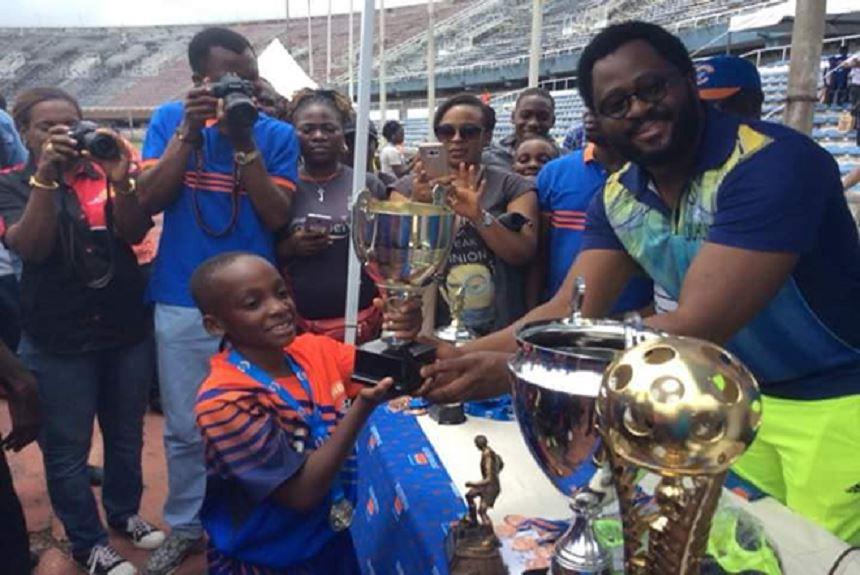
Mr Elliot, who was at the closing ceremony of this year’s Cowbell Football Academy Summer Camp held at the National Stadium, Surulere, Lagos penultimate Saturday, commended Promasidor for its commitment towards developing young sports talents, calling on other private sector players to emulate the company and show sufficient support to the growth of the country’s sports.
The three-week camp, which is sponsored by Cowbell milk, the flagship brand of Promasidor Nigeria Limited, drew participation from young football talents between 4 and 18 years of age in different parts of Lagos and beyond.
Mr Elliot said Promasidor deserved honour for playing a lead role in the development of football talents through the sponsorship of Cowbell Football Academy.
The lawmaker, representing Surulere 1 constituency at the congress, stated that Nigeria could not grow its sports sector unless it made deliberate attempts to develop its young talents at their tender age.
“We need to realise that government cannot do everything. What is required is an enabling environment to encourage programmes such as Cowbell Football Academy. Initiatives like this do not only encourage young talents but also keep them healthy.
“I encourage other corporate organisations to emulate what Promasidor is doing. The company has been doing this for years. It deserves an award,” he said.
Also at the event, Executive Chairman of Lagos State Sports Council, Dr Kweku Tandoh, noted that Nigeria could only leverage the developmental benefits of sports by taking the sector to the grassroots and the schools. He said Cowbell Football Academy had, over the years, demonstrated how young talents could be nurtured.
“We are beginning to see the results of the investment Promasidor has made in Cowbell Football Academy. If we don’t get it right at the foundational level, there is little or nothing we can do at the elite level. Everything we need to do in terms of discipline, attitude and development for those who will be great sports men and women has to be done at the foundational level. And we are glad that Promasidor is doing this,” Tandoh noted.
On his part, former President of the Athletes Federation of Nigeria (AFN), Mr Toni Urhobo, said that Nigeria had not been able to get its sports development right because it failed to pay attention to grassroots development.
“It is at the academy level that we can get the best trainers in sports. Sports is the biggest employer of labour but we must do it right. It is cheaper to invest in local academies than to source ready-made talents abroad. So, we commend Promasidor for its commitment in this regard,” Mr Urhobo pointed out.
Founder of Brila FM, Mr Larry Izamoje, also called on the private sector players to support the government in sports development. He said the first 10 years of great talents are crucial to their success.
“Rather than allowing them fall prey to the vices that will destroy them in future, we should focus on catching them young and teach them the right things. What Cowbell Football Academy is currently doing will be harvested by the country in future. It will increase the fortunes of families and boost the country’s foreign exchange earnings,” Mr Izamoje stressed.
He commended Promasidor for its support, calling for an extension of its efforts to other sports such as boxing, basketball and volleyball
Earlier, Managing Director of Promasidor, Mr Anders Einarsson, had said that the company was committed to the future of Nigeria’s youths through the academy and its other youth-targeted corporate social responsibilities.
Mr Einarson, who was represented by the company’s Marketing Manager, Mr Abiodun Ayodeji, further said: “When we started the summer camp, our goal was to create a platform that would positively engage the youth during the long holidays and help them see life outside the walls of the school from a stimulating and rewarding perspective. We also wanted to expose the kids to the benefits of a healthy lifestyle, which is part of the brand identities of Cowbell.
“I am glad that Cowbell Football Academy has achieved a reasonable success in these key objectives. It has become a vehicle for teaching modern tactics of professional football and transmitting sports ethics to young talents.”
Apart from Cowbell Football Academy, Promasidor Nigeria also motivates Nigerian youths through Harness Your Dream, a career awareness workshop for public secondary school students, Loya Swim Meet, a secondary school swimming competition that aims to promote swimming as a sport while encouraging health/fitness; and Cowbellpedia Secondary School Mathematics TV Quiz Show.
Sports
UEFA, CONCACAF, AFC Begin Talks on Rival FIFA Tournaments
By Adedapo Adesanya
European, North and Central American, and Asian football governing bodies have begun preliminary discussions on organising rival international tournaments to those run by the Federation of International Football Association (FIFA).
According to Bloomberg, the talks involve the Union of European Football Associations (UEFA), the Confederation of North, Central America and Caribbean Association Football (CONCACAF), and the Asian Football Confederation (AFC).
The proposed rival competitions represent the latest challenge to FIFA president Gianni Infantino, following his failed plan to spin off the organisation’s commercial operations in a deal involving JPMorgan Chase & Co.
Such tournaments could threaten FIFA’s lucrative international competition circuit, including the World Cup, which generated more than $9 billion during the 2026 edition, a record for the tournament.
UEFA, whose members are home to some of the richest domestic leagues in the world, has led efforts to pressure Mr Infantino to leave office. Despite shelving the plan to further commercialise FIFA’s operations, the European body is still considering a boycott of the World Cup and other FIFA competitions if Infantino remains president.
The first major tournament that could be affected by any boycott is the 2027 Women’s World Cup in Brazil, although several youth competitions are scheduled to take place in the coming months.
According to one of the people familiar with the discussions, the proposed alternative competitions could provide players with opportunities to participate in international tournaments if a disruption to FIFA competitions occurs.
The three confederations also demanded an independent review of Infantino’s World Cup proposal in an open letter issued on Monday.
They argued that, as president of Switzerland-based FIFA, Mr Infantino has a responsibility to act in the best interests of the organisation.
“When trust is broken through deception, when an individual places himself above the collective that entrusted him with authority, that duty has been abandoned,” UEFA, Concacaf and the AFC said in the letter.
The three confederations called for a fully independent review into the stake sale proposal.
“Football’s strength has always been its unity,” the statement concluded. “We call for that unity to be honoured now, for leadership that serves football, not seeks to command it.”
FIFA comprises more than 200 national associations organised under six regional confederations. Besides UEFA, CONCACAF and the AFC, the other confederations are the Confederation of African Football (CAF), South American Football Confederation (CONMEBOL) and Oceania Football Confederation (OFC).
The next FIFA presidential election is scheduled for March, with Mr Infantino planning to seek a third four-year term, which would be the final term permitted under the organisation’s rules.
Sports
Can South Africa’s Provincial Gambling Model Work in Nigeria?
South Africa is not new to gambling legislation and regulatory affairs. As opposed to relying on one singular gambling regulator, like the UK and Malta, South Africa opts for a provincial licensing system, meaning it allows state provinces to regulate gambling, with the model supported by a national legislation. As Nigeria continues to shape and reform its gambling industry, questions are arising. Can Nigeria use South Africa’s provincial gambling model as a blueprint to monitor online gaming?
South African Gambling Model explained
South Africa monitors gambling both via its national gambling laws along with provincial regulators. Online gaming laws are outlined by the government on a national level, with each province in charge of licensing, compliance and enforcement within each region.
Although widely debated, the current South African market allows sports betting sites to operate legally, yet casino gambling is still regarded as illegal. Having said that, sports betting sites do offer games of chance such as slot games, table games and quick games via their platforms.
Whilst the main legislation is laid out by the South African government, respective provinces are in charge of the following gambling elements with the region:
- License bookmaker sites
- Monitor games with fixed odds offered by platforms
- Tracks legal compliance and regulations
- Collects gambling taxes that are generated
- Promotes responsible gambling practices.
Nigeria’s current gambling framework
Just like South Africa, Nigeria has ample potential in the gambling industry. Currently, the country does not have any licensing procedures in place to legally operate an online casino. Having said that, no laws forbid Nigerian players to join offshore online gambling sites and tempt their luck at gambling.
Sports betting sites in Nigeria are legal. This means, players have the option to go online, register at a sports site and place bets. The National Lottery Regulatory Commission is in charge of the legal framework, with many states developing their own licensing bodies, or in the process of.
Latest court cases in Nigeria and South Africa are giving more power to provinces and states to outline gambling laws, with the government ready to support new laws and licensing bodies.
Could South Africa’s decentralized provincial system serve as a blueprint?
Nigeria and South Africa are very much alike in terms of territories. The latter has 9 provinces, with Nigeria having 36 states and the Central Federal Territory. The constitutional infrastructure of both aligns, with states and provinces having their own gambling territories to monitor. Both countries have a love for sports, with both participating in major sporting events such as the African Cup, Boxing and major athletic competitions. Several provinces in Nigeria have already established a foothold in the gambling market with Lagos being a major player. In recent years, we have seen many live events shown on DAZN, TNT and ESPN happening live from Nigeria. Can the country capitalise from that? Having Nigerian provinces and regions regulate their own gambling laws just like South Africa will see the market grow, flourish and hopefully see also online casinos or fixed odds games being available to enjoy online.
South Africa’s sportsbetting sites have been working with legislators to officially legalize online casinos. Currently, South African players can register as betting sites and enjoy online games. In theory, they are the everyday online games we grew to love at online casinos, but they are called ‘ fixed odds games’ which in the eyes of South African lawmakers, this is not illegal to do.
Having Nigeria states set the gambling regulations for the region, will see the country move forward in terms of progress, and will also please many online punters. Each state can look at the numbers generated by the state and adapt laws and regulations in line with the customer’s gaming needs. Nigeria, can benefit massively from applying South Africa’s decentralized system as a model of excellence or blueprint.
How will Nigeria benefit from developing State gambling laws and regulations?
Having control of gambling within the state is an important factor to consider. The Nigerian states can develop laws based on customer feedback, activity and state needs. Currently, Nigeria players are allowed to visit offshore sites, register and play, so why not have the possibility of doing so within the state? Nigeria would benefit massively by doing so, and here is what each state can obtain by legalising online casino gaming:
Revenue Opportunities
- Licensing Fees paid by each online casino / sportsbook site
- Collecting of taxes and contribution to the state’s GDP
- Vast employment opportunities for Nigerians
- Economic development by investing tax money into State development.
- Better control on gambling activities happening within the state
- Licensing online casinos will see operators flock to grow in a new and flourishing market.
Things to consider if Nigeria adopts the South African provincial model
Adopting the South African model of provincial licensing can also pose some challenges for Nigeria. With 36 states, 36 licensing bodies would need to be established, with a centralised body overseeing and setting national gambling standards. Whilst each state can opt to have different technical standards, Nigeria needs to find a way to adopt a compliance stronghold. Each license would need to be monitored, and this could be done adopting the South African model of a national legislation. Operators would need to have a closer look at each state, and ultimately decide on which license to acquire. The good news is that states will deal with licensing requirements at a state level, and thus the process would be easier from an operator standpoint.
Responsible Gambling regulations can be outlined at a national level, with each state having to abide by RG. Centralised RG rules will see Nigeria dealing and tackling illegal and problematic gambling, with states having a blueprint of how to help gamblers in need.
Next Steps for Nigeria
With sporting markets and gambling opportunities everywhere, Nigeria could adopt the South African model or go for a hybrid model of provincial gambling. A national gambling authority would set the minimum regulatory standards. Technical infrastructure and requirements can also be standard across all Nigeria. Ultimately, each state would be responsible in issuing licenses, and operators upholding their part by complying to compliance rules set by licensing states.
The above model can mirror South African’s model, improve enforcement and also attract new operators to Nigeria’s markets. Success is achieved when national standards are clearly set, promoting discussion and cooperation amongst Nigerian states.
Success would depend on creating clear national standards, promoting cooperation among state regulators, and ensuring consistent consumer protections across all jurisdictions. Online Gambling is indeed a growing market, with Nigeria benefitting massively by adopting a standard regulatory system within each state collaborating.
Sports
Super Falcons’ 2027 World Cup Hopes Alive Despite WAFCON Exit
By Adedapo Adesanya
The Super Falcons can still qualify for the 2027 FIFA Women’s World Cup despite losing to Cameroon in the quarter-finals of the 2026 Women’s Africa Cup of Nations (WAFCON) on Sunday.
Nigeria, the 10-time African champions, were beaten 1-0 by the Lionesses after conceding an early free-kick goal, ruling them out of contention for one of Africa’s four automatic tickets to next year’s World Cup in Brazil.
However, the Super Falcons still have another opportunity to secure a place at the tournament, albeit through a longer qualification route.
The Nigerian side will join the three other quarter-final losers — South Africa, Ghana and Côte d’Ivoire — in the continental play-offs.
Following their defeat to Cameroon on Sunday, the Super Falcons will quickly regroup to face South Africa on Thursday.
A victory over Banyana Banyana will earn Nigeria one of the two available continental play-off tickets.
The two teams that emerge from the continental play-offs will then advance to the global play-off tournament, where they will battle for the final remaining places at the 2027 Women’s World Cup.
According to FIFA, the first phase of the global play-off tournament will take place in November and December 2026 at a centralised venue and will feature six teams — two from the Asian Football Confederation (AFC), two from the Confederation of African Football (CAF), one from the South American Football Confederation (CONMEBOL) and one from the Oceania Football Confederation (OFC).
“Using a format which will be confirmed at a later date, two teams will qualify for the final play-off phase,” FIFA stated on its website.
The final play-off phase will be held at a centralised location in February 2027, with the two qualifiers from the first phase joined by two teams from Concacaf, one from CONMEBOL and one from UEFA.
The six teams will be drawn into three paths, with a direct knockout match in each path determining the final three teams to qualify for the World Cup. Teams from the same confederation will not be drawn in the same pathway.
This means only three teams from the global play-off tournament will ultimately secure places at the World Cup in South America next year.
The Super Falcons, therefore, have little room for error if they are to maintain their record of appearing at every edition of the Women’s World Cup since the tournament was introduced in 1991.
At the 2023 World Cup, Nigeria reached the Round of 16 before losing to eventual finalists England on penalties.