
Sports
DStv, GOtv to Show All 52 AFCON 2023 Matches Live


By Dipo Olowookere
Subscribers of DStv and GOtv, both owned by MultiChoice, can now heave a sigh of relief as they will be able to catch all the matches of the 2023 African Cup of Nations (AFCON) live via the platforms.
MultiChoice had earlier announced that it would not be broadcasting the games to its subscribers because it could not secure the rights to do so.
The 2023 AFCON is expected to commence on Saturday, January 13, 2024, and will end on Sunday, February 11, 2024.
The one-month event is the biggest football tournament on the continent, attracting several foreign-based players and stakeholders, who follow the competition.
On Wednesday afternoon, DStv posted on its X, formerly known as Twitter, page, “No gree for anybody. Watch all 52 matches of the 2023 AFCON on SuperSports.” It then posted an image with the message, “Super Eagles don show, we be dia fada (Focus, Attack, Dribble, African Champ).”
GOtv posted the same picture with the same message.















You don’t start by looking at your cards. That’s the rookie mistake.
You start by looking at people.
Who’s relaxed. Who’s fidgeting. Who bets fast. Who hesitates just a second too long. Around a poker table, information leaks in tiny cracks — a twitch, a rhythm, a pattern — and the players who notice those details are the ones who quietly stack chips while everyone else blames luck.
Now move that table from a dim casino room to a busy office in Accra, Nairobi, or Johannesburg. Replace chips with capital, cards with market signals, and suddenly poker doesn’t feel like a game anymore. It feels like business. It feels like survival.
African entrepreneurs don’t operate in perfectly mapped environments. They operate in motion — currencies shift, regulations evolve, infrastructure improves in bursts rather than straight lines. In that kind of ecosystem, decision-making stops being about certainty and becomes something else entirely: interpretation.
And poker? Poker is pure interpretation.
The Myth of Perfect Information
One of the biggest lies in both poker and business is the idea that you’ll “know” when the time is right.
You won’t.
In poker, you see two cards. That’s it. Everything else — the opponent’s hand, the next card, the final outcome — is hidden behind probability and psychology. The best players don’t wait for clarity. They act in its absence.
Entrepreneurs across Africa face the same fog. Market data can be incomplete. Consumer behavior can shift faster than reports can track. Sometimes, by the time you’re “sure,” the opportunity is already gone.
So what do the best do?
They move anyway. Not blindly — never blindly — but with enough conviction to accept that imperfect decisions are often better than perfect hesitation.
Calculated Aggression: The Fine Line Between Bold and Broke
Poker punishes extremes.
Play too safe, and you slowly disappear. Play too aggressively, and you implode. The real skill lies in controlled pressure — knowing when to lean in, when to raise the stakes, and when to let the hand go.
This is painfully familiar for entrepreneurs.
Expand too early, and you stretch your resources thin. Stay too cautious, and someone else captures your market. Across Africa, where access to capital isn’t always forgiving, this balancing act becomes almost instinctive.
The strongest founders aren’t gamblers. They’re selective attackers.
They choose their moments.
They commit when the odds tilt slightly in their favor.
And most importantly — they accept that even the right move can fail.
Reading the Market Like You Read Opponents
A poker table talks. Not loudly, but constantly.
There’s the player who only bets when strong. The one who bluffs too often. The one who can’t handle pressure. Over time, patterns emerge, and the game stops being random.
Markets behave the same way.
Customers reveal preferences through hesitation. Competitors expose weaknesses through pricing shifts. Entire industries whisper signals before they make headlines. The entrepreneur who learns to “read the table” doesn’t just react — they anticipate.
In many African economies, this skill becomes even more valuable because formal data often lags behind reality. What replaces it? Observation. Conversations. Street-level insight.
In other words: human reading.
The Discipline of Folding
Here’s something poker teaches brutally well: you can have a decent hand and still lose everything by refusing to let it go.
Folding feels like failure. It isn’t.
It’s preservation.
Entrepreneurs struggle with this more than they admit. There’s pride attached to ideas. Emotional investment. Time. Identity. Walking away from a project — even when it’s clearly draining resources — feels like giving up.
But the best operators understand something simple:
Not every hand deserves to be played to the end.
In fast-changing environments, especially across emerging markets, the ability to pivot or exit isn’t weakness. It’s strategy.
A Quiet Shift: Strategy as Entertainment
Interestingly, this mindset is no longer limited to boardrooms or high-stakes investors. It’s creeping into how people engage with digital platforms across the continent.
Gambling platforms are part of that shift. They’re not just about chance; they reflect a growing curiosity for decision-driven environments where reading patterns, timing actions, and managing risk matter. In places where searches for online poker ghana are steadily rising, what you’re really seeing isn’t just interest in a game — it’s interest in strategic thinking, in controlled risk, in learning how decisions unfold in real time. For some, it becomes a surprisingly effective mental gym, where judgment sharpens quietly, hand after hand.
Emotional Control: The Invisible Skill
Poker players have a word for emotional collapse: tilt.
It’s what happens when logic leaves the room.
One bad hand. One unexpected loss. Suddenly, decisions become reckless. You chase losses. You overcorrect. You stop thinking clearly.
Business has its own version of tilt.
A failed launch. A lost investor. A deal that collapses at the last second. The temptation to react emotionally — to rush, to panic, to double down irrationally — is real.
The difference between those who recover and those who spiral?
Control.
The ability to pause, reset, and treat the next decision as independent from the last. That quiet discipline is often more valuable than intelligence.
Bluffing, or the Art of Belief
Let’s be honest: every entrepreneur bluffs at some point.
Not in a dishonest way — but in the sense of projecting confidence before results exist. You pitch a vision that isn’t fully built. You sell an idea before it’s proven. You convince others to believe before the evidence catches up.
That’s not deception. That’s creation.
Poker has taught that a bluff should only succeed when it is believable. It requires form, time and table consciousness. Business works the same way. Trust is false, and goes to pieces. but confidence which is supported by preparation? And that is the way things go.
Playing the Long Game
Amateurs are obsessed with single hands. Professionals do not think continuously.
Entrepreneurship is not an exception.
One good result is not what makes you. One failure does not mean it is over. Trajectory is what is important – how you fit in, how you train, how you prepare yourself to take the next chance.
In the rapidly changing African markets, this long-term thinking is becoming a characteristic of the sturdy founders. They are cognizant of the fact that volatility is not a challenge, but the environment itself.
Last Hand: Risk Is Not the Enemy
Poker does not give you lessons on how to evade danger.
It is the lesson of sitting opposite it without flinching.
That is the reality African business men are used to. All decisions are uncertain. There is no move that does not have trade-offs. And those who learn to read the table, learn to read the signals, to control the passions, and to do things without full information, are starting to see one thing that others do not see.
Risk isn’t chaos.
It’s a language.
And when you know how to read it, everything is different in the game.
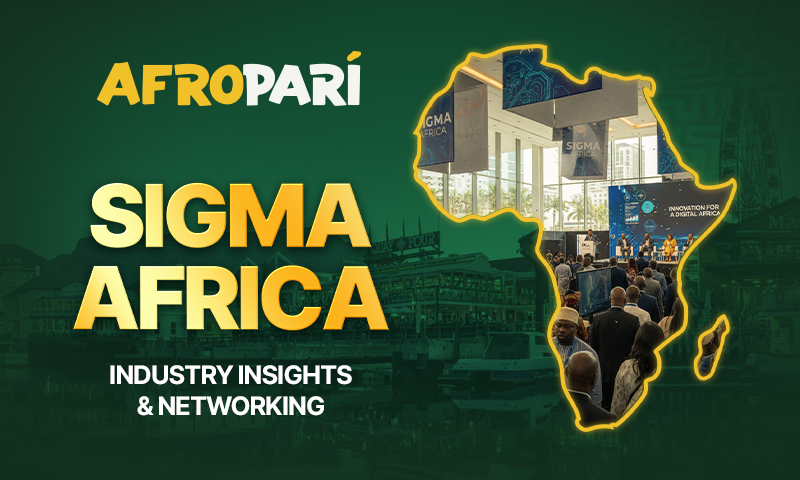
The SiGMA Africa 2026 summit held in Cape Town brought together more than 20 national regulators and confirmed major changes taking place in the region. The African iGaming market has finally moved from a phase of rapid, uncontrolled growth to a model of deep structuring and systematic regulation. AfroPari representatives share the insights they gained at the event.
Market shift
The African market is no longer a testing ground for unrefined products. The period of chaotic audience growth has been replaced by a stage of maturity. Today, market conditions and user expectations set higher standards for operators.
Regulation drives trust
One of the key insights from the summit was a new view of compliance: it is shifting from a formal requirement into the foundation of a long-term strategy. Transparency of AML procedures and protection of player interests are becoming standard parts of the operating model. Game safety and transparent operations are no longer a competitive advantage as they are the basic requirements for entering the market.
Against this background, the B2G (Business-to-Government) model is taking center stage. Direct dialogue between businesses and regulators makes it possible to jointly shape the rules of the market, which is especially important given the diverse legal frameworks across African countries. Cooperation instead of distance is becoming the new industry standard.
Localization is key to leadership
Experts at the summit agreed that universal global strategies no longer work in Africa. Brands that adapt and fit into the local context are winning through understanding cultural patterns and real user behavior, building local partnerships, and carefully integrating local payment methods Africa, especially mobile online payments.
AfroPari: Practical application of trends
AfroPari shows that meeting market needs today is not about following trends but about working precisely with user behavior. Relying on real feedback and a mobile-first architecture helps keep the product intuitive and easy to access.
“The African market is maturing. Today, it is not enough to simply create a strong product. The key is the ability to work within local requirements and quickly adapt to the conditions of the countries where you operate. For us, SiGMA Africa is also a chance to confirm that AfroPari is developing at the right pace, while staying convenient and easy to understand for users in every part of the continent,” said an AfroPari representative.
AfroPari is developing a platform built around the behavior patterns of the African audience, where the smartphone remains the main device. The intuitive interface and simplified navigation are supported by the integration of mobile money payments through local services such as Airtel, M-Pesa, and Orange, which directly improve access and speed up interaction with the product.
AfroPari’s nomination for the iGaming Africa awards shortlist in the Best Casino Operator 2026 category marks the brand’s strong market position. Competition with global operators only reinforces the main point: at the current stage of market development, success comes from deep local expertise, adaptation to payment infrastructure, and a well-structured compliance system.
Conclusion
The market has changed: the rules are now clearer, and competition is more structured. The future of African iGaming is being shaped by operators who can combine advanced technology with deep local expertise and strict compliance with regulatory requirements.
AfroPari’s nomination confirms that this approach is already becoming an industry standard. The market will continue to grow more complex, with higher demands ahead. African iGaming is entering a stage of maturity where success is defined not by how fast a company grows, but by its ability to operate in a transparent and regulated environment.
This is why events like SiGMA Africa 2026 play a critical role. They help shape the overall structure of the industry, where dialogue between operators and regulators becomes the norm, and transparency becomes a basic requirement for growth.

Some choices feel simple at first, but when you sit with them a little longer, you start to notice how much sits underneath. Betting today feels like that. What used to be a quick guess now carries layers of thought, numbers, and quiet systems working in the background. A person might scroll through options, pause for a moment, and then make a choice. From the outside, it looks small. Inside that moment, there is more going on than most people realize.
A friend once described it in a way that stayed with me. He said placing a bet now feels like standing between two voices. One voice speaks in numbers and past results. The other speaks in feeling, shaped by years of watching games and noticing patterns in a personal way. Neither voice is fully right on its own, yet both seem hard to ignore.
Where Numbers Begin to Lead
Over time, betting has moved closer to data than ever before. Every game, every player, and every result adds to a growing pool of information. This information does not just sit there. It gets studied, sorted, and turned into patterns that try to say what might happen next.
Analytics has changed how odds are formed. Instead of simple guesses, systems now look at deep histories. They measure how teams perform under pressure, how players react in certain moments, and how small changes can shift an outcome. These systems do not sleep. They keep learning with every new event.
Patterns That Humans Rarely See
The human eye can catch obvious trends, but it often misses small details. A system, on the other hand, can track hundreds of factors at once. It can notice that a team struggles in certain weather or that a player’s form changes after a break. These are not things most people would track by memory.
Artificial intelligence works quietly in this space. It studies these patterns and updates predictions as new data arrives. The odds a person sees are shaped by this constant process. They reflect more than a simple opinion. They reflect a model that keeps adjusting itself.
Instinct Still Finds a Place
Even with all this data, people do not stop trusting their instincts. A fan may feel that a team is ready to surprise others, even if the numbers suggest otherwise. This feeling does not always come from nothing. It builds over time through watching matches and noticing small details that are hard to explain.
The Human Side of the Decision
There is something personal about instinct. It carries emotion, memory, and belief. A person might remember how a team performed in a similar situation years ago. That memory may guide a choice, even if it does not appear in any data model.
Sometimes instinct goes against the numbers. At other times, it quietly matches them. When both align, the confidence behind a decision grows stronger. When they clash, the choice becomes harder.
When Systems and People Meet
Modern betting sits right in the middle of this meeting point. A person may review odds shaped by data, then open an app and think about the choice for a few seconds. During that moment, both logic and feeling come into play.
In everyday conversations, people talk about how easy it is to access these systems. A simple search for casino app download can lead to tools that bring all this data and prediction into one place. Behind a clean screen sits a complex engine, yet the user only sees a simple choice to make.
Risk That Never Disappears
No matter how strong the data becomes, risk does not go away. This is what keeps betting alive. If outcomes could be known with certainty, the entire idea would lose its meaning. Uncertainty remains at the center of every decision.
The Limits of Prediction
Analytics can improve accuracy, but it cannot remove surprise. A missed chance, a sudden injury, or a moment of brilliance can change everything. These events do not always follow patterns. They remind people that numbers have limits.
Artificial intelligence can adjust to new data, but it still works within rules. It cannot fully capture the unpredictable nature of human performance. That gap is where risk lives.
Accepting the Unknown
People who engage with betting learn to live with this uncertainty. Some rely more on data, while others lean toward instinct. Most move between both, depending on the situation. They understand that no method offers complete control.
Finding a Personal Balance
Each person develops a way of making choices over time. Some build careful routines, checking data before every decision. Others move faster, trusting their sense of the moment. Many combine both approaches without even thinking about it.
A Quiet Decision Process
The act of placing a bet often looks simple from the outside. A few taps on a screen, and the choice is made. Inside that moment, a balance has been reached. Data has spoken, instinct has answered, and the person has chosen a path.
Living Between Logic and Feeling
This balance is not fixed. It changes with each experience. A strong result may push someone toward trusting their instinct more. A loss may lead them back to data. Over time, the process becomes more personal.
The modern betting space is shaped by this quiet interaction between systems and people. Analytics and artificial intelligence provide structure, while human instinct adds meaning. Risk remains present, reminding everyone that no outcome is fully controlled.
In the end, the balance between data, instinct, and risk is not something that can be solved once and for all. It is something people carry with them each time they make a choice. Each decision becomes part of a larger story, one that continues to grow with every result, every surprise, and every moment of doubt.












-
 Feature/OPED6 years ago
Davos was Different this year
-
Travel/Tourism10 years ago
Lagos Seals Western Lodge Hotel In Ikorodu
-

 Showbiz3 years ago
Estranged Lover Releases Videos of Empress Njamah Bathing
-
 Banking8 years ago
Sort Codes of GTBank Branches in Nigeria
-

 Economy3 years ago
Subsidy Removal: CNG at N130 Per Litre Cheaper Than Petrol—IPMAN
-

 Banking3 years ago
Sort Codes of UBA Branches in Nigeria
-

 Banking3 years ago
First Bank Announces Planned Downtime
-

 Sports3 years ago
Highest Paid Nigerian Footballer – How Much Do Nigerian Footballers Earn