
Sports
How Nigeria’s New Tax Rules Could Reshape Sports Betting


As 2024 comes to a gradual end and companies begin to make plans for the new year, the Nigerian sports betting industry is faced with a new year’s resolution which it didn’t make but has been imposed on it by this political administration- the dilemma of withholding tax regulations.
The introduction of this new tax regime could fundamentally alter the sports betting landscape, affecting everything from operator profits to punter behaviour and industry growth.
Once the new regulations come into effect on January 1, 2025, eligible transactions for winnings in i-gaming shall incur applicable rates of 5% for residents and 15% for non-residents.
For Managing Partner, WYS Solicitors & Legal Counsel Africa, Olafadeke Akeju, the fact that i-gaming is largely online means this new tax regime may cause of exodus of customers from licensed operators to illegal remote operators, due to the uncaptured and unprotected nature of the digital space:
“For those who are unlicensed and foreign operators, they will still be able to owe tax to players and offer better odds and better returns because there is no deduction or withholding tax. What this means is that licensed operators will lose customers to the illegal and remote operators, that is the likely implication, as there could be a significant drop in patronage once this withholding tax kicks off.”
Akeju also struggles to understand how this tax would apply to walk-in customers who mostly require age verification but may not require identity verification- especially because this regulation exempts over-the-counter transactions.
Velex Advisory Tax Expert, Jonathan Nwanze is also keen to see how this tax regime would be implemented, but he is more worried about the likelihood that the Tinubu administration, “could be creating a monster asking for remittance without the capacity to check it.”
Nwanze explains that the introduction of withholding tax is not novel, as it occurs in other countries in West Africa like Ghana. However, what makes Nigeria’s exceptional is the timing, investment and the market size:
“It’s not the first time it’s been introduced. However, some of the aforementioned markets cannot be compared to the Nigerian market in terms of size, Nigeria is way bigger. Some are more regulated because of the kind of structure they have. For instance, in Ghana, there are regions, not states and there is one revenue collection body. In Nigeria, we have states, but numerous bodies at various levels of government collect revenue. I think the government has to invest in a lot of technology. If they are looking at getting a lot out of gaming, there must be investment in infrastructure,” Nwanze told sports and betting news site, SportsBoom.com.
What’s the rush?
Nigeria’s economy has been on a steady decline due to a number of factors including the poor timing of policies. For the implementation of withholding tax, it’s equally symptomatic of poor timing, grey areas and an inherent lack of understanding about the i-gaming ecosystem.
Akeju explains that in order for betting operators to comply with the provisions of the new tax regime, there must be upgrades across the betting platforms and since the software/ platform providers aren’t local, the operators need to get in line for an estimated 6 to 9 months before their platforms are upgraded.
She thinks it’s highly likely that: “we could potentially have a situation whereby on the 1st of January 2025, operators won’t be able to comply due to circumstances beyond their control.”
Apart from playing the waiting game, the cost of upgrading betting platforms equally poses a huge financial burden. Akeju explains that while larger betting operators own their betting platforms, the same cannot be said for smaller operators:
“The platforms which smaller operators use for gaming are owned by third parties with whom they have white label agreements. Hence, implementing the withholding tax right now is going to be a challenge for those operators as it would require them to pay for developers, pay for customization and pay for integration of the platforms to suit the regulation in question.”
An eternal optimist may ask, What about alternative revenue streams? Is there any that betting companies could explore to offset the impact of these new taxes? Akeju makes it clear that the operators are caught between a rock and a hard place- that’s because offering a new product translates to applying for another license for the product in question.
Sadly, the alternative products’ providers are primarily based in Europe, which means more cost would be incurred by the operator in Euros.
Akeju is very concerned about how the smaller operators will keep their customers and while she may not have a universal solution for the Nigerian i-gaming industry as a whole, she may have a potential solution for bigger operators, but that entails their willingness to assume a sacrificial role by choosing to “absorb this withholding tax on behalf of their players or offer certain bonuses and promotions that could boost winnings so that players do not really feel the effect.”
A misconception & an opportunity
On Friday, November 22, 2024, the Supreme Court nullified the National Lottery Act and scrapped the National Lottery Regulatory Commission (NLRC). During a crucial meeting held days before the judgment, the Director General of the now defunct NLRC, Lanre Gbajabiamila, made a profound statement about the assumption that the i-gaming industry is a billion-dollar industry:
“How do we know it’s a billion-naira industry? There’s no data to show. Anybody can say it’s worth billions of naira, but until we have proper data, we can’t safely say what the industry is worth.”
Just like Gbajabiamila, this is a perception which Nwanze seeks to correct, and he thinks it may have a lot more to do with this new regulation than we realize:
“The government appears to be keen on generating revenue, but the challenge lies with the timeline – Jan 2025 is not feasible. If you look at best practices as is the case in the UK- there is no collection of withholding tax and that’s because the responsibility of taxes should sit with the company that owns the business. The reason is that the companies make more profit than the players. If you look at the number of losses compared to winnings, you’ll be shocked at how high the former is compared to the latter. In fact, the way the business is structured, it’s from those losses that winnings are paid. I think the government should review its position and opt for more engagement regarding the nature, implementation, application and configuration of this plan.”
Now that the NLRC has been dissolved, there might be an opportunity for states that may choose to opt out of this tax and while the implementation has yet to play out, Nwanze thinks that some states may see exemption as an opportunity to attract more betting companies to their states.
Legal options & absence of meaningful stakeholder engagement
With all the negative hits that the Nigerian i-gaming industry has taken in 2024, is it simply at the mercy of the government policies/ regulations, or could legal options be explored to push back? Akeju explains that “the law is made for man and not vice versa.”
While she is hopeful that the government will do a 180 when it sees the negative impact this tax will have, as was the case in the most regulated market in the world- the UK; she is fearful of Nigeria’s reputation and pace when it comes to repealing laws and regulations.
Akeju recalls attempts made by stakeholders to dialogue with the government on this matter and narrates a scenario which is reminiscent of intentional exclusion until a decision was made:
“The association of Nigerian bookmakers engaged with the presidential committee on fiscal policies and tax reforms. We had a few meetings, but it appeared as though by the time the industry was aware of many of the decisions that were taken by the government, it was at an advanced stage. Now that it has been passed, efforts are still being made for a guidance note to clarify some of the grey areas.”
Akeju and Nwanze make their final appeal by asking the government to focus its taxation efforts on the operators and not the players to make for a more streamlined and better-defined application that is understood by all involved.
Conclusion
As Nigeria’s sports betting industry braces for the 2025 withholding tax storm, both legal and tax experts sound a unified alarm: taxing players instead of operators could backfire spectacularly.
With Akeju warning of an exodus to illegal operators and Nwanze questioning the government’s monitoring capacity, the consensus is clear – this rushed regulation could transform Nigeria’s gaming landscape into a wild west of unregulated betting.
The irony? In pursuing additional revenue, the government might end up with a smaller piece of an increasingly fragmented pie. As the countdown to January 2025 begins, the industry’s message is simple: hit pause, rethink the approach, and focus on operators, not players.










The 12 Hours of Sebring stands as one of endurance racing’s most punishing and prestigious events. Your favorite races are available if you try 1xBet website for betting today.
It is a relentless test of 3 aspects:
- speed;
- stamina;
- and survival.
First held on March 15, 1952, at a former military airfield in Florida, the race quickly became a cornerstone of international motorsport. It attracts elite drivers and manufacturers from around the world. Motorsports fans are also invited to try the 1xBet website for betting on their favorite sports too.
A brutal race
What makes Sebring so grueling is not just its duration, but the unique brutality of the circuit itself. Built from a mix of old concrete runways and asphalt, the track is notoriously bumpy, shaking cars, and drivers, to their limits over 12 continuous hours. Combined with the intense Florida heat and humidity, these conditions push mechanical reliability and human endurance to the edge. Before the next edition of this race starts, you may also want to enjoy best slots casino from the 1xBet website.
The race begins in daylight and ends in darkness, creating constantly changing conditions. Drivers must adapt from glaring sun to the reduced visibility of night racing, all while navigating heavy traffic from multiple classes of cars. Fatigue becomes a critical factor, as teams rotate drivers in a delicate balance between rest and performance. The best casino slots from 1xBet are perfect to enjoy while waiting for other amazing motorsports drivers as well.
Every mistake is amplified over time, and even minor mechanical issues can spell disaster in such a long contest.
Becoing ready for other events
Historically, Sebring has also been a proving ground. Throughout the 1950s and 1960s, it was a key round of the World Sportscar Championship and drew legendary figures such as Juan Manuel Fangio and Stirling Moss. Victories here often signaled readiness for the even longer 24 Hours of Le Mans, with teams using Sebring as a vital preparation event. All those big races are available for betting on the go through the 1xBet download application.
Yet the race’s history also reflects the dangers of endurance racing. A tragic 1966 edition, marked by multiple fatalities, forced significant safety improvements to the circuit. Since then, continuous upgrades have made the track safer while preserving its challenging character.
Today, the 12 Hours of Sebring remains a centerpiece of the IMSA SportsCar Championship and a highlight of the global endurance racing calendar. And if you follow this calendar, it is also a great idea to download the 1xBet app and bet on the tons of available motorsports events available.
Disclaimer:
BCLB №: 0000348
18+
T@C apply
Play responsibly
By Dipo Olowookere
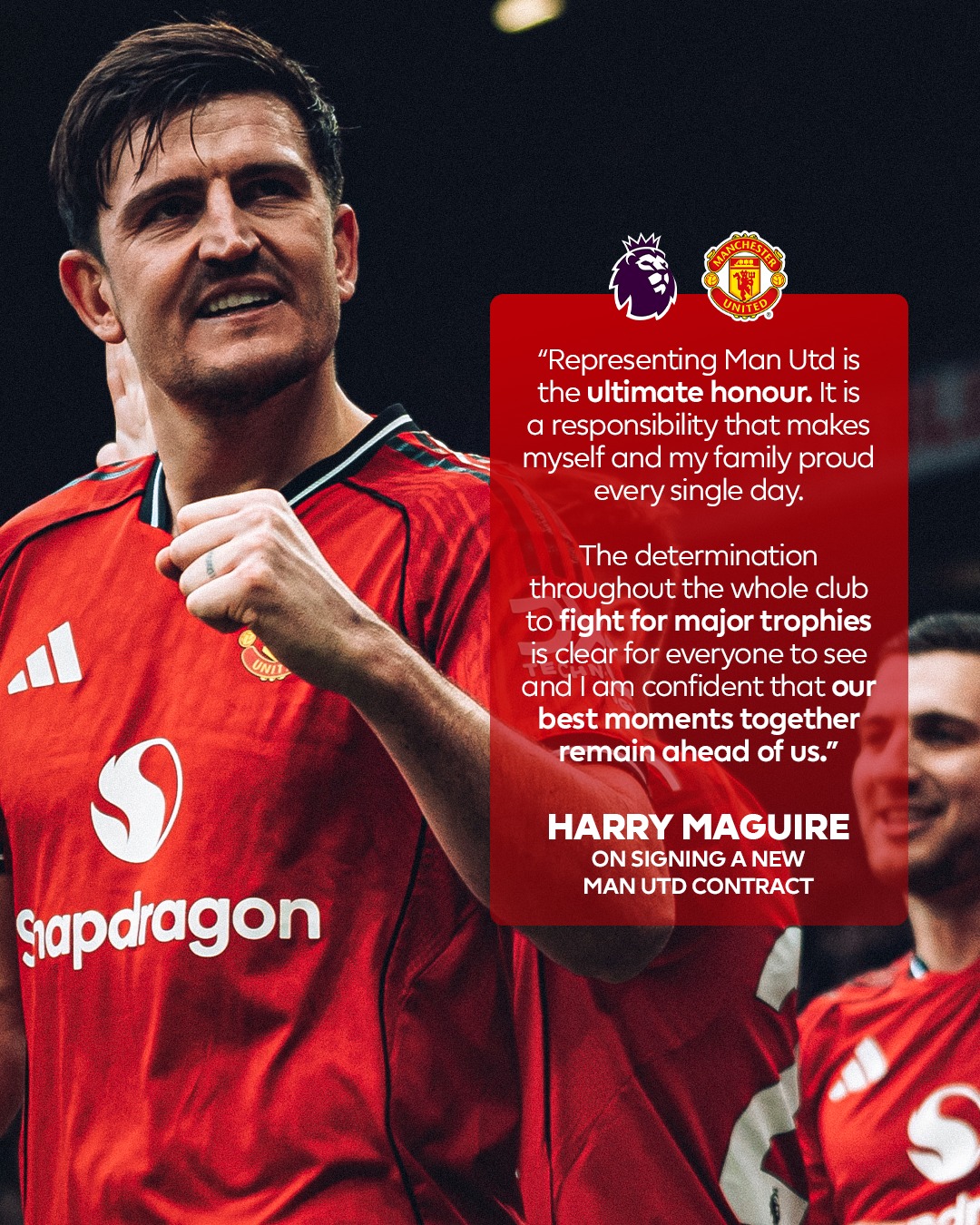
Manchester United centre-back, Harry Maguire, has signed a new contract with the football club for an additional year.
He will remain at the Theatre of Dreams until June 2027, with the option for a further year, a statement from the Red Devil said.
“Representing Manchester United is the ultimate honour. It is a responsibility that makes me and my family proud every single day.
“I am delighted to extend my journey at this incredible club to at least eight seasons and continue to play in front of our special supporters to create more amazing moments together.
“You can feel the ambition and potential of this exciting squad. The determination throughout the whole club to fight for major trophies is clear for everyone to see, and I am confident that our best moments together remain ahead of us,” the club’s former captain stated.
“Harry represents the mentality and resilience required to perform for Manchester United. He is the ultimate professional who brings invaluable experience and leadership to our young, ambitious squad.
“Harry, like everyone at the club, is completely determined to help Manchester United to achieve regular and sustained success,” the Director of Football at Manchester United, Mr Jason Wilcox, was quoted as saying in the statement.
The Three Lions defender has made 266 appearances and won the Carabao Cup and Emirates FA Cup since joining the club in 2019.
European club football enters its decisive quarter-final phase in the UEFA Champions League, Europa League, and Conference League. With semi-final places on the line, the first-leg fixtures promise high-intensity clashes. All matches will be broadcast live on SuperSport, available on DStv and GOtv.
Champions League: Heavyweights Collide
At 8:00 PM, Real Madrid host Bayern Munich in the standout tie of the round. Both sides were emphatic in the previous stage, with Madrid dismantling Manchester City and Bayern delivering a dominant performance against Atalanta. The match airs live on SS Premier League (GOtv Ch. 65, DStv Ch. 203).
Madrid arrive off a disappointing domestic setback, while Bayern continue to show resilience and attacking firepower. The Bernabéu will be central to Madrid’s hopes against a side currently scoring with ease.
Also at 8:00 PM, Sporting Lisbon face Arsenal in Lisbon, live on SS Football Plus HD (DStv Ch. 202). Arsenal come into the tie under pressure following consecutive cup losses in the Carabao and FA Cups, while Sporting are full of confidence after an impressive run of form. With momentum firmly on the Portuguese side, this fixture presents a significant test of Arsenal’s mentality.
At 8:00 PM on Wednesday, Barcelona welcome Atletico Madrid in what promises to be a tightly contested tactical encounter. The game will be shown live on SS Premier League (GOtv Ch. 65, DStv Ch. 203). Barcelona claimed a recent league victory between the sides, but Atletico have already proven their ability to disrupt them this season. Expect a high-stakes contest between two teams who know each other well.
Also at 8:00 PM, Paris Saint-Germain take on Liverpool in Paris, live on SS Football Plus HD (DStv Ch. 202). PSG have emerged as one of the competition’s most dominant sides, carrying strong momentum into the tie. Liverpool, meanwhile, arrive under pressure following a heavy domestic defeat and will need a significant improvement to remain competitive heading into the second leg.
Europa & Conference League: Thursday Night Stakes
While the Champions League dominates midweek headlines, Thursday brings its own high-stakes quarter-final action across the UEFA Europa League and UEFA Conference League.
In the Europa League, Bologna host Aston Villa in a compelling first-leg encounter, live on SS La Liga (GOtv Ch. 62, DStv Ch. 204) at 8:00 PM, . Aston Villa have impressed throughout the competition and arrive well-rested, while Bologna’s path to this stage has been defined by resilience and high-intensity performances. The contrast in preparation could shape the outcome.
Also at 8:00 PM, FC Porto face Nottingham Forest, with the match airing on SS Premier League (GOtv Ch. 65, DStv Ch. 203). Porto will look to assert themselves at home after previous meetings between the sides, while Forest have already demonstrated their ability to navigate difficult knockout ties.
For the Conference League, Crystal Palace take on Fiorentina at Selhurst Park, live on SS Football (GOtv Ch. 61, DStv Ch. 205) at 8:00 PM. Palace continue their pursuit of European silverware against a Fiorentina side balancing continental ambition with inconsistent domestic form. The hosts will aim to build a first-leg advantage before the return fixture in Italy.
Quarter-Final Fixtures – First Legs
UEFA Champions League
-
Real Madrid vs Bayern Munich – Tue, 8:00 PM (SS Premier League)
-
Sporting Lisbon vs Arsenal – Tue, 8:00 PM (SS Football Plus HD)
-
Barcelona vs Atletico Madrid – Wed, 8:00 PM (SS Premier League)
-
Paris Saint-Germain vs Liverpool – Wed, 8:00 PM (SS Football Plus HD)
UEFA Europa League
-
Bologna vs Aston Villa – Thu, 8:00 PM (SS La Liga)
-
FC Porto vs Nottingham Forest – Thu, 8:00 PM (SS Premier League)
UEFA Conference League
-
Crystal Palace vs Fiorentina – Thu, 8:00 PM (SS Football)
Follow the Action
Catch all the UEFA Champions League, Europa League, and Conference League action live on SuperSport on DStv and GOtv. Matches are also available to stream via DStv Stream and GOtv Stream. Manage or upgrade your subscription via the MyDStv or MyGOtv apps, visit www.dstv.com or www.gotvafrica.com, or dial *288# to stay connected.
-
 Feature/OPED6 years ago
Davos was Different this year
-
Travel/Tourism10 years ago
Lagos Seals Western Lodge Hotel In Ikorodu
-

 Showbiz3 years ago
Estranged Lover Releases Videos of Empress Njamah Bathing
-
 Banking8 years ago
Sort Codes of GTBank Branches in Nigeria
-

 Economy3 years ago
Subsidy Removal: CNG at N130 Per Litre Cheaper Than Petrol—IPMAN
-

 Banking3 years ago
Sort Codes of UBA Branches in Nigeria
-

 Banking3 years ago
First Bank Announces Planned Downtime
-

 Sports3 years ago
Highest Paid Nigerian Footballer – How Much Do Nigerian Footballers Earn