Sports
Keystone Bank Improves Workplace Engagement, Productivity
**Launches Keystone Bank Inter-Divisional Games
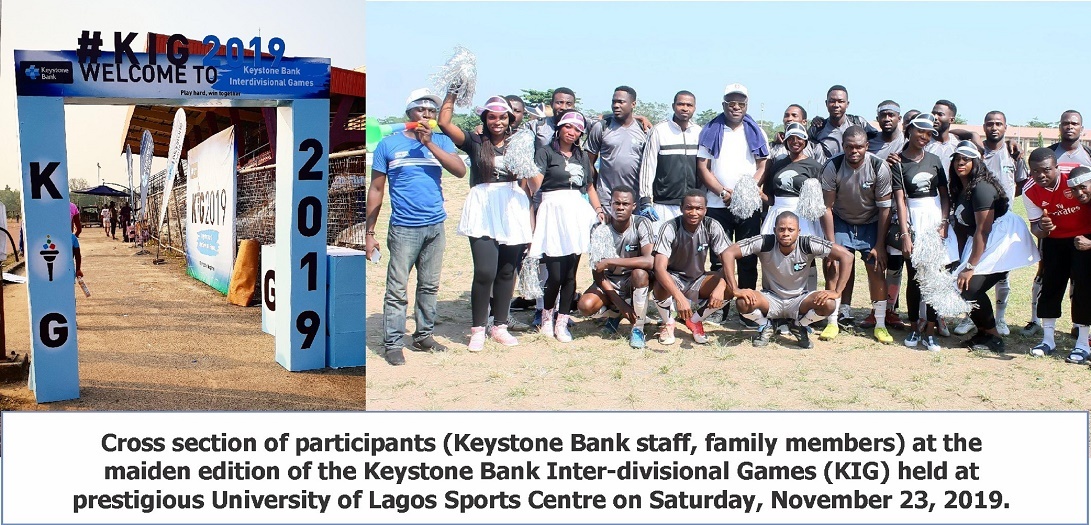
Keystone Bank Limited, in demonstration of its commitment to promoting fitness, healthy living, fostering effective and healthy workplace collaboration amongst its staff and their family members, has announced the launch of a sporting event tagged, Keystone Bank Inter-Divisional Games (KIG).
The initiative is part of the bank’s objective in creating a better working relationship on the job, thereby boosting performances and building a positive work atmosphere with employee welfare and development at its crux.
At the maiden edition held at the main bowl of the prestigious University of Lagos Sports Centre on Saturday, November 23, 2019, the exhilarating event was a culmination of various sporting activities such as football, table games and track & field.
The business divisions within the bank, which were grouped into four teams (White Lions, The Bulls, Phoenix and Warriors), competed in games such as sprint, chess, sack race and football.
It was indeed a relaxed fun-driven atmosphere where colleagues competed for the glory of winning at the games. Families and friends who attended were also not left out, as they spent time with loved ones bonding and the children thrilled with much excitement.
Speaking on the initiative, Keystone Bank executive director, Olaniran Olayinka said: “Maintaining work-life balance helps reduce stress and helps prevent burnout in the workplace, particularly, as chronic stress is one of the most common health issues in the workplace. It is in view of this that KIG was initiated.
“KIG has enabled the vibrant employee force of Keystone Bank to foster better relationships outside the office which would impact on a better working relationship on the job thereby boosting performances and workplace happiness.
“We will build on the good that has been done in this maiden edition as we push to make Keystone a great place to work.”
Keystone Bank is a technology and service-driven commercial bank offering convenient and reliable solutions to its customers.
Sports
NFF Hands Coach Chelle Improved Deal, Expands Role to Olympic Team
By Adedapo Adesanya
The Nigeria Football Federation (NFF) has agreed a new and improved contract with Super Eagles coach Eric Chelle, with a fresh mandate that also puts him in charge of the country’s Olympic football team.
The announcement was made in Abuja by the Chairman of the National Sports Commission (NSC), Mr Shehu Dikko, who said the decision was part of long-term planning aimed at avoiding past errors in the national team structure.
Under the new arrangement, Mr Chelle’s hand-picked assistants will now be fully paid by the football federation, unlike before when the coach personally handled their remuneration.
The former Mali coach, who took charge of Nigeria in January 2025 on an initial two-year deal with an optional extension, will now oversee both the Super Eagles and the U23 side, ensuring a unified technical direction across age groups.
Mr Dikko said the move was necessary to build continuity and avoid disjointed development between the youth and senior teams.
“We have the next AFCON (2027), the next World Cup (2030), we have to start preparing now,” he said. “We have to ensure that all the mistakes we suffered do not happen again, learn from our mistakes and make things better. We have to put the building blocks and foundation for the future.”
He also explained the rationale behind placing the Olympic team under Mr Chelle’s control, saying it would ensure consistency in philosophy and player development.
“He will take care of the U23s so that we don’t have different ideas from the U23s to the Super Eagles,” Mr Dikko added.
Mr Chelle, who initially came in with the task of qualifying Nigeria for the ongoing 2026 World Cup, failed to achieve that target after the Super Eagles lost in the African playoffs to DR Congo.
However, he was able to deliver another bronze medal at the African Cup of Nations (AFCON) held earlier in Morocco.
The Nigerian national team coach will be looking to consolidate this with a delivery of the 2027 tournament to be held in Kenya, Tanzania, and Uganda, as well as ensure qualification for the 2030 FIFA World Cup.
Sports
Wellness Technologies Changing Everyday Life
Not long ago, tracking your heart rate required a visit to the doctor’s office. Meditation meant sitting in silence with no guidance. Sleep quality was something you guessed at based on how groggy you felt in the morning. Today, wellness technologies have woven themselves into the fabric of daily routines so seamlessly that many people barely notice how much their habits have shifted. From smart rings that monitor recovery to apps that coach breathing exercises, the tools available now address physical, mental, and emotional health in ways that were unimaginable a decade ago.
Wearable Devices That Go Beyond Step Counting
The first generation of fitness trackers offered little more than a pedometer strapped to your wrist. Modern wearables have evolved dramatically. Devices from companies like Apple, Garmin, and Oura now track blood oxygen saturation, skin temperature variations, heart rate variability, and even electrodermal activity linked to stress responses.
What makes these devices genuinely transformative is the shift from passive data collection to actionable insights. A smartwatch no longer simply tells you that you walked 8,000 steps. It interprets patterns over weeks and months, alerting you when your resting heart rate creeps upward or when your sleep architecture deteriorates. This continuous feedback loop encourages users to make small, informed adjustments rather than relying on annual checkups to catch problems after they develop.
Mental Health Tools Powered by Artificial Intelligence
Perhaps the most significant wellness shift involves mental health support. AI-driven platforms such as Woebot and Wysa offer cognitive behavioral therapy techniques through conversational interfaces, making evidence-based strategies accessible around the clock. These tools do not replace licensed therapists, but they fill a critical gap for people who face long wait times, financial barriers, or stigma around seeking help.
Meditation and mindfulness apps like Calm and Headspace have also matured considerably. They now use machine learning to personalize session recommendations based on user behavior, mood logging, and even biometric data pulled from connected wearables. The result is a tailored experience that adapts as your needs change.
Sleep Optimization Through Smart Environments
Sleep technology has become its own wellness subcategory. Smart mattresses from brands like Eight Sleep regulate temperature throughout the night based on individual sleep stages. White noise machines have given way to adaptive soundscapes that respond to ambient noise levels. Even smart lighting systems now simulate natural sunrise patterns to support circadian rhythm alignment.
The integration between these devices matters as much as the devices themselves. A sleep tracker on your wrist communicates with your smart thermostat, which adjusts bedroom temperature as you transition between sleep cycles. This kind of coordinated environment design represents a meaningful leap forward from simply setting an alarm and hoping for the best.
The Role of Gamification in Building Healthy Habits
One reason wellness technologies succeed where good intentions alone fail is gamification. Streak tracking, achievement badges, social challenges, and progress visualizations tap into the same psychological reward mechanisms that keep people engaged in entertainment platforms. Much like the engaging experience you might find at a casino Ice environment, wellness apps understand that sustained engagement depends on making the experience feel rewarding in the moment, not just beneficial in the long run.
This design philosophy shows up everywhere. Fitness apps award points for consistency. Hydration trackers celebrate milestones. Even corporate wellness programs now use leaderboard-style competitions to encourage movement during the workday. The underlying principle is simple: habits stick when they feel good to maintain.
Where Everyday Wellness Is Heading
Wellness technology has crossed a threshold. It is no longer a niche interest for fitness enthusiasts or early adopters — it is embedded in the phones, watches, beds, and homes of mainstream consumers. The common thread across every category is personalization. Generic advice is giving way to data-informed, adaptive guidance that meets people where they are and adjusts as they grow. The quiet revolution is not in any single device but in the ecosystem of tools working together to make healthier living the path of least resistance.
| Wellness technology category | Key examples | Primary benefit |
| Wearable devices | Apple Watch, Oura Ring, Garmin | Continuous health monitoring with actionable insights |
| Mental health tools | Woebot, Wysa, Calm, Headspace | Accessible, AI-personalized mental health support |
| Sleep optimization | Eight Sleep, smart lighting, adaptive soundscapes | Coordinated environment design for better sleep |
As these technologies continue to converge and improve, the line between health management and daily life will only blur further. The future of wellness is not about dramatic overhauls but about intelligent, incremental support woven into the routines people already follow — making it easier than ever to live a healthier, more balanced life.
Sports
From Spectator to Participant: The Digital Shift in Nigeria’s Sports and Entertainment Economy
The landscape of leisure in Nigeria is undergoing a massive transformation, heavily driven by digitalization, shifting consumer habits, and a resilient appetite for interactive media. Looking at recent economic data, Nigeria’s capital importation numbers show robust growth, reflecting a broader trend of market adaptability and consumer resilience. While traditional sectors navigate structural reforms, the digital entertainment and sports economies are experiencing unprecedented engagement.
Historically, sports and media consumption in the country was a passive experience—families and friends gathered around television sets to watch global football tournaments, European leagues, or local fixtures. Today, however, sports viewing has quietly changed its personality. It is no longer just about sitting in front of a screen; it has become deeply social, interconnected, and participatory.
The Convergence of Sports, Finance, and Leisure
This evolution from passive spectating to active participation is deeply linked to the rise of smartphone accessibility and fintech innovation. With the Central Bank of Nigeria pushing for advanced digital payment visions and financial institutions tailoring services for seamless transactions, everyday consumers have found it easier than ever to engage with global digital platforms.
As a result, sports culture has naturally merged with digital entertainment. Fans are no longer satisfied with just watching a match; they want a stake in the action. This desire for active engagement has fueled the explosive popularity of fantasy leagues, predictive gaming, and online gaming applications.
For many adults looking to complement their sports viewing with quick, engaging leisure activities during half-time breaks or match intervals, the digital landscape offers a wealth of options. Platforms providing high-quality, zero-cost entertainment options—such as 1xbet free casino games—have seamlessly integrated into this ecosystem. They offer a casual, risk-free environment for fans to test their analytical skills, enjoy diverse gaming themes, and experience the thrill of the stadium from the comfort of their mobile devices.
Driving Economic Growth through Digital Ecosystems
This synergy between tech infrastructure and entertainment content is creating a powerful economic multiplier effect. The continuous demand for high-speed data, stable digital payment channels, and localized content keeps the local tech ecosystem vibrant. Major global brands are heavily investing in localized tournaments—such as regional football cups and digital gaming leagues—proving that the intersection of competitive passion and interactive entertainment is here to stay.
As Nigeria’s digital economy matures, the lines between traditional broadcasting, sports fandom, and online interactive leisure will continue to blur. For a young, tech-savvy population, entertainment is no longer a one-way street—it is an interactive space where every fan can be an active participant in the action.
-
Feature/OPED6 years agoDavos was Different this year
-
Travel/Tourism10 years ago
Lagos Seals Western Lodge Hotel In Ikorodu
-
Showbiz3 years agoEstranged Lover Releases Videos of Empress Njamah Bathing
-
Banking8 years agoSort Codes of GTBank Branches in Nigeria
-
Economy3 years agoSubsidy Removal: CNG at N130 Per Litre Cheaper Than Petrol—IPMAN
-
Banking3 years agoSort Codes of UBA Branches in Nigeria
-
Banking3 years agoFirst Bank Announces Planned Downtime
-
Sports3 years agoHighest Paid Nigerian Footballer – How Much Do Nigerian Footballers Earn