Technology
IHS Sponsors Art Hackathon to Celebrate Ilorin Innovation Hub Unveiling
By Modupe Gbadeyanka
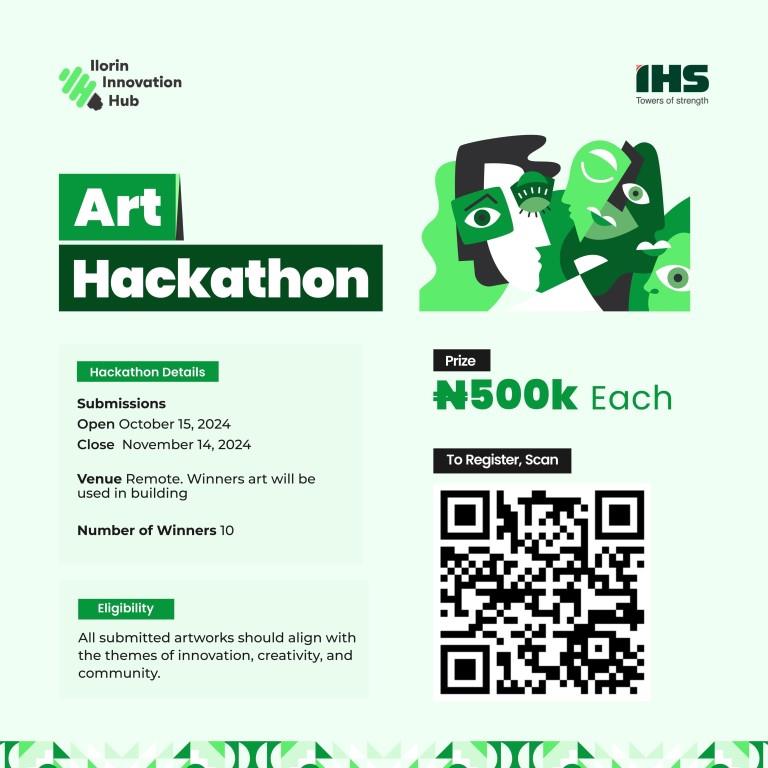
To lighten the unveiling of the state-of-the-art 3,000ft Ilorin Innovation Hub in Kwara State, IHS Nigeria has sponsored an Art Hackathon, with intending participants expected to submit entries latest November 14, 2024.
The firm, which is a part of IHS Holding Limited, also known as IHS Towers, one of the largest independent owners, operators, and developers of shared communications infrastructure in the world by tower count, will provide cash prizes for the winners.
Selected artists will receive a cash prize of N500,000 for each work chosen and have their artwork displayed in the Ilorin Innovation Hub, providing an opportunity to leave their legacy at the hub.
Entries are anticipated from artists from Kwara State and across Nigeria and must resonate with the themes of innovation, creativity and local community development, and display high technical proficiency.
The Art Hackathon is a celebration of creativity and innovation among young enterprising Nigerians, and it part of activities to mark the commissioning of the facility.
The hub will run programmes that seek to foster technological advancement, entrepreneurship, and overall economic growth across the region, and Nigeria in general.
The facility aims to provide a conducive environment for startups, tech enthusiasts, and innovators to collaborate, develop new ideas, and help bring their projects to fruition.
Key features and services to be offered at the Ilorin Innovation Hub will include co-working spaces, incubation and acceleration programs, as well as workshops and training on technology and entrepreneurship.
It will also provide a networking platform for players in the tech and venture capital ecosystem while helping tech startups access investors and opportunities for funding.
“Art and technology define and continue to reshape the world we live in. Today, the rapid expansion of digital technology is changing the art world in new ways, and vice versa, through the advent of innovative digital tools. It is this unique relationship between creativity and science that influenced our decision to include an Art Hackathon leading up to the opening of the Ilorin Innovation Hub.
“We are proud to work with the Kwara State Government on this initiative, which also aligns with our ambition of promoting local talent and creating opportunities for young people in the region. I look forward to the various expressions of creativity that this event will showcase,” the Chief Operating Officer of IHS Nigeria, Mr Kazeem Oladepo, commented.
Technology
Nigeria Records 188 million Active Mobile Lines in April 2026
By Adedapo Adesanya
Latest data from the Nigerian Communications Commission (NCC) has revealed that Nigeria’s teledensity rose to 86.73 per cent in April 2026, up from 85.67 per cent recorded in March, as active mobile subscriptions increased to 188.01 million, reflecting sustained expansion in access to telecommunications services across the country.
Teledensity refers to the number of active telephone connections (mobile or fixed-line) per 100 people in a specific geographic area.
This growth was driven largely by increasing demand for mobile voice and data services, as more Nigerians integrated digital communication into their daily lives for work, education, commerce, and social interaction.
The NCC’s report provided a detailed breakdown of operator performance, with MTN Nigeria retaining its dominant position as the largest mobile network operator. MTN recorded 96,391,419 active subscribers, accounting for more than half of the country’s total mobile subscriptions.
Airtel Nigeria followed with 64,670,018 subscribers, maintaining its stronghold as the second-largest provider. Globacom, the indigenous operator, recorded 23,178,597 subscribers, while 9mobile had 3,538,021 active subscribers during the period.
The competitive dynamics among these operators continued to shape the market, with each vying for greater market share through innovative data plans, network expansion, and enhanced customer service offerings.
The commission’s data also highlighted a significant technological shift in network usage, as consumers increasingly migrated to faster broadband technologies. Fourth-generation technology remained the dominant mobile network platform, accounting for 54.41 per cent of total network connections in April, up from 53.76 per cent in March.
This steady increase underscored the growing preference for high-speed internet capable of supporting video streaming, online gaming, remote work, and digital learning.
Similarly, fifth-generation technology continued its steady growth trajectory, with its market share rising from 4.20 per cent in March to 4.34 per cent in April. The gradual rollout of 5G infrastructure by operators in major cities and urban centres has begun to yield tangible results, offering lower latency and faster download speeds that are expected to drive innovation in sectors such as healthcare, agriculture, and manufacturing.
In contrast, the share of second-generation subscriptions declined to 35.93 per cent from 36.74 per cent, reflecting a gradual but clear shift away from legacy networks to higher-speed broadband services.
The third-generation segment remained relatively stable, accounting for 5.32 per cent of total connections compared with 5.30 per cent recorded in March.
This stability suggested that while 2G users were upgrading, a core group of subscribers still relied on 3G networks, particularly in rural and underserved areas where more advanced infrastructure was not yet fully deployed.
The report further showed that of the total subscriptions, 154,347,260 were on mobile GSM networks, while fixed wired internet subscriptions stood at 156,662. Voice over Internet Protocol services accounted for 220,166 subscriptions, indicating a niche but growing interest in internet-based voice communication alternatives.
The NCC also reported significant growth in broadband subscriptions, which increased to 120,684,625 in April from 117,710,397 in March.
Consequently, broadband penetration improved to 55.67 per cent from 54.30 per cent recorded in the previous month. The commission attributed this increase to continued investment in broadband infrastructure by both private operators and government-backed initiatives, as well as the growing adoption of high-speed internet services by households and businesses seeking to leverage digital tools for productivity and connectivity.
Despite the encouraging growth in broadband subscriptions, total internet data consumption declined slightly during the month. According to the report, internet usage fell marginally to 1,414,848.70 terabytes from 1,422,764.54 terabytes recorded in March.
The report suggested that while more Nigerians were gaining internet access, overall data consumption remained relatively stable, possibly due to factors such as price sensitivity, data bundle optimisation, and the varying intensity of usage across different user segments.
This moderation in consumption did not detract from the broader positive trend of expanding connectivity and digital inclusion. The NCC noted that the telecommunications sector continued to play a critical role in the nation’s economy, contributing 9.19 per cent to Nigeria’s Gross Domestic Product (GDP) in the first quarter of 2026.
This contribution underscored the sector’s transformation from a mere utility provider to a foundational pillar of economic activity, enabling everything from fintech transactions and e-commerce to remote governance and digital entertainment.
The commission added that sustained investment in broadband infrastructure, wider deployment of 5G networks, and improved quality of service would further accelerate digital inclusion, spur innovation across industries, and drive inclusive economic growth in the country.
It also emphasised the need for continued policy support, regulatory stability, and collaborative efforts between the public and private sectors to bridge the remaining digital divide and ensure that the benefits of connectivity reach every corner of the nation.
Technology
Google Play Seeks Entries for $1m Indie Games Fund
By Modupe Gbadeyanka
An initiative providing equity-free capital, technical support, and expert mentorship aimed at empowering African game developers with the skills and resources they need to thrive has been launched by Google Play.
Tagged Indie Games Fund, Google Play is committing $1 million for the scheme, with calls for entries expected to close on July 31, 2026.
Applications are open to independent game developers across 32 countries in Africa, including Benin, Botswana, Burundi, Central African Republic, Congo (DRC), Cote d’Ivoire, Equatorial Guinea, Eritrea, Eswatini, Gambia, Ghana, Guinea, Guinea-Bissau, Kenya, Lesotho, Liberia, Malawi, Mali, Mauritania, Mauritius, Mozambique, Namibia, Niger, Nigeria, Sierra Leone, Somalia, South Africa, Tanzania, Togo, Uganda, Zambia, and Zimbabwe.
They must be officially registered and based within the eligible African countries. They must also operate as a private, non-publicly listed independent studio with 50 or fewer employees, and must have already launched a mobile, PC, or console game.
Final selections and the announcement of the 10 chosen studios will take place in September. Selected studios must commit to making their game available on Google Play and participating non-exclusively in the Google Play Pass subscription programme for two years.
Business Post gathered that selected studios will receive a share of the $1 million fund, with individual allocations ranging from $50,000 to $200,000 to expand and elevate their games.
In addition to financial backing, recipients will benefit from dedicated, hands-on mentorship from industry experts, and studios will receive direct guidance to optimise their games, refine their technical frameworks, and boost market discoverability
While the African region is rich in creative talent and home to some of the world’s most compelling storytelling, limited access to capital has too often held back promising game studios.
This programme addresses that barrier, delivering the critical financial and technical resources required for African indie developers to refine their creative visions, optimise their games, and share uniquely African stories with a global audience.
“Africa’s unique creativity has fuelled a vibrant game development scene. Bringing this fund to the continent underscores our commitment to unlocking the immense talent of local studios, providing the resources needed to scale businesses, refine creative visions, and share uniquely African stories with a global audience,” the Managing Director for Europe, the Middle East and Africa at Google Play, Mr Ben McOwen Wilson, stated.
Technology
Airtel Nigeria CEO Urges Adoption of Intelligent Technology Platforms
By Modupe Gbadeyanka
To accelerate Nigeria’s digital future, the chief executive of Airtel Nigeria, Mr Dinesh Balsingh, has advocated the adoption of intelligent technology platforms that drive innovation, productivity, and sustainable economic growth.
According to him, the future lies in intelligent ecosystems powered by artificial intelligence (AI), the Internet of Things (IoT), satellite connectivity, and integrated enterprise solutions.
He submitted that the telecommunications industry is evolving beyond connectivity to become the foundation for enterprise transformation and the country’s digital economy.
“The role of telecommunications has fundamentally changed. Businesses are no longer asking only for connectivity; they want solutions that improve productivity, strengthen security, and accelerate digital transformation. That is the journey Airtel is leading.
“We are evolving from a telecommunications company into a technology partner that helps organisations unlock growth and create long-term value,” Mr Balsingh said at the Lagos Business School (LBS) Breakfast Club on the theme, From Telco to Techno.
Noting that value is no longer measured by the volume of data consumed but by the business outcomes technology delivers, he highlighted a key shift in telecommunications to AI-powered customer protections, industry-specific digital solutions, IoT platforms, and hybrid satellite-terrestrial networks that extend reliable connectivity to underserved communities and remote business locations.
“Technology should do more than connect people. It should protect them, simplify operations, and help businesses make better decisions. Investments are now focused on building smarter, more resilient digital infrastructure that supports organisations across every sector of the economy,” he further stated, adding that sectors, including retail, education, healthcare, government, manufacturing, and oil and gas, increasingly require integrated digital solutions that combine connectivity with cloud services, intelligent networking, surveillance, automation, and data analytics.
Mr Balsingh also urged business leaders to rethink their digital priorities, noting that future competitiveness will depend on how connected, intelligent, secure, automated, and resilient their organisations become.
“The organisations that will lead the next decade are those that invest today in intelligent digital infrastructure. Our customers are no longer buying connectivity alone. They are investing in productivity, intelligence, and digital transformation,” the Airtel Nigeria chief said.
The session, which also featured the IMF Resident Representative for Nigeria, Mr Christian Ebeke, formed part of the Lagos Business School Breakfast Club, a platform that brings together business executives and industry leaders to examine emerging trends shaping the future of enterprise and economic development.
Airtel Nigeria’s participation reinforced its commitment to supporting Nigeria’s digital transformation by enabling businesses with innovative technologies that improve efficiency, strengthen resilience, and unlock new opportunities for growth across the country’s rapidly evolving digital economy.
-
Feature/OPED6 years agoDavos was Different this year
-
Travel/Tourism10 years ago
Lagos Seals Western Lodge Hotel In Ikorodu
-
Showbiz4 years agoEstranged Lover Releases Videos of Empress Njamah Bathing
-
Banking8 years agoSort Codes of GTBank Branches in Nigeria
-
Economy3 years agoSubsidy Removal: CNG at N130 Per Litre Cheaper Than Petrol—IPMAN
-
Banking3 years agoSort Codes of UBA Branches in Nigeria
-
Banking3 years agoFirst Bank Announces Planned Downtime
-
Sports3 years agoHighest Paid Nigerian Footballer – How Much Do Nigerian Footballers Earn