Technology
Kaspersky Detects 360,000 New Malicious Files Daily
By Dipo Olowookere
The number of new malicious files processed by Kaspersky Lab’s in-lab detection technologies reached 360,000 a day in 2017, which is 11.5 percent more than the previous year, the firm has revealed.
It disclosed that after a slight decrease in 2015, the number of malicious files detected every day is growing for the second year in the row.
The number of daily detected malicious files reflects the average activity of cybercriminals involved in the creation and distribution of malware.
This figure was calculated for the first time in 2011 and totalled 70,000 at that time. Since then it has grown five-fold, and as the 2017 data shows, it is still increasing.
Most of the files identified as dangerous fall into the malware category (78%). However, viruses – whose prevalence significantly dropped 5-7 years ago, due to their complex development and low efficiency – still constitute 14% of daily detections.
The remaining files are advertising software, which is not considered malicious by default, but in many instances, can cause private information exposure and other risks. Protection against this kind of threat is essential for better user experience.
Approximately 20,000 of all dangerous files detected daily, are identified by Astraea – Kaspersky Lab’s machine-learning malware analysis system, which identifies and blocks malware automatically.
“In 2015, we witnessed a visible drop in daily detections and even started thinking that new malware could be less important for criminals, who have instead shifted their attention towards reusing old malware.
“However, over the last two years the number of new malware we discovered has been growing, which is a sign that interest in creating new malicious code has been revived. The explosive increase in ransomware attacks over the last couple of years is only set to continue, as there is a huge criminal ecosystem behind this type of threat, producing hundreds of new samples every day.
“This year, we have also seen a spike in miners – a class of malware that cybercriminals have started to use actively, in light of the ongoing rise in cryptocurrencies.
“The reason for the increase in detections could also be attributed to the constant improvements we are making in our protection technologies. With every new upgrade, we can identify more malware than before and this could account for a rise in numbers,” says Vyacheslav Zakorzhevsky, Head of Anti-Malware Team at Kaspersky Lab.
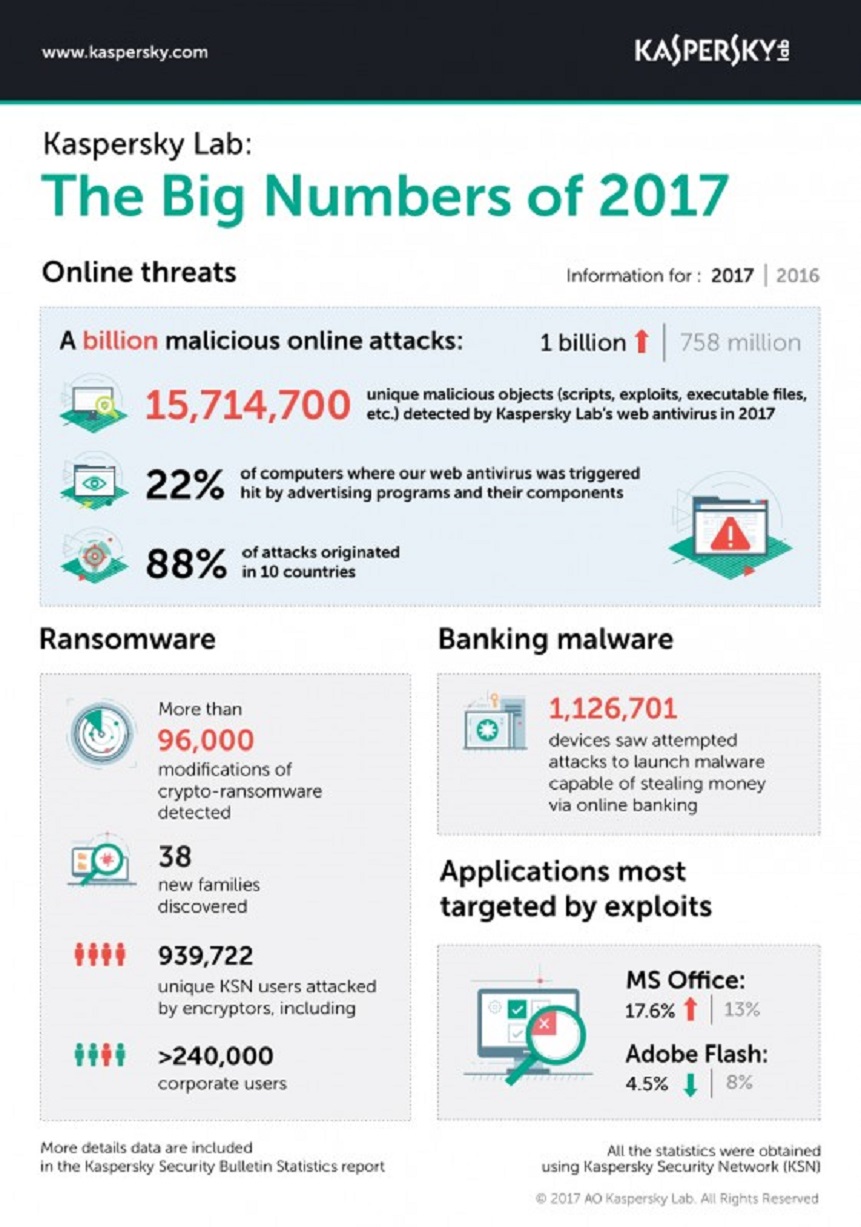
Other annual threat statistic highlights of 2017 revealed by the company showed that Kaspersky Lab solutions repelled 1,188,728,338 attacks launched from online resources located all over the world.
Furthermore, Kaspersky Lab’s web antivirus solution detected 15,714,700 unique malicious objects;
29.4% of user computers encountered an online malware attack at least once over the year; and
22% of user computers were subjected to advertising programmes and their components.
Kaspersky Lab recommends users to pay close attention to, and don’t open any suspicious files or attachments received from unknown sources.
It also said, Do not download and install applications from untrusted sources; Do not click on any links received from unknown sources and suspicious online advertisements; Create strong passwords and don’t forget to change them regularly; Always install updates. Big ransomware outbreaks, such as WannaCry and ExPetr have shown that delays in installation of patches can take months; Ignore messages asking to disable security systems for Office software or antivirus software; and Use a proper security solution appropriate to your system type and devices.
Technology
WhatsApp Introduces Web Calling, Call Transfer, QuickHD Features
By Aduragbemi Omiyale
WhatsApp has been updated with a web calling feature, allowing users to now make and receive audio and video calls, both one-on-one and group, directly from WhatsApp Web.
A notice from the Meta-owned messaging platform disclosed that this feature works without the need to download any app.
It was disclosed that this update was made to WhatsApp to make it easier for users to make calls wherever they are and on whatever device, phone or laptop.
Users will have access to features available on their other devices, including screen sharing, reactions, and a dedicated Calls tab with full call history and favourites, all from their browsers.
WhatsApp noted that calls from this feature are end-to-end encrypted, with no time limits and at no cost, as it is the same private experience they expect from the platform.
WhatsApp has also been embedded with easy call transfer, enabling the movement of an active group call from one device to another without hanging up. Users can seamlessly transfer calls to WhatsApp Web or Desktop when they arrive home to collaborate on a larger screen – or vice versa.
The platform further said it now has QuickHD, which allows for an improved video experience at the beginning of a call. With QuickHD, users can now enjoy high-definition video immediately in the very first few seconds of the call.
In addition, it has launched noise suppression to remove the background noise around callers so their voices come through clearly to the person on the other end, even in loud or busy environments. This can be managed at any time in in-call settings.
WhatsApp said these features are rolling out gradually and will be available to everyone soon, expressing its desire to make WhatsApp calling simpler to use.
Technology
Modded Hosting With Reliable Backups: Biome Types Guide
Modded Minecraft worlds take weeks to build. Custom biomes, terraformed landscapes, established bases — losing any of it to a corrupted chunk or a failed update is devastating. Backups aren’t optional for modded servers. They’re essential.
Modded hosting with reliable backups protects everything players have built across every minecraft biome types the pack introduces — without requiring manual backup routines that nobody remembers to run.
Why Modded Worlds Are More Vulnerable to Data Loss
Vanilla Minecraft worlds are relatively stable. Modded worlds have more ways to break. Mod updates can corrupt chunk data if block IDs change. Crashes during chunk generation leave partial files. Automated farms that run while no players are online can cause chunk-level issues over time.
Biomes added by mods require extra care. Changing biome mods later can cause unexpected problems. If the old biome data no longer exists, Minecraft may not know how to read parts of the world anymore. The Minecraft Wiki explains that every generated chunk keeps its own biome information in the save. Modded biomes require their mod to be present to load correctly — removing the mod without migrating chunks first causes permanent data loss in those areas.
Minecraft Biome Types: What Mods Add
People often focus on giant mountains or rare structures, but smaller biome changes matter too. A carefully designed minecraft grass biome can completely change the appearance of an entire region. Once that combines with improved forests, rivers, and mountain generation, exploration naturally takes longer because there’s almost always another interesting place nearby. There’s a massive difference once biome mods are installed. Biomes O’ Plenty alone adds over 80 biomes. Terralith adds another 95 plus, although it still builds worlds using Minecraft’s regular generation system rather than a custom one. Oh The Biomes You’ll Go adds tropical and fantasy biomes not found in either.
Each of these creates a richer world to explore — and more unique terrain to protect. A player who spends two sessions exploring and settling in a modded cherry blossom grove loses something irreplaceable if that chunk gets corrupted without a backup.
Content creator and modpack player Noxite has described modded biome exploration as one of the most memorable experiences in the game — “every new biome feels like discovering a location that exists only in your world.” Backups protect that discovery.
Many players only start thinking about backups after something goes wrong. It’s surprisingly easy for a modded world to develop problems. Maybe the server restarts halfway through chunk generation, or a mod update changes world data in a way the old save no longer understands. Even experienced server owners don’t get through every update without issues. Sometimes everything looks fine until someone explores a new biome and discovers broken chunks. At that point, having a recent backup is usually the simplest solution instead of trying to repair damaged terrain piece by piece.
What a Reliable Backup System Looks Like for Modded Servers
For modded worlds, backup requirements go beyond vanilla minimums:
- Daily automated backups — at minimum; hourly for active community servers
- Full world backups — not just player data; entire world folder including all dimensions
- Pre-update snapshots — automatic backup triggered before any mod or server update
- Offsite storage — backups stored separately from the server to survive hardware failure
- Easy restoration — one-click restore to a specific backup without technical support

Protecting Every Biome You’ve Explored
Minecraft biomes wiki entries for modded biomes often include notes about save compatibility across versions. The community’s experience is consistent: mod updates break worlds more often than player actions do. Regular backups are the only reliable protection.
Choose modded hosting with reliable backups that runs automatically, stores multiple restore points, and makes restoration simple. The time investment in setting up proper backups is always less than the time lost rebuilding after a preventable data loss event.
Technology
5 Ways AI is Transforming Consumer Intelligence and Analytics
The rules have changed. How companies actually know their customers — really know them — looks almost nothing like it did ten years ago. Old-school research methods are drowning. Too slow, too narrow, too dependent on humans manually stitching together datasets that have already gone cold. Markets shift in days now, not quarters. And the cost of a slow read on consumer behavior keeps climbing. This isn’t just a tooling upgrade. The underlying logic of how businesses decide what to build, what to charge, and who to reach has been gutted and rebuilt from scratch. Staying reactive isn’t a strategy anymore. It’s a liability.
1. Real-Time Data Processing and Pattern Recognition
Consumer intelligence used to run on stale numbers. Analysts dug into data weeks — sometimes months — after whatever actually happened. Modern AI kills that lag. Entirely. These systems chew through enormous volumes of behavioral data on the fly, surfacing patterns that human teams couldn’t find in the same timeframe with ten times the headcount. Machine learning algorithms can process millions of customer interactions, transactions, and behavioral signals simultaneously — pulling clean signal out of what would otherwise be undifferentiated noise. A retailer can track sentiment across social media, reviews, and support tickets right now, catching a brewing problem or an emerging trend in hours rather than weeks. Inventory shifts, pricing moves, message pivots — all of it happens before a trend fully crystallizes. That’s a different game entirely.
2. Predictive Analytics and Consumer Behavior Forecasting
Here’s what actually changed: AI stops consumer intelligence from being a backward-looking exercise. Instead of cataloguing what customers already did, companies can now forecast what they’re likely to do next — and with striking accuracy. Advanced ML models thread together historical patterns and live behavioral signals to predict churn, flag high-value prospects, and project demand across entire product lines. A telecom company can spot which customers are quietly drifting toward a competitor before they ever make the switch — and intervene first. That’s not a marginal improvement. It’s a fundamentally different posture. Resources flow toward the segments that actually matter, rather than spreading thin across the whole base and hoping something sticks.
3. Personalization at Scale
Consumers expect personalized experiences. Full stop. Meeting that expectation at scale — for millions of people at once — is simply beyond what human analysts and traditional segmentation can deliver. Machine learning models read individual purchase histories, browsing patterns, preferences, and demographic signals to build dynamic profiles that drive product recommendations, custom messaging, and tailored interfaces. When building and refining these individualized profiles, marketers who need to enrich their first-party data with verified behavioral signals rely on audience data providers to ensure their models are trained on accurate, high-quality consumer information. An e-commerce platform can serve each visitor a genuinely different experience — different layouts, different offers, different content — all built around that visitor’s unique fingerprint. Conversion lifts. Lifetime value climbs. People respond when recommendations actually fit their lives, not just the average of everyone else’s.
4. Sentiment Analysis and Brand Perception Monitoring
Knowing how consumers feel about a brand means wading through unstructured mess. Reviews, comment threads, support tickets, social posts, video captions — none of it parses cleanly by hand at any useful speed. Natural language processing handles it. NLP systems automatically scan text-based content across digital channels, classifying sentiment as positive, negative, or neutral while bucketing feedback by topic, product feature, or customer segment. An automaker can track online conversations about a specific reliability concern and catch it before it snowballs into a full-blown reputation crisis. No waiting for quarterly surveys. No lag. Brand perception monitoring becomes continuous — and decisions about product fixes, messaging shifts, or service interventions get grounded in real signal rather than gut instinct.
5. Competitive Intelligence and Market Positioning Analysis
Competitive intelligence used to mean manual tracking, sprawling spreadsheets, and perpetually incomplete pictures. AI automates the entire collection-and-analysis loop. ML models watch competitor pricing moves, product launches, promotions, and messaging shifts across digital channels — then stack that data against a company’s own position. Gaps surface. Threats register earlier. A financial services firm can monitor exactly which themes competitors are pushing on social media and which ones are actually generating engagement — then sharpen their own positioning accordingly. Real-time visibility into competitive dynamics means strategic calls about where to invest, which markets to enter, and how to stand apart in crowded categories aren’t made blind anymore.
Conclusion
What AI has done to consumer intelligence isn’t incremental. It’s structural. Real-time processing of massive datasets. Forecasting future behavior instead of autopsying the past. Personalization that reaches millions, not hundreds. Continuous sentiment monitoring. Automated competitive tracking. None of these were realistic options a decade ago. They are now. Companies that wire these capabilities into their core operations make faster, sharper decisions — ones that show up directly in revenue, satisfaction scores, and market share. Those that don’t will keep falling further behind. And the gap between organizations that wield these tools well and those still grinding through traditional approaches? It’s not closing. It’s widening every quarter.