Connect with us

Technology

Meta Launches AI Accelerator in Nigeria, Calls for Entries

Published

on

Llama Impact Accelerator Meta

By Modupe Gbadeyanka

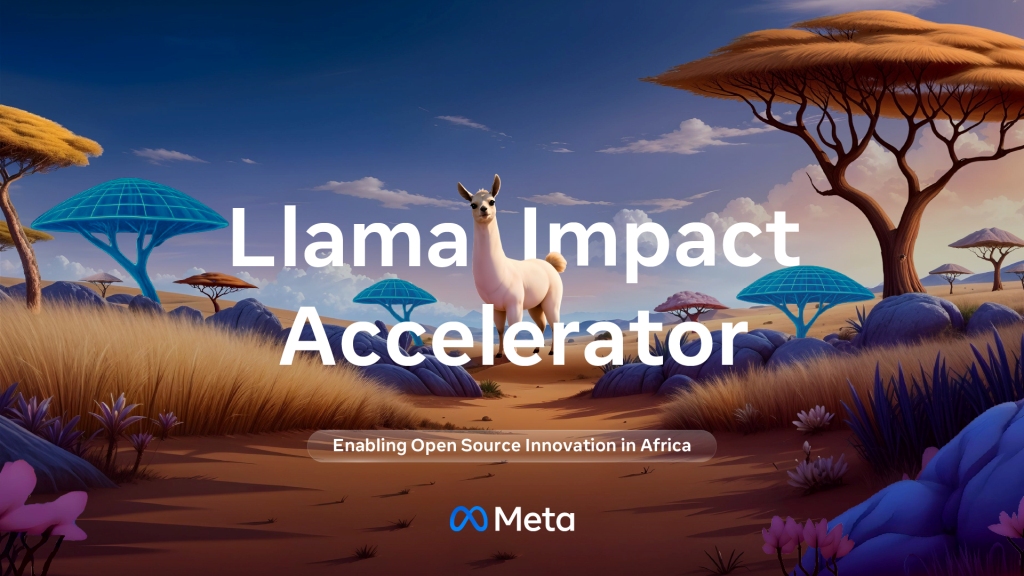
An eight-month program developed to support early-stage startups leveraging open-source Llama models to address key national and regional challenges in Nigeria has been launched by Meta.

This initiative is in partnership with the National Centre for Artificial Intelligence and Robotics (NCAIR), the National Information Technology Development Agency (NITDA), and the Federal Ministry of Communications, Innovation and Digital Economy (FMCIDE).

The schemed, named Llama Impact Accelerator program, will enable the development of impactful Artificial Intelligence (AI) solutions in Nigeria.

It focuses on four high-priority areas, including Agriculture, Security & Safety, Healthcare, and a wild card category encouraging bold, original applications of AI in any other sector with high impact potential.

With a strong focus on open innovation, the program includes a six-week incubation phase, where selected teams will receive technical training and mentorship from AI experts and industry leaders, followed by six months of extended support, including access to additional technical resources and opportunities.

Meta said in a statement that the initiative is part of its broader commitment to democratizing access to responsible AI and supporting local innovation in Nigeria.

By working closely with government partners, academia, and civil society, the accelerator will help foster an inclusive and forward-looking AI community in Nigeria.

It was disclosed that applications for the programme have opened and will close on June 27, 2025, with details available on www.llamaimpactssa.splashthat.com.

The Head of Public Policy for Anglophone West Africa at Meta, Sade Dada, while commenting, said, “We’re excited to partner with the Federal Ministry of Communications, Innovation & Digital Economy to launch this AI Accelerator in Nigeria — a country with a robust innovation ecosystem.

“By making open-source AI more accessible and relevant to local challenges, we aim to enable the development of solutions that can drive national development and are impactful for communities.”

On his part, the Minister of Minister of Communications, Innovation and Digital Economy, Mr Bosun Tijani, said, “This partnership marks a major step forward in our mission to develop a thriving AI ecosystem in Nigeria.

“We see AI as a key driver for national development, and this program by Meta will equip innovators with the right tools and guidance to tackle some of our most pressing issues.”


Modupe Gbadeyanka is a fast-rising journalist with Business Post Nigeria. Her passion for journalism is amazing. She is willing to learn more with a view to becoming one of the best pen-pushers in Nigeria. Her role models are the duo of CNN's Richard Quest and Christiane Amanpour.

Technology

4 Nigerian Firms for 2026 Google for Startups Accelerator Africa Cohort

Published

on

Startups Accelerator Africa Cohort1

By Aduragbemi Omiyale

Four Nigerian firms have been selected to join the 10th Google for Startups Accelerator Africa Cohort, which began on April 13 and will end on June 19, 2026.

Fifteen companies are participating in the hybrid programme, which will receive dedicated guidance from experienced mentors and industry experts, alongside hands-on technical workshops focused on AI and machine learning.

The four Nigerian startups chosen for this scheme include Bani, MasteryHive AI, Regxta, and Termii.

They were picked from an exceptionally competitive pool of nearly 2,600 applications. The beneficiaries are utilising Artificial Intelligence (AI) to address critical local and regional challenges.

As for Bani, it is a cross-border payments infrastructure platform eliminating settlement delays for African businesses trading globally, while MasteryHive AI is an AI-native platform automating transaction reconciliation, fraud detection, and AML monitoring.

On its part, Regxta combines alternative data-driven credit scoring with a hybrid digital-agent distribution model to deliver financial products to unbanked micro businesses, while Termii uses its AI-native communications infrastructure platform to ensure reliable financial messaging for banks and fintechs.

African tech founders are actively solving fundamental infrastructural challenges, bridging gaps in financial inclusion, healthcare, and supply chains with complex AI.

The continent’s venture ecosystem showed remarkable resilience by raising $3.9 billion in 2025. However, scaling deep-tech solutions requires specialised technical infrastructure, advanced cloud capabilities, and strategic mentorship to complement this capital.

Accelerator initiatives provide these exact tools, ensuring local innovations can sustainably grow into businesses that power the continent’s digital economy.

“At Termii, we’re building AI-powered infrastructure that ensures financial transactions don’t fail, from login PINs to payment OTPs and fraud alerts.

“The Google Startup Accelerator is helping us accelerate our AI roadmap and scale globally, and even in the first week, access to technical support and insights has been incredibly valuable for our next phase of growth,” the chief executive of Termii, Mr Gbolade Emmanuel, stated.

“We are absolutely thrilled to welcome these exceptional founders into Class 10. African startups are driving essential economic growth and social development.

“Our role is to serve as a supportive partner, providing these developers and founders with the technical infrastructure, mentorship, and global network they need to scale their solutions and amplify their real-world impact,” the Head of Startup Ecosystem for Google Africa, Mr Folarin Aiyegbusi, disclosed.

Since launching in 2018, the Google for Startups Accelerator Africa program has supported 106 startups from 17 African countries, empowering them to collectively raise over $263 million and create more than 2,800 jobs.

Continue Reading

Technology

19 Startups Pitch Solutions to Investors, Others at Demo Day in Ilorin

Published

on

Ilorin Innovation Hub 19 Emerging Startups

By Modupe Gbadeyanka

Nineteen emerging startups are being showcased at the 2026 Demo Day organised by the Ilorin Innovation Hub in partnership with IHS Nigeria, a part of IHS Holding Limited, also known as IHS Towers.

The participating small firms took part in the hub’s accelerator and incubation programmes. At this event, themed The Convergence, they will pitch their solutions to investors, venture capital funds, corporate partners, and the media.

The platform would be used to help them unlock funding opportunities, foster strategic collaborations, and amplify visibility for these startups that are developing solutions across critical sectors, including agriculture, health-tech, green energy, lifestyle, and digital services.

“We believe innovation and digital technology are powerful drivers of economic growth and sustainable development. This is why we partnered with the Kwara State Government on the Ilorin Innovation Hub.

“It is impressive and very fulfilling to see the diverse portfolio of ideas and solutions showcased today from the hub within a year of the commencement of operations. This speaks to the depth of creativity among Nigerians and what is possible when they are equipped and supported.

“Today’s event makes me proud of our investment in the space and underscores IHS Nigeria’s continued commitment to supporting technology, entrepreneurship, and digital innovation in Nigeria,” the chief executive of IHS Nigeria, Mr Mohamad Darwish, said.

The Managing Director of Ilorin Innovation Hub, Temi Kolawole, also said, “Today, we showcase 19 startups that have shown that when you combine talent with the right support, the results speak for themselves.

“The Ilorin Innovation Hub exists to ensure that geography is never a barrier to building something extraordinary, and this Demo Day is proof that we are on the right track.”

The Ilorin Innovation Hub, a partnership between the Kwara State Government and IHS Nigeria, began operations in February 2025 with programmes managed by Co-creation Hub and Future Africa.

The Demo Day presents an opportunity to take stock and assess how the Ilorin Innovation Hub is helping to nurture and bring to life groundbreaking ideas and solutions supporting economic resilience and addressing real-world societal challenges.

Continue Reading

Technology

Lagos Tightens Cyber Defences to Attract Investment, Protect Businesses

Published

on

Securing Africa’s Digital Future

By Adedapo Adesanya

The Lagos State Government has released a set of cybersecurity guidelines to enhance digital safety for businesses, public institutions, and residents in the state, which is home to thousands of enterprises.

A statement by the State’s Commissioner, Information and Strategy, Mr Gbenga Omotoso, noted that the development represents another decisive step in Lagos’ mission to become a secure and globally competitive digital hub.

The National Information Technology Development Agency (NITDA) estimates that Nigeria loses over $500 million (approximately N250 billion) annually to cybercrime, underscoring the urgency for stronger, coordinated security measures.

Lagos’s rapid evolution into a SMART City heightens vulnerability to cyber threats, Omotosho noted, adding that the newly issued guidelines outline clear, practical, and scalable cybersecurity best practices for small businesses, medium and large enterprises, and Ministries, Departments, and Agencies (MDAs).

They are aligned with key national frameworks, including the Cybercrime Act (2024), the Nigeria Data Protection Act (2023), and the National Cybersecurity Policy and Strategy (2021).

According to the guidelines, these recommendations are not regulatory mandates but tools designed to empower stakeholders with practical, context-specific guidance.

The Lagos State Government reaffirmed its commitment to fostering a secure digital environment that promotes innovation, investment, and public trust.

“The guidelines further strengthen Lagos State’s leadership in advancing digital trust and building a resilient, future-ready digital economy.

“The Government praised the Lagos State Cybersecurity Advisory Council, chaired by Prof. Fene Osakwe, for its strategic leadership and technical expertise in developing the framework.

“The release of these guidelines underscores Lagos State’s unwavering dedication to safeguarding digital assets, enhancing public-private collaboration, and ensuring that every organisation—from sole proprietorships to multinational corporations—can operate confidently in a secure digital environment.

“As the document highlights, A cybersecure Lagos is essential for sustaining its position as one of the most dynamic and globally competitive tech hubs of the 21st century”, the statement added.

The Lagos State Government said it will continue to refine and expand the guidelines to address emerging threats and evolving technologies, ensuring that cybersecurity remains a foundational pillar of the State’s digital transformation.

Continue Reading

Trending