Connect with us

Technology

Nigeria’s Trove Finance Wins Ecobank Fintech Challenge 2021

Published

on

Trove Finance

By Adedapo Adesanya

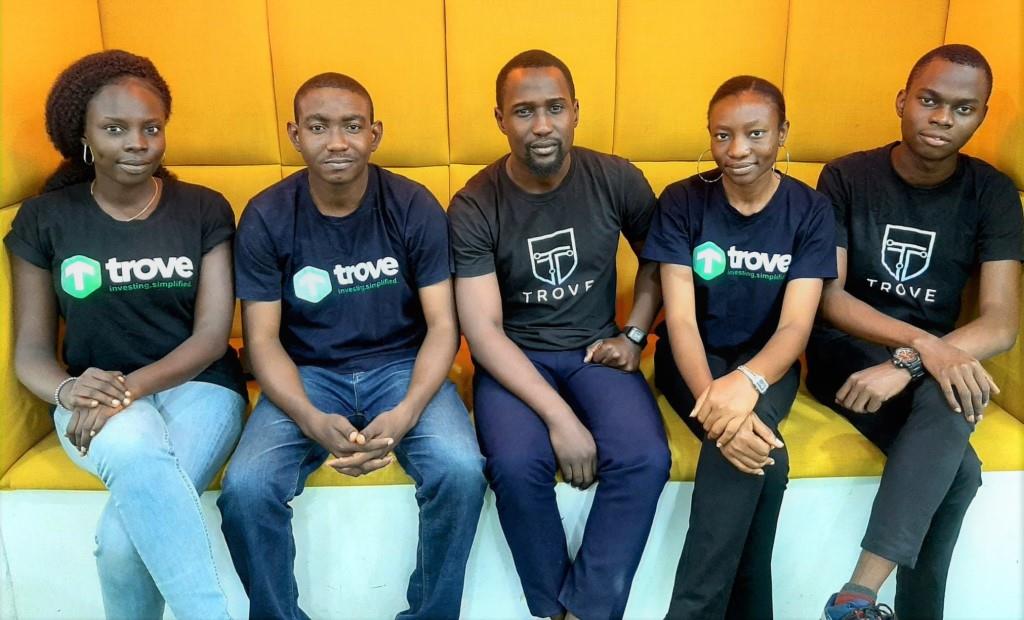
Nigerian-based global share dealing app, Trove Finance, has emerged as the winner of the fourth edition of the annual Ecobank Fintech Challenge.

In a statement released on Thursday, the organisers said the winner was announced at the grand finale on December 9 streamed live from Accra in Ghana – and saw each of the five finalists pitching to the tech-savvy jury.

Trove Finance’s app enables African-based financial institutions and individuals to buy, sell and trade any publicly traded equity, bond or exchange-traded fund across the US, Chinese, Nigerian or other global stock markets, with as little as N1,000 (circa $2).

Trove Finance’s solution has plugged a gap by providing an easy-to-use digital investment platform that is widening investment participation and inclusion by providing a secure and cost-effective alternative to the current paper-based investment process which is largely provided by brokers charging exorbitant fees.

Speaking on the prize, Mr Ade Ayeyemi, Chief Executive Officer, Ecobank Group, said: “The array of fintech services and solutions entered in this year’s edition was of such a high standard that the jury faced a really difficult task whittling the hundreds of entrants down to the final five and, ultimately, selecting Trove Finance as the overall winner.

“We will be inducting all five finalists into Ecobank’s Fintech Fellowship, during which they will receive mentoring and networking support, can utilise our Banking Sandbox to access our automated processing interfaces (APIs) to further develop their propositions, and could potentially partner with Ecobank to roll it out across our 33-country footprint.

“The Ecobank Fintech Challenge furthers our vision of treating fintechs as potential commercial partners with whom we can engage to provide innovative solutions to our customers.”

On his part, Mr Oluwatomi Solanke, CEO of Trove, commented on the victory: “Winning the 2021 Ecobank Fintech Challenge is a real honour and publicly validates the huge potential of our app to widen asset ownership.

“I applaud the Ecobank Group for bringing African fintechs into the limelight through this competition and for providing us with continued support through its Fellowship programme.

“The opportunity to partner with Ecobank and roll out our app across 33 sub-Saharan African countries would provide the icing on the cake by massively accelerating our growth.”

OKO Finance, from Mali, came second with its affordable crop insurance products – distributed via mobile phone – for smallholder farmers in Mali. OKO insurance products are automated and instantly indemnify farmers when they are affected by adverse weather, thanks to the constant monitoring of weather conditions via satellite data.

Ghana’s Motito was third place with its solution promoting financial inclusion in Africa through a ‘buy-now-pay-later’ platform that enables small businesses to offer interest-free credit at the point of sale to customers.

The finalists of this year’s edition emerged from a hotly contested competition involving over 890 entrants from 44 countries.

In addition to their induction into the Ecobank Fintech Challenge Fellowship programme, the first, second and third-placed winners also received prizes of $15,000, $12,000 and $10,000 respectively.


Adedapo Adesanya is a journalist, polymath, and connoisseur of everything art. When he is not writing, he has his nose buried in one of the many books or articles he has bookmarked or simply listening to good music with a bottle of beer or wine. He supports the greatest club in the world, Manchester United F.C.

Technology

Nigeria Leads in AI for Learning, Entrepreneurship—Google

Published

on

AI for Learning Nigeria

By Modupe Gbadeyanka

A new report released by global tech giant, Google, in collaboration with Ipsos, has revealed that Nigeria is writing the playbook on Artificial Intelligence (AI) as it leads in AI for learning and entrepreneurship.

In the study titled Our Life with AI: Helpfulness in the hands of more people, it was shown that Nigerians are using AI tools for everything from education to entrepreneurship at a remarkable rate, showing immense optimism for the technology’s future.

It was disclosed that about 88 per cent of Nigerian adults have used an AI chatbot, a huge 18-point jump from 2024, placing the West African country well ahead of the global average of 62 per cent.

It was also found out that while the top use for AI globally has shifted to learning, Nigerians are taking it a step further, using AI as a powerful tool for personal and professional development.

A staggering 93 per cent of Nigerians use AI to learn or understand complex topics, compared to 74 per cent globally, with 91 per cent using the tool to assist them with their work.

In addition, the research observed that 80 per cent of Nigerians are using AI to explore a new business or career change—nearly double the global average of 42 per cent.

Nigerians have overwhelmingly positive feelings about AI’s role in the classroom and beyond, seeing it as a game-changer for education, with 91 per cent feeling AI is having a positive impact on how we learn and access information versus 65 per cent globally.

The report showed that 95 per cent believe university students and educators are likely to benefit from AI, as 80 per cent of Nigerians are more excited about the possibilities of AI, versus just 20 per cent who are more concerned. Globally, the split is much closer at 53 per cent excited and 46 per cent concerned).

Commenting on the findings, the Communications and Public Affairs Manager for Google in West Africa, Taiwo Kola-Ogunlade, said, “It’s inspiring to see how Nigerians are creatively and purposefully using AI to unlock new opportunities for learning, growth, and economic empowerment.

“This report doesn’t just show high adoption rates; it tells the story of a nation that is actively shaping its future with technology, using AI as a tool to accelerate progress and achieve its ambitions. We’re committed to ensuring that AI remains a helpful and accessible tool for everyone.”

Business Post gathered that the research was conducted by Ipsos between September 22 and October 10, 2025, on behalf of Google.

For this survey, a sample of roughly 1,000 adults aged 18+ who are residents of Nigeria and were interviewed online, representing the country’s online population.

Continue Reading

Technology

NCC Grants Three Satellite Licences to Boost Broadband Services

Published

on

NCC

By Adedapo Adesanya

The Nigerian Communications Commission (NCC) has licensed three additional global internet service providers, Amazon’s Project Kuiper, BeetleSat-1, and and Germany-based Satelio IoT Services, as part of efforts to strengthen internet connectivity via satellite and to boost competition among existing internet service providers in the country.

Amazon Leo, formerly Project Kuiper, is Amazon’s Low Earth Orbit (LEO) satellite network, designed to provide fast, reliable internet to customers and communities beyond the reach of existing networks, while BeetleSat (formerly NSLComm) is an international company with strong ties to both Israel and Spain, and its corporate structure involves multiple countries, building a Low Earth Orbit (LEO) constellation of 250 satellites to provide high-throughput, low-latency, satellite internet, cellular backhaul, and mobility services globally, and Satelio IoT was approved for its planned 491-satellite IoT system, though only one satellite is currently in orbit.

NCC granted the global internet operators seven-year licences to each to operate in Nigeria from February 28, 2026, to February 28, 2033.

These operators were granted Ka-Band for their frequency band operations, and the licence is renewable after the seven years expiration, according to the regulator.

The NCC’s landing permit authorises Project Kuiper to operate its space segment in Nigeria as part of a global constellation of up to 3,236 satellites.

According to the NCC, the approval aligns with global best practices and reflects Nigeria’s willingness to open its satellite communications market to next-generation broadband providers.

The permit positions Project Kuiper to provide satellite internet services over Nigerian territory and sets the stage for intensified competition with Starlink, currently the most visible Low-Earth Orbit (LEO) satellite internet provider in the country.

The permit also gives Amazon LEO and BeetleSat-1, the legal certainty to invest in ground infrastructure, local partnerships, and enterprise contracts, while giving Nigeria a wider market opportunity to play in space internet service delivery, where Starlink currently operates.

Amazon’s Kuiper will offer three categories of satellite services in Nigeria: Fixed Satellite Service (FSS), Mobile Satellite Service (MSS), and Earth Stations at Sea (ESAS).

FSS enables broadband connectivity between satellites and fixed ground stations, such as homes, enterprises, telecom base stations, and government facilities. This is the core service behind satellite home internet and enterprise backhaul; MSS, by contrast, is designed for mobility and resilience; and ESIM extends high-speed satellite broadband to moving platforms, including aircraft, ships, trains, and vehicles.

These systems rely on sophisticated antennas that can track satellites in real time while in motion, making them critical for aviation and maritime connectivity as well as logistics and transport sectors.

BeetleSat was founded in Israel, where its groundbreaking antenna technology was developed and supported by the Israel Space Agency.

In 2021, it formed a strategic alliance with the Spanish technology group Arquimea, which is now BeetleSat’s largest shareholder and main industrial partner.

Continue Reading

Technology

The Evolution of Digital Communication: How Modular Platforms Are Changing Business Efficiency

Published

on

Nicegram

In today’s corporate world, the lines between personal communication and professional production have been blurred into non-existence. As working remotely becomes the norm, not the exception, businesses are seeking ways of making their workflows streamlined in the Apps that their employees are already using.

This change has led to the appearance of powerful third-party clients like Nicegram, which allow users to fill in the gap between simple message brokers and elaborate task managers. By scraping the cream of the crop into interfaces that we’re familiar with, these tools are not only changing the way that we chat, but they are fundamentally changing the ROI of digital communication.

The History of the Super-App Philosophy

The technosphere has been pursuing the vision of the so-called Super-App – one ecosystem where a user can bank, shop, work, and be social. Where the Western market has been lagging behind the Eastern in devoting itself to a single monolithic App, we are witnessing a new form of evolution, that of the modular development of existing ones.

It is becoming apparent to the business leaders that there is fatigue that results when you attempt to make your employees cross a series of fifteen tabs (CRM systems up to project management boards). Such a mental burden may lead to a 40% loss of 40%. The solution? Taking the tools to the conversation instead of making the conversation compatible with the tools.

The Dynamics of Messaging Infrastructure to Business

The last competitive advantage in the year 2026 will be the speed of information. Agile startups tend to be too slow on traditional email, whereas specialized enterprise software can be too strict to facilitate creativity. Instant messaging networks have bridged this divide and emerged as a trade-off in the relationships between immediate, persistent, and available.

Nevertheless, in many situations, off-the-shelf messaging Apps lack the scalability and controls to be used professionally. This is the point of intersection of business and tech, and this is where the interesting part appears. Improved client access is beginning to be exploited by modern companies:

  • State-of-the-art multi-accounting. Important to social media managers and consultants who are involved with various clients.
  • Built-in translation tools. Enabling transnational communication between localised teams without turning off the chat interface.
  • Encryption layers and privacy. Securing confidential proprietary information during transit.

The Security Imperative

The more business logic we include in our channels of communication, the greater the risk of security increasing. Cybersecurity is no longer the business of the IT department; it is a fundamental building block of business. In adopting digital tools, organisations are making a statement regarding transparency and sovereignty of the information.

The tendency is in favor of open source foundations and API based enhancements. This enables the businesses to authenticate the security measures of the business communication tools and yet access the custom functionality to enhance productivity daily.

With platforms being set upon enforced and dependable protocols, the firms can always have the best of both worlds: reliability of a worldwide giant combined with the adaptability of a niche, productive package.

Artificial Intelligence integration: the Best Frontier

AI is a vital part of tech and business that cannot be discussed. The biggest advancement in the history of communication technology in the recent past has been the inclusion of the Large Language Model (LLM) on chat windows. To illustrate this, suppose that the manager of a project was endowed with a complicated brief that was brought to him by a message. AI-boosted clients can now type a summary of it or make a calendar appointment instead of doing it manually:

  • Write long lines into lists that you can;
  • create expert replies depending on the distinct tone of the user;
  • program the scheduling with natural language.

The tools that we employ to encrypt our information, to generate our daily reminders, and even the way we are automating our lives through the tools that we consume, determine how rapidly we are maturing. With the adoption of the strength of the improved messaging ecosystem, companies may assist in building a more connected, effective, and secure future.

Continue Reading

Trending