Technology
Nigeria’s Touch and Pay Wins $50,000 Ecobank Fintech Challenge Prize
By Adedapo Adesanya
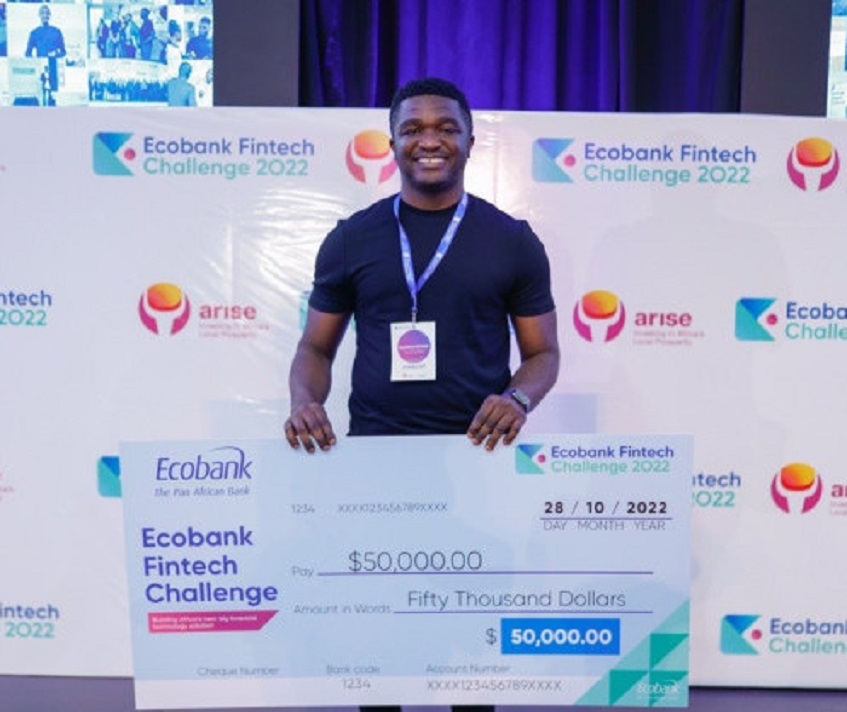
Nigeria-based fintech, Touch and Pay, has won the 2022 edition of the Ecobank Fintech Challenge.
This announcement was made at the grand finale on Friday at Ecobank’s headquarters in Lomé.
At an event presided over by Mr Cina Lawson, Togo’s Minister of Digital Economy and Transformation, Touch and Pay was given a $50,000 cash prize, the largest no-strings attached fintech cash prize in Africa.
Touch and Pay processes microtransactions across Africa, such as paying for bus journeys. Today, the company has over 2 million users who help 500,000 people make payments daily.
The winner and the other five finalists were also inducted into the Ecobank Fintech Fellowship – a unique programme that gives the Fintech Fellows the opportunity to explore potential commercial partnerships with the Bank, such as integrating with Ecobank’s pan-African banking platforms and scaling their fintech businesses across Ecobank’s 33 African markets.
Mr Ade Ayeyemi, Chief Executive Officer, Ecobank Group, while congratulating the finalists, said: “This year’s six finalists have set the bar high at this Grand Finale. Their innovations are revolutionising the financial payments landscape in Africa and advancing financial inclusion. It is an honour for the Ecobank Group to partner with them and jointly transform the financial landscape of our continent.”
Mr Ayeyemi also expressed Ecobank’s “profound appreciation to all our partners especially Arise, the gold sponsor of the 2022 Challenge, as well as to the Jury who worked tirelessly to evaluate the finalists and select the winner.”
On his part, Mr Gavin Tipper, the CEO of Arise, a gold partner and co-sponsor of the challenge, said: “Arise extends its congratulations to the finalists and the winner for the creativity and innovation they displayed.
“The Ecobank Fintech Challenge has become an important platform for supporting fintech innovators and encouraging bold solutions to advancing financial inclusion in Africa. The talent on offer in this year’s pool of finalists once again exceeded expectations, and we look forward to seeing how the different products transform financial services on the continent.”
Expressing his delight, Mr Oluwole Michael, CEO of Touch and Pay, said, “We at Touch and pay (TAP) are excited about the opportunity given to us to work with Ecobank, a pan-African bank operating across Africa. This plugs into our vision of helping 250m Africans process cash-based transactions digitally, making them truly cashless and providing true credit facilities for merchants, retailers, and customers.”
In addition to the pitch by each of the six finalists and a keynote address by Mr Cina Lawson, highlights at the Grand Finale included panel discussions on sustaining and deepening investor interest in African Fintech in the face of the global economic crisis. There were discussions on what investors, Fintech companies and governments should do.
There were also discussions towards ensuring fintech-friendly regulations that accelerate start-up growth and maturity in Africa.
Almost 4,000 start-ups have participated in the five editions of the Ecobank Fintech Challenge since it was launched in 2017. Since then, 52 Fintechs have been inducted into the Ecobank Fintech Fellowship. The 2022 Challenge was supported by partners including Arise, Konfidants, Tech Cabal, Africa Fintech Network and ALX Ventures.
Technology
Meta Expands Business Agent to Instagram, WhatsApp, Messenger
By Aduragbemi Omiyale
The reach of the Meta Business Agent is being expanded to Instagram and other platforms of the social media giant.
Meta Business Agent is an artificial intelligence (AI) that allows business owners to attend to customers’ needs with ease.
Customers expect instant responses, but no team can be everywhere at once. This innovation handles such without hassles.
It helps businesses to answer questions specific to the business, makes product recommendations from the catalogue, books appointments, qualifies incoming leads, and closes sales.
More than one million businesses are already using a Meta Business Agent on WhatsApp and Messenger to respond to customers around the clock.
“We’re now expanding our Business Agent to businesses big and small globally, so within minutes you can have yours up and running, responding in your customer’s local language using your tone,” Meta said in a statement.
“We’re also expanding these agents to Instagram since businesses connect with their customers there, too. Businesses can activate their Business Agent here. Getting started with the Business Agent is free. In the coming months, businesses will access the agent through our paid subscription offerings, with options for businesses of every size,” it added.
Meta also stated that it is making it simpler for people to discover businesses powered by a Meta Business Agent directly on WhatsApp. It noted that starting soon, people will be able to find businesses by typing their name in the Search bar, or by sharing their phone number or contact card in chats with friends and family. This way, when more customers reach out, they get a quick, helpful response.
Technology
Lagos Eyes 250MW Data Centre Capacity by 2030
By Adedapo Adesanya
The Lagos State government plans to expand the city’s data centre capacity to over 250 megawatts (MW) by 2030 as part of efforts to strengthen its digital infrastructure ecosystem.
This was disclosed by the state’s Commissioner for Innovation, Science, and Technology, Mr Olatubosun Alake, at the launch of the Kasi Cloud LOS1 data centre facility in Lekki. Nigeria Sovereign Investment Authority (NSIA) invested in Kasi Cloud through an $8 million convertible loan note in 2021.
Mr Alake said Lagos already hosts nearly three-quarters of Nigeria’s commercial data centre capacity, adding that the government intends to expand its infrastructure footprint significantly over the next five years.
“There are about 146 additional megawatt data centres planned in the pipeline,” he said. “We envisage that by 2030, we would have over 250 megawatts of data centre capacity in Lagos, three times the current capacity growth.”
The expansion comes as demand for cloud services, AI computing power, and local data storage continues to grow across Nigeria’s digital economy, with Lagos at the forefront, housing thousands of businesses and startups.
Mr Alake said the Kasi Cloud facility represents Lagos’ entry into “large-scale hyperscale AI infrastructure,” signalling the state’s ambition to evolve beyond being known primarily as a startup hub into a major centre for digital infrastructure and AI computing.
“Lagos is no longer simply a startup city,” he said. “It is an infrastructure city.”
The Kasi LOS1 facility is designed as a 40MW hyperscale data centre campus, beginning operations with an initial 7.2MW IT load.
According to Mr Alake, the facility includes advanced GPU computing infrastructure powered by Nvidia H100 and H200 chips, alongside liquid cooling systems and cloud infrastructure services designed to support AI workloads.
The Lagos State government believes such infrastructure will become critical as AI adoption accelerates globally.
Mr Alake said the state is investing in fibre optic networks, smart city technologies, university innovation programmes, and digital government systems to prepare for the transition.
“The AI economy is going to require hundreds of megawatts,” he said. “The market has already made its decision about where digital infrastructure belongs.”
On his part, Mr Johnson Agbogun, co-founder and chief executive officer of Kasi Cloud, said the project was built to reduce Nigeria’s dependence on foreign cloud infrastructure and give African businesses more control over how their data and AI systems are developed.
“Nigerian enterprises are currently spending $850 million every year on foreign cloud infrastructure,” he said. “Every naira spent abroad on cloud and AI infrastructure helps build capabilities somewhere else.”
He added that the facility runs GPU-powered AI workloads from local enterprises and described the Lekki campus as “the beginning of Nigeria’s AI factory.”
“As artificial intelligence reshapes economies globally, the nations that control their own compute infrastructure and data will be the ones positioned to lead,” added Mr Kolawole Owodunni, NSIA’s Executive Director and Chief Information Officer.
Technology
Google I/O 2026: 4 Major Updates That Are Changing How Google Search Works
The goal of Google Search has always been simple: to help you ask anything on your mind. Whether it is a quick fact to help with your daily hustle or a complex question about starting a new business, Nigerians rely on Search every single day.
Over the last year, Google has rapidly reimagined what Search can do with AI. The momentum has been incredible—just one year after its debut, AI Mode has surpassed one billion monthly users globally. As people have realised just how much more Search can do for them, they are searching more than ever before, reaching an all-time high in search queries last quarter. Today at Google I/O, Google shared the next step in its journey to bring together the best of a search engine with the best of AI.
To power this next chapter, Google is officially upgrading Search with Gemini 3.5 Flash as the new default model in AI Mode for everyone worldwide. Delivering sustained frontier performance for agents and coding, Gemini 3.5 Flash is the engine driving the new era of AI-powered Search. Because curiosity doesn’t always fit into standard keywords, this powerful AI model is transforming Search from a tool that simply finds information into an intelligent platform capable of reasoning, monitoring the web, and executing complex tasks on your behalf.
Here is a look at the four biggest AI-powered announcements coming to Google Search:
1. A Completely Reimagined Search Box
Google is introducing the biggest upgrade to its Search box in over 25 years. Now completely reimagined with AI, the new intelligent Search box dynamically expands to give you the space to describe exactly what you need. It goes beyond simple autocomplete by anticipating your intent and helping you phrase your questions. You are no longer limited to typing; you can now search using text, images, files, videos, or even Chrome tabs as inputs. Additionally, Google is making it easier to ask follow-up questions directly from an AI Overview, flowing naturally into a conversational back-and-forth where your context stays with you as you explore.
2. New Search Agents That Work in the Background
We are entering the era of Search agents, where you can create and manage multiple AI agents directly in Search. Google is launching “Information agents” that operate in the background 24/7. These agents intelligently scan the web—alongside fresh data on finance, shopping, and sports—to monitor for changes related to your specific questions. For example, if you are house hunting, your agent will continuously scan the market and notify you the moment a listing matches your exact criteria. Furthermore, Search is expanding its agentic booking capabilities; you can soon share specific criteria (like a late-night private karaoke room) and Search will pull the latest pricing and links to finish booking. For certain categories, Google can even call businesses on your behalf.
3. Custom Mini-Apps and Visuals Built Just for You
Search is no longer just returning links; it is now building the ideal response in the perfect format for your query entirely on the fly. By bringing the power of Google Antigravity and the agentic coding capabilities of Gemini 3.5 Flash into Search, users will get a custom “Generative UI.” This means Search can design custom layouts, interactive visuals, tables, graphs, or simulations in real-time. But it goes a step further: if you have an ongoing task, like establishing a new health routine, Search can actually code a custom fitness tracker or mini-app for you. These custom dashboards tap into real-time sources like live maps and weather, giving you a personalised tracker you can return to again and again.
4. Expanded Personal Intelligence Without a Subscription
For AI to be truly helpful, it shouldn’t just know the world’s information—it should understand your personal context, too. To achieve this, Google is expanding Personal Intelligence in AI Mode to more people in nearly 200 countries and territories across 98 languages. Crucially, this is being rolled out with no subscription required. Users can securely connect apps like Gmail, Google Photos, and soon Google Calendar directly to Search. Designed with transparency and choice at its heart, this allows you to safely ask Search to find information buried in your own personal files, always keeping you in complete control of your connected data.
-
Feature/OPED6 years agoDavos was Different this year
-
Travel/Tourism10 years ago
Lagos Seals Western Lodge Hotel In Ikorodu
-
Showbiz3 years agoEstranged Lover Releases Videos of Empress Njamah Bathing
-
Banking8 years agoSort Codes of GTBank Branches in Nigeria
-
Economy3 years agoSubsidy Removal: CNG at N130 Per Litre Cheaper Than Petrol—IPMAN
-
Banking3 years agoSort Codes of UBA Branches in Nigeria
-
Banking3 years agoFirst Bank Announces Planned Downtime
-
Sports3 years agoHighest Paid Nigerian Footballer – How Much Do Nigerian Footballers Earn