Connect with us

Technology

5 Ways AI is Transforming Consumer Intelligence and Analytics

Published

on

AI consumer analytics

The rules have changed. How companies actually know their customers — really know them — looks almost nothing like it did ten years ago. Old-school research methods are drowning. Too slow, too narrow, too dependent on humans manually stitching together datasets that have already gone cold. Markets shift in days now, not quarters. And the cost of a slow read on consumer behavior keeps climbing. This isn’t just a tooling upgrade. The underlying logic of how businesses decide what to build, what to charge, and who to reach has been gutted and rebuilt from scratch. Staying reactive isn’t a strategy anymore. It’s a liability.

1. Real-Time Data Processing and Pattern Recognition

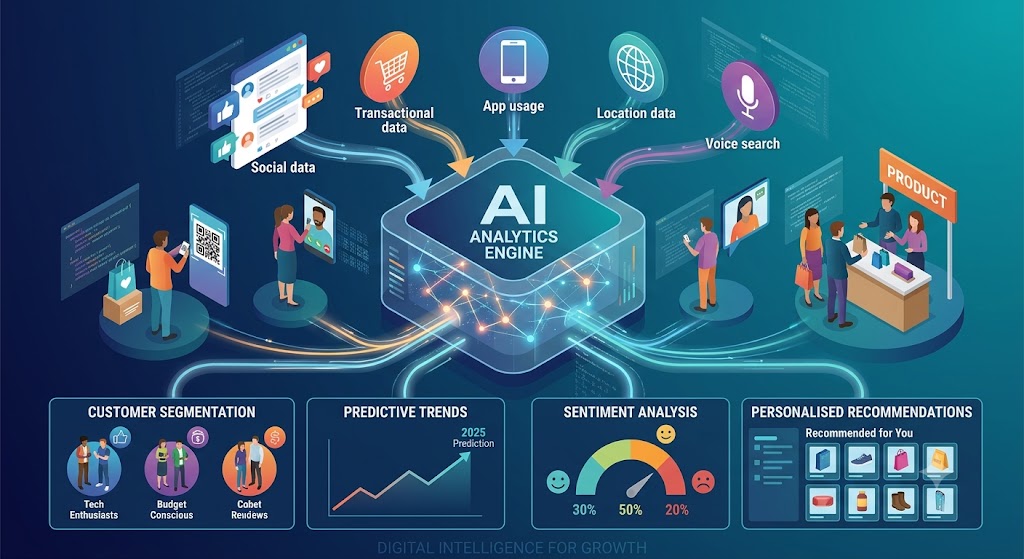
Consumer intelligence used to run on stale numbers. Analysts dug into data weeks — sometimes months — after whatever actually happened. Modern AI kills that lag. Entirely. These systems chew through enormous volumes of behavioral data on the fly, surfacing patterns that human teams couldn’t find in the same timeframe with ten times the headcount. Machine learning algorithms can process millions of customer interactions, transactions, and behavioral signals simultaneously — pulling clean signal out of what would otherwise be undifferentiated noise. A retailer can track sentiment across social media, reviews, and support tickets right now, catching a brewing problem or an emerging trend in hours rather than weeks. Inventory shifts, pricing moves, message pivots — all of it happens before a trend fully crystallizes. That’s a different game entirely.

2. Predictive Analytics and Consumer Behavior Forecasting

Here’s what actually changed: AI stops consumer intelligence from being a backward-looking exercise. Instead of cataloguing what customers already did, companies can now forecast what they’re likely to do next — and with striking accuracy. Advanced ML models thread together historical patterns and live behavioral signals to predict churn, flag high-value prospects, and project demand across entire product lines. A telecom company can spot which customers are quietly drifting toward a competitor before they ever make the switch — and intervene first. That’s not a marginal improvement. It’s a fundamentally different posture. Resources flow toward the segments that actually matter, rather than spreading thin across the whole base and hoping something sticks.

3. Personalization at Scale

Consumers expect personalized experiences. Full stop. Meeting that expectation at scale — for millions of people at once — is simply beyond what human analysts and traditional segmentation can deliver. Machine learning models read individual purchase histories, browsing patterns, preferences, and demographic signals to build dynamic profiles that drive product recommendations, custom messaging, and tailored interfaces. When building and refining these individualized profiles, marketers who need to enrich their first-party data with verified behavioral signals rely on audience data providers to ensure their models are trained on accurate, high-quality consumer information. An e-commerce platform can serve each visitor a genuinely different experience — different layouts, different offers, different content — all built around that visitor’s unique fingerprint. Conversion lifts. Lifetime value climbs. People respond when recommendations actually fit their lives, not just the average of everyone else’s.

4. Sentiment Analysis and Brand Perception Monitoring

Knowing how consumers feel about a brand means wading through unstructured mess. Reviews, comment threads, support tickets, social posts, video captions — none of it parses cleanly by hand at any useful speed. Natural language processing handles it. NLP systems automatically scan text-based content across digital channels, classifying sentiment as positive, negative, or neutral while bucketing feedback by topic, product feature, or customer segment. An automaker can track online conversations about a specific reliability concern and catch it before it snowballs into a full-blown reputation crisis. No waiting for quarterly surveys. No lag. Brand perception monitoring becomes continuous — and decisions about product fixes, messaging shifts, or service interventions get grounded in real signal rather than gut instinct.

5. Competitive Intelligence and Market Positioning Analysis

Competitive intelligence used to mean manual tracking, sprawling spreadsheets, and perpetually incomplete pictures. AI automates the entire collection-and-analysis loop. ML models watch competitor pricing moves, product launches, promotions, and messaging shifts across digital channels — then stack that data against a company’s own position. Gaps surface. Threats register earlier. A financial services firm can monitor exactly which themes competitors are pushing on social media and which ones are actually generating engagement — then sharpen their own positioning accordingly. Real-time visibility into competitive dynamics means strategic calls about where to invest, which markets to enter, and how to stand apart in crowded categories aren’t made blind anymore.

Conclusion

What AI has done to consumer intelligence isn’t incremental. It’s structural. Real-time processing of massive datasets. Forecasting future behavior instead of autopsying the past. Personalization that reaches millions, not hundreds. Continuous sentiment monitoring. Automated competitive tracking. None of these were realistic options a decade ago. They are now. Companies that wire these capabilities into their core operations make faster, sharper decisions — ones that show up directly in revenue, satisfaction scores, and market share. Those that don’t will keep falling further behind. And the gap between organizations that wield these tools well and those still grinding through traditional approaches? It’s not closing. It’s widening every quarter.


Click to comment

Leave a Reply

Your email address will not be published. Required fields are marked *

Technology

Redtech Broadens West African Presence, Earns Global Fintech Recognition

Published

on

Redtech

By Adedapo Adesanya

Redtech, a financial technology company backed by Mr Tony Elumelu’s Heirs Holdings, has intensified its pan-African expansion strategy as it extends its payment infrastructure beyond Nigeria and leverages recent global recognition to strengthen its footprint across the continent.

The fintech firm was named in the payments category of the World’s Top Fintech Companies 2026 ranking by CNBC and Statista. It is among the only 11 African companies recognised in this year’s edition.

Developed by CNBC and Statista, the annual ranking identifies 500 leading fintech companies from a pool of more than 3,500 businesses worldwide. Serving as a data-driven benchmark, the ranking highlights companies shaping the future of financial services through technology, innovation and scalable digital solutions.

The company said it is accelerating its push into new African markets with the rollout of digital banking and payment solutions.

As part of this expansion, the UBA RedPay mobile application is now operational in Benin, Burkina Faso, Côte d’Ivoire, Mali and Senegal, marking the company’s first significant digital banking presence outside Nigeria.

It has also introduced virtual account services in Ghana through a partnership with UBA, broadening its payment collection capabilities in West Africa.

The company said the move aligns with its long-term ambition to build a unified payment infrastructure that enables businesses to collect, process, reconcile, disburse and manage funds seamlessly across African markets.

Commenting on the company’s growth strategy, the chief executive of Redtech, Mr Emmanuel Ojo, said Africa’s increasingly interconnected digital economy requires payment infrastructure that can support cross-border commerce.

“Recognition from CNBC and Statista reflects the growing relevance of African Fintech companies on the global stage and validates our ambition to build Redtech into Africa’s payment infrastructure company.

“We are building the technology that enables businesses of every size to collect, pay and manage money seamlessly across channels and markets. As African commerce becomes increasingly digitally connected across multiple market borders, businesses need payment infrastructure that is reliable, secure, interoperable and designed for the realities of operating across the continent.

“Our goal is to help power that growth by making payments simpler and more connected for African businesses, while building solutions that reflect global standards.”

Redtech continues to scale its operations, with available numbers showing that the fintech has processed approximately N45.84 trillion ($33.21 billion) in transaction value through its flagship RedPay platform and deployed more than 55,000 point-of-sale terminals serving merchants across sectors including banking, fintech, retail, hospitality, energy and utilities.

Looking ahead, the company said it plans to expand its collections and financial infrastructure capabilities across all 54 African countries, enabling businesses and financial institutions to manage transactions across multiple markets through a single technology platform.

Continue Reading

Technology

CREDICORP Expands Consumer Credit for Locally-assembled Digital Devices With C.L.I.C.K.D.

Published

on

C.L.I.C.K.D. scheme

By Modupe Gbadeyanka

To expand affordable consumer credit for locally assembled laptops and devices for digital workers, the Nigerian Consumer Credit Corporation (CREDICORP) has launched the C.L.I.C.K.D (Credit for Laptops, Internet, Connectivity and Knowledge Digital Devices) scheme.

This initiative is in partnership with the federal government through the Three Million Technical Talent (3MTT) Programme.

It was designed to democratise access to consumer credit, expand economic opportunity and empower millions of Nigerians to improve their quality of life through responsible borrowing.

At the unveiling of the scheme on Tuesday in Abuja at the Afreximbank African Trade Centre (AATC), the chief executive of CREDICORP, Mr Uzoma Nwagba, said the initiative focuses on fellows’ training through the Learn2Earn platform, many of whom are acquiring in-demand digital skills without access to the devices needed to complete their training and transition into employment or entrepreneurship.

Delivered in collaboration with Fidelity Bank as credit administration partner and NASENI and Imose Technologies as device manufacturers, it will provide 1,000 locally assembled laptops to eligible fellows across Nigeria, with 77 beneficiaries in Abuja receiving their devices at the launch ceremony as the first phase of a nationwide rollout.

Assembling the devices in Nigeria shows how consumer credit can expand digital inclusion, strengthen local manufacturing and deepen the country’s technology ecosystem.

“C.L.I.C.K.D. transforms digital devices from a barrier into an opportunity. By embedding affordable consumer credit into a national talent programme like 3MTT, starting with locally assembled laptops, we are giving qualifying Nigerians a responsible pathway to the tools they need to learn, work and earn, while advancing the federal government’s vision for industrial development and job creation on both sides,” Mr Nwagba averred.

Also commenting, the Minister of Communications, Innovation and Digital Economy, Mr Bosun Tijani, said, “Nigeria’s digital economy can only thrive when our people have both the skills and the tools to succeed.

“Through C.L.I.C.K.D., we are helping qualifying Nigerians participate more fully in the opportunities created by the 3MTT initiative while strengthening local manufacturing through the use of locally assembled devices.”

C.L.I.C.K.D. is CREDICORP’s flagship device financing initiative, open to working Nigerians nationwide, with the 3MTT programme as launch partner for this first phase. Interested Nigerians can register at www.credicorp.ng/clickd.

Continue Reading

Technology

Designing Secure Digital Workflows: Why Verification Matters in Modern Technology

Published

on

Secure Digital Workflows

Innovation has transformed the way engineers, designers, developers, and makers collaborate. Cloud-based CAD platforms, AI-assisted design tools, collaborative manufacturing software, and digital marketplaces have streamlined product development, but they have also increased the importance of protecting user accounts. As organizations rely on connected platforms throughout the design process, secure authentication has become an essential component of modern digital workflows.

Whether accessing engineering software, managing design repositories, or collaborating with distributed teams, professionals regularly create accounts across multiple online platforms. Protecting those accounts starts with strong security practices, including password management, multi-factor authentication, and reliable verification methods. Reports covering global cybersecurity developments continue to demonstrate how evolving cyber threats are encouraging organizations to strengthen identity verification across their digital infrastructure.

Many online platforms require SMS verification before activating new accounts or unlocking specific features. For legitimate verification scenarios that require a temporary number, BotCode SMS Free Online provides a practical solution for receiving verification codes while helping users maintain greater privacy during supported account registrations.

Why Identity Verification Supports Better Digital Security

Verification serves a much broader purpose than simply confirming account ownership. It helps technology providers reduce fraudulent registrations, protect platform integrity, and improve trust among legitimate users.

Some key benefits include:

  • Reducing automated bot registrations.
  • Confirming user authenticity during onboarding.
  • Supporting secure password recovery.
  • Helping detect suspicious login activity.
  • Strengthening platform-wide account security.

As digital collaboration expands across industries, these safeguards become increasingly valuable.

Security Challenges Facing Technology Professionals

Engineers, product designers, and developers often manage numerous software subscriptions, cloud platforms, testing environments, and collaboration tools. Each additional account increases the need for organized credential management.

Recent insights discussing enterprise cybersecurity trends emphasize that businesses continue investing in stronger identity management strategies as hybrid work environments and cloud-based services become standard across technical industries.

Common Account Management Challenges

Challenge Recommended Practice
Multiple online accounts Use a password manager
Shared project environments Apply role-based permissions
Remote collaboration Enable multi-factor authentication
Frequent software access Review login activity regularly
Sensitive project files Keep recovery methods updated

Building More Secure Engineering Workflows

Security should be integrated into every stage of a digital workflow rather than treated as an afterthought. Organizations that prioritize authentication and access control often reduce operational risks while improving long-term reliability.

Strengthen Authentication

Unique passwords and multi-factor authentication remain among the most effective methods for protecting professional accounts. Combined with secure verification processes, these measures significantly reduce unauthorized access.

Manage Access Carefully

Project administrators should periodically review user permissions to ensure former collaborators, contractors, or inactive accounts no longer retain unnecessary access to sensitive information.

Monitor Security Updates

Software vendors regularly release security patches that address newly discovered vulnerabilities. Keeping engineering applications updated protects both users and project data from emerging threats.

Verification in Cloud-Based Collaboration

Modern engineering rarely happens in isolation. Cloud platforms allow geographically distributed teams to collaborate on CAD models, manufacturing documentation, software development, and product lifecycle management.

Secure verification plays an important role by helping:

  • Confirm legitimate user registrations.
  • Protect shared design environments.
  • Prevent unauthorized account creation.
  • Improve trust across collaborative platforms.
  • Reduce abuse of cloud-based services.

As remote collaboration continues expanding, verification systems become increasingly important to maintaining platform integrity.

Practical Security Habits for Technical Professionals

Technology professionals already understand the value of system reliability. Applying that same mindset to account security helps create stronger digital environments.

Consider adopting these habits:

  • Use unique passwords for every platform.
  • Enable login notifications whenever available.
  • Remove inactive third-party integrations.
  • Verify software downloads from official sources.
  • Regularly audit account permissions.
  • Review recovery information before it’s needed.

These practices require minimal effort while offering meaningful long-term protection.

Security and Innovation Can Work Together

Innovation often focuses on creating faster, smarter, and more efficient technologies, but sustainable innovation also depends on trust. Secure verification systems, responsible authentication practices, and informed users all contribute to healthier digital ecosystems where professionals can collaborate confidently.

As engineering platforms, cloud applications, and collaborative design tools continue evolving, organizations that balance usability with strong account security will be better positioned to support innovation without compromising user protection. Thoughtful verification practices remain a fundamental part of building secure and reliable digital experiences.

Continue Reading