Technology
Organisers Unveil Dates for Int’l Robotics Challenge in UAE

By Dipo Olowookere
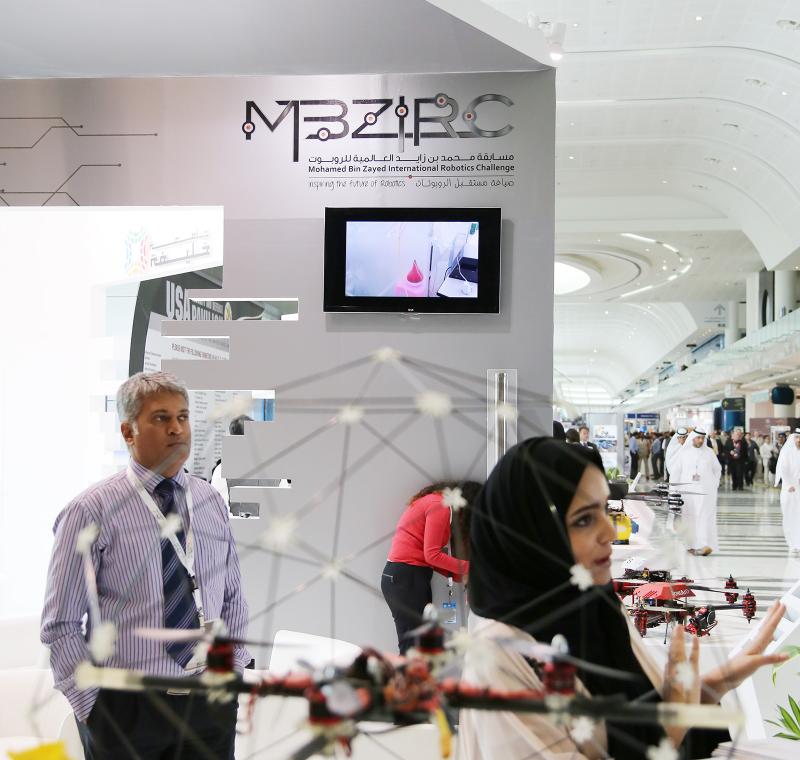
Khalifa University, organizers of the Mohamed Bin Zayed International Robotics Challenge (MBZIRC), have announced that the competition will take place from March 16 – 18, 2017 at the Yas Marina Circuit in Abu Dhabi, United Arab Emirates.
The contest will inevitably take up a large area of the circuit since it will consist of three challenges and a triathlon type Grand Challenge. Challenge 1 will require teams to use an Unmanned Aerial Vehicle (UAV) to locate, track and land on a moving vehicle.
This means that the UAV must be capable of locating the moving vehicle, navigating the path and speed of the vehicle and land on the target location while the vehicle is in motion.
Challenge 2 requires an Unmanned Ground Vehicle (UGV) to locate and reach a panel and physically operate a valve stem on it. It will require a UGV capable of navigating the path and locating the panel, identifying the valve, and choose the appropriate tool to close it.
Challenge 3 requires a team of UAVs to work together in order to search, locate, track, pick up and place a set of still and moving objects. The Grand Challenge will require a team of robots (UAVs and UGVs) to compete in an event that combines challenges 1, 2 and 3 simultaneously.
“This will be a hard challenge,” said Dr Arif Al Hammadi, Khalifa University’s Executive Vice President. “It will require the teams to not only utilize most known robotics technology, but also invent new ones. Undoubtedly, the resulting technologies from this competition will drive robotics research for some time and, as a university dedicated to the advancement of research and development in engineering and technology, we are eager to see what the results are.”
The 45 teams selected to take part in the inaugural challenge come from leading universities and international organizations such as the Georgia Institute of Technology, the Korea Advanced Institute of Science and Technology (KAIST), the National University of Singapore and Xi’an Jiaotong University.
Teams from the UAE, Italy, Germany, KSA, Russia, Singapore, Malaysia, Canada, South Korea, and Spain were chosen from over 316 teams from 45 countries, who expressed their interest in participating in the Challenge.
Technology
NCC Dangles Presidential Waivers Before Phone Manufacturers
By Modupe Gbadeyanka
Any phone manufacturer that builds a factory in Nigeria has been promised unprecedented policy incentives and executive alignment by the Nigerian Communications Commission (NCC).
The chairman of the industry’s regulatory agency, Mr Idris Olorunnimbe, made this pledge at the unveiling of the commission’s strategic blueprint aimed to drive domestic manufacturing of smartphones, tablets, and routing equipment.
He stated that some of the incentives to be enjoyed include specialised customs protocols and manufacturing tax holidays, to lower retail device costs for citizens.
According to him, the NCC is moving beyond mere market regulation to actively co-authoring an industrial renaissance with willing investors, highlighting the fundamental link between strong market regulations and consumer affordability.
“Regulation and market integrity are what make a market affordable in the first place. They are the precondition for it. A phone is only truly cheap if it is real, if it is safe, if it connects properly, and if it carries a warranty the buyer can rely on,” he declared.
Mr Olorunnimbe noted that the goal is to shatter the old paradigm that forces citizens to save up for months just to buy basic technology, urging the industry to “retire the assumption that a Nigerian must buy a phone outright, in one payment, on the day. That is not how it works anywhere else in the world.”
The commission’s intervention is expected to address a critical bottleneck in Nigeria’s otherwise booming telecom sector. While aggressive network expansion driven by the executive team has successfully placed coverage within the geographical reach of most citizens, the high upfront cost of compatible entry-level smartphones remains a persistent roadblock.
Central to this industrial masterplan is the integration of the hardware rollout with the NCC’s ongoing project to zero-rate educational websites across the federation. By removing data costs from educational content, the NCC is building a digital ecosystem where learning is universally accessible.
To maximise the impact of this framework, the regulator is advocating locally manufactured MiFi devices, routers, and smartphones to feature embedded, un-deletable shortcuts to national education repositories and open-source vocational training portals. This turns every locally produced device into an immediate, out-of-the-box digital classroom.
Technology
Meta Reaffirms Commitment to Safer, Positive Digital Experiences for Teens
By Modupe Gbadeyanka
Meta, the parent company of Facebook, Instagram and WhatsApp, has said it will not rest on its laurels in promoting safer and more positive digital experiences for teens.
The firm gave this assurance at the Nigeria Youth Safety Summit, which it co-hosted with the Federal Ministry of Youth Development at the Transcorp Hilton, Abuja.
This event brought together government officials, civil society organisations, parents, educators, creators and youth leaders to discuss digital wellbeing priorities, strengthen partnerships, and promote safer online experiences.
Meta used the opportunity to showcase its ongoing investments in youth safety through built-in protections, parental supervision tools, and digital literacy resources designed to help teens navigate the digital world safely and confidently.
At the centre of Meta’s youth safety efforts are Teen Accounts, a reimagined experience across Meta’s apps designed specifically for teenagers.
Teen Accounts include built-in protections that address parents’ concerns by promoting age-appropriate experiences, limiting unwanted contact, and encouraging healthier digital habits.
Teen Accounts are turned on automatically for all teens, with built-in protections including private accounts, the strictest messaging settings, sensitive content restrictions, limited interactions (tagging/mentions only from people they follow), time limit reminders after 60 minutes each day, and sleep mode between 10 pm and 7 am. Teens under 16 need a parent’s permission to change any of these settings to be less strict.
“At Meta, our goal is to provide teens with safe, age-appropriate online experiences, and events like the Nigeria Youth Safety Summit reflect our commitment to promoting safer and more positive digital experiences for teens.
“With products such as Teen Accounts, Meta is putting the right protections in place so teens can explore their interests and express their creativity in a safe, age-appropriate space.
“We will continue to build the safety features and tools that families need to support young people online,” the Head of Safety Police for EMEA at Meta, Sylvia Musalagani, stated.
“Child online safety is one of our central pillars, and we are steadfast in our mandate to safeguard the Nigerian child from technology-enabled violence. Children cannot navigate the complexities of the online world without informed adults guiding them because safety begins with the parents.
“Safety is a shared tripartite responsibility between parents, technological industries, and government. That is the fundamental premise of today’s summit, a hands-on walk-through of parental supervision tools and Teen Accounts.
“We appreciate Meta for the collaboration and for creating a platform for these important conversations,” the Minister of Women Affairs and Social Development, Ms Imaan Sulaiman-Ibrahim, said.
Also commenting, the Minister of Youth Development, Mr Ayodele Olawande, said, “We believe that keeping young people safe online is a shared responsibility. Government, technology companies, schools, parents, social organisations, community groups, and young people themselves all have a role to play. We encourage Meta to make the tools, guides, and learning materials from this initiative more widely available so that young people across Nigeria can continue to benefit from this laudable summit.”
It was learned that through keynote presentations, the Parents Learn & Brunch session held in partnership with the Federal Ministry of Women Affairs and Social Development, and panel discussions featuring parent creators and parents, participants explored practical approaches to supporting safer online engagement.
The summit also reinforced the importance of multi-stakeholder collaboration in advancing digital wellbeing and online safety for young people.
Technology
9 African Firms, Others for 2026 AWS Social Entrepreneur Accelerator Cohort
By Modupe Gbadeyanka
Nine African organisations, including Nigeria, will join 33 others from the USA, Australia, India, the UK and others for the fourth Social Entrepreneur Accelerator cohort of Amazon Web Services (AWS).
The companies from Africa chosen for the 2026 edition of this programme are from Nigeria, Kenya, Ghana, South Africa, Cameroon and Tanzania.
These founders are using cloud and AI technology to solve skills shortages, youth unemployment and food security. Building from the ground up, they are creating African solutions for African challenges.
Nigeria leads the selection with three organisations, namely Sabi Scholar, Kayode Alabi Leadership and Wetech Incorporated.
The chief executive of Sabi Scholar, Mr Divine Iloh, said he is creating an “operating system” for African higher education, enabling any university to launch online degrees in 30 days, a potential game-changer for the continent’s 200M+ youth population.
For Kayode Alabi Leadership, the founder, Hammed Kayode Alabi, is reducing inequalities by empowering underserved young people to lead and innovate through transformative education and technology-driven solutions to solve local challenges and thrive as community changemakers.
As for Wetech Incorporated, established by Gabriella Uwadiegwu, it is building Africa’s largest pipeline of women in technology, from training to mentorship to direct employment pathways.
Kenya follows with two organisations, KuzeKuze and STEM Centre Africa. According to the CTO of KuzeKuze, Enock Sangaka Mong’are, the organisation is building “education passports,” as digital records that follow learners throughout their lives, making personalised education measurable and scalable.
While STEM Centre Africa, a non-profit launched in 2017 by two brothers, Dancun, the CTO and Denish Akoum, the CEO, to promote hands-on STEM education, including coding, robotics and 3D design, reaching over 18,000 + students since inception, with 90 per cent gaining proficiency in Python, Scratch and electronics. Operating two centres in Homa Bay County with 10 organisational partners, SCA aims to reach 100,000 learners by 2030.
The remaining four spots are shared by Ghana, South Africa, Cameroon and Tanzania.
In Ghana, BASICS International, founded by CEO Patricia Wilkins, is breaking cycles of poverty by providing education, certified digital skills training and holistic support to underserved children and youth, equipping them to thrive academically, economically and socially.
For South Africa, FunHouse Digital, founded by Ayabulela Yokwana, is turning gaming lounges into self-sustaining education hubs in rural communities – profits from gaming directly fund free coding and digital literacy programs.
In Cameroon, EduCloud, founded by Rosius Ndimofor Ateh, delivers hands-on Cloud and AI workshops across Africa, bridging the gap between academic theory and industry-ready skills.
From Tanzania is Fiqra Academy, founded by CEO Gerald Revocatus. The firm is creating a direct pipeline from digital skills training to employment for East African youth, with certifications that lead to real careers through their digital learning platform.
In collaboration with Deloitte, the accelerator provides technical training, strategic business planning, and ongoing AWS and Deloitte support to help mission-driven organisations scale.
Since 2023, the programme has supported more than 100 social entrepreneurs across 34 countries, bringing together a global community of social entrepreneurs who are working to address some of the world’s most urgent challenges across education, health and climate resilience.
“Africa’s representation in this cohort reflects what we’re seeing across the continent: a generation of founders who don’t wait for conditions to be perfect. They build anyway.
“Our role is to ensure they have access to the same world-class cloud and AI technology as any startup in Silicon Valley and the support to scale impact across borders,” the General Manager for Sub-Saharan Africa at AWS, Jyoti Ball, stated.
-
Feature/OPED6 years agoDavos was Different this year
-
Travel/Tourism10 years ago
Lagos Seals Western Lodge Hotel In Ikorodu
-
Showbiz3 years agoEstranged Lover Releases Videos of Empress Njamah Bathing
-
Banking8 years agoSort Codes of GTBank Branches in Nigeria
-
Economy3 years agoSubsidy Removal: CNG at N130 Per Litre Cheaper Than Petrol—IPMAN
-
Banking3 years agoSort Codes of UBA Branches in Nigeria
-
Banking3 years agoFirst Bank Announces Planned Downtime
-
Sports3 years agoHighest Paid Nigerian Footballer – How Much Do Nigerian Footballers Earn