Travel/Tourism
Emirates’ Resumption of Flights to Nigeria Delights Passengers
By Aduragbemi Omiyale
The resumption of flights to Nigeria by Emirates is already thrilling passengers, who have waited for a long time to have this happen.
On Sunday, two planes flew from Dubai to Nigeria and touched down at the Murtala Mohammed Airport, Lagos and the Nnamdi Azikwe International Airport, Abuja and were received with a spectacular water cannon welcome.
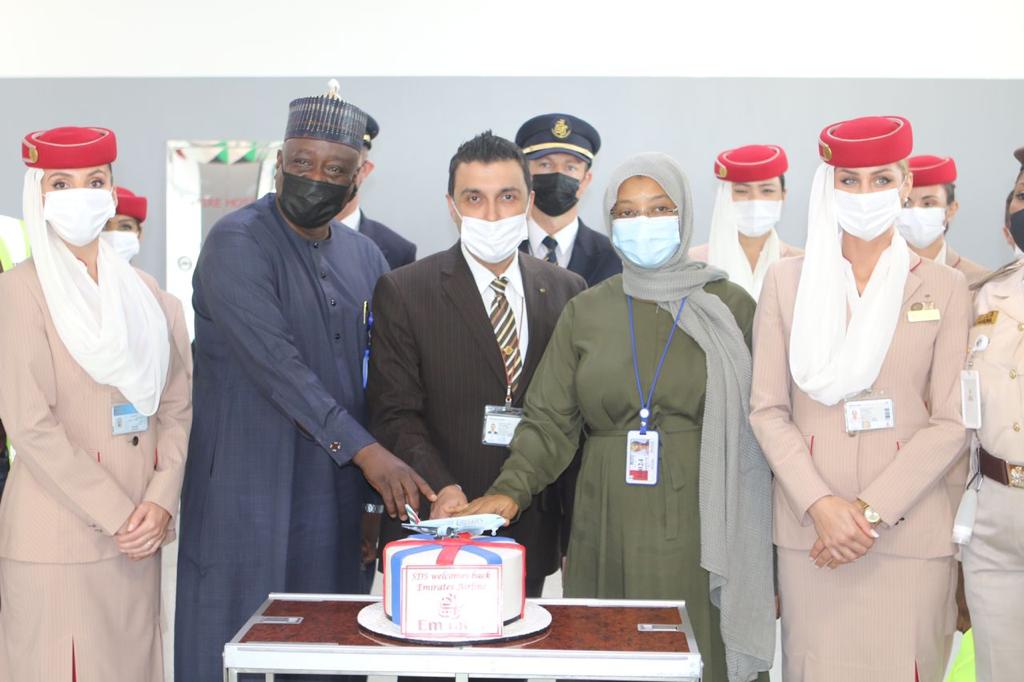
The arrival of the flights signalled the restart of daily services to Nigeria from Dubai. Both flights from Dubai, EK 785 to Abuja and EK 783 to Lagos, upon arrival, witnessed a cake cutting ceremony.
“We are delighted to resume operations to and from Nigeria and are pleased to see strong interest from our customers, reflected in robust forward bookings from the time of our announcement, as well as today’s full flights from Dubai to Abuja and Lagos.
“The services will also give our customers the opportunity once again to safely experience Emirates’ superior product and service, offering them convenient travel options to Dubai, an already popular destination for Nigerian travellers, as well as seamless connectivity other key cities across our network,” Paulos Legesse, Country Manager Nigeria said.
The aircraft being deployed to both Nigerian cities is the three-class Boeing 777-300ER which offers 8 luxurious First Class suites, 42 generous Business Class seats, and over 300 seats in Economy Class.
Customers across all classes were able to enjoy the airline’s regional delicacies onboard, as well as its renowned in-flight entertainment system, ice, featuring over 4,500 channels of on-demand entertainment, including Nollywood films and content.
Emirates operates to Abuja with EK 785 and 786. EK 785 departs Dubai at 1100hrs, arriving in Abuja at 1540hrs.
The return flight, EK 786 takes off from Abuja at 1900, arriving in Dubai at 0435hrs the next day. Emirates flight EK 783 to Lagos departs Dubai at 1030hrs, arriving in Lagos at 1540hrs. The return flight EK 784 departs Lagos at 1810hrs, arriving in Dubai at 0415hrs the next day.
Ensuring the safety of travellers, visitors, and the community, COVID-19 PCR tests are mandatory for all inbound passengers arriving to Dubai, including UAE citizens, residents and tourists, irrespective of the country they are coming from.
Travellers coming from Nigeria must hold a negative COVID-19 PCR test certificate for a test taken no more than 72 hours before departure.
Additionally, the Nigerian Centre for Disease Control (NCDC) has specified designated laboratories for passengers departing Nigeria and travellers must obtain their certificate from one of the labs listed here to be accepted on the flight. Travellers coming from Nigeria will also need to take another Covid-19 PCR test on arrival at Dubai International Airport.
Since it safely resumed tourism activity in July 2020, Dubai remains one of the world’s most popular holiday destinations, especially during the winter season. The city is open for international business and leisure visitors. From sun-soaked beaches and heritage activities to world-class hospitality and leisure facilities,
Dubai offers a variety of world-class experiences. It was one of the world’s first cities to obtain the Safe Travels stamp from the World Travel and Tourism Council (WTTC) – which endorses Dubai’s comprehensive and effective measures to ensure guest health and safety.
Dubai is currently hosting the world for Expo 2020, happening between October 2021 and March 2022. Through the theme of Connecting Minds, Creating the Future, Expo 2020 Dubai aims to inspire people by showcasing the best examples of collaboration, innovation and cooperation from around the world.
Its programme is packed with experiences to suit all ages and interests, including a rich line-up of themed weeks, entertainment, and edutainment. Art and culture fans, as well as food and technology enthusiasts, can explore exhibits, workshops, performances, live shows and more.
Emirates continues to lead the industry with innovative products and services and recently took its customer care initiatives further with even more flexible booking policies which have been extended to May 31, 2022.
Travel/Tourism
Nigeria Caps Jet Fuel Prices, Allows Airlines Buy on Credit to Avert Disruptions
By Adedapo Adesanya
The Nigerian government is capping jet fuel prices and allowing airlines to get supplies on credit as part of efforts to avert flight disruptions caused by soaring fuel costs.
Reuters reported that the Nigerian Midstream and Downstream Petroleum Regulatory Authority (NMDPRA) said in an internal document that aviation fuel should sell for N1,760 to N1,988 ($1.29 to $1.46) per litre in Lagos and N1,809 to N2,037 in Abuja, based on benchmarks from April 17 to April 23.
The decision follows emergency talks after airlines threatened to go on a strike, warning that jet fuel prices had jumped by more than 300 per cent, forcing fare increases and raising the risk of capacity cuts.
The strike was averted after the federal government met with the Airline Operators of Nigeria (AON) and other stakeholders.
President Bola Tinubu last week approved 30 per cent relief on airlines’ debts to aviation agencies and ordered fuel marketers, airlines and regulators to agree on a “fair” fuel price within 72 hours to prevent the sector-wide shutdown that would have impacted the country’s economy.
The talks also agreed to grant airlines a 30-day credit window to pay for fuel and tasked the aviation ministry with mediating debt disputes between operators and oil marketers, according to the document.
The NMDPRA also formed a technical committee, which recommended that fuel marketers sell directly to airlines within the indicated price range to cut costs and improve supply-chain transparency.
The committee also urged regulators to engage Dangote Petroleum Refinery and Petrochemicals over the increased premiums applied to international benchmarks used to price jet fuel.
Other recommendations include validating airside fuel distributors with adequate infrastructure, potentially reducing the number of authorised suppliers at airports, and considering jet fuel for Nigeria’s Crude-for-Naira initiative to limit airlines’ foreign exchange exposure. So far, the Crude-for-Naira has only been for upstream operations.
The cost of fuel has generally risen in the last two months due to the escalating war with Iran by the US and Israel, which has triggered one of the most severe energy shocks in decades. Oil prices are currently above $100 per barrel as markets react to escalating tensions and the risk of prolonged disruption.
At the centre of the crisis is the Strait of Hormuz, a chokepoint through which roughly one-fifth of global oil supply flows. With shipping constrained, the effects are cascading across the global economy, raising fuel costs, fueling inflation, and increasing the risk of economic slowdown across many economies. This is forcing airlines to raise fares, curb growth plans and rethink forecasts.
Travel/Tourism
US to Nigerian Travellers: Visa Overstays Not Good for Fellow Citizens
By Adedapo Adesanya
The United States (US) has warned that visa overstays by Nigerian travellers could deny future opportunities for other aspiring applicants.
The United States embassy had earlier in February stated that compliance would help protect visa access for students and business travellers.
In a reminder statement posted on its official X handle on Monday, the US Mission in Nigeria advised that strengthening compliance helps protect visa access for students, business travellers, and families who travel responsibly.
“#Reminder: Visa overstays by Nigerian travellers can affect opportunities for their fellow citizens. Strengthening compliance helps protect access for students, business travellers, and families who travel responsibly. If you are aware of visa fraud, please report it to [email protected] or [email protected],” the statement read.
Last August, the Mission also announced that all non-immigrant visa applicants must now provide details of their social media accounts from the past five years.
In a statement, the embassy said applicants are required to disclose usernames or handles from every platform used within the period when completing the DS-160 visa application form.
“Visa applicants are required to list all social media usernames or handles of every platform they have used from the last 5 years on the DS-160 visa application form. Applicants certify that the information in their visa application is true and correct before they sign and submit,” the statement read.
The mission warned that omitting such information could result in visa denial and render applicants ineligible for future visas.
The DS-160 is the standard online form required for most US non-immigrant visas, including temporary business (B-1), tourism (B-2), student visas (F and M), and work-related categories such as the H-1B.
It insisted the new rules were designed to enhance security, they come amid repeated US criticism of governments accused of clamping down on free speech online.
Travel/Tourism
Tinubu Okays 30% Debt Relief to Airlines, Orders Fuel Price Talks
By Adedapo Adesanya
President Bola Tinubu has approved a 30 per cent relief on debts owed by local airlines to aviation agencies and ordered talks involving fuel marketers, airlines, and regulators to reach a fair jet fuel price.
He had earlier agreed in principle to write off part of domestic airlines’ debts to aviation agencies following successful talks with the Airline Operators of Nigeria (AON).
The group demanded a total waiver of debts owed to aviation agencies to cushion the effect of a 300 per cent increase in aviation fuel prices during a crucial high-level meeting with the Minister of Aviation and Aerospace Development, Mr Festus Keyamo and other critical stakeholders in Abuja.
Recall that the airlines had called off their impending strike due to commence on Monday over the rising cost of operations, particularly for fuel, triggered by the current Middle East crisis.
In an update on Thursday, Mr Keyamo said President Tinubu had approved the 30 per cent write‑off and tasked stakeholders, including fuel marketers, government representatives, airlines, and regulators, to reach a fair jet fuel price by Sunday.
Also, the federal government agreed to set up a committee to review taxes, levies and fees charged on domestic air tickets, to recommend cuts to ease pressure on airlines and passengers.
Engagements among representatives from government, airlines, fuel marketers, and regulators will continue to agree on what the minister described as “fair and reasonable” pricing for jet fuel, with any outcome to be made public.
The cost of fuel has generally risen in the last two months due to the escalating war with Iran by the US and Israel, which has triggered one of the most severe energy shocks in decades. Oil prices are currently above $100 per barrel as markets react to escalating tensions and the risk of prolonged disruption.
At the centre of the crisis is the Strait of Hormuz, a chokepoint through which roughly one-fifth of global oil supply flows. With shipping constrained, the effects are cascading across the global economy, raising fuel costs, fueling inflation, and increasing the risk of economic slowdown across many economies. This is forcing airlines to raise fares, curb growth plans and rethink forecasts.
-
Feature/OPED6 years agoDavos was Different this year
-
Travel/Tourism10 years ago
Lagos Seals Western Lodge Hotel In Ikorodu
-
Showbiz3 years agoEstranged Lover Releases Videos of Empress Njamah Bathing
-
Banking8 years agoSort Codes of GTBank Branches in Nigeria
-
Economy3 years agoSubsidy Removal: CNG at N130 Per Litre Cheaper Than Petrol—IPMAN
-
Banking3 years agoSort Codes of UBA Branches in Nigeria
-
Banking3 years agoFirst Bank Announces Planned Downtime
-
Sports3 years agoHighest Paid Nigerian Footballer – How Much Do Nigerian Footballers Earn