World
African Mediators: Who, What, Where, Why and How
By Kestér Kenn Klomegâh
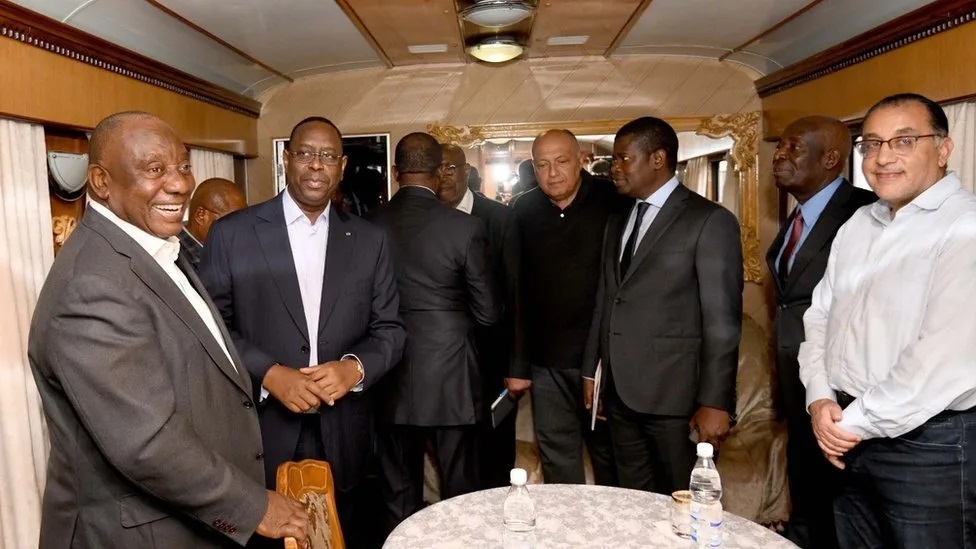
The African peace mission on the Russia-Ukraine crisis comprised four presidents: President of the Republic of South Africa, Cyril Ramaphosa, the head of the Mediation Group. The current Chairman of the African Union (AU) and President of the Union of Comoros Azali Assoumani; the President of the Republic of Senegal, Macky Sall and the President of the Republic of Zambia, Hakainde Hichilema.
The mission was also expected to include the leaders of Egypt, the Republic of the Congo and Uganda. Egypt was represented by the country’s prime minister, President of the Republic of Uganda Yoweri Museveni was diagnosed with the coronavirus right before the trip, while his Congolese counterpart Denis Sassou Nguesso decided not to take part.
The high-ranking delegation went through Warsaw, Poland and then by train to Kiev and St. Petersburg. In the run-up to his departure, Ramaphosa said that “the conflict between Ukraine and Russia is a grave situation that affects all of us in an interconnected world.”
United Nations Resolutions: More than half of Africa’s 55 states voted in favour of United Nations resolutions condemning the invasion of Ukraine, while most of the rest abstained. Many African states have maintained a non-aligned position, but Washington says these African leaders must necessarily define the “true non-alignment” position.
One distinctive feature is that Africans have different views on the conflict. South Africa and Uganda are seen as leaning towards Russia, while Zambia and Comoros are closer to the West. Egypt, Senegal and Congo-Brazzaville have remained largely neutral.
Ramaphosa’s government has come under growing pressure from the United States because of its alleged support for Russia.
Reasons: The key aim of the African peace mission is primarily to propose “confidence-building measures” in order to facilitate peace between the two countries. It was to seek a peaceful settlement of the conflict, which began on February 22, 2022.
Russia referred to it as a “special military operation” largely directed at “demilitarization” and “denazification” in neighbouring Ukraine. Both Russia and Ukraine were part of the Soviet Union. After the Soviet collapse in 1991, both as independent states have, in the first instance, legal claims to their territorial integrity and political sovereignty within international law.
The African delegation had on their agenda to discuss the export of Ukrainian grain and Russian fertilizers. As well-known, the Russia-Ukraine crisis, as well as the sanctions, have had an adverse effect on African economies and livelihoods. But most of the African countries have claimed neutrality in the conflict, and Moscow has long nurtured good political relations with the governments on the African continent.
Russians are currently in a dilemma. They are globetrotting for Soviet-era friends and to avoid isolation. Russians are soliciting support for its illegal invasion of Ukraine. This is different from the emerging multipolar world. A multipolar world must have relative peace and be more integrative, but Russia has partitioned the world.
Background: Russian President Vladimir Putin insisted that he was still open to any contacts to discuss possible scenarios for and taking a resolution of the Ukraine conflict. Russia is open to negotiations. We know that Moscow has already annexed four regions in eastern and southern Ukraine and the Crimea peninsula, which it seized in 2014.
Ukraine wants to protect its territory from illegal encroachment. It clearly says its peace plan, which envisages the withdrawal of Russian troops from all Ukrainian land, must be the basis for any war settlement.
What documents say: The peace mission could propose a series of “confidence-building measures” during initial efforts at mediation, according to a draft framework document. The document states that the mission’s objective is “to promote the importance of peace and to encourage the parties to agree to a diplomacy-led process of negotiations”.
According to a framework document, those measures could include a Russian troop pull-back, removal of tactical nuclear weapons from Belarus, suspension of implementation of an International Criminal Court arrest warrant targeting Putin, and sanctions relief, it indicated.
The document stated that a cessation of hostilities agreement could follow and would need to be accompanied by negotiations between Russia and the West. Kyiv says its plan, which envisages the withdrawal of Russian troops from Ukrainian land, must be the basis for any settlement of the war.
How it started: The main organizer of this peace mission is the non-profit Brazzaville Foundation based in Britain. Jean-Yves Ollivier has described the mission’s goals as modest.
He said the aim was to start talking rather than to resolve the conflict, to begin a dialogue on issues that do not directly affect the military situation and build from there.
The other is to try and find solutions to issues that matter to Africa, like grain and fertilizer. Ollivier expected African leaders to persuade the Russians to extend the fragile agreement that allows Ukraine to ship grain through the Black Sea.
Ollivier heads a UK-based organization known as the Brazzaville Foundation, which focuses primarily on African peace and development initiatives.
World
Essent Slashes Contact Centre Technology Costs by 50%
By Modupe Gbadeyanka
The Netherlands’ largest energy provider, Essent, has cut the technology costs of its contact centre infrastructure by half.
The organisation, which serves 2.5 million customers, recorded zero critical incidents post-migration and improved agent workplace satisfaction by 36 per cent.
The migration was delivered in partnership with AI-first customer experience transformation specialists, Sabio Group, and was completed in under 12 weeks for an operation spanning over 1,000 agents across two locations.
Agents were forced to juggle multiple disconnected screens simultaneously — a workflow that was as inefficient as it was stressful.
“Our agents were constantly working with different screens — multiple chat instances open at once, multiple agent desktop instances. It was messy, and in some cases, quite stressful,” SAFe Product Manager for Customer Interaction, Omnichannel and Digital Transformation at Essent, Michiel Kouijzer, stated.
“A lot of colleagues were saying I was mad for even suggesting this approach. It kind of feels like a victory on a personal level that it did work out. You just have to be a little ambitious — and have the right expert partner who can make it work,” Kouijzer added.
With stable cloud infrastructure now firmly in place, Essent is turning its attention to the capabilities that were impossible in its legacy environment: AI-powered call summarisation, agentic customer self-service, and next-generation workforce optimisation.
Rather than a reckless ‘big bang’ cutover that could have affected service to millions of households, Sabio engineered a phased migration strategy — beginning with Essent’s SME segment to validate technical readiness before scaling to the full enterprise operation.
“This project showcases Sabio’s unique position in the contact centre technology landscape. We’re not just moving Essent to the cloud — we’re establishing a foundation for continuous improvement in their customer experience delivery,” the Country Manager for Sabio Group Benelux, Wouter Bakker, commented.
World
Africa: A New Market for Russian Business
By Kestér Kenn Klomegâh
On April 11, the presentation of the book “Africa: a new market for Russian business” took place, which aroused lively diverse interests among business representatives, entrepreneurs and employees of federal structures of Russia. The event was dedicated to discussing the prospects of Russian companies entering the African market and became a platform for the exchange of views and experiences.
Participating guests, packed in the small hall, included:
– representatives of business circles,
– entrepreneurs interested in new directions of development,
– employees of federal agencies curating foreign economic activity.
The presentation was held in a constructive and friendly atmosphere. The author of the book, Serge Fokas Odunlami, detailed the key ideas and conclusions presented in the publication. Particular attention was paid to the practical aspects of operating in the African market, as well as the analysis of opportunities and risks for Russian companies.
During the lively discussion, participants asked questions, shared their experiences and made suggestions for developing cooperation with African countries. This format allowed not only to get acquainted with the content of the book, but also to discuss topical issues of expanding business relations.
Meaning of the book: The publication, “Africa: a new market for Russian business” offers readers not only analytical, but also practical recommendations on investment and market trends, and how to enter the African market. The book will be a useful tool for those considering Africa as a promising destination for investment and business development.
The presentation of the book became a significant event for the Russian business community interested in expanding cooperation with Africa. Serge Fokas Odunlami introduced the participants to the new edition, which is a comprehensive business guide that gives an impetus for dialogue and implementation of joint entrepreneurial projects and corporate initiatives across Africa.
World
Ryan Collyer Reveals Reasons Behind Africa’s Significant Energy Deficit
By Kestér Kenn Klomegâh
Perhaps Russia’s state nuclear corporation, Rosatom, is at the frontline, shaping Africa’s energy security. And African countries are also accelerating coordinated efforts to build nuclear power plants primarily to supply their energy, which will drive industrialisation and boost power capacity for domestic utilisation.
Energy experts say adopting nuclear can further support a diverse energy mix, reduce reliance on fossil fuels, and help across the continent. Over the past two decades, Russia has been collaborating with African countries, adopting energy initiatives to provide power to approximately half the continent’s population, and making it an important component of Africa’s future energy strategy and solutions. At this point, however, it is necessary to underline the irreversible fact that Russia’s ultimate goal is to ensure long-term African energy security.
In this interview, Rosatom’s Chief Executive Director for Central and Southern Africa, Ryan Collyer, reiterates the strategic importance of Russia-Africa’s energy cooperation through strengthening bilateral agreements on collaboration on the peaceful use of nuclear energy. Collyer explains that the Russian approach is its ability to offer an integrated solution, from technology and financing to training and localisation. According to him, partnerships must be built on mutual benefit and on the principle of transparency. Here follows the interview excerpts:
What are the expectations, specifically in the nuclear energy sphere, for Africa during the forthcoming Russia–Africa Summit scheduled for 2026?
The expectation is a clear shift from dialogue to delivery. Over the past few years, we have built a strong foundation through agreements, feasibility discussions and partnerships. The 2026 Russia–Africa Summit is an opportunity to demonstrate tangible progress.
In practical terms, I would expect greater focus on implementation readiness. That includes regulatory development, human capital, financing models and localisation strategies. We also expect to see more structured cooperation in areas like small modular reactors, which are particularly relevant for many African grids, as well as stronger emphasis on education and training partnerships. Ultimately, the success of the Summit will be measured by how many initiatives move from concept to execution.
Why, despite many bilateral agreements, is Africa still experiencing a significant energy deficit?
Africa’s energy deficit is not a result of a lack of ambition or agreements. It is primarily a question of scale, financing and infrastructure readiness. Energy projects, especially large-scale ones, require long-term investment, stable policy frameworks and strong institutional capacity. Many countries are working under fiscal constraints, and at the same time, demand is growing rapidly due to population growth and urbanisation. So, even when progress is made, it can be outpaced by rising demand.
It is also important to understand that many agreements are not meant to deliver immediate infrastructure. They are part of a longer preparation cycle, including feasibility studies, regulatory development and workforce training. Nuclear projects in particular are long-term by nature, and while this can be perceived as slow progress, it is actually a reflection of the level of diligence required.
How do you assess the contribution of nuclear energy to climate change mitigation and technological development in Africa?
Nuclear energy plays a dual role in Africa’s development, both as a clean energy source and as a driver of technological advancement. From a climate perspective, nuclear provides reliable, low-carbon electricity at scale. Africa needs a significant expansion of its energy capacity to support economic growth, and this growth must be both stable and sustainable.
Nuclear allows countries to increase power generation without increasing emissions, while ensuring a consistent baseload supply. At the same time, its impact goes beyond electricity. Nuclear technologies support medicine, agriculture, water management and industrial processes. Across Africa, they are already used in areas such as cancer treatment, food preservation and environmental monitoring, making nuclear a broader platform for sustainable development.
In this context, Rosatom offers integrated solutions across the full nuclear value chain. This includes large-scale and small modular reactors, as well as advanced non-power applications such as nuclear medicine and irradiation technologies. Our focus is on delivering practical, tailored solutions that support long-term development and local capacity building.
Is Africa unprepared to deal with nuclear waste, as some critics suggest?
I would say that preparedness varies across countries, but it would be inaccurate to suggest that the issue is being ignored. Responsible nuclear programmes require a comprehensive approach to waste management from the very beginning. This includes legal frameworks, regulatory oversight, storage solutions and long-term planning. These elements are part of international best practice and are supported by organisations such as the IAEA. What is true is that this topic is often undercommunicated in the public space. It should be discussed more openly, because transparency builds trust.
Countries that are serious about nuclear energy understand that waste management is not optional. It is a core component of the programme, and it is addressed in parallel with all other aspects of development. Rosatom offers comprehensive solutions for spent fuel and radioactive waste management. These include technologies for safe storage, transportation, reprocessing and recycling of nuclear materials. In fact, advanced reprocessing solutions allow for the reuse of valuable components of spent fuel, significantly reducing the volume of waste and improving the overall sustainability of the nuclear cycle.
Nuclear power remains controversial. Why do you believe it is important for Africa, and what role does it play in the energy mix?
Africa needs a balanced and pragmatic energy strategy. The conversation should not be about choosing one technology over another, but about building an energy mix that is reliable, affordable and sustainable. Renewables will play a critical role and are already expanding rapidly. However, they are variable by nature. For industrialisation, countries also need stable, continuous power that is baseload. This is where nuclear can make a meaningful contribution. A diversified energy mix that includes renewables, nuclear, hydropower and other sources allows countries to reduce risk, improve energy security and support long-term economic growth.
Nuclear is not the only solution, but it is an important part of a resilient system, especially for countries with growing industrial ambitions. In this context, Rosatom is able to support countries with integrated energy solutions that combine reliability, sustainability and long-term partnership models, tailored to national development priorities.
How can we shift public perception, given the legacy of Chornobyl and Fukushima?
We cannot rewrite history, and we should not try to. Events like Chornobyl and Fukushima shaped public perception for a reason. The starting point is respect for those concerns, not dismissal. At the same time, what is often missing in the conversation is what happened after those events. Chornobyl, in particular, fundamentally reshaped the entire philosophy of nuclear safety. It led to a complete rethinking of reactor design, emergency response, and regulatory oversight. Independent regulators were strengthened, safety responsibilities were clearly separated from operators, and safety culture became not just a principle but a legal requirement supported by continuous drills and probabilistic risk assessments.
Technologically, the industry also changed dramatically. Modern reactors are designed to withstand even worst-case scenarios, with multi-layered “defence-in-depth” systems, core melt traps, and passive safety mechanisms that rely on natural physical processes rather than human intervention. These are not incremental improvements. They are the direct result of lessons learned at a very high cost. But facts alone do not change perception. People do not build trust through reports. They build it through experience and transparency. That is why our approach in Africa is deliberately open.
We create opportunities for students, young professionals and journalists to visit nuclear facilities, research centres and training programmes. When people can see how systems operate, how safety is managed, and how seriously it is taken, the conversation becomes more grounded and less abstract. There is also an important human dimension that is often overlooked.
The history of Chornobyl is not only a story of tragedy. It is also a story of professionalism, responsibility and the people who managed the crisis and generated the knowledge that made today’s safety standards possible. Acknowledging that the full picture helps move the discussion away from fear alone toward understanding. At the same time, we need to broaden the narrative. Nuclear is not only about power generation. It is about cancer treatment, food security, water management and high-skilled employment. When communities begin to connect nuclear technology with real benefits in their own lives, it stops being an abstract risk and starts becoming a practical solution. Ultimately, perception does not change through persuasion. It changes through consistency. Through transparency, long-term engagement, and real-world impact.
What are your final thoughts on Russia’s preparedness to support Africa’s nuclear ambitions?
Russia has demonstrated that it is committed to long-term partnerships in Africa, particularly in the nuclear sector. We are already seeing concrete examples of cooperation in areas such as project development, education and skills transfer. The key strength of the Russian approach is its ability to offer an integrated solution, from technology and financing to training and localisation. Partnerships must be built on mutual benefit and transparency. Africa’s priorities are clear: energy security, economic development and local capacity building. Any partner that is ready to contribute to these goals consistently and practically will have a meaningful role to play. If we look country by country, the picture becomes even more interesting.
Take Ethiopia. This is a country thinking long-term about energy security and industrialisation. It has strong hydropower, but also understands the need to diversify. Ethiopia is prepared to take a big step towards nuclear energy. In Rwanda, the approach is different. It is focused on innovation and speed. There is a strong interest in small and flexible nuclear technologies, alongside active use of nuclear science in healthcare and agriculture. What stands out is the clarity of vision and pace of implementation.
Then, there is Namibia. As a major uranium producer, the question is how to move up the value chain. Partnerships can help connect resources to technology, skills and future energy applications. So, Russia’s role is not one-size-fits-all.
The real strength lies in adapting to each country’s strategy. If that continues, nuclear cooperation becomes not just about energy, but about shaping long-term technological development. Rosatom is one of the few global players capable of delivering the entire nuclear value chain. This includes reactor technologies, fuel supply, waste management solutions, including reprocessing, as well as long-term operational support and human capital development. This comprehensive capability is what allows us to move projects from concept to reality in a structured and sustainable way.
-
Feature/OPED6 years agoDavos was Different this year
-
Travel/Tourism10 years ago
Lagos Seals Western Lodge Hotel In Ikorodu
-
Showbiz3 years agoEstranged Lover Releases Videos of Empress Njamah Bathing
-
Banking8 years agoSort Codes of GTBank Branches in Nigeria
-
Economy3 years agoSubsidy Removal: CNG at N130 Per Litre Cheaper Than Petrol—IPMAN
-
Banking3 years agoSort Codes of UBA Branches in Nigeria
-
Banking3 years agoFirst Bank Announces Planned Downtime
-
Sports3 years agoHighest Paid Nigerian Footballer – How Much Do Nigerian Footballers Earn