World
Central Region Sees Atlantic Lithium Powering Local Employment
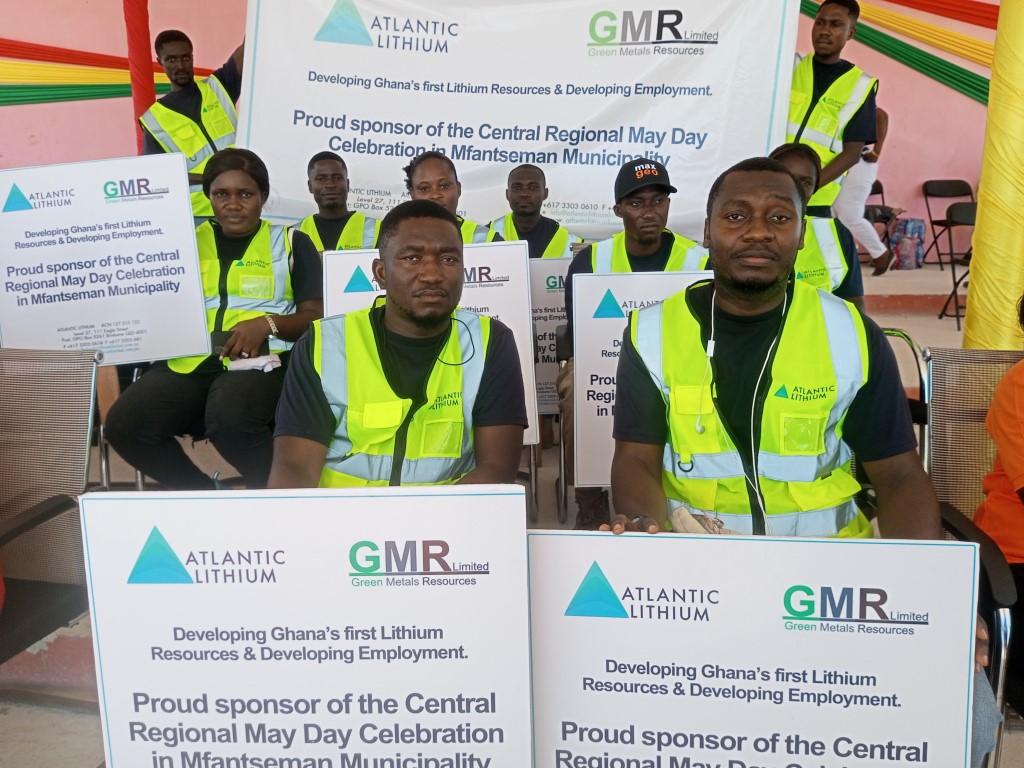
Ghana’s May Day is a public holiday honouring workers and their contribution to the country’s development. Central Region marked the occasion by holding a unique programme of celebratory events for the community at Saltpond Victoria Park in the Mfantseman Municipality.
Lithium exploration and development company Atlantic Lithium Ltd. was a proud headline sponsor of the event, demonstrating its strong commitment to local community development through employment. Atlantic Lithium is advancing the Ewoyaa Project, a significant lithium spodumene concentrate discovery on track to become Ghana’s first lithium-producing mine. Over 95% of the company’s employees are Ghanaian, many of which are from the Central Region.
The theme of Central Region’s 2023 May Day celebration was ‘Protecting Incomes and Pensions in an Era of Economic Crises: Our Responsibility’, which aimed to encourage an open discussion between local stakeholders and government on the growing contribution of the mining sector to the region’s development.
Atlantic Lithium is already one of the leading taxpayers and employers in the Central Region, however, the company expects to deliver many more long-standing benefits to the region as it advances the Ewoyaa Project towards production. It hopes to employ over 300 staff, mainly locals and has stated its intention to establish a community development fund to allocate a portion of profits generated from the project to regional development initiatives.
In attendance at the event was the Central Regional Minister, Hon. Justina Marigold Assan and leaders of the Mfantseman Municipal Assembly, including the Chief Executive, Hon. Ike Lord Innu, Minister of Parliament, Hon. Ophelia Mensah Hayford and Francis Odoom, Chairman of the occasion and Regional Chairman of the Trades Unions Congress, who praised Atlantic Lithium for playing its part in developing local skills and reducing unemployment in the region.
The Municipality sees a strong role for Atlantic Lithium to further contribute to local content and is looking forward to the governing bodies and the Minerals Commission granting the mining lease Atlantic Lithium requires to move the project forward. A large contingent of Atlantic Lithium staff attended the event along with other workers from the region.
Mr Abdul Razak, Atlantic Lithium’s In-Country Manager for Ghana, has made a firm commitment to focus on hiring locally and investing in regional development. In an interview with News Ghana, he explained, “Employing and developing our workforce in the Central Region is important to us for several reasons.
Firstly, salaries paid to workers are likely to be spent within the community, thereby benefitting not only their families but also local businesses. Secondly, it enables us to build a deeper understanding and respect for local customs, values and traditions throughout our company, an ethos that is of great importance to us.
Finally, as we move forward to develop Ghana’s first lithium mine, retaining our skilled workforce is key to the growth of the company. Maintaining a happy and productive workforce while assisting in the improvement of the local economy, therefore, aligns Atlantic Lithium with the goals of the leaders of the local community and Government bodies. Together, these put us in the best position to deliver a successful project and bring about positive change for the region.”
World
Nigeria Leads Africa in Equity Funding as Startup Investment Hits $254m in H1 2026
By Adedapo Adesanya
Nigeria regained its position as Africa’s leading destination for equity startup investment in the first half of 2026, raising $214 million in equity financing and a total of $254 million across equity and debt, according to the latest Africa: The Big Deal report.
The report, titled H1 2026: Mapping the Money, showed that Nigeria ranked second on the continent in total funding, behind Egypt, which attracted $327 million, while Kenya and South Africa followed with $126 million and $83 million, respectively.
However, the report noted that Egypt’s top position was largely driven by a single fundraising by electric mobility company Spiro, which secured $327 million, including $270 million in equity and $57 million in debt. Excluding debt financing, Nigeria emerged as Africa’s largest equity funding market in the first six months of the year.
According to the breakdown by Africa: The Big Deal, Nigeria’s equity funding of $214 million was higher than Egypt’s $183 million, while South Africa and Kenya attracted $66 million and $46 million, respectively.
Beyond funding value, Nigeria also led the continent in the number of startups that raised at least $100,000 during the review period, reclaiming the top spot after what the report described as an “underwhelming” second half of 2025.
The publication observed that Nigeria’s fundraising performance has remained relatively stable over the past few years and exceeded the $250 million mark for the first time since 2022, pointing to renewed investor confidence in the country’s startup ecosystem.
It also found that while the Big Four startup markets—Nigeria, Egypt, Kenya and South Africa—continued to dominate Africa’s investment landscape, their combined share of total funding stood at 58 per cent in the first half of 2026.
“Zooming back on the Big Four (110 out of 190 $100k+ deals, i.e. 58%), Nigeria is head and shoulders above its peers, with Egypt and Kenya almost tying, and South Africa in fourth position again,” the report noted.
The report highlighted contrasting performances among the continent’s largest startup ecosystems. While Nigeria and Egypt maintained strong funding momentum, Kenya recorded its weakest funding performance since early 2021 after a strong second half of 2025, and South Africa failed to attract $100 million in funding during the period despite leading the continent a year earlier.
Africa: The Big Deal also noted a broader shift in investor behaviour, with funding increasingly concentrated in larger transactions while early-stage investments continued to decline. According to the publication, the drop in smaller funding rounds reflects growing concerns about limited capital available for early-stage startups across Africa.
World
SCRYPT Expands Stablecoin Settlement Infrastructure to East Africa
By Aduragbemi Omiyale
Accessing the US Dollar in the East Africa region has now been made easier with the expansion of the stablecoin settlement infrastructure of SCRYPT.
This development enables banks, payment providers and corporate treasury teams to move value into and out of the continent in real time.
Businesses paying international suppliers frequently have to convert local currency into USD before purchasing stablecoins for settlement, incurring FX conversions and spreads before any payment is made.
But SCRYPT is eliminating this intermediate conversion by enabling direct settlement corridors for local African currencies into stablecoins.
This development allows businesses to move from local currency to stablecoin settlement in a single licensed transaction, without first sourcing rationed bank dollars, as stablecoins are increasingly becoming settlement infrastructure rather than an investment product.
The expansion adds settlement support across four African currencies: the Kenyan shilling (KES), Tanzanian shilling (TZS), Rwandan franc (RWF) and Ugandan shilling (UGX). Each corridor is delivered through the same full-stack infrastructure our clients already use for trading, custody and treasury operations.
Speaking on this, the chief executive of SCRYPT, Norman Wooding, said, “Across Africa, stablecoin adoption is driven by economic need, not speculation.
“Businesses here are not chasing yield; they are trying to pay suppliers and manage treasury without losing margin to a banking system that rations dollars. Licensed, fair-rate dollar access is the clearest proof of what this infrastructure is for.”
Also commenting, the Managing Director of Markets & Trading at SCRYPT, Mr Gabriel Titopoulos, said, “Until now, reaching stablecoins from local African currencies meant buying scarce dollars and incurring several layers of conversion costs.
“SCRYPT removes this friction. Firms and payment providers can now settle straight from local currencies through live corridors, with local partners.”
World
African Graduates Association Promoting Multifaceted Initiatives With Russian Educational Institutions
By Kestér Kenn Klomegâh
In preparations for the third Russia-Africa Summit, scheduled for late October 2026, Dr Francois Ngan, deputy chairman of the Union of Associations of African Graduates of Soviet and Russian Universities, during an official working visit, has held a consultative meeting with Professor Vladimir Filippov, the President of the Russian University of Peoples’ Friendship (RUDN), and former Minister of Higher Education of Russia, Chairman of the National Commission for Accreditation of Higher Education.
RUDN is an educational institution established in 1960, primarily to provide higher education to Third World students. It has now become a popular multidisciplinary spot for many students, especially from developing countries. The university offers various academic programmes and has research infrastructure that comprises laboratories and interdisciplinary centres. The university is named after the former Congolese leader, Patrice Lumumba.
Dr Francois Ngan and Professor Filippov discussed the importance of the Graduates Association as a continental platform dedicated to strengthening unity, cooperation, and promoting shared progress among African graduates who studied in the former Soviet Union and in the Russian Federation. They also reviewed multifaceted initiatives that could bring together alumni associations from across Africa, whose members obtained education and professional training, and cultural experiences in Soviet and Russian institutions of higher learning.
Professor Filippov expressed optimism in addressing emerging challenges as a result of shifting geopolitical changes, emphasised strategic cooperation in the educational sphere with Africa, in general, and with the Republic of Cameroon, in particular, and further about the integration of African students during their studies in the Russian Federation.
The meeting also touched on academic and scientific work, the possibility of rewriting a scientific thesis, and the official organisation of transferring versions translated into six languages for the library of RUDN. Significant questions relating to Russia’s educational opportunities, collaborations and partnerships involving African countries were thoroughly discussed.
The Union of Associations of African Graduates of Soviet and Russian Universities was created under one continental umbrella to promote friendship, for professional networking, to engage in cultural exchange, and with particular emphasis on forging strategic cooperation between Africa and Russia.