World
Eni Commences Exports of Vegetable Oil from Kenya
By Kestér Kenn Klomegâh
The first cargo of vegetable oil for biorefining produced by Eni in Kenya has left the port of Mombasa on its way to Gela’s biorefinery.
This marks the start of the transport and logistics system that will support the value chain in the country, starting with a production of 2,500 tons by the end of 2022 to scale up rapidly to 20,000 tons in 2023.
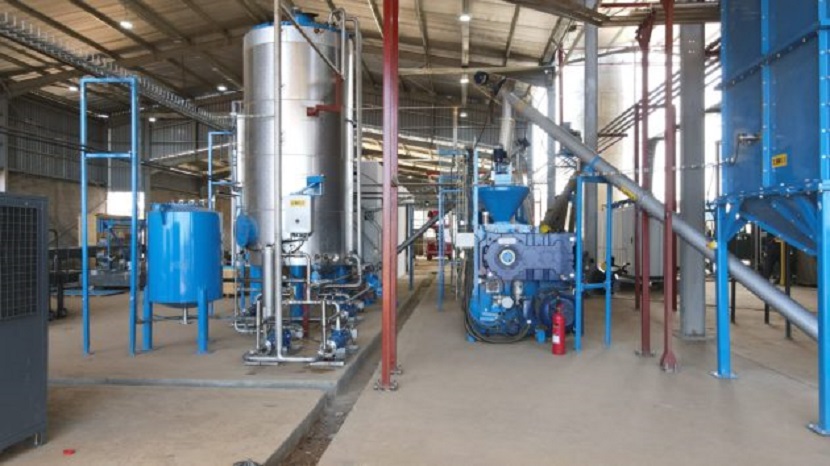
The vegetable oil from Kenya is produced in the Makueni agri-hub, the pressing plant opened by the company in July 2022, which processes castor, croton and cotton seeds. These are agri-feedstock, which are not in competition with the food chain, cultivated in the degraded area, harvested from spontaneous trees or resulting from the valorization of agricultural by-products, providing income opportunities and market access to thousands of farmers.
The centre also manufactures feed and bio-fertilisers from the protein component of seeds, benefiting livestock production and thus contributing to food security.
“Just three months after the start-up of the Makueni agri-hub, we are launching the export of vegetable oil for the biorefineries through a vertical integration model that promotes sustainable local development while valorizing the supply chain for biofuels production.
“These are the seeds of a new energy, a concrete step to decarbonize transport with an innovative approach that, starting from the production in Kenya, will extend to Congo in the next year, aiming at involving gradually the other African countries and geographic areas where we are carrying out these projects,” said Claudio Descalzi, Eni’s Chief Executive Officer.
Eni Kenya, its supply chain and all agri-feedstock developed are certified according to the ISCC-EU (International Sustainability and Carbon Certification) sustainability scheme, one of the main voluntary standards recognised by the European Commission for the certification of biofuels (RED II).
Eni was the first company in the world to certify castor and croton and to enable an African cotton mill to achieve these assurance standards, offering new market opportunities to local farmers for this raw material.
It launched the project in Kenya in 2021 after signing the Memorandum of Understanding with the Kenyan institutions. The initiative foresees the construction of other agri-hubs, with the second one to be operational in 2023, and the production growth with the involvement of tens of thousands of farmers, contributing significantly to the country’s rural development and long-term value creation.
In addition to vegetable oil, Eni also plans to export the Used Cooking Oil (UCO) collected from hotel chains, restaurants and bars in Nairobi through a project already underway that promotes the culture of recycling, raising awareness of the environmental and health benefits that derive from the proper disposal of waste oil, and generating income from waste.
Kenya leads the way for Eni’s initiatives in the agro-industrial chain, which currently includes Congo, Mozambique, Angola, Ivory Coast, Benin, Rwanda and Kazakhstan.
For these countries, as well as for Italy, feasibility studies have been launched in the most mature realities aiming at carrying out the first phase of agricultural activities starting in 2022 and then proceeding with the construction of seeds-pressing plants for bio-refining.
The first cargo of vegetable oil will be delivered to Eni’s biorefinery in Gela, which was launched in 2019. This is one of the most innovative plants in Europe; it has high operational flexibility, can process different types of feedstock, and has an authorised capacity of 750,000 tonnes/year.
By 2025, the company aims to cover 35% of its biorefineries’ supply thanks to the vertical integration of the agri-feedstock and waste & residue chain, which will enable it to secure volumes of vegetable oil in a challenging environment in terms of prices, growing energy demand and availability of sustainable oils.
World
From Conviction To Execution: LEAD Launches Its Second Cohort In Rabat
By Kestér Kenn Klomegâh
One year after launching a continental initiative designed to make excellence in public governance the foundation of a new drive to transform Africa, LEAD, the Africa CEO Forum’s pan-African leadership programme, takes stock of its first cohort and announces the launch of its second class. Built around a community of senior public decision-makers committed to modernising the state and to the continent’s digital transformation, this new cohort gathers for three days, from 28 to 30 August 2026, on the campus of Mohammed VI Polytechnic University (UM6P) in Rabat, Morocco.
A second cohort that confirms the programme’s durability
For its second class, LEAD brings together 50 fellows, senior public decision-makers engaged in the design and implementation of the continent’s economic and social policies. Over three days, participants take part in collective and collaborative working sessions, peer exchanges and meetings with figures from the public, business and academic spheres, in order to compare their practices and build shared responses to the major challenges of governance.
Speakers include Mehdi Jomaa, former Head of Government of Tunisia, Donald Kaberuka, Managing Partner & Founder, SouthBridge Group, and former President of the African Development Bank, Serge Ekue, President of the West African Development Bank (BOAD), Sanjay Jain, co-creator of India Stack and Director of Digital Public Infrastructure, Gates Foundation, and Mauricio Cardenas, Professor of Professional Practice in Global Leadership, Columbia SIPA, and former Finance Minister of Colombia (2012-2018).
They share their reform experience, their public policy trade-offs and their view of continental priorities. Throughout the programme, the cohort benefits from the dedicated support of Mohammed VI Polytechnic University, Asafo & Co, BOAD, BCG and the African Development Bank, LEAD partners that have chosen to invest in the transformation of African public action.
LEAD, a pan-African community serving public action
Created by the AFRICA CEO FORUM, LEAD is a leadership programme whose ambition is to reposition Africa’s administrative elite as a driver of reform, of performance and of dialogue with all the continent’s stakeholders.
Designed for senior African public decision-makers, LEAD sets out to build a lasting community of public officials able to share their experience, compare their practices and build common solutions to the major economic, technological and institutional transformations under way in Africa. That community is structured around three pillars: modernizing the state, improving public services, and strengthening cooperation between governments, development institutions and private-sector players.
From fellows to alumni: a long-term initiative
Made up of 36 fellows drawn from a range of administrations and institutions and representing 24 countries across the continent, LEAD’s first cohort demonstrated the quality and the potential of this community from its very first year. In less than twelve months, six of its members have taken a significant step forward: two have been appointed ministers, two have moved into strategic positions at the highest level of the state and two have been promoted to chief executive roles. These moves, which account for 16.7% of the first class, show the role LEAD plays as an accelerator of impact within African administrations.
By bringing together a new cohort of fellows every year, each of them joining the LEAD alumni community, the initiative follows a long-term trajectory: in time, to unite several hundred African public decision-makers around a shared culture of transparency, performance and regional cooperation.
A first year devoted to public service and digital public infrastructure
Throughout the year, the fellows devoted their work to strengthening African public action, to make excellence in public governance a central lever of transformation. An awareness campaign, run as part of Africa Public Service Day, brought to light those who, within the continent’s administrations and institutions, are concretely transforming public policy and improving the services offered to citizens.
Members of the cohort also took part in a special round table held in Kigali during the ACF 2026, in order to carry their thinking to a wider community of public and private leaders. That forum reinforced LEAD’s role as a platform for dialogue between the administrative elite and the continent’s economic players. Digital public infrastructure (DPI) formed the main thread of this first year of work.
Discussions covered issues at the heart of the digital sovereignty of African states: digital identity, payments, secure data exchange, interoperability, governance and the protection of citizens. This work examined the conditions under which African states are developing, in some cases, and can develop, in others, shared, open infrastructure robust enough to improve the quality of public services while supporting local innovation and preserving the capacity of public authorities to set the rules of the game.
A white paper to move from consuming technology to creating value
This year of work concludes with the publication, in collaboration with BCG, LEAD’s Knowledge Partner, of a white paper on Africa’s place in the digital economy and in artificial intelligence. With the digital economy still accounting for around 5% of African GDP, against close to 15% worldwide, the paper calls on the continent to shift from a logic of technology consumption to one of value creation.
The white paper identifies three structuring priorities for African public actors:
- Building shared digital infrastructure that serves as the backbone of public services and private innovation.
- Pooling investment in order to reach critical mass and avoid the fragmentation of efforts across the continent.
- Favouring open and interoperable architectures, with trust and governance built in by design, so as to protect citizens while stimulating the entrepreneurial ecosystem.
The white paper is available here to all public decision-makers, technical partners and institutions concerned.
“LEAD’s first cohort confirms a simple conviction: Africa already has the women and men capable of profoundly transforming public action. Our responsibility, either with our partners, is to give them, at pan-African level, a space in which to compare experience, build common solutions and bring forward a new generation of public policy. With this second cohort, we want to accelerate the move from ambition to execution, in particular on digital public infrastructure and artificial intelligence, two decisive issues for sovereignty, for the effectiveness of the state and for value creation across the continent,” says Amir Ben Yahmed, President of the Africa CEO Forum.
World
Global Leaders Head to Addis Ababa for First World Public Summit in Africa
By Kestér Kenn Klomegâh
Africa is set to make history as it hosts the World Public Summit for the first time, with Addis Ababa, Ethiopia, welcoming global leaders and changemakers from July 29–30, 2026, for the landmark gathering under the theme “New World: Africa in Shaping a Shared Future.”
The inaugural African edition of the World Public Summit marks a significant milestone in the continent’s growing role in shaping international dialogue on governance, sustainable development, human-centred leadership and global cooperation.
Hosted by the World Peoples Assembly in partnership with African and international organisations, the summit will convene government officials, diplomats, business leaders, academics, journalists, youth representatives, civil society organisations and cultural leaders from across Africa and around the world.
According to Andrey Belyaninov, General Secretary of the World Peoples Assembly, “the Summit is not just a meeting—it is a space for unity. A space where the ‘values that unite us’ come to life: respect for people, openness to the world, responsibility for the future, and a commitment to creation.
“Today, we understand more clearly than ever: the future cannot be built alone. It is born in dialogue, in trust, in the ability to listen to one another and to act together.”
The programme begins on July 29 with a series of high-level roundtables and expert discussions covering Pan-African economic integration, civil society, education, scientific cooperation, cultural diplomacy and humanitarian partnerships.
The opening plenary, “Values, Development and Partnership as the Basis of a Sustainable and Just World,” will explore how African values—including Ubuntu—can help shape a more inclusive and sustainable global future. Discussions will also focus on youth leadership, innovation, civil society, ethical AI, public initiatives and international partnerships.
The summit will also showcase Africa’s creativity and innovation through the “Innovations for the Future” exhibition, the contemporary African art exhibition “Unity,” and the international exhibition “The World Paints Happiness.”
Another featured initiative is “The Zambezi River: Economy, Society, Soul,” an international interdisciplinary project exploring the river’s socioeconomic importance across Angola, Botswana, Mozambique, Namibia, Zambia and Zimbabwe, highlighting the shared heritage and development potential of one of Africa’s most important waterways.
The event will conclude with the adoption of the African Communiqué, reflecting the summit’s shared vision for stronger international cooperation, sustainable development and people-centred leadership.
Tsegaye Chama, General Secretary of the Global Black Centre, promised that, “The Summit will be delivered with exceptional distinction, reflecting the magnitude and spirit of the World Peoples Assembly. It embodies a unity that is not transactional, but purposeful and conscious, a unity that shapes new contours for a world that works for all peoples of the World.”
As delegates prepare to arrive in Addis Ababa, anticipation continues to build for what promises to be one of Africa’s most significant international gatherings of 2026—one that will place the continent firmly at the centre of global conversations about the future.
World
Nigeria Leads Africa in Equity Funding as Startup Investment Hits $254m in H1 2026
By Adedapo Adesanya
Nigeria regained its position as Africa’s leading destination for equity startup investment in the first half of 2026, raising $214 million in equity financing and a total of $254 million across equity and debt, according to the latest Africa: The Big Deal report.
The report, titled H1 2026: Mapping the Money, showed that Nigeria ranked second on the continent in total funding, behind Egypt, which attracted $327 million, while Kenya and South Africa followed with $126 million and $83 million, respectively.
However, the report noted that Egypt’s top position was largely driven by a single fundraising by electric mobility company Spiro, which secured $327 million, including $270 million in equity and $57 million in debt. Excluding debt financing, Nigeria emerged as Africa’s largest equity funding market in the first six months of the year.
According to the breakdown by Africa: The Big Deal, Nigeria’s equity funding of $214 million was higher than Egypt’s $183 million, while South Africa and Kenya attracted $66 million and $46 million, respectively.
Beyond funding value, Nigeria also led the continent in the number of startups that raised at least $100,000 during the review period, reclaiming the top spot after what the report described as an “underwhelming” second half of 2025.
The publication observed that Nigeria’s fundraising performance has remained relatively stable over the past few years and exceeded the $250 million mark for the first time since 2022, pointing to renewed investor confidence in the country’s startup ecosystem.
It also found that while the Big Four startup markets—Nigeria, Egypt, Kenya and South Africa—continued to dominate Africa’s investment landscape, their combined share of total funding stood at 58 per cent in the first half of 2026.
“Zooming back on the Big Four (110 out of 190 $100k+ deals, i.e. 58%), Nigeria is head and shoulders above its peers, with Egypt and Kenya almost tying, and South Africa in fourth position again,” the report noted.
The report highlighted contrasting performances among the continent’s largest startup ecosystems. While Nigeria and Egypt maintained strong funding momentum, Kenya recorded its weakest funding performance since early 2021 after a strong second half of 2025, and South Africa failed to attract $100 million in funding during the period despite leading the continent a year earlier.
Africa: The Big Deal also noted a broader shift in investor behaviour, with funding increasingly concentrated in larger transactions while early-stage investments continued to decline. According to the publication, the drop in smaller funding rounds reflects growing concerns about limited capital available for early-stage startups across Africa.