Connect with us

World

Green Conference Re-shapes Career Focus of Ghanaian Architecture Students

Published

on

Ghanaian Architecture Students

Architecture students from the Central University in Accra say they have started the new year with a clearer career focus following their participation in the Green Building Council of South Africa’s annual conference in Cape Town.

The students, Cheryl Omani-Baah, Olufemi Abodunrin and David Gifat Ampiaw, have a new perspective after the conference, placing a larger value on the importance of sustainable design.

Bringing their experience home to Ghana, the students aim to be change agents, inspiring their colleagues to design green and help the Ghanaian government enforce their new green building code.

The students told News Ghana in an interview that they were pleasantly surprised to see that people in Cape Town were so conscious of the environment.

“The property sector in Cape Town has gone far in making the city sustainable,” said Cheryl Omani Baah. “The materials that we normally throw away in Ghana are being reused in Cape Town and not as much waste is being produced. I hope that one day our building sector gets to the level where we are equally enthusiastic about saving the environment.”

Olufemi Abodunrin agreed. “What I gathered from the conference is that Cape Town is advanced in terms of green buildings and people are very conscious of protecting the environment.”

The students continued with how the experience in South Africa has helped to influence their interest in sustainable design.

“Since returning from the conference, I’ve been more focused on how to reduce carbon emissions,” said David Gifat Ampiaw. “I’ve also been sharing the knowledge I acquired at the conference with my peers to influence them to think of the environment as they design their projects.”

Cheryl Omani-Baah agreed. “Since we came back, I’ve been able to influence my mates to design in a new way. When we leave the classroom, we’re going to influence other architects, our friends and families to also go green. It really starts with one person spreading the concept.”

The students concluded their conversation with News Ghana with advice for architects to be more conscious of the environmental impacts of buildings when executing projects.

“In Ghana, we tend to design to fit what the client wants,” Cheryl Omani-Baah said. “We’re not thinking of how we may end up destroying the environment. In the design stage, we should inform the client of the environmental impact of the building and suggest a greener way. If we do that, we will help the entire economy of Ghana.”

David Gifat Ampiaw, Olufemi Abodunrin and Cheryl Omani-Baah are winners of the Architectural Design Competition organized by the International Finance Corporation (IFC) and its partners in July 2019.

The competition challenged students to design a cutting-edge, single-family home intended for a young family on the outskirts of Accra, using locally-available materials and IFC’s EDGE software. Homes had to reach the EDGE standard of a minimum savings of 20 percent less energy, water, and embodied energy in materials.

Winners of the competition travelled to Cape Town to attend the Green Building Council of South Africa’s conference in early October last year.

3A- Olufemi Abodunrin, Cheryl Omani-Baah and David Gifat Ampiaw in Capetown.

3B- Green building expert shares his experience with the students

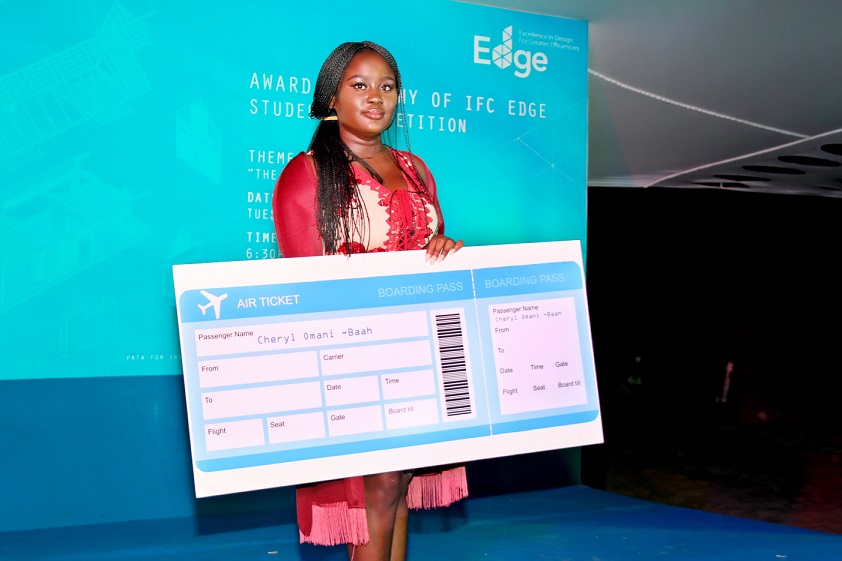
3C- Cheryl Omani-Baah at the IFC EDGE Student Design Awards

Dipo Olowookere is a journalist based in Nigeria that has passion for reporting business news stories. At his leisure time, he watches football and supports 3SC of Ibadan. Mr Olowookere can be reached via [email protected]

Click to comment

Leave a Reply

Your email address will not be published. Required fields are marked *

World

AfDB President Sees More African Nations Regaining Investment-Grade Ratings

Published

on

Sidi Ould Tah

By Adedapo Adesanya

The President of the African Development Bank (AfDB), Mr Sidi Ould Tah, says more African countries are likely to regain or achieve investment-grade credit ratings by next year as reforms begin to deliver results and economic growth accelerates.

Several African sovereigns have already been upgraded in recent months, including Nigeria. However, Nigeria is not yet near investment-grade status.

In May, S&P Global Ratings upgraded Nigeria’s sovereign credit ratings to ‘B’ with a stable outlook, citing structural reforms under President Bola Tinubu and key drivers like higher oil production and improved fiscal revenue.

The country is still five notches from investment-grade. Under S&P’s rating scale, the progression follows— B → B+ → BB- → BB → BB+ → BBB- (investment grade).

S&P raised Morocco to investment grade last year and increased South Africa by one level to BB in November. Ghana, Zambia, the Ivory Coast and Kenya have also benefited from positive rating action linked to fiscal, debt and economic reforms.

“We’re quite confident that the continent will continue to grow very strongly and that African countries will be better rated in the coming years,” Mr Ould Tah said in an interview with Bloomberg.

“We’ve seen Morocco receive investment grade during the last few months, and we expect other countries by next year to get toward that,” he added.

The outlook reflects improving fiscal positions and reforms implemented across countries on the continent, even as the conflict in the Middle East threatens to slow economic growth and raise costs for energy-importing nations. Better credit ratings can help countries borrow at lower rates and fund development projects.

The AfDB projects the continent’s gross domestic product expansion will accelerate to 4.4 per cent next year, if the conflict in the Middle East does not extend for a longer period. It expects the continent to slow to 4.2 per cent this year.

The war in Iran has benefited oil producers such as Nigeria, Angola and Gabon, while exerting pressure on the fiscal positions of net energy importers such as South Africa, Kenya, Ghana and Senegal.

Mr Ould Tah said the bank is ready to support countries facing budget constraints and high debt burdens due to the impact of the Iran crisis, including increasing credit lines to them.

“The board of directors of the bank will examine in the coming days how the bank can increase the volume of resources it will provide to its member countries in this specific situation,” he said.

Continue Reading

World

State Duma Reviews Africa’s Food Security

Published

on

State Duma

By Kestér Kenn Klomegâh

Within the framework of the Expert Council on Africa at Russia’s State Duma, the lower chamber of parliamentarians, during its annual round-table conference, held in late May 2026, focused concretely on food security in Africa.

Under the chairmanship of Deputy Speaker of the State Duma, Alexander Babakov, the council’s round-table session on Russian-African cooperation in the field of ensuring food security, introduction of closed cycle technologies in agricultural and bioeconomy projects, was held in the State Duma.

Opening the meeting, Alexander Babakov noted the importance of continuing cooperation with African countries already in the new convocation of the State Duma, to which elections will be held in September 2026. “I am sure that right from the beginning of the work of the new convocation, the theme of cooperation between Russia and African countries will work as an example for circulation and use in other areas,” he said.

Member of the Committee on the Development of the Far East and the Arctic, deputy chairman of the Expert Council on Africa, Nikolai Novichkov, in his speech stressed the importance of a gradual transition to trade with African high-tech countries. “Our African partners are interested in producing and processing food locally, including earning a living on it,” the parliamentarian stated.

Director of the Department of Partnership with Africa at the Russian Foreign Ministry, Tatiana Dovgalenko, drew attention to the continued importance of the humanitarian component of Russian-African cooperation, which, despite efforts, “unforeseen, including and along the lines of specialised UN agencies, the number of hungry people in the world, according to experts, has been growing over the past few years.” According to Dovgalenko, the food crisis is localised in about 10 countries, four of which are in Africa.

As first deputy chairman of the Committee on International Affairs, Alexei Chepa noted, the food crisis and a number of other serious threats on the African continent are today exacerbated by a complex international situation, with the United States and Israel versus Iran causing rising energy prices worldwide. “This has also reflected on the cost of fertilisers that needed to be purchased previously. Even if prices fall in a few months, the yield still won’t. And there will be problems in Africa. At the same time, we understand that population growth in the coming years will be at Africa’s expense,” Chepa underlined in his contribution at the meeting.

Alexei Chepa also mentioned the special role of security enhancement in Africa, including in countering extremism and terrorism.

As part of the continuation of the work of the roundtable to promote cooperation with African countries in ensuring food security, the introduction of closed-loop technologies in agricultural and bioeconomics projects was discussed. As a traditional procedure, some recommendations are addressed to the Government of the Russian Federation.

In addition to representatives of the State Duma, diplomats, scientists, experts from related fields, representatives of the Government of the Russian Federation and the business community took part in the round-table discussion.

Continue Reading

World

African Union Postpones India-Africa Forum Summit 2026

Published

on

India-Africa Forum Summit

By Kestér Kenn Klomegâh

The fourth India-Africa Forum Summit (IAFS-IV), originally scheduled for May 28 to May 31, 2026, in New Delhi, has been deferred to a later date due to the high risks of the Ebola virus, emerging and rapidly spreading from the Democratic Republic of Congo (DRC), in the central African region.

The African Union and Indian authorities jointly decided to postpone the summit to ensure the health safety of African leaders, stakeholders, corporate executives and entrepreneurs, amid public concerns over participants travelling from the virus-infested continent to New Delhi, India.

The India-Africa business dialogue is designed to strengthen bilateral partnerships, while facilitating networks for building not just real conversations but accessing new models of transacting corporate business and remoulding investments. It has three-fold dimensions: strategic partnerships, getting new clients and potential investors. An entirely significant collaboration that opens new markets.

Too often, businesses focus only on visibility and forget the power of relationships. But growth rarely happens alone. It happens through collaboration, trusted partnerships, and being in spaces where serious conversations happen naturally.

India-Africa has previously held a series of such high-level meetings with key trade and economic institutions in Africa as part of efforts to strengthen bilateral trade, investment cooperation and private-sector partnerships between India and Africa. These engagements aimed at identifying new economic opportunities and supporting the expansion of Indian-based companies into promising African markets.

Key Details & Context

Postponement Status: Following joint consultations, both sides mutually agreed to convene the summit at a later date. No rescheduled date has been announced at this time.

Summit Objectives: The summit, the first gathering since 2015, aims at deepening strategic multifaceted ties, focusing on South-South cooperation, technology transfers, capacity building, and healthcare resilience.

Official Information:

  1. Tracking the latest developments, both the Government of the Republic of India and the African Union have been working closely on the convening of the Fourth India–Africa Forum Summit (IAFS IV), initially scheduled to take place in New Delhi from 28–31 May 2026.
  2. The two sides exchanged views on the evolving health situation in parts of Africa and reaffirmed the importance of continued cooperation in strengthening public health preparedness and response capacities across the continent, including through support to Africa CDC and relevant national institutions.
  3. India reaffirmed its solidarity with the peoples and Governments of Africa and expressed its readiness to contribute to Africa CDC-led efforts aimed at addressing the evolving health situation, in line with the shared commitment to an Africa-led response.
  4. Recognising the importance of ensuring the full participation and engagement of African leaders and stakeholders, and mindful of the emerging public health situation on the continent, consultations were held between the Government of India, the Chairperson of the African Union, and the African Union Commission regarding the holding of the Summit and associated activities.
  5. Following these consultations, the two sides agreed that it would be advisable to convene the Fourth India–Africa Forum Summit at a later date.
  6. New dates for the Summit and its associated meetings will be finalised through mutual consultations and communicated in due course.
  7. India and Africa reaffirmed their longstanding partnership founded on solidarity, mutual respect, South–South cooperation, and a shared commitment to peace, development, prosperity, and the well-being of their peoples.

Previous Editions of the India–Africa Forum Summit

1st India–Africa Forum Summit

New Delhi, India – 2008

The first edition was held in New Delhi from 4–8 April 2008. It marked the launch of the India–Africa strategic partnership framework and resulted in the adoption of the Delhi Declaration and the India–Africa Framework for Cooperation.

2nd India–Africa Forum Summit

Addis Ababa, Ethiopia – 2011

The second edition was held in Addis Ababa in May 2011. Leaders focused on expanding cooperation in trade, infrastructure, human resource development, agriculture and peace and security.

3rd India–Africa Forum Summit

New Delhi, India – 2015

Theme: “Reinvigorated Partnership – Shared Vision” This edition was historic because all African countries were invited, making it one of India’s largest diplomatic gatherings with African leaders.

About the India–Africa Forum Summit: The first three Summits were held in New Delhi (2008 and 2015) and Addis Ababa (2011), resulting in important outcomes such as the Delhi Declaration and the Africa–India Framework for Cooperation. The India–Africa Forum Summit (IAFS) is the highest institutional platform for dialogue and cooperation between India and African countries, held under the leadership of the African Union.

Continue Reading

Trending