Connect with us

World

Private Support Vital to Protecting Abused Women, Children

Published

on

Pearl Haven

Private donors have stepped forward to help complete the construction of a refuge facility for women and children escaping family and gender-based violence.

This comes at a time when a campaign is being led by actress Ama K. Abebrese to abolish medical fees for rape victims, highlighting the plight of victims seeking treatment and justice due to cost.

The Pearl Safe Haven in Accra will save lives by providing essential support and safety for women and children who are often left with nothing when they escape violent situations.

The organisation has recently received its NGO certificate from the Department of Social Welfare, Ghana. The team is undergoing training with the International Justice Mission (IJM) to ensure that it can manage reported cases with the care required.

To assist with the construction of the safe house has recently received a significant sum of 80,000 cedis from Accra based international drilling company, Geodrill.

The mining services company has a strong philosophy of giving back to the community and CEO, Dave Harper, has shown an outstanding level of support to protect the lives of some of Ghana’s most vulnerable women and children.

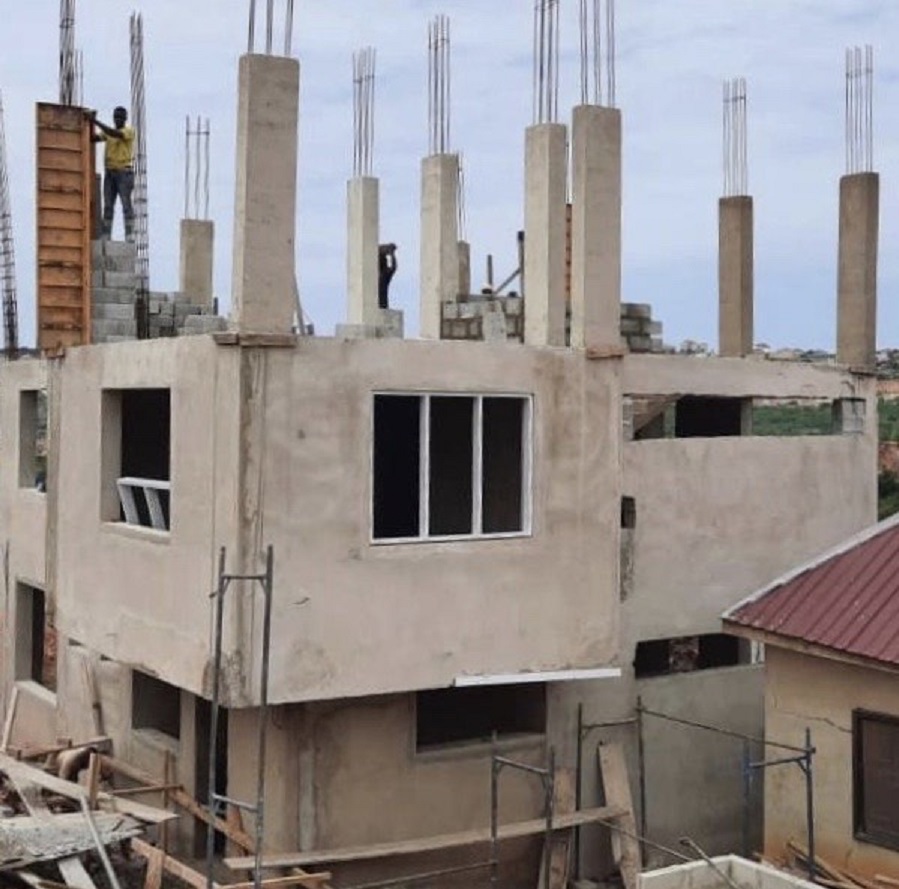
The Mohinani Group, a family-owned manufacturing group shares this view and has been a solid donor. The combined contributions have funded a multi-level building with roofing and water tank having recently been installed. Ongoing work to complete the security setup of the compound still needs to be fitted out.

Once the haven is able to open it will be able to offer its patients 3 months of on-site support, including medical and psychological services and life skills training, followed by a minimum 6-month post-residency monitoring to ensure they are successfully reintegrated into the community. There are many components of care needed and the cost per survivor is 10,500 cedis ($1900).

Audrey Ankah the Project Manager of the Pearl Safe Haven has strongly commended all those who are working to change the narrative on gender-based violence. A diagram below highlights the types of violence women and girls fall prey to:

Recently actress Ama K. Abebrese has drawn international attention to ensure free medical examinations for victims of sexual violence.

“When victims arrive at the haven, one of the initial costs we have to cover are medical expenses and rape kits.

“Some survivors are not able to get the required examinations done because they cannot afford to do so and this leads to them not reporting the matter to the police due to lack of evidence,” Ms Ankah explains.

Ama K. Abebrese has called on the Government of Ghana to abolish the medical costs for sexual assault victims to enable them to seek proper justice against the perpetrators.

The campaign that has been launched through the Change.org platform has received over 15,000 signatures so far and received the attention of the BBC and Reuters International.

Isobel Afful-Mensah (Acquah), co-founder of the Pearl Safe Haven and a lawyer by profession further highlights the need and responsibility of everyone to speak out about the injustices women face when dealing with gender-based violence issues.

She hopes that ensuring free medical examinations will reduce the stigma for victims to come forward as well as relieve the Haven financially, allowing them to use resources on the many other areas of care needed.

To support a survivor, donations can be made in full or monthly instalments by the following ways:

Access Bank Ghana: Account No. 0030107532161, Osu-Oxford St Branch, ABNGGHAC

Mobile Money: The Pearl Safe Haven – 0247293648

Click to comment

Leave a Reply

Your email address will not be published. Required fields are marked *

World

Nigeria Leads Africa in Equity Funding as Startup Investment Hits $254m in H1 2026

Published

on

Investment-Worthy Startups

By Adedapo Adesanya

Nigeria regained its position as Africa’s leading destination for equity startup investment in the first half of 2026, raising $214 million in equity financing and a total of $254 million across equity and debt, according to the latest Africa: The Big Deal report.

The report, titled H1 2026: Mapping the Money, showed that Nigeria ranked second on the continent in total funding, behind Egypt, which attracted $327 million, while Kenya and South Africa followed with $126 million and $83 million, respectively.

However, the report noted that Egypt’s top position was largely driven by a single fundraising by electric mobility company Spiro, which secured $327 million, including $270 million in equity and $57 million in debt. Excluding debt financing, Nigeria emerged as Africa’s largest equity funding market in the first six months of the year.

According to the breakdown by Africa: The Big Deal, Nigeria’s equity funding of $214 million was higher than Egypt’s $183 million, while South Africa and Kenya attracted $66 million and $46 million, respectively.

Beyond funding value, Nigeria also led the continent in the number of startups that raised at least $100,000 during the review period, reclaiming the top spot after what the report described as an “underwhelming” second half of 2025.

The publication observed that Nigeria’s fundraising performance has remained relatively stable over the past few years and exceeded the $250 million mark for the first time since 2022, pointing to renewed investor confidence in the country’s startup ecosystem.

It also found that while the Big Four startup markets—Nigeria, Egypt, Kenya and South Africa—continued to dominate Africa’s investment landscape, their combined share of total funding stood at 58 per cent in the first half of 2026.

“Zooming back on the Big Four (110 out of 190 $100k+ deals, i.e. 58%), Nigeria is head and shoulders above its peers, with Egypt and Kenya almost tying, and South Africa in fourth position again,” the report noted.

The report highlighted contrasting performances among the continent’s largest startup ecosystems. While Nigeria and Egypt maintained strong funding momentum, Kenya recorded its weakest funding performance since early 2021 after a strong second half of 2025, and South Africa failed to attract $100 million in funding during the period despite leading the continent a year earlier.

Africa: The Big Deal also noted a broader shift in investor behaviour, with funding increasingly concentrated in larger transactions while early-stage investments continued to decline. According to the publication, the drop in smaller funding rounds reflects growing concerns about limited capital available for early-stage startups across Africa.

Continue Reading

World

SCRYPT Expands Stablecoin Settlement Infrastructure to East Africa

Published

on

SCRYPT stablecoin

By Aduragbemi Omiyale

Accessing the US Dollar in the East Africa region has now been made easier with the expansion of the stablecoin settlement infrastructure of SCRYPT.

This development enables banks, payment providers and corporate treasury teams to move value into and out of the continent in real time.

Businesses paying international suppliers frequently have to convert local currency into USD before purchasing stablecoins for settlement, incurring FX conversions and spreads before any payment is made.

But SCRYPT is eliminating this intermediate conversion by enabling direct settlement corridors for local African currencies into stablecoins.

This development allows businesses to move from local currency to stablecoin settlement in a single licensed transaction, without first sourcing rationed bank dollars, as stablecoins are increasingly becoming settlement infrastructure rather than an investment product.

The expansion adds settlement support across four African currencies: the Kenyan shilling (KES), Tanzanian shilling (TZS), Rwandan franc (RWF) and Ugandan shilling (UGX). Each corridor is delivered through the same full-stack infrastructure our clients already use for trading, custody and treasury operations.

Speaking on this, the chief executive of SCRYPT, Norman Wooding, said, “Across Africa, stablecoin adoption is driven by economic need, not speculation.

“Businesses here are not chasing yield; they are trying to pay suppliers and manage treasury without losing margin to a banking system that rations dollars. Licensed, fair-rate dollar access is the clearest proof of what this infrastructure is for.”

Also commenting, the Managing Director of Markets & Trading at SCRYPT, Mr Gabriel Titopoulos, said, “Until now, reaching stablecoins from local African currencies meant buying scarce dollars and incurring several layers of conversion costs.

“SCRYPT removes this friction. Firms and payment providers can now settle straight from local currencies through live corridors, with local partners.”

Continue Reading

World

African Graduates Association Promoting Multifaceted Initiatives With Russian Educational Institutions

Published

on

Francois Ngan Professor Vladimir Filippov African Graduates Association

By Kestér Kenn Klomegâh

In preparations for the third Russia-Africa Summit, scheduled for late October 2026, Dr Francois Ngan, deputy chairman of the Union of Associations of African Graduates of Soviet and Russian Universities, during an official working visit, has held a consultative meeting with Professor Vladimir Filippov, the President of the Russian University of Peoples’ Friendship (RUDN), and former Minister of Higher Education of Russia, Chairman of the National Commission for Accreditation of Higher Education.

RUDN is an educational institution established in 1960, primarily to provide higher education to Third World students. It has now become a popular multidisciplinary spot for many students, especially from developing countries. The university offers various academic programmes and has research infrastructure that comprises laboratories and interdisciplinary centres. The university is named after the former Congolese leader, Patrice Lumumba.

Dr Francois Ngan and Professor Filippov discussed the importance of the Graduates Association as a continental platform dedicated to strengthening unity, cooperation, and promoting shared progress among African graduates who studied in the former Soviet Union and in the Russian Federation. They also reviewed multifaceted initiatives that could bring together alumni associations from across Africa, whose members obtained education and professional training, and cultural experiences in Soviet and Russian institutions of higher learning.

Professor Filippov expressed optimism in addressing emerging challenges as a result of shifting geopolitical changes, emphasised strategic cooperation in the educational sphere with Africa, in general, and with the Republic of Cameroon, in particular, and further about the integration of African students during their studies in the Russian Federation.

The meeting also touched on academic and scientific work, the possibility of rewriting a scientific thesis, and the official organisation of transferring versions translated into six languages ​​for the library of RUDN. Significant questions relating to Russia’s educational opportunities, collaborations and partnerships involving African countries were thoroughly discussed.

The Union of Associations of African Graduates of Soviet and Russian Universities was created under one continental umbrella to promote friendship, for professional networking, to engage in cultural exchange, and with particular emphasis on forging strategic cooperation between Africa and Russia.

Continue Reading