Connect with us

World

Russia’s Far East Development: Fostering Collaboration through Eastern Economic Forum

Published

on

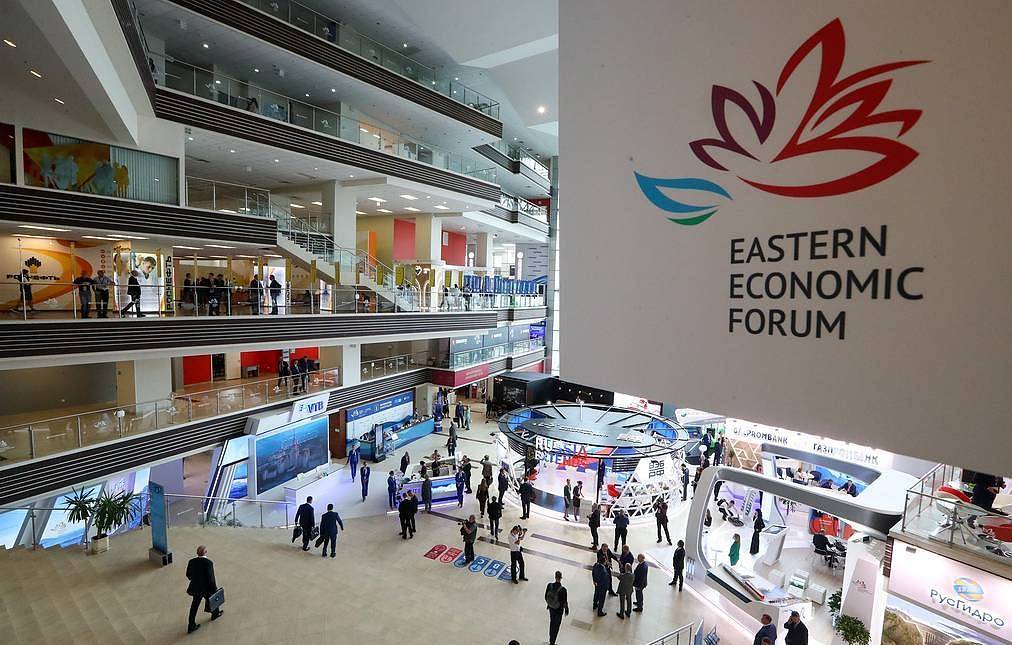
Eastern Economic Forum

By Kester Kenn Klomegah

The Far Eastern Federal University (FEFU) will host the 6th edition of the Eastern Economic Forum (EEF) on September 2-4 in Vladivostok that is expected to bring together corporate business directors and investors from the Asian-Pacific region and the Far East region of Russia.

Roscongress Foundation, the organizer of the forum, said in a statement that preparations were underway and would depend on the situation with the current pandemic.

“The EEF will most likely be held this year, the dates are under discussion so far, but the issue is about autumn. The format will depend on the epidemiological situation,” it said.

The forum is traditionally held in early September on Russky Island in the Primorye Territory. But, it was cancelled in 2020 due to the coronavirus pandemic.

“I am confident that this year’s Forum will build on its investment capacity. Moreover, it will become an important platform for developing humanitarian ties in light of our cooperation with Asian countries in fighting COVID-19,” according to the Advisor to the President of the Russian Federation, Executive Secretary of the EEF Organizing Committee, Anton Kobyakov.

Kobyakov said that, “the forum will be organized at the highest level, following the recommendations of Russia’s Federal Service for the Oversight of Consumer Protection and Welfare (Rospotrebnadzor) and the World Health Organization (WHO).

Kobyakov describes the economic forum as an efficient tool for developing international multilateral cooperation in the Asia-Pacific, which annually brings together leaders of the top APAC countries for discussing universal aspects of the global economy.

The meeting considered an important step forward in developing and strengthening investment‑related collaboration between business communities in the Far East.

As one of the biggest economic forums in Russia, it yearly gathers several thousands of participants, including representatives of ministries and government bodies, financial and investment organizations, startups, and tech and innovation companies, and representatives of the media.

The 5th forum in September 2019, hosted over 100-panel discussions, roundtables, and business breakfasts dedicated to the most relevant topics on the international and regional agendas. The discussions were focused on 4 thematic areas:

  • New Solutions for Accelerating Economic Growth
  • Improving the Business Environment
  • The Far East and Asia Pacific: Fostering Collaboration
  • New Solutions for Improving Quality of Life

The plenary session featured Vladimir Putin, President of the Russian Federation, Shinzō Abe, Prime Minister of Japan, Narendra Modi, Prime Minister of India, Mahathir Bin Mohamad, Prime Minister of Malaysia, and Khaltmaagiin Battulga, President of Mongolia and many other dignitaries and high-profile personalities.

Russia is one of the few countries that is located both in Europe and in Asia. Its unique geographical location makes it a bridge between East and West, between Europe and Asia. It (forum) helps foster partnership across the Asia-Pacific region.

The Eastern Economic Forum was established by decree of President of the Russian Federation Vladimir Putin in 2015 to support the economic development of Russia’s Far East and to expand international cooperation in the Asia-Pacific region.

During the 2019 forum, the Welcome to the Far East exhibition particularly showcased the results of the work of government agencies over the previous five years and the prospects for the development of the Far East under the National Programme 2025.

President Vladimir Putin has been making efforts to transform the Far East into a vibrant industrial and commercial region by attracting both local and foreign investors. The Russian government has allocated a huge budget for its development. Putin has stated, several times, that the government implements additional initiatives to drive the economy, rebuild infrastructure and intensify efforts to improve the investment climate, and create employment opportunities there as part of its priority programme.

Given the vast territory of the Far East, 6.3 million people translate to slightly less than one person per square kilometre, making the Far East one of the most sparsely populated areas in the world. The Russian government continues discussing a range of population programmes, hoping to attract in particular Russians there, but eventually agreeing on populating the region through system immigration similar to Canada.

Until 2000, the Russian Far East lacked officially-defined boundaries. A single term “Siberia and the Far East” often referred to Russia’s regions east of the Urals without drawing a clear distinction between “Siberia” and “the Far East”. That, however, the Far East is generally considered as the easternmost territory of Russia, between Lake Baikal in Eastern Siberia and the Pacific Ocean.


Click to comment

Leave a Reply

Your email address will not be published. Required fields are marked *

World

Russia, Tanzania Boost Bilateral Economic Ties

Published

on

Russia Tanzania

By Kestér Kenn Klomegâh

From Africa’s perspectives on attaining economic sovereignty, Tanzania, located in East Africa, has seriously begun showing the investment model as Russia pledges tremendous support during the meeting of the Russian-Tanzanian intergovernmental commission in Arusha, in mid-May 2026. Russia is undertaking various development projects as well as addressing bilateral issues relating to investment, trade and innovation on the African continent, and described Tanzania as the gateway to the broader East African region.

Step 1:  Gazprom is interested in implementing comprehensive gas projects in Tanzania, according to the report issued by the Ministry of Economic Development. It says Gazprom, in addition to selling natural gas, LNG, and petrochemical products, is ready to supply technologies and equipment for gas production, processing, transportation, and sales. It says Gazprom is continuing its work on a pilot project launched last year to supply two mobile gas tankers to Tanzania.

NOVATEK has also indicated its preparedness to participate in natural gas exploration and production projects in Tanzania, and for now, the staff are awaiting information on the date of the fifth round of license allocation for exploration blocks, as well as on the acquisition of blocks outside the tender process—specifically, at the Ntorya field. “Tanzania has significant resource potential, and the economy’s growing demand for electricity and fuel opens up significant opportunities for joint projects. The current situation in the Strait of Hormuz compels us to seek new solutions to ensure that it does not reduce economic growth on the African continent, and particularly in Tanzania,” said Maxim Reshetnikov, head of the Ministry of Economic Development, speaking at a meeting of the Russian-Tanzania intergovernmental commission in Arusha.

Step 2: Russia and Tanzania plan to sign a memorandum of cooperation in tourism in Moscow. In June, as part of the “Travel!” forum in Moscow (June 10-14), the Tanzanian delegation was already given the invitation to participate, noted Reshetnikov while further explaining that Russia is interested in launching direct air service between the two countries, which would “give a powerful boost to tourism development.”

Air Tanzania’s initiative to launch flights from Moscow to Dar es Salaam, with high hopes that Russia and Tanzania will complete the necessary procedures for the entry into force of the new air traffic agreement as quickly as possible. In particular, officials are awaiting notification from the Tanzanian side regarding the entry into force of this agreement.

Air Tanzania will begin flights from Dar es Salaam, Tanzania’s largest city, on May 28. According to the online flight information at the capital’s Vnukovo Airport, flights on this route will include a stopover on the island of Zanzibar. Flights will operate three times a week, on Tuesdays, Thursdays, and Saturdays. The program will run until October 24.

Step 3: Tanzanian President Samia Suluhu Hassan is expected on an official state visit to Russia in June, and that will boost bilateral trade and investment, and provide an additional impetus to developing mutual cooperation.

“In preparation for the upcoming high-level meeting, I propose discussing both promising areas and specific projects… and identifying key areas for further cooperation. In addition to trade, these include energy, transport, industry, agriculture, tourism, science, and education,” Reshetnikov said.

The Tanzanian delegation is expected to participate in the St. Petersburg International Economic Forum, which will be held from June 3 to 6.  Usually, at the St. Petersburg forum, the African agenda is of great importance. The programme includes the Russia-Africa Business Dialogue, which, since 2016, has been the annual meeting place for representatives of Russian and African business and official communities. Roscongress Foundation organises it.

Continue Reading

World

AFC Backs Future Africa, Lightrock in $100m Tech VC Funding Bet

Published

on

Lightrock Africa

By Adedapo Adesanya

Infrastructure solutions provider, Africa Finance Corporation (AFC), has committed parts of a $100 million investment to fund managers—Future Africa and Lightrock Africa—to boost African tech venture backing.

The commitment to Lightrock Africa Fund II and Future Africa Fund III is the first tranche of a broader deployment, AFC noted.

The corporation added that it is actively evaluating a pipeline of additional Africa-focused funds spanning a range of strategies and stages, with further commitments expected in the near term.

This is part of its efforts to plug a persistent gap in long-term institutional capital on the continent, which constrains the development and scaling of high-potential technology businesses across the continent, especially with a drop in foreign investments.

“Through this commitment, AFC will deploy catalytic capital in leading Africa-focused technology Funds and, in particular, African-owned fund managers,” it said in a statement on Monday.

AFC aims to address the underrepresentation of local capital in venture funding by catalysing greater participation from African institutional investors and deepening local ownership within the ecosystem.

Despite some success stories on the continent, local institutional capital remains significantly underrepresented across many fund cap tables, with the majority of venture funding continuing to flow from international sources.

AFC’s commitment is designed to shift that dynamic, according to Mr Samaila Zubairu, its chief executive.

“Across the continent, young Africans are not waiting for the digital economy to arrive; they are seizing the moment — adopting technology, creating markets and solving real economic problems faster than infrastructure has kept pace. That is the investment signal.

“AFC’s $100 million Africa-focused Technology Fund will accelerate the convergence of growing demand, rapid technology adoption, youthful demographics and the enabling infrastructure we are building.

“Digital infrastructure is now as fundamental to Africa’s transformation as roads, rail, ports and power — enabling productivity, payments, logistics, services, data and cross-border trade, while creating jobs and industrial scale.”

Mr Pal Erik Sjatil, Managing Partner & CEO, Lightrock, said: “We are delighted to welcome Africa Finance Corporation as an anchor investor in Lightrock Africa II, deepening a strong partnership shaped by our collaboration on high-impact investments across Africa, including Moniepoint, Lula, and M-KOPA.

“With aligned capital, a long-term perspective, and a shared focus on value creation, we are well positioned to support exceptional management teams and scale category-leading businesses that deliver attractive financial returns alongside measurable environmental and social outcomes,” he added.

Adding his input, Mr Iyin Aboyeji, Founding Partner, Future Africa, said: “By investing in AI-native skills, financing productive tools such as phones and laptops, and expanding energy, connectivity and compute infrastructure, we can convert Africa’s greatest asset — its people — into critical participants in the new global economy. AFC’s US$100 million commitment is the anchor this moment demands.

“As our first multilateral development bank partner, AFC is sending a clear signal that digital is as fundamental to Africa’s transformation as agriculture, manufacturing and physical infrastructure. We trust that other development finance institutions, insurers, reinsurers and pension funds will follow AFC’s lead.”

Continue Reading

World

Dangote Secures Uganda’s Support for East African Refinery Ambition

Published

on

Dangote monopoly Political Economy of Failure

By Adedapo Adesanya

Dangote’s East African refinery plan gained momentum as Ugandan President Yoweri Museveni threw his support behind the proposed project following talks with Mr Aliko Dangote.

In a tweet posted on X (formerly Twitter) on May 17, 2026, the Ugandan President announced that he had met with the Nigerian billionaire at Nakasero, and revealed that the meeting centred around the development of a proposed 650,000 barrels per day regional oil refinery in East Africa.

Mr Museveni emphasised adding value by refining oil locally rather than exporting crude, to maximise economic and strategic benefits for the region.

He called for greater regional cooperation and market integration in East Africa, highlighting the importance of large-scale projects for shared prosperity.

Business Post has earlier reported that Kenya has been positioned as the central player following Tanzania’s recent denial of its support of the project.

Mr Dangote said the East African country was his preferred choice due to its established fuel logistics network and port infrastructure serving several neighbouring countries.

In the latest development, the Ugandan president explained that his primary focus remains on value addition.

He detailed why Uganda has historically refrained from exporting raw crude oil, arguing that doing so allows foreign entities to exploit the country’s natural resources and reap the financial rewards of refined products.

“Without refining our oil, it would not make economic or strategic sense to simply export crude oil while others benefit from the finished products,” Mr Museveni stated.

The president expressed strong support for a larger regional refinery, describing it as a crucial step toward “African integration and shared prosperity.”

He further emphasised that East African nations must move past an individualistic mindset and overcome fragmented markets, urging regional cooperation to execute large-scale projects that benefit the entire populace.

“We cannot continue operating in fragmented and weak markets,” Mr Museveni wrote. “If East Africa works together, such projects become more viable and beneficial to our people.”

“Uganda is ready to support the regional refinery initiative while also continuing with the development of our own refinery in Hoima,” he added.

Continue Reading

Trending