Connect with us

Economy

FAAC Allocation for April 2022 Increases by 4.39% to N725.57bn

Published

on

FAAC disburses

By Aduragbemi Omiyale

The amount disbursed to the federal government, state government and the 774 local councils in the country for the month of April 2022 increased by 4.39 per cent as a result of the increase in Petroleum Profit Tax (PPT), Oil and Gas Royalties, Import and Excise Duties, Companies Income Tax (CIT) and Value Added Tax (VAT).

According to the communiqué issued on Wednesday after the monthly Federation Account Allocation Committee (FAAC) meeting, the revenue generated by the nation in March 2022 and shared this month stood at N725.57 billion compared with the N 695.03 billion distributed from the federation account revenue last month.

From this, the sum of N521.17 billion was distributable statutory revenue, while N204.40 billion was distributable VAT revenue, higher than the N177.87 billion of the preceding month.

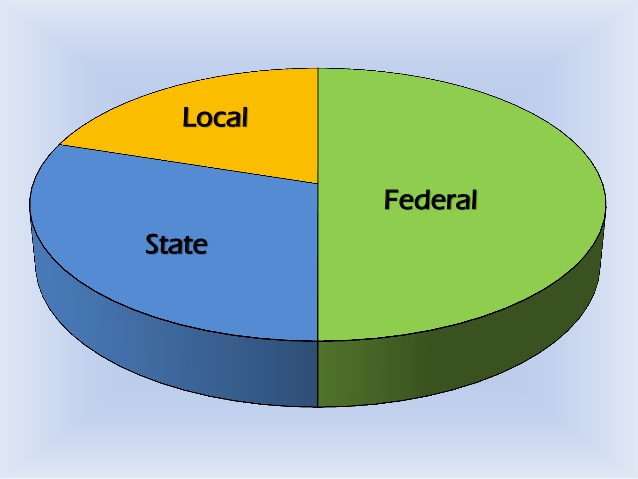
It was stated that from the distributable statutory revenue of N725.57 billion, the federal government received N277.10 billion, the state governments got N227.20 billion, and the local government councils were given N167.91 billion.

A breakdown indicated that from the N521.17 billion distributable statutory revenue, the federal government was given N246.44 billion, the states got N125.00 billion, while the councils received N96.37 billion, with N53.36 billion shared with the relevant states as 13 per cent derivation revenue.

The sum of N6.32 billion was allocated to North East Development Commission (NEDC) and the N8.780 billion cost of the collection were deducted from the VAT revenue of N219.50 billion, resulting in the distributable VAT of N204.40 billion.

From this, the federal government received N30.66 billion, the states got N102.20 billion, and the local government councils received N71.54 billion.

According to FAAC, the balance in the Excess Crude Account (ECA) of the nation is $35.372 million.

Business Post reports that the states were able to force the federal government to delay the planned deductions for the $418 million Paris Club refund consultant fee being disputed at the court.


Aduragbemi Omiyale is a journalist with Business Post Nigeria, who has passion for news writing. In her leisure time, she loves to read.

Advertisement
1 Comment

Leave a Reply

Your email address will not be published. Required fields are marked *

Economy

Fidson, Jaiz Bank, Others Keep NGX in Green Territory

Published

on

Jaiz Bank new logo

By Dipo Olowookere

A further 0.99 per cent was gained by the Nigerian Exchange (NGX) Limited on Friday after a positive market breadth index supported by 53 price gainers, which outweighed 23 price losers, representing bullish investor sentiment.

During the trading day, the trio of Jaiz Bank, Fidson, and NPF Microfinance Bank chalked up 10.00 per cent each to sell for N11.00, N86.90, and N6.27, respectively, while Deap Capital appreciated by 9.96 per cent to N7.62, and Mutual Benefits increased by 9.94 per cent to N5.42.

Conversely, Secure Electronic Technology shed 10.00 per cent to trade at N1.62, Sovereign Trust Insurance slipped by 9.73 per cent to N2.32, Ellah Lakes declined by 7.91 per cent to N12.80, International Energy Insurance retreated by 5.56 per cent to N3.40, and ABC Transport moderated by 5.26 per cent to N9.00.

Data from Customs Street revealed that the insurance counter was up by 2.52 per cent, the industrial goods sector grew by 2.28 per cent, the banking space expanded by 1.43 per cent, the consumer goods index gained 1.23 per cent, and the energy industry rose by 0.05 per cent.

As a result, the All-Share Index (ASI) went up by 1,916.20 points to 194,989.77 points from 193,073.57 points, and the market capitalisation moved up by N1.230 trillion to N125.164 trillion from Thursday’s N123.934 trillion.

Yesterday, investors traded 820.5 million stocks valued at N28.3 billion in 63,507 deals compared with the 898.5 million stocks worth N38.5 billion executed in 61,953 deals, showing a jump in the number of deals by 2.51 per cent, and a shortfall in the trading volume and value by 8.68 per cent and 26.49 per cent apiece.

Closing the session as the most active equity was Mutual Benefits with 79.0 million units worth N427.1 million, Zenith Bank traded 44.0 million units valued at N3.8 billion, Chams exchanged 43.9 million units for N182.0 million, AIICO Insurance transacted 42.4 million units valued at N179.8 million, and Veritas Kapital sold 36.0 million units worth N90.6 million.

Continue Reading

Economy

Brent Climbs to $71 on Fears of US Military Action Against Iran

Published

on

brent crude oil

By Adedapo Adesanya

The price of Brent crude oil grade went up by 0.14 per cent or 10 cents to $71.76 per barrel on Friday as investors worried about US military action against Iran, as President Donald Trump presses the Islamic Republic to halt nuclear weapon development.

However, the US West Texas Intermediate (WTI) crude oil grade finished at $66.39 a barrel after going down by 4 cents or 0.06 per cent.

The market awaited developments in the struggle between Iran and the US after President Trump said, “We have to make a meaningful deal, otherwise bad things happen,” referring to Iran.

The main concern for the crude oil market is that military activity will lead to a supply disruption if Iran decides to block shipping in the Strait of Hormuz. About 20 per cent of the world’s oil consumption passes through that waterway. Conflict in the area could limit oil entering the global market and push up prices.

There is the fear that a potential US military campaign in Iran could disrupt shipping in the Middle East are also adding upward pressure on supertanker rates.

Traders and investors ramped up purchases of call options on Brent crude in recent days, betting on higher prices.

Also supporting oil were reports of falling crude stocks and limited exports in the world’s biggest oil-producing and exporting countries. US crude inventories dropped by 9 million barrels as refining utilisation and exports climbed, an Energy Information Administration (EIA) report showed on Thursday.

Markets were also considering the impact of ample supply, with talks of the Organisation of the Petroleum Exporting Countries and its allies (OPEC+) leaning towards a resumption in oil output increases from April.

Eight OPEC+ producers – Saudi Arabia, Russia, the United Arab Emirates, Kazakhstan, Kuwait, Iraq, Algeria and Oman will meet on March 1. The eight members raised production quotas by about 2.9 million barrels per day from April to the end of December 2025, equating to about 3 per cent of global demand, and froze further planned increases for January through March 2026 because of seasonally weaker consumption.

Meanwhile, the oil market shrugged off a US Supreme Court decision ruling unconstitutional President Trump’s use of a law to levy tariffs in national emergencies.

Continue Reading

Economy

PENGASSAN Kicks Against Tinubu’s Executive Order on Oil, Gas Revenues

Published

on

By Adedapo Adesanya

The Petroleum and Natural Gas Senior Staff Association of Nigeria (PENGASSAN) has faulted the Executive Order signed by President Bola Tinubu on oil and gas revenues.

President Tinubu this week signed the Executive Order, titled The Upstream Petroleum Operations Cost Efficiency Incentives Order (2025), to safeguard and enhance oil and gas revenues for the Federation, curb wasteful spending, eliminate duplicative structures in the sector, and redirect resources for the benefit of the Nigerian people.

However, at a press conference in Abuja, PENGASSAN president, Mr Festus Osifo, argued that the tax incentives granted to oil companies by the President may not help in the reduction of cost if insecurity is not addressed.

“The Executive Order signed by the President yesterday is a direct attack on the provisions of the Petroleum Industry Act (PIA)—specifically Sections 8, 9, and 64,” Mr Osifo said.

“What the President has done is use an Executive Order to set aside a law of the Federal Republic of Nigeria. This is deeply troubling. What signal are we sending to investors and the international community?

“We are effectively telling them that the law of the land can be set aside by a simple executive decree. This is an aberration and should never have happened.”

According to a statement by the presidential spokesperson, Mr Bayo Onanuga, the President signed the EO in pursuance of Section 5 of the Constitution of the Federal Republic of Nigeria (as amended).

The Executive Order is anchored on Section 44(3) of the Constitution, which vests ownership, control, and derivative rights in all minerals, mineral oils, and natural gas in, under, and upon any land in Nigeria—including its territorial waters and Exclusive Economic Zone—in the Government of the Federation.

The directive seeks to restore the constitutional revenue entitlements of the federal, state, and local governments, which were removed in 2021 by the Petroleum Industry Act (PIA).

According to Mr Onanuga, the PIA created structural and legal channels through which substantial Federation revenues are lost via deductions, sundry charges, and fees.

Under the current PIA framework, NNPC Limited retains 30 per cent of the Federation’s oil revenues as a management fee on Profit Oil and Profit Gas derived from Production Sharing Contracts, Profit Sharing Contracts, and Risk Service Contracts. Additionally, the company retains 20 per cent of its profits for working capital and future investments.

The federal government considers the additional 30 per cent management fee unjustified, as the 20 per cent retained earnings are already sufficient to support NNPC Limited’s functions under these contracts.

Moreover, NNPC Limited also retains another 30 per cent of profit oil and profit gas under the Frontier Exploration Fund, as stipulated in sections 9(4) and (5) of the PIA.

Continue Reading

Trending