World
Russia’s Strategic Interest in Eritrea
By Kester Kenn Klomegah
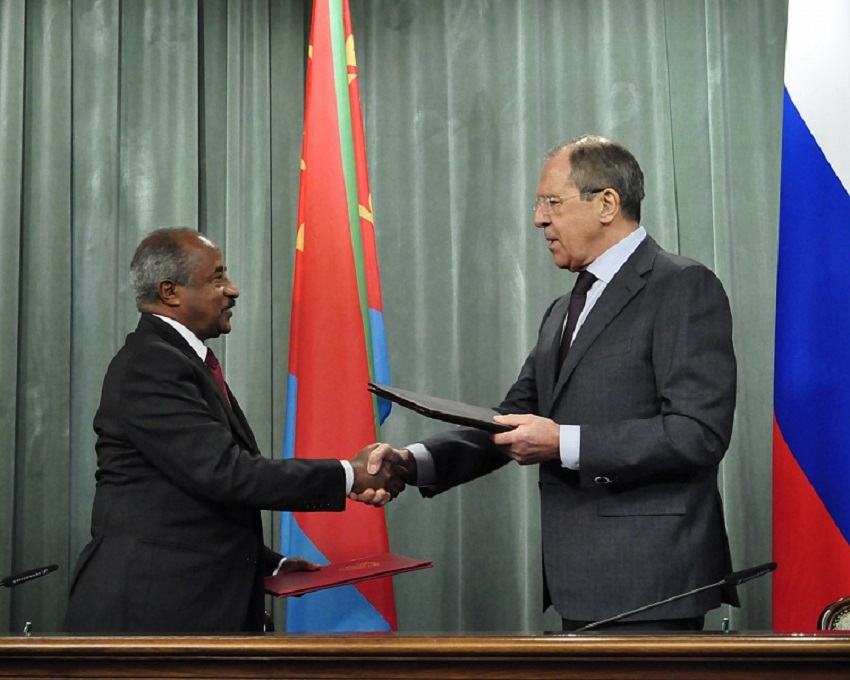
Foreign Minister Sergey Lavrov has reaffirmed Russia’s strategic interest to make coordinated efforts aimed at building a logistics hub along the coastline of the Republic of Eritrea during diplomatic talks attended by Foreign Minister of the State of Eritrea Osman Saleh who, on April 27, paid a working visit to Moscow.
Ahead of the diplomatic talks, there was the speculation that Russia would use Eritrea but voted against the United Nations resolution on March 2. In late February, Russia started “special military operations” directed at demilitarizing and denazifying in the post-Soviet republic of Ukraine.
After the heated debates and discussions, the UN General Assembly overwhelmingly adopted a resolution demanding that Russia immediately end its military operations in Ukraine. According to reports, the Assembly had all 193 UN Member States in attendance. A total of 141 countries voted in favour of the resolution, which reaffirms Ukrainian sovereignty, independence and territorial integrity.
Reports say that Africa, however, presented a divided front that was reflected in the attitude toward voting. Out of the 35 countries that abstained from voting, 17 (nearly half) were Africans. Twenty-eight African countries voted in favour, seven others did not participate in the vote, while Eritrea backed Russia. Eritrea’s expression of support has policy significance for Russia. It glaringly showcases its expression of traditional friendly interest and solidarity.
With the changing global politics, Russia and Eritrea noted the similarity of views on the main current issues, including the importance of making international affairs more democratic and ensuring the right of nations to choose their own future, their political and socio-economic development paths and models, Lavrov said during the joint media conference.
“We presented our views on the situation in and around Ukraine. We pointed out that the goal of our actions is to protect people from the military threat posed by the Kyiv regime and to demilitarize and denazify that country. We expressed appreciation for Eritrea’s objective and responsible position regarding the situation in Ukraine,” he said.
Highlighting the general developments in the African Horn region, Lavrov reassured Moscow’s continuous contribution towards stronger stability and security in Africa, including on the basis of the African Solutions to African Problems principle.
Both ministers reviewed some aspects of preparations for the second Russia-Africa summit during the third quarter of 2022. On economic cooperation, the Russian Ministry of Foreign Affairs, in its official media statements, said the agenda for Russia-Eritrea cooperation has a key focus on the implementation of potential joint projects, including the logistics hub in Asmara.
Eritrea, bordered by Ethiopia in the south, Sudan in the west, and Djibouti in the southeast, has an extensive coastline along the Red Sea. It could be the busiest shipping lane, with the controlling access to the Red Sea and the Indian Ocean. The commercial activities revolve around this strategic location as a transit point and the strategic location also makes the country prime for an increased military presence. This is the strategic importance for Russia.
Against this backdrop, Lavrov and Sahel have previously discussed this logistics project. For instance, 0n August 31, 2018, Lavrov held talks with Saleh in the southern city of Sochi. In fact, the year 2018 marked 25 years of diplomatic relations between Russia and Eritrea.
Lavrov spoke extensively about economic cooperation. According to him, Russia’s truck maker KAMAZ was already working in Eritrea, supplying its products to that country, as was Gazprombank Global Resources, which was building cooperation in the banking sector. In the same year 2018, concrete talks were held to build a logistics centre at the port of Eritrea, which makes the world’s class logistics and services hub for maritime transportation through the Suez Canal and definitely set to promote bilateral trade.
Still that same year, Eritrea was interested in opening a Russian language department at one of the universities in the capital of the country, Asmara. Lavrov further indicated: “We agreed to take extra measures to promote promising projects in the sphere of mining and infrastructure development and to supply specialized transport and agricultural equipment to Eritrea.”
According to the official website of the Foreign Ministry, the information posted in 2018 to media questions concerning the Russian side that noted positive trends on the Horn of Africa, and steps being taken by both sides to settle conflicts in the region, Lavrov replied: “we cooperate in many diverse areas: natural resources, all types of energy engineering, including nuclear and hydroelectric energy, and new sources of energy, infrastructure in all its aspects, medicine, the social sphere, transport and many more.”
Regarding the conflicts in the Horn of Africa, Lavrov pointed back in 2018 that “Eritrea and Ethiopia are our longstanding partners. We wish them success in stepping up the normalization process that will benefit all, including the people of both countries, in the economy as well.”
Russia and Eritrea have shown interest in deepening the inter-state dialogue and economic cooperation, objective conditions exist for enhanced interaction between our two countries in the international arena. The Republic of Eritrea plays an important role in sub-regional affairs. As already known, despite its location, it has some competitive advantages and at the same time a number of problems with its neighbour Ethiopia.
The undemarcated border with Ethiopia is the primary external issue facing Eritrea. Its relations with Ethiopia turned from that of cautious mutual tolerance, following the 30-year war for Eritrean independence, to a deadly rivalry that led to the outbreak of hostilities from May 1998 to June 2000 which claimed approximately 70,000 lives from both sides. A peace treaty between both nations was signed on 8 July 2018, formally ending the conflict with Ethiopia.
Eritrea is now a member of the African Union. The Eritrean government previously withdrew its representative to the African Union to protest the AU’s alleged lack of leadership in facilitating the implementation of a binding border decision demarcating the border between Eritrea and Ethiopia. The Eritrean government has since January 2011 appointed an envoy, Tesfa-Alem Tekle, to the African Union.
World
Trump Picks Kevin Warsh to Succeed Jerome Powell as Federal Reserve Chair
By Adedapo Adesanya
President Donald Trump has named Mr Kevin Warsh as the successor to Mr Jerome Powell as the Federal Reserve chair, ending a prolonged odyssey that has seen unprecedented turmoil around the central bank.
The decision culminates a process that officially began last summer but started much earlier than that, with President Trump launching a criticism against the Powell-led US central bank almost since he took the job in 2018.
“I have known Kevin for a long period of time, and have no doubt that he will go down as one of the GREAT Fed Chairmen, maybe the best,” Mr Trump said in a Truth Social post announcing the selection.
US analysts noted that the 55-year old appear not to ripple market because of his previous experience at the apex bank as Governor, with others saying he wouldn’t always do the bidding of the American president.
If approved by the US Senate, Mr Warsh will take over the position in May, when Mr Powell’s term expires.
Despite having argued for reductions recently, “Warsh has a long hawkish history that markets have not forgotten,” one analyst told Bloomberg.
President Trump has castigated Mr Powell for not lowering interest rates more quickly. His administration also launched a criminal investigation of Powell and the Federal Reserve earlier this month, which led Mr Powell to issue an extraordinary rebuke of President Trump’s efforts to politicize the independent central bank.
World
BRICS Agenda, United States Global Dominance and Africa’s Development Priorities
By Kestér Kenn Klomegâh
Donald Trump has been leading the United States as its president since January 2025. Washington’s priority is to Make America Great Again (MAGA). Trump’s tariffs have rippled many economies from Latin America through Asian region to the continent of Africa. Trump’s Davos speech has explicitly revealed building a ‘new world order’ based on dominance rather than trust. He has also initiated whirlwind steps to annex Greenland, while further created the Board of Peace, aimed at helping end the two-year war between Israel and Hamas in Gaza and to oversee reconstruction. Trump is handling the three-year old Russia-Ukraine crisis, and other deep-seated religious and ethnic conflicts in Africa.
These emerging trends, at least in a considerable short term, are influencing BRICS which has increased its geopolitical importance, and focusing on uniting the countries in the Global East and Global South. From historical records, BRICS, described as non-western organization, and is loosing its coherence primarily due to differences in geopolitical interests and multinational alignments, and of course, a number of members face threats from the United States while there are variations of approach to the emerging worldwide perceptions.
In this conversation, deputy director of the Center for African Studies at Moscow’s National Research University High School of Economics (HSE), Vsevolod Sviridov, expresses his opinions focusing on BRICS agenda under India’s presidency, South Africa’s G20 chairmanship in 2024, and genegrally putting Africa’s development priorities within the context of emerging trends. Here are the interview excerpts:
What is the likely impact of Washington’s geopolitics and its foreign policy on BRICS?
From my perspective, the current Venezuela-U.S. confrontation, especially Washington’s tightened leverage over Venezuelan oil revenue flows and the knock-on effects for Chinese interests, will be read inside BRICS as a reminder that sovereign resources can still be constrained by financial chokepoints and sanctions politics. This does not automatically translate into BRICS taking Venezuela’s side, but it does strengthen the bloc’s long-running argument for more resilient South-South trade settlement, diversified energy chains, and financing instruments that reduce exposure to coercive measures, because many African and other developing economies face similar vulnerabilities around commodities, shipping, insurance, and correspondent banking. At the same time, BRICS’ expansion makes consensus harder: several members maintain significant ties with the U.S., so the most likely impact is a technocratic push rather than a loud political campaign.
And highlighting, specifically, the position of BRICS members (South Africa, Ethiopia and Egypt, as well as its partnering African States (Nigeria and Uganda)?
Venezuela crisis urges African members to demand that BRICS deliver usable financial and trade tools. For South Africa, Ethiopia, and Egypt, the Venezuela case is more about the precedent: how quickly external pressure can reshape a country’s fiscal room, debt dynamics, and even investor perceptions when energy revenues and sanctions compliance collide. South Africa will likely argue that BRICS should prioritize investment, industrialization, and trade facilitation. Ethiopia and Egypt, both debt-sensitive and searching for FDI, will be especially attentive to anything that helps de-risk financing, while avoiding steps that could trigger secondary-sanctions anxieties or scare off diversified investors.
Would the latest geopolitical developments ultimately shape the agenda for BRICS 2026 under India’s presidency?
India’s 2026 chairmanship is already framed around “Resilience, Innovation, Cooperation and Sustainability,” and Venezuela’s shock (paired with broader sanction/market-volatility lessons) will likely sharpen the resilience part. From an African perspective, that is an opportunity: South Africa, Ethiopia, and Egypt can press India to translate the theme into deliverables that matter on the ground: food and fertilizer stability, affordable energy access, infrastructure funding. India, in turn, has incentives to keep BRICS focused on economic problem-solving rather than becoming hostage to any single flashpoint. So the Venezuela episode may function as a cautionary case study that accelerates practical cooperation where African members have the most to gain. And I would add: the BRICS agenda will become increasingly Africa-centered simply because Africa’s weight globally is rising, and recent summit discussions have repeatedly highlighted African participation as a core Global South vector. South Africa’s G20 chairmanship last year explicitly framed around putting Africa’s development priorities high on the agenda, further proves this point.
World
Afreximbank Terminates Credit Relationship With Fitch Amid Rating Tension
By Adedapo Adesanya
African Export-Import Bank (Afreximbank) has has officially terminated its credit rating relationship with Fitch Ratings, indicating friction between both firms.
According to a statement on Friday, the Cairo-based African lender said the decision follows a review of the relationship, and its firm belief that the credit rating exercise no longer reflects a good understanding of the bank’s Establishment Agreement, its mission, and its mandate.
“Afreximbank’s business profile remains robust, underpinned by strong shareholder relationships and the legal protections embedded in its Establishment Agreement, signed and ratified by its member states,” the statement added.
Business Post reports that Fitch had cut Afreximbank’s credit rating to one notch above ‘junk’ Status last year and currently has it on a ‘negative outlook’, which is a rating agency’s terminology for another downgrade warning.
Lower rating means higher borrowing costs for Afreximbank, which could directly impact its ability to lend and the low rates at which it does so.
Recall that Fitch in its report published in June 2025, had estimated Afreximbank’s non-performing loans at 7.1 per cent by the end of 2024, exceeding Fitch’s 6 per cent “high risk” threshold.
The African Peer Review Mechanism (APRM) contested Fitch’s assessment and argued that Fitch confused loan restructuring requests from South Sudan, Zambia, and Ghana by considering them as defaults, claiming this was inconsistent with the 1993 treaty establishing Afreximbank.
African policymakers have raised worries about the ratings by foreign rating agencies like Fitch, Moody’s, and S&P among others. This has increased call for an African focused agency, which is expected to have commenced but continues to face delays.
-
Feature/OPED6 years agoDavos was Different this year
-
Travel/Tourism9 years ago
Lagos Seals Western Lodge Hotel In Ikorodu
-
Showbiz3 years agoEstranged Lover Releases Videos of Empress Njamah Bathing
-
Banking8 years agoSort Codes of GTBank Branches in Nigeria
-
Economy3 years agoSubsidy Removal: CNG at N130 Per Litre Cheaper Than Petrol—IPMAN
-
Banking3 years agoSort Codes of UBA Branches in Nigeria
-
Banking3 years agoFirst Bank Announces Planned Downtime
-
Sports3 years agoHighest Paid Nigerian Footballer – How Much Do Nigerian Footballers Earn