Feature/OPED
Upholding Governor Okowa’s Gbaramatu Initiative As Panacea For Niger Delta Peace

By Ephraim Okwuosa
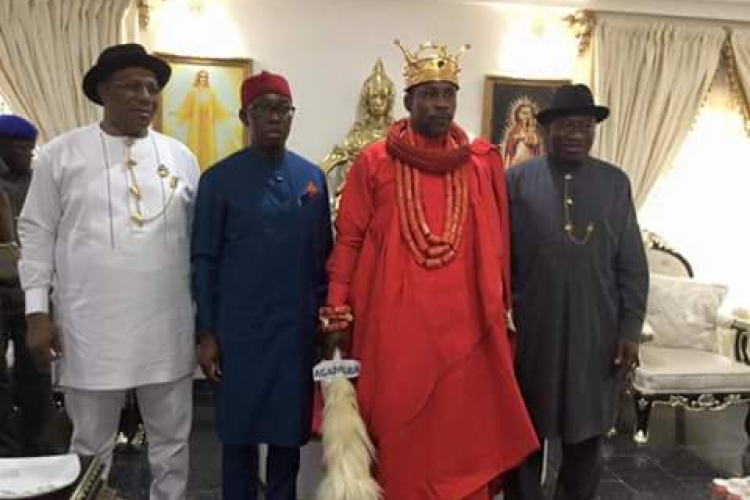
The recent initiative of the Delta State Governor, Dr Ifeanyi Okowa, in requesting the company of immediate past President Goodluck Jonathan for a joint visit to Gbaramatu kingdom in the oil producing area of Niger Delta in pursuit of peace, is clear demonstration that a new wave of patriotic support has emerged to boost the on-going efforts of the President Buhari’s leadership to restore peace in the Niger Delta region.
Governor Ifeanyi Okowa’s role as a new dove in the Niger Delta crisis despite his contrasting partisan interest with the Nigeria’s ruling government of President Buhari is not only highly commendable but demonstrates unique intent for collective pursuit of peace.
Nevertheless, this Okowa’s presumed desire for peace demands a thorough substantive discussion that should not end with mere rhetoric.
For now, it is wise to recognise that the fresh initiative for calm by Governor Okowa may be the much needed rational response to the Niger Delta uncertainty. In truth, Governor Okowa’s idea of taking former President Goodluck Jonathan to appeal to the King of Gbaramatu for peace in the Niger Delta region is considered an effective and purposeful diplomacy. Indeed, it is an indication that peace in the Niger Delta may no longer be a distant prospect because this particular action shares a number of features with the past strategy employed in restoring peace in the Niger Delta by the late President Umaru Yar’Adua.
Without a doubt, the problems of militancy in the Niger Delta region of Nigeria’s oil producing areas have had real bite in reducing the Federal Government’s revenue particularly in its era of economic recession. Presently, under President Muhammadu Buhari’s leadership, where both oil production and price have sharply reduced, what this simply portends is likely threat of economic turmoil for a nation with inadequate foreign reserves, yet highly dependent on troubled proceeds from oil sales which accounts for over eighty percent of its foreign revenue.
That the crisis situation in Niger Delta has largely contributed in casting Nigeria led democratic government of President Buhari to be described a nation with seeming economic uncertainty does not call for any expanded debate. In any case, the fact is that at the moment, any purposeful discourse on Nigeria cannot end without including the depressing reality associated with vandalization of oil facilities and insecurity caused by some disgruntled persons. These illegitimate actions have not only brought about so much devastation on the country’s economy but also introduced an unprecedented level of suffering to a majority of the Nigerian population. All these combined with issues of inappropriate and confusing government economic policies have resulted in the dwindling value of Nigeria’s currency, growing unemployment, complications in the management of the economy, delayed salaries and disappearing business outfits.
Succinctly put, Nigeria’s pathetic situation has left over half of its population reeling in economic hardships. Conceivably, the current state of affairs might be the reason why some economic analysts strongly believe that without the stoppage of hostilities in the Niger Delta, Nigeria’s quest to overcome its recession may just be a dream too distant for actualization. Such analysts, even though recorded to have commended the tasking efforts of the seventy four year old President Buhari in addressing corrupting, remain sceptical that the global conversing by the Nigerian government for fresh investments will translate to meaningful gains without appropriately addressing the domestic problems of the Niger Delta disturbances which has projected Nigeria as unsafe for investment especially for oil related activities.
Even so, one twisty contradiction herein is that these acts of violence perpetuated by persons largely termed Niger Delta militants are best described as self-inflicted injuries. This is particularly so because those that advance such ignoble activities are not immune to the economic hardship they cause the Nigerian people.
Specifically, even the nine oil producing states that were hitherto classified as rich and distinctively different courtesy of billions of naira they earn as monthly allocation from oil derivation have witnessed diminished revenue which has made them incapable of paying salaries to their workers.
On this Niger Delta predicament, the factual reality is that even though there is no amount of logic that would provide legitimate excuses for the violent acts and ill motivations of the Niger Delta militants, their claim of being the goose that lay the golden eggs yet neither feeds appropriately from it nor enjoys a proportionate share cannot be dismissed in any quality dialogue. Arguably, some persons may wish to use similar premises like Nigeria’s days of groundout pyramids to reach a set of varied troubling conclusions or raise skewed questions on the alleged preferential treatment of Niger Delta oil producing communities but this does not reflect the realities in oil production activities and the dangers it brings to the communities at a gain to the Federal Government.
Consequently, the actuality remains that people from oil producing areas and those causing problems in the Niger Delta should be treated as mere trouble makers but pacified through rational responses and constructive dialogue. Indeed, the recent renewed violence in the Niger Delta region even though suspicious of skewed motive is a specific situation that calls for definite practical and sensible responses. This why I find the recent visit of Governor Okowa and Former President Jonathan to Gbaramatu Kingdom very relevant and necessary for an expansive discussion.
Presently, the Niger Delta region though summed with the tag of complex unsettled issues is certainly not beyond remediation either by brute force or dialogue. However, on a sensible reasoning, dialogue remains a best option for peace if really Nigeria is desirous of continuing its oil production in the said region.
In fact, it is also important to state that in any diverse society like Nigeria, at times unity may not suggest absolute uniformity because of existing varied interest groups and agitations. None the less, on some issues, national interest must take first place as there are lines that should not be crossed even by the most focused agitation; otherwise such may upturn the security and economic interests of a country.
Certainly, this is what I think the President Muhammadu Buhari’s administration has tried to preach to the Niger Delta people.
Unfortunately, the government’s approach of communication does not seem most appropriate especially for a people that have ears that seem blocked on the assumption of righteous anger.
Again, on this dismal issue of Niger Delta restiveness, a lot of objective observers have posited that the Nigerian government is not blame free because contrary to its claim of doing so much for the Niger Delta, there exist a lot of contentious issues.
Fundamentally, to the majority of Niger Delta people, the Nigerian Government is largely termed as another bullying masquerade that claims it is assisting on the one hand, yet on the other divide; it silently kills host communities through oil exploration activities without apposite corresponding development and remediation measures over issues of environmental degradation. Indeed, this remains a major disputation in government’s involvement in oil production activities in Niger Delta.
On the other hand, granted that various efforts have been made by the Buhari’s administration to establish likely mechanisms it thinks would stop the violence in Niger Delta, however with due acknowledgement to the good efforts of the present Minister of State for Petroleum Resources, Dr Ibe Kachikwu, the reality is that such efforts are yet to provide any signal for long lasting peace. Consequently, the big question herein is, how best can the Nigerian government achieve stability in the Niger Delta region with neither force nor needless deaths, an issue which was hitherto almost perfectly tackled for almost a decade until the arrival of the President Buhari’s administration. Politely put, is it not possible to create a new line of diplomacy that can constructively persuade the militants to understand that there can never be any reasonable justification or righteousness for any group of persons to engage in extreme violence of murder of security personnel, innocent citizens and workers in guise of pursuit of self-aspirations? On this, the Nigerian Government seems to be missing the woods for the trees.
In any case, the need to support peace with determined action is a must for both the people of Niger Delta and the Nigerian government.
However, while the Niger Delta militants must get over the delusion that their inappropriate actions will provide credible solutions to their seeming neglect, on the converse, the Government should stop listening to only those that think vandalization of oil facilities by militants can be stopped by the power of military confrontation. With hindsight, it is easy to say this may just end up as an unnecessary war that the Nigerian military is woefully underprepared to win without causing thousands of civilian casualties and huge damage to the human rights of persons the government claims it is desirous to give better lives.
Besides the many ambiguities that surround Niger Delta and the widely presumed attitude of Government’s neglect, the essential truth is that it is hopelessly naïve for any reasonable person to think that meaningful development will take place in Niger Delta region without peace.
Indeed, even though it is not far from fact that the Niger Delta people believe they have been highly marginalized by previous governments until the emergence of the late President Umaru Yar’adua’s
Amnesty in exchange for peace programme, in the present situation, what is essentially needed is not much squabble but a quick resolution of the differing issues for common good. Indeed, many polity watchers believe that the unique approach of peace employed by the late President Yar’Adua did not only clear the major obstacles of doubt but opened possibilities of trust on many issues of common interest between the government and the Niger Delta people.
Realistically, any reasonable analyst on Niger Delta crisis will automatically understand that the exclusive peace initiative of the late President Yar’Adua was actually what guaranteed tranquillity in the Niger Delta region for almost a decade. Indeed, the Yar’adua’s peace initiative actually did show that talking frankly with the militants is not an admission of incompetence.
Rather, it is wisdom which opens doors to strategic partnership for worthwhile deal for all parties in the Niger Delta crisis. Unfortunately, with Muhammadu Buhari as President and the militants back to the creeks to continue violence, there is no doubt that the late President Yar’adua’s peace initiative has been weakened to a state of near collapse. A regrettable incident and sad issue is that many people do not have the understanding that the entire blame should not be on the door steps of President Buhari but more on the greed of some different actors from the Niger Delta extract over socio political and economic personal gains. This is why the President must be clear eyed on what he reads about the Niger Delta crisis from some of trusted persons.
For now, it may not be strange that even those politicians close to Mr President may be offering half-truths that give the an erroneous impression of the Niger Delta mess, thus sadly creating apprehension that may negatively motivate those that have sympathy for the militants not to embrace any patriotic zeal that will encourage an end to the conflict. This is for sure the extend that greed and politics have thrust Niger Delta.
Interestingly, despite the above stated conjectures, all hope does not appear lost for genuine peace in Niger Delta. This is because after long months of chaos and imbroglio, it does seem that some persons from Niger Delta are beginning to think more creatively. The recent visit of Governor Okowa and former President Jonathan to Gbaramatu is clear testament that the quest for peace has gained steam. Indeed, any good follower of Niger Delta crisis ought to know the historical significance of Gbaramatu Kingdom. For avoidance of doubt, Gbaramatu is strategically located in the oil producing area of Delta State in the Niger Delta Region. It is a major Ijaw ethnic settlement that consists of many communities including Okerenkoko and Oporoza.
Also, it is the home of one Chief Government Ekpemupolo a.k.a Tompolo, a well-known influential ex militant or militant depending on how one’s lenses are polarized. Certainly, given the new realities in the Niger Delta, the categorization of Tompolo will form sufficient discourse elsewhere but for now, let this peace go with the healthy assumption of Ex militant because the Nigerian constitution accords his the status of innocence until proven guilty.
Never the less, it is on record that Tompolo was the force behind encouraging his co agitators to embrace the Amnesty of the late President Umaru Yar’Adua, unfortunately, that bond of peace between the Nigerian government and Tompolo faded as soon as the Buhari’s led Government charged him to court on multiple allegations of corruption and froze his bank accounts with billions of naira, he claimed he earned genuinely through contracts of pipeline monitoring and other related transactions related to sustaining peace in the Niger Delta.
Ever since the government decent on Tompolo and issuance of arrest warrant, neither, Niger Delta, Gbaramatu, Tompolo, oil production nor Nigerian economy has known peace. Whatever this means, can be easily interpreted by the average mind but the truth is that Tompolo is still at the heart of Niger Delta matters and no amount of pretence or denial can diminish the fact of his influence over his people, an attribute the late President Yar’adua aptly utilized to attain peace in the Niger Delta.
For ease of comprehension on Gbaramatu’s significance and Tompolo’s influence, in May 2009, according to Media reports, the Gbaramatu kingdom was attacked by a combined team of Army, Navy and Air force known as Joint Task Force (JTF). Military aircraft was used in attacking Tompolo’s infamous Camp 5 and his personal house at Oporoza.
During the said military operation, it was alleged that innocent women and children were reportedly killed. Indeed, the military was said to have been provoked into taking the action because some of their personnel were allegedly attacked by the militants.
Thereafter, at the instance of the late President Yar’Adua, his then Vice President, Goodluck Jonathan visited the Gbaramatu kingdom for successful peace talk with Tompolo and his fellow travelers. Definitely, the 2009 visit to Gbaramatu was highly instrumental to ending Niger Delta violence under the late President Umaru Yar’Adua; an event that will be too difficult to discard in the documentation of the history of Niger Delta.
Specifically, the recent joint visit of Governor Okowa and former President Goodluck Jonathan to Gbaramatu in search of peace signals a personal commitment of these leaders that are indigenes of Niger Delta. That these men have spoken openly on an issue of national concern implicitly acknowledging that peace in the Niger Delta is a necessity, deserves commendation. The primacy of the visit by the duo of Governor Okowa and former President Goodluck Jonathan to Gbaramatu is that it has the potential of accomplishing success like the 2009 visit to Gbaramatu by former Delta State Governor, Dr Emmanuel Uduaghan and the same Goodluck Jonathan.
While it is unrealistic to assume that the mere presence of Okowa and Goodluck Jonathan will magically bring about cessation of violence in Niger Delta without necessary corresponding actions by major parties in the crisis, nevertheless, the simple fact herein is that what Governor Okowa has resurrected at Gbaramatu will provide opportunity for some behind-the-scenes work that is certain to offer a more holistic approach to resolving the Niger Delta crisis. Such a vital peace initiative should not be allowed to crash on the basis of Government’s usual attitude of Talk only, No action, NATO or swallowed by unnecessary political cynicism, and bitterness.
Consequently, now that Governor Okowa has provided a decent chance for what appears to be a short but effective road to peace, this diplomacy should not be thrown to the dustbin of history. The government of President Buhari must take on this positive momentum because if genuine actions for peace are swiftly pursued including quashing cases in court against some militants like Tompolo, then Yar’adua’s success on quelling militancy in Niger Delta may repeat itself.
Certainly, there would be deep misgivings about the wisdom of this recommendation but the naked fact and unpretentious ugly reality is that Tompolo and company are significant interest group in this Niger Delta issue. Any denial of this should best be regarded as an assault to the sensibilities of any credible analyst.
Be that as it may, the fact is that with present circumstances in Niger Delta, the capturing of Tompolo by the gallant men of Nigeria’s military on the basis of suspicion for alleged connection with militancy may just take a little time but will that ever suggest lasting peace in Niger Delta? Even the pursuit of seeming justice for the incarceration of Tompolo on issues related to alleged corruption is very unwise especially given that the entire momentary value in question is less than what is lost by the Nigerian government to violence in just a day in the Niger Delta crisis. Without quality reason and diplomacy, such actions of government may introduce a fresh set of complications.
Fortunately, many analysts have already stated that such a judicial pursuit though apt is certainly deficient in common sense and the cost of sustaining military presence in the region is huge waste for a country in recession. This is even twisty for the people of Niger Delta that controversially lay ceaseless claim that they deserve 50 percent of resource control from oil production in their region against the existing 13% offered by the Nigerian Government. This is why this writer believes that those that have the ears of President Buhari must not be petty minded on their nature of advice relating to this sad issue that has grossly affected the Nigerian economy put millions of Nigeria in hunger and angry. Firmly put, if the government ever agrees to embrace the wisdom of genuine especially for a soft landing for the assumed new militants and enhancement of the Paul Boroh led
Amnesty, Rehabilitation and Reintegration Initiative of President Buhari, then failure of these new militants to adhere to peace will be a self-inflicted tragedy that would not only ruin them but will make them miss a last viable opportunity to access a likely new form of Amnesty which the focused Okowa’s initiative might negotiate for them.
All said, Governor Okowa in his capacity as the Leader of an area that accounts for about sixty percent of this new militancy must further his peace initiative to actually demonstrate that he is both good at talking peace and walking the walk. On the other side, both the government and militants must see this Governor Okowa’s diplomacy as the best hope for the salvation of the Niger Delta and Nigeria’s economic concerns, thus encourage and embrace it.
Dr Ephraim Okwuosa, a concerned citizen from Niger Delta and Co-ordinator, Anti-Corruption Advocates, writes from Area 11, Garki, Abuja.
Feature/OPED
After the Capital Rush: Who Really Wins Nigeria’s Bank Recapitalisation?
By Blaise Udunze
By any standard, Nigeria’s ongoing bank recapitalisation exercise is one of the most consequential financial sector reforms since the 2004-2005 consolidation that shrank the number of banks from 89 to 25. Then, as now, the stated objective was stability to have stronger balance sheets, better shock absorption, and banks capable of financing long-term economic growth.
The Central Bank of Nigeria (CBN), in 2024, mandated a sweeping recapitalisation exercise compelling banks to raise substantially higher capital bases depending on their license categories. The categorisation mandated that every Tier-1 deposit money bank with international authorization is to warehouse N500 billion minimum capital base, and a national bank must have N200 billion, while a regional bank must have N50 billion by the deadline of 31st March 2026. According to the apex bank, the objectives were to strengthen resilience, create a more robust buffer against shocks, and position Nigerian banks as global competitors capable of funding a $1 trillion economy.
But in the thick of the race to comply and as the dust gradually settles, a far bigger conversation has emerged, one that cuts to the heart of how our banking system works. What will the aftermath of recapitalisation mean for Nigeria’s banking landscape, financial inclusion agenda, and real-sector development?
Beyond the headlines of rights issues, private placements, and billionaire founders boosting stakes, every Nigerians deserve a sober assessment of what has changed, and what still must change, if recapitalisation is to translate into a genuinely improved banking system.
The points are who benefits most from its evolution, and whether ordinary Nigerians will feel the promised transformation in their everyday financial lives, because history has taught us that recapitalisation is never a neutral policy. The fact remains that recapitalization creates winners and losers, restructures incentives, and often leads to unintended outcomes that outlive the reform itself.
Concentration Risk: When the Big Get Bigger
Recapitalisation is meant to make banks stronger, and at the same time, it risks making them fewer and bigger, concentrating power and risks in an ever-narrowing circle. Nigeria’s Tier-1 banks, those already controlling roughly 70 percent of banking assets, are poised to expand further in both balance sheet size and market influence. This deepens the divide between the “haves” and “have-nots” within the sector.
A critical fallout of this exercise has been the acceleration of consolidation. Stronger banks with ready access to capital markets, like Access Holdings and Zenith Bank, have managed to meet or exceed the new thresholds early by raising funds through rights issues and public offerings. Access Bank boosted its capital to nearly N595 billion, and Zenith Bank to about N615 billion.
In contrast, banks that lack deep pockets or the ability to quickly mobilise investors are lagging. The results always show that the biggest banks raise capital faster and cheaper, while smaller banks struggle to keep pace.
As of mid-2025, fewer than 14 of Nigeria’s 24 commercial banks met the required capital base, meaning a significant number were still scrambling, turning to rights issues, private placements, mergers, and even licensing downgrades to survive.
The danger here is not merely numerical. It is systemic: as capital becomes more concentrated, the banking system could inadvertently mimic oligopolistic tendencies, reducing competition, narrowing choices for customers, and potentially heightening systemic risk should one of these “too-big-to-fail” institutions falter.
Capital Flight or Strategic Expansion? The Foreign Subsidiary Question
One of the most contentious aspects of the recapitalisation aftermath has been the deployment of newly raised capital, especially its use outside Nigeria. Several banks, flush with liquidity from rights issues and injections, have signalled or executed investments in foreign subsidiaries and expansions abroad, like what we are experiencing with Nigerian banks spreading their tentacles to the Ivory Coast, Ghana, Kenya, and beyond. Zenith Bank’s planned expansion into the Ivory Coast exemplifies this outward push.
While international diversification can be a sound strategic move for multinational banks, there is an uncomfortable optics and developmental question here: why is Nigerian money being deployed abroad when millions of Nigerians remain unbanked or underbanked at home?
According to the World Bank, a large number of Nigeria’s adult population still lack access to formal financial services, while millions of SMEs, micro-entrepreneurs, and rural households remain on the edge, underserved by traditional banks that now chase profitability and scale.
Of a truth, redirecting Nigerian capital to foreign markets may deliver shareholder returns, but it does little in the short term to advance domestic financial inclusion, poverty reduction, or grassroots economic participation. The optics of capital flight, even when legal and strategic, demand scrutiny, especially in a nation still struggling with deep regional and demographic disparities.
Impact on Credit and the Real Economy
For the ordinary Nigerian, the most important question is simple: will recapitalisation make credit cheaper and more accessible?
History suggests the answer is not automatic. The tradition in Nigeria’s bank system is mainly to protect returns, and for this reason, many banks respond to higher capital requirements by tightening lending standards, raising interest rates, or focusing on low-risk government securities rather than private-sector loans, because raising capital is expensive, and banks are profit-driven institutions. Small and medium-sized enterprises (SMEs), often described as the engine of growth, are usually the first casualties of such risk aversion.
If recapitalisation results in stronger balance sheets but weaker lending to the real economy, then its benefits remain largely cosmetic. The economy does not grow on capital adequacy ratios alone; it grows when banks take measured risks to finance production, innovation, and consumption.
Retail Banking Retreat: Handing the Mass Market to Fintechs?
In recent years, we have witnessed one of the most striking shifts, or a gradual retreat of traditional banks from mass retail banking, particularly low-income and informal customers.
The question running through the hearts of many is whether Nigerian banks are retreating from retail banking, leaving space for fintech disruptors to fill the void.
In recent years, players like OPAY, Moniepoint, Palmpay, and a host of digital financial services arms have become de facto retail banking platforms for millions of Nigerians. They provide everyday payment services, wallet functionalities, micro-loans, and QR-enabled commerce, areas traditional banks once dominated. This trend has accelerated as banks chase corporate clients where margins are higher and risk profiles perceived as more manageable. The true picture of the financial landscape today is that the fintechs own the retail space, and banks dominate corporate and institutional finance. But it is unclear or uncertain if this model can continue to work effectively in the long term.
Despite the areas in which the Fintechs excel, whether in agility, product innovation, and customer experience, they still rely heavily on underlying banking infrastructure for liquidity, settlement, and regulatory compliance. Should the retail banking ecosystem become split between digital wallets and corporate corridors, rather than being vertically integrated within banks, systemic liquidity dynamics and financial stability could be affected.
Nigerians deserve a banking system where the comforts and conveniences of digital finance are backed by the stability, regulatory oversight, and capital strength of licensed banks, not a system where traditional banks withdraw from retail, leaving unregulated or lightly regulated players to carry that mantle.
Corporate Governance: When Founders Tighten Their Grip
The recapitalisation exercise has not been merely a technical capital-raising exercise; it has become a theatre of power plays at the top. In several banks, founders and major investors have used the exercise to increase their stakes, concentrating ownership even as they extol the virtues of financial resilience.
Prominent founders, from Tony Elumelu at UBA to Femi Otedola at First Holdco and Jim Ovia at Zenith Bank, have all been actively increasing their shareholdings. These moves raise legitimate questions about corporate governance when founders increase control during a regulatory exercise. Are they driven by confidence in their institutions, or are they fortifying personal and strategic influence amid industry restructuring?
Though there might be nothing inherently wrong with founders or shareholders demonstrating faith in their institutions, one fact remains that the governance challenge lies not simply in who holds the shares, but how decisions are made and whose interests are prioritised. Will banks maintain robust internal checks and balances, ensuring that capital deployment aligns with national development goals? The question is whether the CBN is equipped with adequate supervisory bandwidth and tools to check potential excesses if emerging shareholder concentrations translate into undue influence or risks to financial stability. These are questions that transcend annual reports; they strike at the heart of trust in the system.
Regional Disparity in Lending: Lagos Is Not Nigeria
One of the persistent criticisms of Nigerian banking is regional lending inequality. It has been said that most bank loans are still overwhelmingly concentrated in Lagos and the Southwest, despite decades of financial deepening in this region; large swathes of the North, Southeast, and other underserved regions receive disproportionately smaller shares of credit. This imbalance not only undermines inclusive growth but also fuels perceptions of economic exclusion.
Recapitalisation, in theory, should have enhanced banks’ capacity to support broader economic activity. Yet, the reality remains that loans and advances are overwhelmingly concentrated in economic hubs like Lagos.
The CBN must deploy clear incentives and penalties to encourage geographic diversification of lending. This could include differentiated capital requirements, credit guarantees, or tax incentives tied to regional loan portfolios. A recapitalised banking system that does not finance national development is a missed opportunity.
Cybersecurity, Staff Welfare, and the Technology Deficit
Beyond balance sheets and brand expansion, there is a human and technological dimension to the banking sector’s challenge. Fraud remains rampant, and one of the leading frustrations voiced by Nigerians involves failed transactions, delayed reversals, and poor digital experience. Banks can raise capital, but if they fail to invest heavily in cybersecurity, fraud detection, staff training, and welfare, the everyday customer will continue to view the banking system as unreliable.
Nigeria’s fintech revolution has thrived precisely because it has pushed incumbents to become more customer-centric, agile, and tech-savvy. If banks now flush with capital don’t channel a portion of those funds into robust IT systems, workforce development, fraud mitigation, and seamless customer service, then the recapitalisation will have achieved little beyond stronger balance sheets. In short, Nigerians should feel the difference, not merely in stock prices and market capitalisation, but in smooth banking apps, instant reversals, responsive customer care, and secure platforms.
The Banks Left Behind: Mergers, Failures, or Forced Restructuring?
With fewer than half the banks having fully complied with the recapitalisation requirements deep into 2025, a pressing question is: what awaits those that lag? Many banks are still closing capital gaps that run into hundreds of billions of naira. According to industry estimates, the total recapitalisation gap across the sector could reach as much as N4.7 trillion if all requirements are strictly enforced.
Banks that fail to meet the March 2026 deadline face a few options:
– Forced M&A. Regulators could effectively compel weaker banks to merge with stronger ones, echoing the consolidation wave of 2005 that reduced the sector from 89 to 25 banks.
– License downgrades or conversions. Some banks may choose to operate at a lower license category that demands a smaller capital base.
– Exits or closures. In extreme cases, banks that can neither raise capital nor find a merger partner might be forced out of the market.
This regulatory pressure should not be construed merely as punitive. It is part of the CBN’s broader architecture of ensuring that only solvent, well-capitalised, and risk-prepared institutions operate. However, the transition must be managed carefully to prevent contagion, protect depositors, and preserve confidence.
Why Are Tier-1 Banks Still Chasing Capital?
Perhaps the most intriguing puzzle is why some Tier-1 banks, long regarded as strong and profitable, are aggressively raising capital. Even banks thought to be among the strongest, such as UBA, First Holdco, Fidelity, GTCO, and FCMB, have struggled to close their capital gaps. UBA, for instance, succeeded in raising around N355 billion toward its N500 billion target at one point and planned additional rights issues to bridge the remainder.
This reveals another reality that capital is not just numbers on paper; it is investor confidence, market appetite, and macroeconomic stability.
One can also say that the answer lies partly in ambition to expand into new markets, infrastructure financing, and compliance with stricter global standards.
However, it also reflects deeper structural pressures, including currency depreciation eroding capital, rising non-performing loans, and the substantial funding required to support Nigeria’s development needs. Even giants are discovering that yesterday’s capital is no longer sufficient for tomorrow’s challenges.
Reform Without Deception
As the Nigerian banking sector recapitalization exercise comes to a close by March 31, 2026, the ultimate test will be whether the reforms deliver on their transformational promise.
Some of the concerns in the minds of Nigerians today will be to see a system that supports inclusive growth, equitable credit distribution, world-class customer service, and resilient financial intermediation. Or will we see a sector that, despite larger capital bases, still reflects old hierarchies, geographic biases, and operational friction? The cynic might say that recapitalisation simply made big banks bigger and empowered dominant shareholders.
But a more hopeful perspective invites stakeholders, including regulators, customers, civil society, and bankers themselves, to co-design the next chapter of Nigerian banking; one that balances scale with inclusion, profitability with impact, and stability with innovation. The difference will be made not by press releases or shareholder announcements, but by deliberate regulatory action and measurable improvements in how banks serve the economy.
For now, the capital has been raised, but the true capital that counts is the confidence Nigerians place in their banks every time they log into an app, make a transfer, or deposit their life’s savings. Only when that trust is visible in everyday experience can we say that recapitalisation has truly succeeded.
Blaise, a journalist and PR professional, writes from Lagos and can be reached via: [email protected]
Feature/OPED
Ledig at One: The Year We Turned Stablecoins Into Real Liquidity for the Real World
Ledig, one of Africa’s leading fintech infrastructure companies, marked its first anniversary this year. The company used the anniversary to reflect on how it has approached one of the most persistent problems in cross-border finance: moving large sums of money into and out of emerging markets without the uncertainty, delays, or volatility present in emerging markets.
According to the company, many businesses operating across Africa and similar markets had long dealt with unreliable settlement timelines, opaque processes, and a lack of credible hedging options. Transactions often depended on manual coordination and informal assurances, leaving companies exposed to both operational risk and volatile exchange rates.
Ledig said this reality shaped its decision to enter the market with a focus on scale, speed, and predictability rather than small retail transfers.
The company explained that its infrastructure was designed from the outset to handle high-value flows, ranging from hundreds of thousands of dollars to several million, with settlement measured in seconds rather than days. It built an instant liquidity engine, demonstrating a two-way system that allows businesses to convert stablecoins to local currencies and local currencies back to stablecoins with equal efficiency, demonstrating that corporate cash flows frequently move in both directions, sometimes within the same week.
Ledig noted that early users typically began with smaller test transactions before increasing volumes once they saw payments settle quickly and reliably. That pattern, it said, contributed to the platform crossing $100 million in processed volume within its first year, driven largely by international companies operating across Africa and other emerging markets.
Much of the underlying complexity associated with stablecoin payments, the company added, remains intentionally hidden from users. Wallet management, local settlement rails, and an adaptive foreign exchange engine operate in the background, while clients interact through a simple dashboard or API. Ledig emphasised that users do not need to engage directly with crypto mechanics, as stablecoins function as an internal settlement layer rather than a product they must actively manage.
Beyond settlement speed, Ledig identified currency volatility as a major challenge facing businesses in emerging markets. To address this, the firm introduced a derivatives hedging protocol designed to help businesses lock in value earlier and reduce exposure to adverse exchange rate movements.
The company reported that this hedging product initially operated off-chain and still facilitated over $55 million in activity. It is now transitioning the protocol fully on-chain, with Base selected as the deployment network due to its compatibility with the stablecoins used in Ledig’s settlement flows. Ledig said the move is intended to provide greater transparency and a cleaner execution environment tailored to commercial hedging needs rather than speculative trading.
Ledig also pointed out that its relatively small team has been an advantage rather than a limitation. By avoiding excessive expansion early on, the company said it was able to focus on building modular components that work independently but integrate into a broader treasury and risk management system. These components cover stablecoin-to-fiat conversion, fiat-to-stablecoin flows, foreign exchange management, treasury support, and hedging, allowing businesses to assemble a unified setup for money movement and risk control.
While the company does not publicly disclose detailed revenue figures, it stated that its strongest indicator of growth has been repeat, high-volume usage. Ledig said clients continue to route core operational payments through its platform, including payroll, supplier settlements, and expansion-related transfers, particularly in markets where delays can disrupt entire business operations.
Looking ahead to 2026, Ledig said its priorities include scaling the on-chain deployment of its derivatives hedging protocol, expanding liquidity capacity to support even larger transactions, and strengthening its licensing and regulatory framework to accommodate more institutional partners. The company added that it remains focused on reducing friction for businesses entering or operating in emerging markets.
In closing, Ledig described its first year as an early step rather than a milestone. It reiterated that its objective remains centered on enabling fast, large-value money movement and protecting businesses from currency volatility through a proven hedging framework, while keeping the underlying technology largely invisible to users.
Feature/OPED
If You Understand Nigeria, You Fit Craze
By Prince Charles Dickson PhD
There is a popular Nigerian lingo cum proverb that has graduated from street humour to philosophical thesis: “If dem explain Nigeria give you and you understand am, you fit craze.” It sounds funny. It is funny. But like most Nigerian jokes, it is also dangerously accurate.
Catherine’s story from Kubwa Road is the kind of thing that does not need embellishment. Nigeria already embellishes itself. Picture this: a pedestrian bridge built for pedestrians. A bridge whose sole job description in life is to allow human beings cross a deadly highway without dying. And yet, under this very bridge, pedestrians are crossing the road. Not illegally on their own this time, but with the active assistance of a uniformed Road Safety officer who stops traffic so that people can jaywalk under a bridge built to stop jaywalking.
At that point, sanity resigns.
You expect the officer to enforce the law: “Use the bridge.” Instead, he enforces survival: “Let nobody die today.” And therein lies the Nigerian paradox. The officer is not wicked. In fact, he is humane. He chooses immediate life over abstract order. But his humanity quietly murders the system. His kindness baptises lawlessness. His good intention tells the pedestrian: you are right; the bridge is optional.
Nigeria is full of such tragic kindness.
We build systems and then emotionally sabotage them. We complain about lack of infrastructure, but when infrastructure shows up, we treat it like an optional suggestion. Pedestrian bridges become decorative monuments. Traffic lights become Christmas decorations. Zebra crossings become modern art—beautiful, symbolic, and useless.
Ask the pedestrians why they won’t use the bridge and you’ll hear a sermon:
“It’s too stressful to climb.”
“It’s far from my bus stop.”
“My knee dey pain me.”
“I no get time.”
“Thieves dey up there.”
All valid explanations. None a justification. Because the same person that cannot climb a bridge will sprint across ten lanes of oncoming traffic with Olympic-level agility. Suddenly, arthritis respects urgency.
But Nigeria does not punish inconsistency; it rewards it.
So, the Road Safety officer becomes a moral hostage. Arrest the pedestrians and risk chaos, insults, possible mob action, and a viral video titled “FRSC wickedness.” Or stop cars, save lives, and quietly train people that rules are flexible when enough people ignore them.
Nigeria often chooses the short-term good that destroys the long-term future.
And that is why understanding Nigeria is a psychiatric risk.
This paradox does not stop at Kubwa Road. It is a national operating system.
We live in a country where a polite policeman shocks you. A truthful politician is treated like folklore—“what-God-cannot-do-does-exist.” A nurse or doctor going one year without strike becomes breaking news. Bandits negotiate peace deals with rifles slung over their shoulders, attend dialogue meetings fully armed, and sometimes do TikTok videos of ransoms like content creators.
Criminals have better PR than institutions.
In Nigeria, you bribe to get WAEC “special centre,” bribe to gain university admission, bribe to choose your state of origin for NYSC, and bribe to secure a job. Merit is shy. Connection is confident. Talent waits outside while mediocrity walks in through the back door shaking hands.
You even bribe to eat food at social events. Not metaphorically. Literally. You must “know somebody” to access rice and small chops at a wedding you were invited to. At burial grounds, you need connections to bury your dead with dignity. Even grief has gatekeepers.
We have normalised the absurd so thoroughly that questioning it feels rude.
And yet, the same Nigerians will shout political slogans with full lungs—“Tinubu! Tinubu!!”—without knowing the name of their councillor, councillor’s office, or councillor’s phone number. National politics is theatre; local governance is invisible. We debate presidency like Premier League fans but cannot locate the people controlling our drainage, primary schools, markets, and roads.
We scream about “bad leadership” in Abuja while ignoring the rot at the ward level where leadership is close enough to knock on your door.
Nigeria is a place where laws exist, but enforcement negotiates moods. Where rules are firm until they meet familiarity. Where morality is elastic and context-dependent. Where being honest is admirable but being foolish is unforgivable.
We admire sharpness more than integrity. We celebrate “sense” even when sense means cheating the system. If you obey the rules and suffer, you are naïve. If you break them and succeed, you are smart.
So, the Road Safety officer on Kubwa Road is not an anomaly. He is Nigeria distilled.
Nigeria teaches you to survive first and reform later—except later never comes.
We choose convenience over consistency. Emotion over institution. Today over tomorrow. Life over law, until life itself becomes cheap because law has been weakened.
This is how bridges become irrelevant. This is how systems decay. This is how exceptions swallow rules.
And then we wonder why nothing works.
The painful truth is this: Nigeria is not confusing because it lacks logic. It is confusing because it has too many competing logics. Survival logic. Moral logic. Emotional logic. Opportunistic logic. Religious logic. Tribal logic. Political logic. None fully dominant. All constantly clashing.
So, when someone says, “If dem explain Nigeria give you and you understand am, you fit craze,” what they really mean is this: Nigeria is not designed to be understood; it is designed to be endured.
To truly understand Nigeria is to accept contradictions without resolution. To watch bridges built and ignored. Laws written and suspended. Criminals empowered and victims lectured. To see good people make bad choices for good reasons that produce bad outcomes.
And maybe the real madness is not understanding Nigeria—but understanding it and still hoping it will magically fix itself without deliberate, painful, collective change.
Until then, pedestrians will continue crossing under bridges, officers will keep stopping traffic to save lives, systems will keep eroding gently, and we will keep laughing at our own tragedy—because sometimes, laughter is the only therapy left.
Nigeria no be joke.
But if you no laugh, you go cry—May Nigeria win.
-
Feature/OPED6 years agoDavos was Different this year
-
Travel/Tourism9 years ago
Lagos Seals Western Lodge Hotel In Ikorodu
-
Showbiz3 years agoEstranged Lover Releases Videos of Empress Njamah Bathing
-
Banking8 years agoSort Codes of GTBank Branches in Nigeria
-
Economy3 years agoSubsidy Removal: CNG at N130 Per Litre Cheaper Than Petrol—IPMAN
-
Banking3 years agoFirst Bank Announces Planned Downtime
-
Banking3 years agoSort Codes of UBA Branches in Nigeria
-
Sports3 years agoHighest Paid Nigerian Footballer – How Much Do Nigerian Footballers Earn


7 Comments