

Economy
Economic Recovery: Fashola Charges Youths to Keep Hope Alive


By Dipo Olowookere
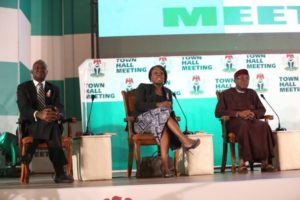
Minister of Power, Works and Housing, Mr Babatunde Fashola, on Tuesday participated in a Special Town Meeting with Youths in Abuja bearing an unmistakable message of hope even as he called for patience and hard work among Nigerians as the panacea for the much desired national economic recovery.
Mr Fashola, who spoke at the Town Hall Meeting with Nigerian Youths in Abuja organised by the Federal Ministry of Information and Culture, prefaced his contribution with an acknowledgement of his age and some of his colleagues as being beyond the youth bracket but quickly added that he has useful experience to share with the gathering.
In his words, “The point really is that as unyouthful as I am there is a lot of story and history there. For the very, very young people, the first thing I’ll like to say to you is don’t despair. There is hope and there is light at the end of the tunnel. I have seen Nigeria like this before, even worse…I want to say to you don’t lose faith.”
The Minister also urged the young people to be patient and hopeful assuring that government policies and actions being implemented across the country from the 2016 budget had given the indication that economic recovery was on the way.
Addressing the capacity audience of youths, representatives of youth organisations, Ministers and top government functionaries, Mr Fashola said because recession came about when the country stopped producing and started having negative growth the only means of recovery was for all, especially the youths, to roll up their sleeves and “work very hard to take back our economy”.
The Minister said the 2017 Budget was appropriately named, “Budget of Recovery and Growth” by President Muhammadu Buhari, adding, however, that although the President has set all the parameters for economic recovery and growth, the President can neither recover nor grow back the economy alone.
He declared, “It is the sum total of what all of us do that the National Bureau of Statistics will record and that is when the numbers come out. It is either a plus or a minus. To everybody here and to those who are watching us at home, you must understand that this is the time when we must work our hardest”.
“I don’t pretend that it is easy. I don’t assume that people are not facing difficult times, I am mindful of it; I see it up close. I know those who are struggling to pay rent; I know those who are struggling to pay fees, those who are withdrawing their children from school. I have relations, but I know that we can turn this corner together”, the Minister said.
Predicating his stance on the implementation of the 2017 Budget proposals, Mr Fashola said as more money became available for the country, Nigerians would feel it in the quality of infrastructure; in railway projects being completed, electricity installations being expanded and liabilities in electricity being cleared, pointing out that there were “quite a number of liabilities there that have to be paid off”.
Appealing to people engaged in counterproductive activities against the economy to stop, the Minister declared, “As money moves around, if I pay A, A can buy sugar and milk. The sugar and milk seller can pay for her children’s school fees; the school fees can pay salaries of teachers. That is how money moves around in an economy”.
“It is important for us, especially those who are sabotaging this economy, breaking pipelines, that this is time to stop if we must recover; because the price of oil is going to go up but we will not benefit from it if we don’t produce; that was why I talked about working hard and producing because that is still a major source of our income. It is also the major source of our foreign exchange”, he said adding that selling more oil would also reduce the pressure on Dollar to Naira for the benefits of all Nigerians.
On the role of his Ministry in achieving a turn-around for the economy, Mr Fashola, who recalled his earlier addresses in which he had disclosed the realities he met on assumption of duties, pointed out that for upwards of two to three years, the contractors in Power and in Works were not paid while nothing except Public Private Partnership (PPP) was happening in Housing.
According to the Minister, “As contractors started losing income, the net effect was to start shedding jobs. So the first thing that we have started doing is to recover those jobs by starting to pay contractors. The first disbursements were made, I think, in June, the second disbursements were made between October and November”.
The Minister, who also noted Ministers have spent one year, one month and nine days in office during which period they have implemented the 2016 budget for roughly seven months, added that in seven months, the government has quarter by quarter, as confirmed by Minister of Finance and Minister of Economic Planning and Development, been able to put contractors back to work.
“Contractors who haven’t worked for three years are back to work. Those are the first steps to recovery, getting those who have lost their jobs back to work and I am optimistic that if what I see, what’s being reported to me, and we are not by any means near to where we want to be, with what I am seeing in the seven months of implementing a budget, recovery is on the way”, he said.
Tracing the recession to what government did and failed to do in the past as well as unavoidable global events, Mr Fashola recalled that between 1979 and 1984 Nigeria had much money but wasted it all in importation of frivolities adding that by 1984, most of the imported things had disappeared.
“By 1985, in my University, recession meant we could not go to the cafeteria again. We used to eat a meal at 50 kobo; eggs, coffee and tea in this country, chicken at lunch, 50k per meal… That disappeared. But, you know what? Nigeria did not disappear”, he said.
Saying the scenario of those years were almost similar to what is happening again today, Fashola urged Nigerian youths not to despair “because there is hope” adding that the best thing for them to do was not to “check out” as was popular in his time, but to stay put and take the opportunities emerging in the economy to build the nation up to international standard and acceptability.
Responding to a question on the supply of prepaid meters and ending estimated bills, the Minister assured that his Ministry was doing all in its power to end the vexed issue adding, however, that it was better to come to the public with results than speak of the efforts being made now for which it would receive no credit.
He, however, noted that if the Government of Nigeria could not meter all Nigerians in the 63 years it was in full control of electricity generation, transmission and distribution, it would be unfair to expect that private companies that took over ownership of generation and distribution three years ago would perform that feat.
“The point to make, therefore, is that the Power Sector in private hands is a three-year transition thus far. We are doing a lot of things and one of the things we are trying to ensure does not happen again is massive importation of meters because the more meters we import the more jobs we take away from you”, he told the youths.
The Minister said that government was trying to encourage local meter manufacturing companies to produce the meters here adding, however, that because there were still components that still technologically were not produced in the country, government was trying to get support for the companies to access funds.
“Just yesterday, I signed a letter to the Governor of CBN supporting the request of the two meter manufacturing companies to access foreign exchange which had been denied them in the past”, he said adding, “But that is one half of the story. The other half of the story is also the liquidity issue in the Power Sector which I have alluded to and which makes it difficult for the DisCos to access funds to buy meters and supply you”.
He said in order to avoid the mistrust between the DisCos and consumers over supply of meters, government has advised the DisCos that their responsibility was to provide the meters and stop passing the burden to consumers adding, “Their (customers’) burden is to pay bills for energy consumed”.
Expressing the commitment of the present administration to the local manufacture and supply of meters, Mr Fashola declared, “This administration is determined that the mistake we made in the telecommunications sector will not be repeated in the same way that we are trying to localise our opportunities for producing what we eat”. He added, “So bear with us. Step by step, but very progressively and assuredly we will reach you and in the fullness of time”.
Earlier, in his opening remarks, the Minister of Information, Mr Lai Mohammed, said the present administration headed by President Muhammadu Buhari, was very concerned about youth empowerment in the country, adding that in the first phase of the N-Power programme government created 200,000 jobs pointing out that it was the greatest number of jobs created in one swoop by any administration in the country.
According to him, another 300, 000 jobs were next in line to bring the number to the 500,000 which the administration promised adding that most of the jobs, which he said would be from Education, Health and Agriculture programmes, would benefit the youths.
He noted that the school feeding had taken off in Anambra, Kaduna and Osun States and was being scaled up now to 11 of the 18 states designated for the first phase of the programme, the Minister added that some 45,000 cooks had been trained in all the states.
Urging the youths to cooperate with government in achieving the set goals, the Minister said the data for cash transfers for nine states of the country was now ready and the payment processes in those states were already in top gear adding that for the micro-credit scheme, more than 1,000,000 Nigerians were set to get loans at low interest rates through the Bank of Industries.
Other Ministers that addressed the youths and answered questions during the robust interactive sessions were, the Minister of Labour and Employment, Minister of Sports and Youths Development, Minister of Finance, Minister of Agriculture and Minister of State for Budget and National Planning.


