Connect with us

Health

Over 4.7 Children for Vaccines Against Measles in Borno, Others

Published

on

By Modupe Gbadeyanka

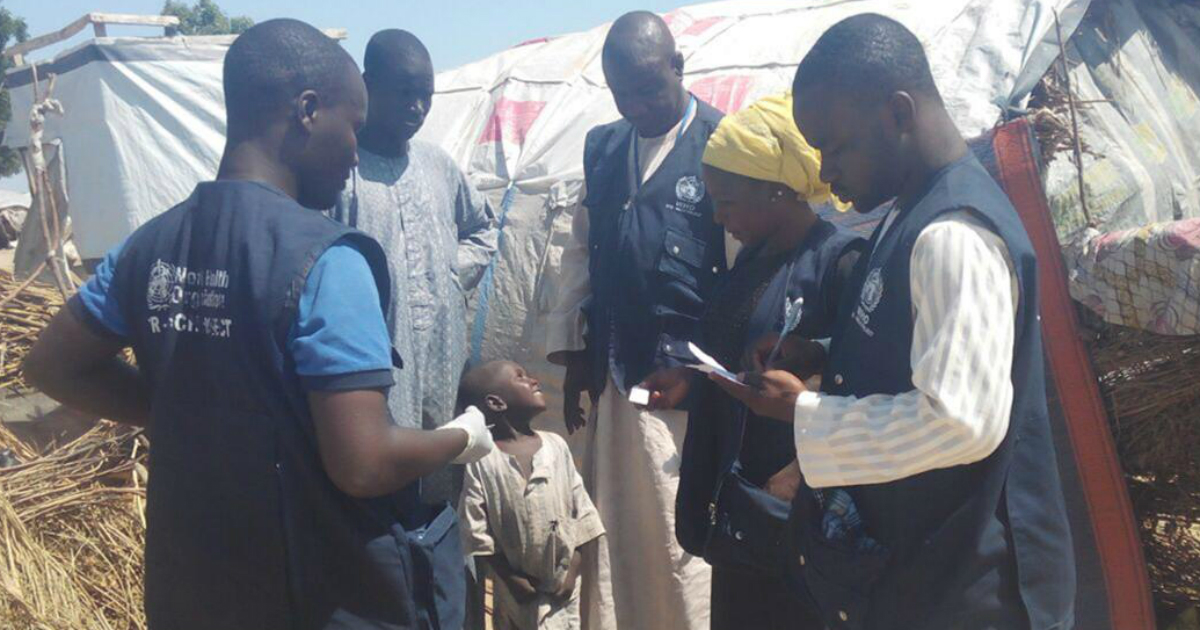
A United Nations-supported mass vaccination campaign is set to start tomorrow to protect more than 4.7 million children against a measles outbreak in conflict-affected states in north-eastern Nigeria.

“This measles vaccination campaign is an emergency intervention to protect more than 4 million children against a highly contagious and sometimes deadly disease,” said Dr Wondimagegnehu Alemu, Country Representative of the UN World Health Organization (WHO).

“Massive disruption to health services in conflict-affected areas for many years has deprived these children of essential childhood vaccinations. In addition, many of them have severe malnutrition, making them extremely vulnerable to serious complications and death from measles,” he added.

Measles is a highly contagious, serious disease that is one of the leading causes of death in young children. In 2015, there were more than 134,000 measles deaths globally, with most of them below the age of five.

During 2000-2015, measles vaccination prevented an estimated 20.3 million deaths making measles vaccination one of the best buys in public health.

The current two-week campaign will target all children aged from six months to 10 years old in accessible areas in Borno, Yobe and Adamawa states, where WHO is supporting the primary healthcare development agencies by providing expertise in areas including logistics, data management, training, social mobilization, monitoring and evaluation, supportive supervision and waste management.

From early September to 18 December 2016, the WHO-established Early Warning, Alert and Response System (EWARS) reported more than 1,500 suspected measles cases in Borno state. More than 77 per cent of children under the age of five in the state have never received the measles vaccine and this is the age group where most cases occurred.

The state’s health authorities, with support from WHO and partners, have already vaccinated more than 83,000 children aged six months to 15 years old living in camps for internally displaced people (IDPs).

The humanitarian crisis caused by conflict in Borno state has resulted in more than 1.4 million IDPs living in more than 100 camps.


Modupe Gbadeyanka is a fast-rising journalist with Business Post Nigeria. Her passion for journalism is amazing. She is willing to learn more with a view to becoming one of the best pen-pushers in Nigeria. Her role models are the duo of CNN's Richard Quest and Christiane Amanpour.

Health

Helical Secures $10m Funding Package for Expansion

Published

on

Helical

By Dipo Olowookere

A $10 million capital has been raised by Helical to support expansion across more top-20 pharma programmes and growth of its deployed science engineering team.

The firm will also use the money to build the compounding evidence layer that improves performance across diseases, as its mission is to make every scientist able to test hypotheses at the speed of inference and to turn in-silico discovery into a reliable engine for R&D throughput.

The funding package was from redalpine, Gradient, BoxGroup, Frst and notable angels, including Aidan Gomez (CEO Cohere), Clement Delangue (CEO HuggingFace) and Mario Goetze (pro soccer player).

Helical has a product known as the virtual AI lab for pharma, an application layer that turns biological foundation models into decision-ready, reproducible in-silico discovery workflows.

The platform has two product surfaces — the Virtual Lab for biologists and translational scientists, and the Model Factory for ML engineers and data scientists — built on the same data, the same models, and the same results.

By putting both sides in the same system, Helical closes the gap between computational predictions and biological decision-making, so teams that traditionally worked in silos can collaborate on the same evidence.

Helical was founded in early 2024. It was created by three school friends who took different paths to the same problem.

Rick Schneider built tech at Amazon and later helped the German enterprise Celonis scale in France and Japan. Maxime Allard led data science teams at IBM before pursuing a PhD focused on reinforcement learning and robotics. Mathieu Klop became a cardiologist and genomics researcher.

When bio foundation models emerged, the trio saw the chance to build the missing application layer that would let pharma teams move from model experimentation to reproducible, production discovery.

“The models alone don’t discover drugs. The system does. Pharma teams need a system that turns foundation models into workflows scientists can run, validate, and defend.

“We built Helical to make in-silico science reproducible at pharma scale, so teams can go from hypothesis to decision in days instead of months,” the co-founder of Helical, Mr Rick Schneider, said.

“We are at a unique point in time where biological foundation models and general language reasoning models are converging.

“We backed Helical because we strongly believe they have what it takes to build the pharma AI orchestration platform that will drive this transition from siloed AI models to integrated virtual AI labs,” the General Partner at redalpine, Mr Daniel Graf, stated.

Continue Reading

Health

NARD Suspends Indefinite Strike, Gives FG Fresh Two-Week Ultimatum

Published

on

resident doctors strike

By Adedapo Adesanya

The Nigerian Association of Resident Doctors (NARD) has suspended its planned nationwide indefinite strike, granting the federal government a two-week ultimatum to address lingering welfare issues affecting resident doctors across the country.

The decision was taken after an emergency meeting of the association’s National Executive Council on Tuesday, where members reviewed assurances from government representatives and resolved to give dialogue another chance.

NARD said the suspension was informed by “progress made” in negotiations, particularly commitments on the prompt payment of salary arrears, hazard allowances, and steps toward resolving issues surrounding the Medical Residency Training Fund.

The association did not declare a full resolution of the dispute. It noted that the government had shown “renewed willingness” to address the concerns that triggered the strike threat.

The association noted that while these engagements signalled a willingness by the government to resolve the dispute, several critical issues remain outstanding, particularly the delayed payment of promotion arrears, salary arrears, the 2026 Medical Residency Training Fund (MRTF), and the backlog of 19 months’ professional allowance arrears owed to resident doctors.

It also expressed concern over the Federal Government’s decision to halt the implementation of the reviewed PAT, which had earlier triggered widespread dissatisfaction among its members and raised fears of disruption to healthcare services nationwide.

Despite these unresolved issues, NARD said it opted to suspend the strike as a demonstration of goodwill and commitment to ongoing dialogue, while giving the government a two-week window to take concrete, measurable and verifiable steps to meet its demands.

The association insisted on the immediate reversal of the decision affecting the PAT, payment of all outstanding arrears, prompt disbursement of the MRTF, and full settlement of the accumulated professional allowance backlog.

It warned that it would reconvene at the expiration of the ultimatum to assess the level of compliance and determine its next course of action, adding that failure by the government to meet its demands within the stipulated timeframe would result in the resumption of the suspended strike without further notice.

NARD also called on its members nationwide to remain calm, united and resolute, while urging the Federal Government to act swiftly to prevent a potential crisis in the health sector.

The association further appreciated the interventions of the Vice President and other stakeholders, expressing hope that their involvement would lead to the timely resolution of the dispute and help sustain healthcare delivery across the country.

Continue Reading

Health

Jacaranda Gets Funds to Expand Affordable Maternal Healthcare in Kenya

Published

on

Jacaranda Maternity

By Modupe Gbadeyanka

To expand affordable healthcare in Kenya, Swedfund has invested about $600,000 into Jacaranda Health Limited (Jacaranda Maternity) to support innovations in neonatal intensive care and strengthen Jacaranda’s ability to provide life-saving services to underserved populations.

Jacaranda Maternity provides high-quality maternal health care at more affordable pricing than typical private providers, focusing on women in Nairobi’s low- and middle-income communities.

The new funding will support the opening of new hospitals, upgrading of neonatal care, and improvements to existing facilities.

Maternal and newborn health outcomes in Kenya remain a challenge, with maternal mortality still high despite improvements in skilled birth attendance.

Public health facilities play a central role but face capacity constraints, while access to reliable, quality care varies across regions and income groups.

Private healthcare providers offering essential maternity services at accessible price points can complement public provision.

Jacaranda Maternity aims to expand its network to six hospitals to achieve financial sustainability while scaling its impact. The healthcare provider is a recognised leader in promoting women’s health, with 71 percent of its staff being women, and a track record of effective environmental and social management.

“This investment will help Jacaranda Maternity provide life-saving care to more women and families while furthering Swedfund’s mission to promote inclusive and sustainable healthcare,” a Senior Investment Manager at Swedfund, Audrey Obara, said.

Continue Reading

Trending