Connect with us

Economy

Fresh Bargain-Hunting Lifts Domestic Stock Exchange by 0.22%

Published

on

domestic stock exchange

By Dipo Olowookere

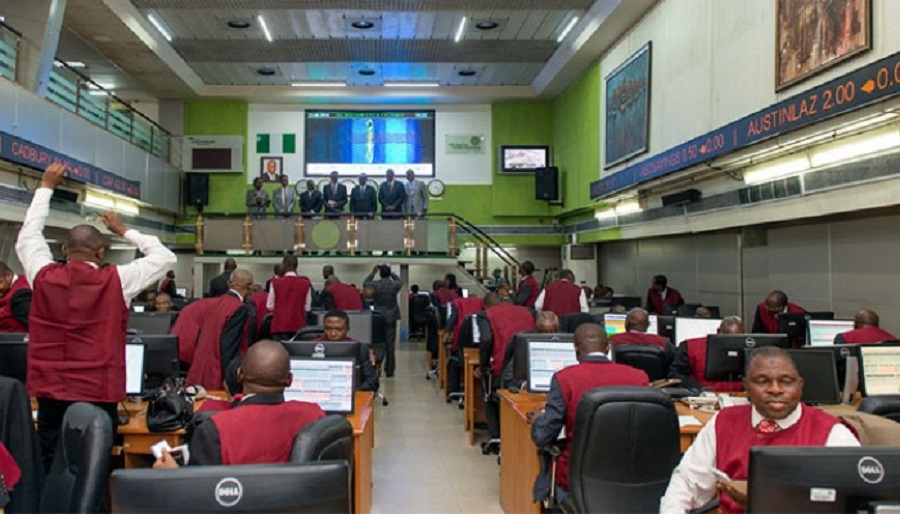
The domestic stock exchange witnessed a rebound of 0.22 per cent on Monday as investors cherry-picked some large-cap equities, especially in the banking and industrial goods sectors, ahead of the end of the first half of 2023.

Some traders rekindled their interest in local shares as they anticipate price appreciation in names like GTCO, BUA Cement, Zenith Bank, and others in the short term.

This bet left the Nigerian Exchange (NGX) Limited closing with 46 price gainers and 23 price losers, indicating a positive market breadth index and a strong investor sentiment.

Consequently, the top 5 price gainers, Tantalizers, Academy Press, Thomas Wyatt, Transcorp Hotels, and ABC Transport, gained 10.00 per cent each to settle at 22 Kobo, N2.20, N1.43, N19.36, and 44 Kobo, respectively.

Conversely, Unity Bank suffered the heaviest loss after its value shrank by 10.00 per cent to 99 Kobo, Japual depreciated by 9.23 per cent to 59 Kobo, Veritas Kapital went down by 8.70 per cent to 21 Kobo, Secure Electronic Technology dropped 7.89 per cent to 35 Kobo, and Cutix lost 5.45 per cent to trade at N2.60.

All the key sectors of the market ended in green yesterday, with the banking space rising by 2.40 per cent, the insurance growing by 1.68 per cent, the industrial goods industry appreciating by 1.00 per cent, the energy counter jumping by 0.52 per cent, and the consumer goods sector improving by 0.14 per cent.

As a result, the All-Share Index (ASI) increased by 132.13 points to 59,338.76 points from 59,206.63 points, and the market capitalisation expanded by N72 billion to N32.309 trillion from N32.237 trillion.

Business Post reports that investors bought and sold 552.7 million shares worth N13.1 billion in 8,052 deals during the session compared with the 627.9 million shares worth N9.2 billion traded in 6,953 deals last Friday, implying a decline in the volume of trades by 11.98 per cent, and an increase in the value of transactions and the number of deals by 42.39 per cent and 15.81 per cent apiece.

Access Holdings was the busiest stock on Monday as it sold 74.6 million units valued at N1.1 billion, BUA Cement transacted 45.4 million units worth N3.9 billion, GTCO traded 44.8 million units worth N1.5 billion, Universal Insurance exchanged 40.4 million units valued at N9.1 million, and Ecobank traded 39.8 million units for N604.8 million.


Dipo Olowookere is a journalist based in Nigeria that has passion for reporting business news stories. At his leisure time, he watches football and supports 3SC of Ibadan. Mr Olowookere can be reached via [email protected]

Advertisement
2 Comments

Leave a Reply

Your email address will not be published. Required fields are marked *

Economy

FCMB Capital Market Reaffirms Commitment to Fixed-income Market Development

Published

on

fcmb capital markets

By Aduragbemi Omiyale

FCMB Capital Markets Limited, the investment banking arm of FCMB Group Plc, has promised to continue to contribute to the development of the fixed-income market in Nigeria.

The company gave this assurance while reacting to its top position on the Fixed Income Primary Markets Sponsors’ League Table of the FMDQ Securities Exchange Limited in 2025.

The company facilitated the raising of N1.53 trillion in corporate debt capital through bond listings and commercial paper quotations on the platform.

The exchange’s report shows FCMB Capital Markets led overall sponsor contributions across the bond listings and commercial paper quotation markets during the year.

In the bond market, the firm accounted for 11.66 per cent of total listings, for the top spot. In the commercial paper market, FCMB Capital Markets achieved the highest share of quotations at 7.68 per cent, outpacing other registration members in that segment.

The exchange reported that 58 registration members participated in listings and 77 in quotations. During the period under review, 47 institutions actively sponsored fixed-income securities listings or quotations, excluding federal government securities.

“Our ranking reflects the confidence issuers place in our ability to structure and execute capital market transactions.

“Mobilising more than N1 trillion in a single year demonstrates the depth of demand for capital market funding and the role we play in connecting issuers with long-term investors,” the Executive Director for Coverage and Investment Banking at FCMB Group, Mr Femi Badeji, said.

The chief executive of FCMB Capital Markets, Mr Ikechukwu Omeruah, on his part, said the firm remains focused on helping corporates access both long-term and short-term funding through the capital markets.

“Achieving this position reflects the work of our team and the trust of our clients. We remain committed to structuring financing solutions that enable businesses to raise capital efficiently while contributing to the continued development of Nigeria’s fixed-income market,” he said.

Over the past five years, FCMB Capital Markets has participated in several debt and equity transactions across sectors, including oil and gas, power, real estate, financial services, consumer goods and telecommunications.

Continue Reading

Economy

Beta Glass Grows FY25 Revenue by 27% on Improved Production Efficiency

Published

on

beta glass

By Aduragbemi Omiyale

In the 2025 financial year, Beta Glass Plc grew its revenue by 27 per cent to N149.12 billion from N117.58 billion in 2024, reflecting continued demand for the company’s glass packaging products across key sectors of the Nigerian economy.

Despite market challenges, the organisation performed well due to improved production efficiency, effective cost management, and a clear focus on its key customers and segments.

In the year, the gross margin improved to 35.3 per cent from 26.3 per cent, operating margin rose to 32.3 per cent from 20.0 per cent, reflecting improved operating efficiency and effective cost management.

A look at the bottom-line showed that profit after tax (PAT) went up by 144 per cent to N33.25 billion from N13.63 billion, demonstrating the resilience of its operations despite evolving global and regional market conditions, while the Earnings Per Share (EPS) stood at N55.41 versus N22.71 in 2024.

The chief executive of Beta Glass, Mr Alex Gendis, said, “This year’s results reflect the resilience of our business model and the successful execution of our strategic initiatives.

“Despite market challenges, our commitment to delivering value to our shareholders was and remains strong. Our performance was underpinned by improved production efficiency, effective cost management, and a clear focus on our key customers and segments.

“At the same time, we continued to invest significantly in our asset base, with the rebuild of our furnace in Delta, positioning the business for sustainable long-term growth.”

Continue Reading

Economy

Nigeria’s Oil Reserves to Last 59 Years at Current Output—NUPRC

Published

on

oil reserves

By Adedapo Adesanya

If Nigeria continues producing crude oil at its current pace, its proven reserves would be exhausted in about 59 years, according to the Nigerian Upstream Petroleum Regulatory Commission (NUPRC).

The regulator disclosed this on Wednesday in Abuja, as it released the nation’s official petroleum reserves position as of January 1, 2026.

In a statement signed by its chief executive, Mrs Oritsemeyiwa Eyesan, the commission said Nigeria’s total oil and condensate reserves stand at 37.01 billion barrels, while total gas reserves are about 215.19 trillion cubic feet.

“The Nigerian Upstream Petroleum Regulatory Commission, in keeping with its mandate, is committed to improving upstream sector performance, enhancing the growth of oil and gas reserves, and ensuring stable production for shared prosperity via the operationalisation of the Petroleum Industry Act, 2021, and implementation of the strategic pillars of the commission,” she said.

Providing a breakdown, she stated that “2P crude oil and condensate reserves stand at 31.09 billion barrels and 5.92 billion barrels, respectively, amounting to a total of 37.01 billion barrels.”

On gas, she said, “2P associated gas and non-associated gas reserves stand at 100.21 trillion cubic feet and 114.98 trillion cubic feet, respectively, resulting in total gas reserves of 215.19 trillion cubic feet.”

Explaining the changes recorded within the period, Mrs Eyesan noted that crude volumes declined slightly due to production activities during the previous year.

While Nigeria’s reserves life index stands at 59 years for oil, it was put at 85 years for gas, indicating the estimated duration the resources would last at current production levels.

“The Reserves Life Index is 59 Years and 85 Years for Oil and Gas, respectively. The reason for the slight change in 1.1.2026 oil and condensate reserves by 0.74 per cent is attributable to production in 2025 and reserves update due to field performance and technical evaluation based on subsurface studies.

“The reason for the increase in 1.1.2026 AG and NAG reserves by 2.21 per cent is largely because reserves update is based on discoveries and the result of robust reservoir studies,” she said.

In contrast, she said gas reserves increased on the back of fresh discoveries and improved technical assessments.

“The reason for the increase in 1.1.2026 associated gas and non-associated gas reserves by 2.21 per cent is largely because the reserves update is based on discoveries and the result of robust reservoir studies,” she added.

Declaring the figures official, Mrs Eyesan said, “Consequently, and in furtherance of the provisions of the Petroleum Industry Act, I hereby declare the total oil and condensate reserves of 37.01 billion barrels and total gas reserves of 215.19 trillion cubic feet as the official national petroleum reserves position as of 1st January 2026.”

Findings show that Nigeria’s reserves position in 2026 reflects a modest shift from 2025, when total oil and condensate reserves were slightly higher at about 37.3 billion barrels, while gas reserves stood at approximately 210–211 trillion cubic feet.

The 2026 data, therefore, indicates a 0.74 per cent decline in oil reserves, largely driven by sustained production and limited new oil discoveries, while gas reserves expanded by 2.21 per cent due to ongoing exploration success and renewed focus on gas development.

Continue Reading

Trending