Economy
ATFX Broker | Comprehensive Review Compiled By Forex Specialists
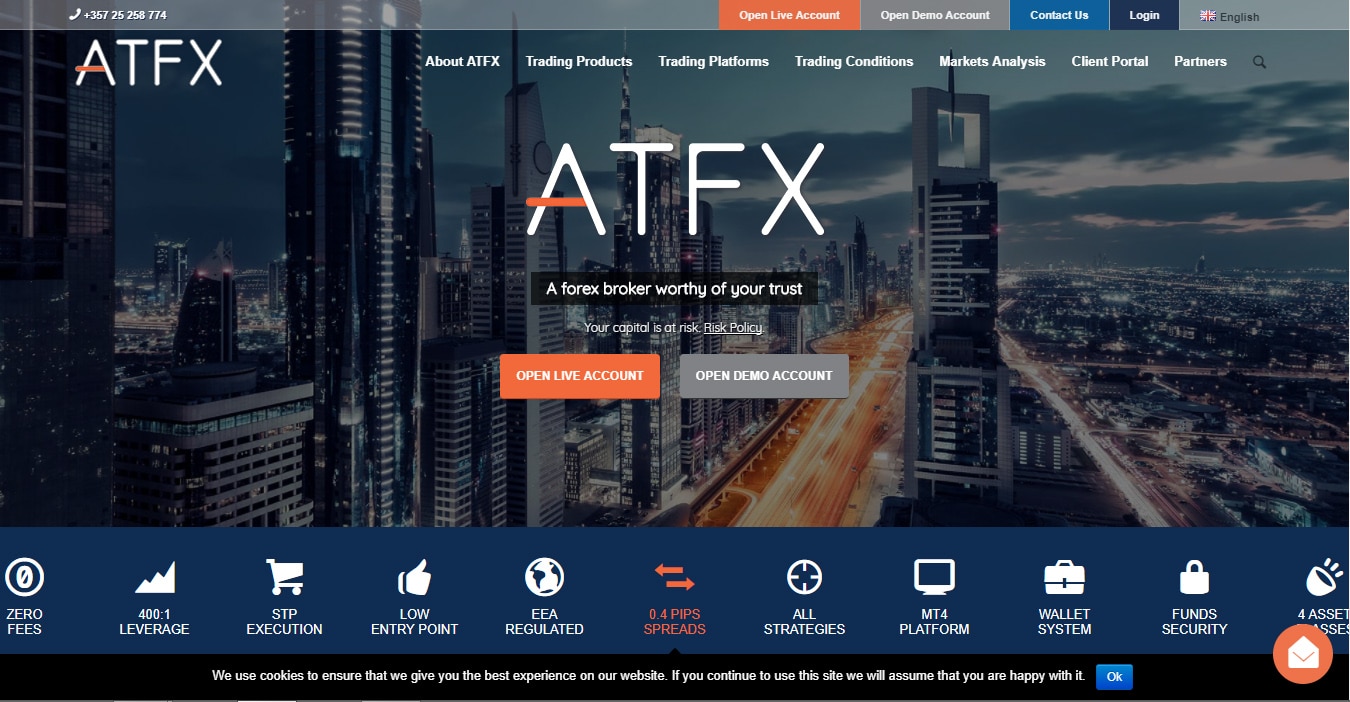
In the ever-evolving landscape of Forex and CFD trading, selecting the right broker can be a daunting task. Today, our focus will be on a renowned player in the industry as we seek to answer a critical question: “ATFX broker review” – how does it hold up? This topic is crucial for optimizing trading conditions, safety, and overall trading experience.
Traders Union recently published a comprehensive ATFX broker review, unveiling several key insights about this broker’s offerings. This review discusses ATFX’s background, advantages, disadvantages, influential parameters, trading conditions, and commissions & fees.
What is ATFX broker?
According to Traders Union experts, ATFX is a Forex and CFD broker under the umbrella of AT Global Markets, a globally recognized investment holding company. ATFX operates under several international regulatory bodies, including the FCA (UK), CySEC (Cyprus), FSC (Mauritius), and FSA (Saint Vincent and the Grenadines). The broker extends advantageous trading conditions for both active traders and passive investors. Furthermore, the quality of ATFX’s services has been acknowledged by numerous accolades, including the “Fastest Growing Forex Broker in Europe” in 2017 and the “Best Forex CFD Broker” award from UK Forex Awards in 2018.
Advantages and disadvantages of ATFX
Traders Union experts have highlighted the following advantages and disadvantages of ATFX:
Advantages:
- Multiple Licenses from International Regulators: ATFX is a globally regulated entity, holding licenses from renowned international regulators, enhancing its reliability and trustworthiness.
- Attractive Trading Conditions for Professional Traders and Substantial Investors: With tailored trading conditions, ATFX caters effectively to the needs of professional traders and substantial investors, offering a conducive trading environment.
- Opportunities to Invest in PAMM Accounts and Copy Trades: ATFX allows its users to invest in PAMM accounts and utilize their proprietary platform for copy trading, adding to the diversity of its offerings.
Disadvantages:
- No Cent Accounts Available: The absence of cent accounts limits the options for novice traders to test and familiarize themselves with the platform and trading conditions without significant investment.
- High Minimum Deposit on Standard Accounts: The high minimum deposit on standard accounts may pose a barrier to entry for some traders, particularly beginners with limited capital.
- Bonuses Not Universally Available: Bonuses can incentivize trading activity; however, their non-universal availability might disappoint some traders seeking added value.
- Broader Market Spreads on Standard Accounts: The wider market spreads on standard accounts can inflate trading costs, especially for those engaging in high-frequency trading strategies.
- Limited Variety of Partnership Programs: The limited range of partnership programs may restrict opportunities for collaborative growth and additional income streams for traders.
Evaluation of the most influential parameters of ATFX
The Traders Union experts evaluated ATFX on several key parameters:
- User Satisfaction: 3.67/10
- Regulation and Safety: 3.96/10
- Commissions and Fees: 3.6/10
- Variety of Instruments: 3.38/10
- Brand Popularity: 3.54/10
- Customer Support Work: 3.9/10
- Education: 4.12/10
Trading conditions for ATFX users
Traders Union experts assert that ATFX’s trading conditions are particularly attractive for professionals and traders with a considerable equity volume. The minimum deposit is $250, a relatively high entry barrier for novice traders. Further, the lack of cent accounts impedes traders from testing the conditions with minimal investment. Standard account spreads range from 1-1.8 pips, a factor that may deter high-frequency strategy traders.
ATFX commissions & fees
Traders Union experts delved deep into ATFX’s trading conditions to reveal transparent and hidden fees. ATFX charges a spread. If the withdrawal amount to a debit/credit card or electronic wallet is less than USD/EUR 100, an additional USD/EUR 5 fee applies. No fee is charged on withdrawals over USD/EUR 1,000 for wire transfers.
In addition to the ATFX broker, Traders Union also reviewed the Mindful trader. To read an insightful and detailed review, visit the official website of Traders Union.
Conclusion
ATFX offers several advantages for traders, including regulatory backing, diversified trading conditions, and a robust platform. However, certain limitations may affect some traders, such as the lack of cent accounts and a high entry barrier. We encourage readers to visit the Traders Union’s official website and explore more.
Economy
PEBEC Blocks Introduction of New Policies by MDAs
By Adedapo Adesanya
The Presidential Enabling Business Environment Council (PEBEC) has directed Ministries, Departments, and Agencies (MDAs) to suspend the introduction of new policies and regulatory changes to prevent disruptions to businesses.
The directive was issued in a statement by PEBEC director-general, Mrs Zahrah Mustapha-Audu, on Monday in Abuja, noting that the move is part of the Federal Government’s broader effort to improve regulatory quality, ensure policy consistency, and strengthen Nigeria’s ease of doing business environment.
The council emphasised that the suspension will remain in place until all MDAs fully comply with the Regulatory Impact Analysis (RIA) Framework, which governs evidence-based policymaking across government institutions.
The council said the directive is aimed at ensuring that all government policies are backed by verifiable data and do not negatively impact businesses or investors.
“It is imperative to emphasise that no new reform or policy will be permitted to proceed without being grounded in clear, verifiable evidence,” said Mrs Mustapha-Audu.
“The framework provides the structured mechanism through which such evidence-based decisions can be rigorously developed, assessed, and validated.
“This directive is necessary to prevent policy shocks that may adversely affect businesses, investors, and citizens, as well as to eliminate policy inconsistencies and frequent reversals.”
She added that the government remains committed to working collaboratively with regulators and does not intend to embarrass any institution.
The Regulatory Impact Analysis (RIA) Framework, introduced in January 2025, is designed to improve transparency and ensure that policies undergo proper evaluation before implementation.
All MDAs are required to align new policies and amendments with the RIA framework before approval and rollout.
The framework has been circulated by the Office of the Secretary to the Government of the Federation (SGF) and is available on the PEBEC website.
MDAs are encouraged to seek technical support from the PEBEC Secretariat to ensure proper implementation.
Exceptions to the directive will only be granted in cases of urgent national interest, subject to appropriate approvals.
PEBEC noted that the framework will help institutionalise evidence-based policymaking, enhance transparency, and improve stakeholder confidence in government decisions.
Economy
DMO Sells 3-Year FGN Savings Bond at 14.082% for April Batch
By Aduragbemi Omiyale
Subscription for the Federal Government of Nigeria (FGN) savings bonds for April 2026 has opened, a circular from the Debt Management Office (DMO) on Tuesday, April 7, 2026, confirmed.
The debt office is selling the retail debt instrument for this month in two tenors of two years and three years.
Offer for the savings bonds opened today and will close on Friday, April 10, 2026, a part of the disclosure stated.
The 2-year FGN savings bond due April 15, 2028, is being sold at a coupon rate of 13.082 per cent per annum, while the 3-year FGN savings bond due April 15, 2029, is being sold at a coupon rate of 14.082 per cent per annum.
The interests are paid every quarter, and the bullet repayment to subscribers on the maturity date.
The bonds are sold at N1,000 per unit, subject to a minimum subscription of N5,000 and in multiples of N1,000 thereafter, subject to a maximum subscription of N50 million.
Interested investors are required to reach out to the stockbroking firms appointed as distribution agents by the DMO via the agency’s website.
An FGN savings bond qualifies as securities in which trustees can invest under the Trustee Investment Act. It also qualifies as government securities within the meaning of the Company Income Tax Act (CITA) and the Personal Income Tax Act (PITA) for tax exemption for pension funds, amongst other investors, meaning it is tax-free.
It can be used as a liquid asset for liquidity ratio calculation for banks, and is listed on the Nigerian Exchange (NGX) Limited to allow for easy exit (liquidation) before maturity by selling at the secondary market.
Economy
Oil Prices Rise as US-Iran Tensions Escalate Despite Talks
By Adedapo Adesanya
Oil prices climbed on Monday’s short trade as the United States and Iran threatened more attacks, as the two countries are engaging in indirect talks that could lead to the de-escalation of hostilities.
Brent crude futures settled at $109.77 a barrel after chalking up 74 cents or 0.68 per cent, while the US West Texas Intermediate (WTI) crude futures traded at $112.40 after growing by 87 cents or 0.78 per cent.
The US and Iran received a framework from Pakistan to end hostilities, but this was rejected by Iran, especially the idea of immediately reopening the strait after President Donald Trump threatened to rain “hell” on the nation if it did not make a deal by the end of Tuesday.
Iran said it had formulated its positions and demands in response to recent ceasefire proposals conveyed via intermediaries.
The US is eyeing an agreement to open the crucial Strait of Hormuz, the shipping artery used by one-fifth of the world’s oil and gas supply, but the strait, which carries oil and petroleum products from Iraq, Saudi Arabia, Qatar, Kuwait and the United Arab Emirates, remains largely closed due to Iranian attacks on shipping after the U.S.-Israel attacks began on February 28.
Some vessels, however, including an Omani-operated tanker, a French-owned container ship and a Japanese-owned gas carrier, have passed through the strait since Thursday.
Meanwhile, major oil consumers, particularly in Asia, are conserving barrels or cutting consumption in response to the closure of the strait.
The Middle East supply disruptions have led refiners to seek alternative sources for crude, particularly for physical cargoes in the US and Britain’s North Sea.
Indian refiners have also postponed maintenance shutdowns of their units to meet local fuel demand.
On Sunday, the Organisation of the Petroleum Exporting Countries and its allies (OPEC+) agreed to a modest rise of 206,000 barrels per day for May. However, this will only appear on paper as the disruption is limiting the ability of the top producers to add the needed output.
OPEC’s combined oil output losses for March were estimated at 7.2 million barrels daily. The biggest production cuts were made by Kuwait, Iraq, the United Arab Emirates, and Saudi Arabia, for a total OPEC output of 21.57 million barrels daily for March. This is the lowest OPEC production rate since June 2020.
-
Feature/OPED6 years agoDavos was Different this year
-
Travel/Tourism10 years ago
Lagos Seals Western Lodge Hotel In Ikorodu
-
Showbiz3 years agoEstranged Lover Releases Videos of Empress Njamah Bathing
-
Banking8 years agoSort Codes of GTBank Branches in Nigeria
-
Economy3 years agoSubsidy Removal: CNG at N130 Per Litre Cheaper Than Petrol—IPMAN
-
Banking3 years agoSort Codes of UBA Branches in Nigeria
-
Banking3 years agoFirst Bank Announces Planned Downtime
-
Sports3 years agoHighest Paid Nigerian Footballer – How Much Do Nigerian Footballers Earn