Economy
NNPC Gets Afreximbank $3bn Emergency Loan for Naira Stability
By Adedapo Adesanya
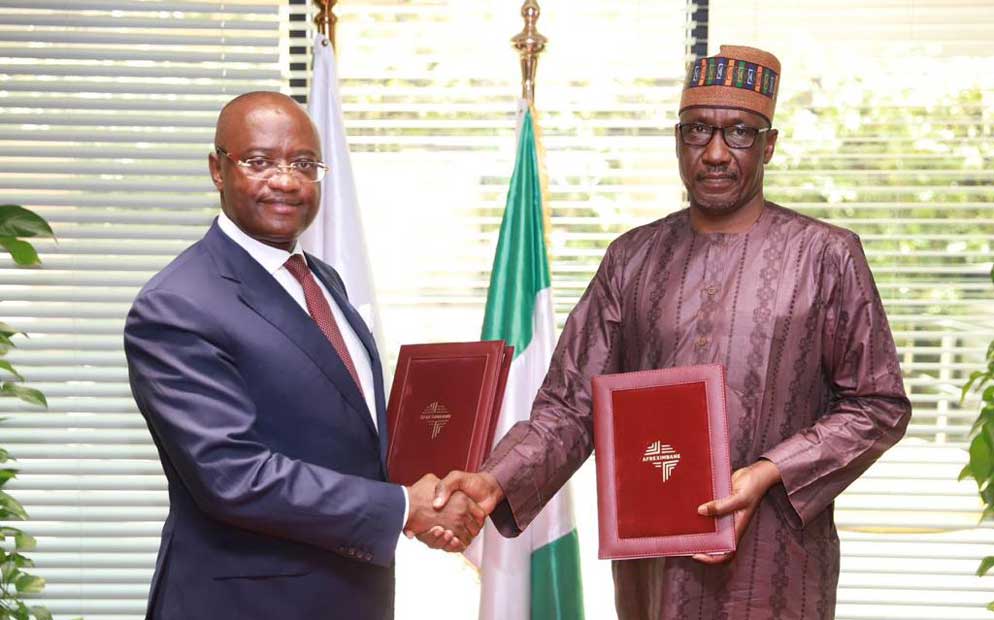
The Nigerian National Petroleum Company (NNPC) Limited and Africa Export-Import Bank (Afreximbank) have jointly signed a commitment letter and term sheet for an emergency $3 billion crude oil repayment loan.
The signing, which took place on Wednesday, August 16, at the bank’s headquarters in Cairo, Egypt, will provide some immediate disbursement that will enable the NNPC Limited to support the federal government in its ongoing fiscal and monetary policy reforms aimed at stabilising the exchange rate market.
The country is about $3 billion deep in debt to trading houses and oil majors for crude oil swap arrangements, through which the country imports petroleum products.
The country is also said to be over six months behind schedule for the repayment in crude.
The direct sale direct purchase (DSDP) initiative is an agreement that allows the sale of crude oil to refiners, who will in turn supply the country with an equivalent worth of petroleum products.
Through the DSDP arrangement, Nigeria exchanges petroleum products for crude cargoes with major trading houses and international oil majors, including BP, TotalEnergies, Vitol, and Mercuria.
The decision to pay cash for petrol imports follows the federal government’s removal of petrol subsidy and the subsequent issuance of petrol importation licences to interested companies — displacing NNPC Limited as the sole importer of petrol.
The country has also faced recent headwinds in the forex market after the Central Bank of Nigeria (CBN) liberalised the local currency that included collapsing all segments of the foreign exchange market into the Investors and Exporters’ (I&E) window and the reintroduction of the “willing buyer, willing seller” model at the window.
However, this didn’t lead to the elimination of the other markets as illiquidity at the official market sent those in need of the FX to other alternative segments like the parallel market and the Peer-2-Peer (P2P) segment.
Economy
PETROAN Reiterates Calls for Fuel Import Licences to Stabilise Prices
By Adedapo Adesanya
The Petroleum Products Retail Outlets Owners Association of Nigeria (PETROAN) has thrown its weight behind the World Bank call for the reinstatement of petrol import licences, warning that limited competition in Nigeria’s downstream sector is driving price instability and inflation risks.
Reacting to the World Bank’s position, PETROAN President, Mr Billy Gillis-Harry, said the recommendation reinforces the association’s long-standing advocacy for a fully liberalised petroleum market.
“Competition remains the most effective tool for stabilising prices and ensuring energy security,” Mr Gillis-Harry stated.
According to him, the restriction of supply sources has contributed to rising petrol prices, with Premium Motor Spirit (PMS) selling above import parity levels.
PETROAN noted that the World Bank had warned that continued supply rigidity, combined with rising global oil prices, could worsen inflationary pressures across the Nigerian economy.
Aligning with this position, Mr Gillis-Harry stressed that reintroducing petrol import licences would diversify supply, curb monopolistic tendencies, and protect consumers from exploitative pricing.
“A competitive and liberalised market framework is essential for ensuring price moderation, product availability, and operational efficiency,” he said.
The association also argued that the current pricing challenges could have been mitigated if Nigeria’s government-owned refineries were fully functional or properly privatised.
It called for a dual strategy of sustained fuel importation and full privatisation or restructuring of refineries in Port Harcourt, Warri, and Kaduna to drive efficiency and eliminate bottlenecks.
Drawing parallels with the telecoms sector, PETROAN cited the impact of private sector participation by firms such as MTN Nigeria and Airtel Nigeria, noting that liberalisation led to improved services, wider access, and reduced costs.
The group maintained that healthy competition would complement, not undermine, local refining efforts, including output from the Dangote Petroleum Refinery.
“Healthy competition is not a threat to local refining but a necessary mechanism to stabilise the market while domestic capacity continues to grow,” Mr Gillis-Harry said.
PETROAN urged the Federal Government, the Nigerian Midstream and Downstream Petroleum Regulatory Authority, and NNPC Limited to urgently implement policies that encourage open market participation and ensure fair pricing across the downstream value chain.
The association reaffirmed its commitment to working with stakeholders to build a “resilient, transparent, and competitive petroleum distribution system” to support economic stability.
Economy
Nipco, Three Others Buoy NASD OTC Bourse by 0.61%
By Adedapo Adesanya
Four price gainers buoyed the NASD Over-the-Counter (OTC) Securities Exchange by 0.61 per cent on Tuesday, April 14, with the market capitalisation growing by N14.11 billion to N2.334 trillion from N2.320 trillion, and the Unlisted Security Index (NSI) increasing by 23.57 points to 3,902.42 points from the previous day’s 3,878.83 points.
During the trading session, Nipco Plc went up by N31.00 to close at N344.oo per unit compared with the previous session’s N313.00 per unit, Okitipupa Plc appreciated by N20.00 to N280.00 per share from N300.00 per share, MRS Oil Plc improved by N16.40 to N180.40 per unit from N164.00 per unit, and Central Securities Clearing System (CSCS) Plc advanced by N2.50 to N65.55 per share from N63.04 per share.
Business Post reports that the NASD OTC bourse posted a sole price decliner yesterday, which was FrieslandCampina Wamco Nigeria Plc. It lost N9.89 to trade at N90.00 per unit versus N99.89 per unit.
The volume of securities traded by investors decreased by 97.9 per cent to 55,546 units from 2.6 million units, the value of securities declined by 73.4 per cent to N8.3 million from N31.2 million, and the number of deals dipped by 45.95 per cent to 20 deals from 37 deals.
Great Nigeria Insurance (GNI) Plc finished the day as the most traded stock by value on a year-to-date basis with 3.4 billion units worth N8.4 billion, followed by CSCS Plc with 57.6 million units transacted for N3.9 billion, and Okitipupa Plc with 27.6 million units traded at N1.8 billion.
GNI Plc also closed the session as the most traded stock by volume on a year-to-date basis with 3.4 billion units valued at N8.4 billion, trailed by Resourcery Plc with 1.1 billion units sold for N415.7 million, and Infrastructure Guarantee Credit Plc with 400 million units exchanged for N1.2 billion.
Economy
Naira Strengthens to N1,343/$1 on Improved FX Liquidity
By Adedapo Adesanya
The Naira continued its appreciation against the Dollar in the Nigerian Autonomous Foreign Exchange Market (NAFEX) on Tuesday, April 14, by N12.42 or 0.92 per cent to close at N1,343.77/$1 compared with the preceding day’s N1,356.19/$1.
In the same vein, the local currency gained 58 Kobo against the Pound Sterling in the spot market during the session to settle at N1,824.57/£1 versus Monday’s closing value of N1,825.15/£1, and appreciated against the Euro by N2.18 to N1,585.51/€1 from N1,587.69/€1.
Similarly, the Naira strengthened its value against the US Dollar at the GTBank forex counter yesterday by N2 to quote at N1,371/$1, in contrast to the previous session’s N1,373/$1, and at the black market, it improved by N5 to trade at N1,380/$1 compared with the N1,385/$1 it was transacted a day earlier.
Interbank liquidity increased sharply to N141.315 million across 175 deals, according to the FX update published by the Central Bank of Nigeria (CBN), a 260 per cent surge from N38.256 million the previous day.
High FX inflows, boosted by foreign portfolio investors’ funds channelled into OMO bills, increased demand for Naira.
Credit rating agency, Fitch, projected that Nigeria’s FX reserves may fall to $47 billion over mounting fiscal pressures, predicting that Nigeria’s budget deficit could widen to nearly five per cent of Gross Domestic Product (GDP).
The forecast comes amid continued reforms by the central bank aimed at stabilising the FX market, including measures to ease restrictions on the repatriation of oil export proceeds by international oil companies.
According to Fitch, these reforms have supported a “gradual normalisation” of the FX market and improved investor confidence, although structural weaknesses continue to weigh on the economy.
As for the cryptocurrency market, profit-taking by investors occurred amid signals of renewed US-Iran talks and growing expectations of Federal Reserve rate cuts later this year, which are projected to add liquidity and support risk assets, including digital currencies.
Optimism that the US and Iran will enter a second round of talks in the coming days has kept crude oil below $100 a barrel, easing the inflationary overhang that weighed on markets through March.
Solana (SOL) slumped by 3.1 per cent to $83.03, Ethereum (ETH) declined by 1.8 per cent to $2,318.70, Cardano (ADA) fell by 1.1 per cent to $0.2393, Ripple (XRP) dropped 0.7 per cent to $1.35, and Bitcoin (BTC) depreciated by 0.5 per cent to $74,019.75.
However, TRON (TRX) appreciated by 0.6 per cent to $0.3232, Dogecoin (DOGE) added 0.3 per cent to trade at $0.0933, and Binance Coin (BNB) rose by 0.1 per cent to $613.93, while the US Dollar Tether (USDT) and the US Dollar Coin (USDC) traded flat at $1.00 each.
-
Feature/OPED6 years agoDavos was Different this year
-
Travel/Tourism10 years ago
Lagos Seals Western Lodge Hotel In Ikorodu
-
Showbiz3 years agoEstranged Lover Releases Videos of Empress Njamah Bathing
-
Banking8 years agoSort Codes of GTBank Branches in Nigeria
-
Economy3 years agoSubsidy Removal: CNG at N130 Per Litre Cheaper Than Petrol—IPMAN
-
Banking3 years agoSort Codes of UBA Branches in Nigeria
-
Banking3 years agoFirst Bank Announces Planned Downtime
-
Sports3 years agoHighest Paid Nigerian Footballer – How Much Do Nigerian Footballers Earn

Pingback: NNPC Gets Afreximbank $3bn Emergency Loan for Naira Stability – African Budget Bureau