Connect with us

General

Tinubu Swears In Wale Edun, Wike, Others as Ministers

Published

on

swears in ministers

By Adedapo Adesanya

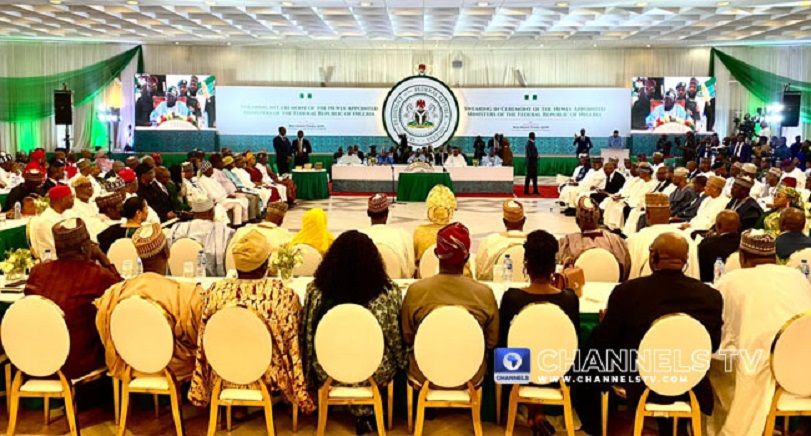
President Bola Tinubu, on Monday, August 21, swore in 46 Ministers at the State House Conference Center, Abuja.

Last week, President Tinubu released the portfolios for the appointees, including Mr Wale Edun (Finance and Coordinating Minister of the Economy), Mr Bosun Tijani (Communication, Innovation, and Digital Economy), Dr Muhmmad Ali Pate (Health and Coordinating Minister of Health and Social Welfare), former Rivers State governor Nyesom Wike in charge of the Ministry of Federal Capital Territory (FCT), and Mr Festus Keyamo (Aviation).

On Sunday, he made some changes as he redeployed the ex-Governor of Osun State, Mr Adegboyega Oyetola, from the Ministry of Transportation to the Ministry of Marine and Blue Economy. The President also redeployed Mr Abubakar Momoh from the Federal Ministry of Youth to the Federal Ministry of Niger Delta Development.

The swearing-in of the cabinet members today was attended by dignitaries such as Vice President, Mr Kashim Shettima, Senate President, Mr Godswill Akpabio, Speaker of the House Representatives, Mr Tajudeen Abass, and Secretary to the Government of the Federation, Mr George Akume.

The Ministers were sworn in in batches but were all inaugurated on Monday.

See the full list below:

  1. Minister of Communications, Innovation and Digital Economy, Bosun Tijani
  2. Minister of State, Environment and Ecological Management, Ishak Salaco
  3. Minister of Finance and Coordinating Minister of the Economy Wale Edun
  4. Minister of Marine and Blue Economy, Bunmi Tunji
  5. Minister of Power, Adedayo Adelabu
  6. Minister of State, Health and Social Welfare, Tunisia Alausa
  7. Minister of Solid Minerals Development, Dele Alake
  8. Minister of Tourism, Lola Ade-John
  9. Minister of Transportation, Adegboyega Oyetola
  10. Minister of Industry, Trade and Investment, Doris Anite
  11. Minister of Innovation Science and Technology, Uche Nnaji
  12. Minister of State, Labour and Employment, Nkiruka Onyejeocha
  13. Minister of Women Affairs, Uju Kennedy
  14. Minister of Works, David Umahi
  15. Minister of Aviation and Aerospace Development, Festus Keyamo
  16. Minister of Youth, Abubakar Momoh
  17. Minister of Humanitarian Affairs and Poverty Alleviation, Betta Edu
  18. Minister of State, Gas Resources, Ekperikpe Ekpo
  19. Minister of State, Petroleum Resources, Heineken Lokpobiri
  20. Minister of Sports Development, John Enoh
  21. Minister of Federal Capital Territory, Nyesom Wike
  22. Minister of Art, Culture and the Creative Economy, Hannatu Musawa
  23. Minister of Defence, Mohammed Badaru
  24. Minister of State Defence, Bello Matawalle
  25. Minister of State Education, Yusuf T. Sunumu
  26. Minister of Housing and Urban Development, Ahmed M. Dangiwa
  27. Minister of State, Housing and Urban Development, Abdullah T. Gwarzo
  28. Minister of Budget and Economic Planning, Atiku Bagudu
  29. Minister of State, Federal Capital Territory, Mairiga Mahmud
  30. Minister of State, Water Resources and Sanitation, Bello M. Goronyo
  31. Minister of Agriculture and Food Security, Abubakar Kyar
  32. Minister of Education, Tahir Maman
  33. Minister of Interior, Sa’Idu A. Alkali
  34. Minister of Foreign Affairs, Yusuf M. Tuggar
  35. Coordinating Minister of Health and Social Welfare, Ali Pate
  36. Minister of Police Affairs, Ibrahim Geidam
  37. Minister of State, Steel Development, U. Maigari Ahmadu
  38. Minister of Steel Development, Shuaibu A. Audu
  39. Minister of Information and National Orientation, Muhammed Idris
  40. Attorney General of the Federation and Minister of Justice, Lateef Fagbemi
  41. Minister of Labour and Employment, Simon B. Lalong
  42. Minister of State, Police Affairs, Imaan Sulaiman-Ibrahim
  43. Minister of Special Duties and Inter-Governmental Affairs, Zephaniah Jisalo
  44. Minister of Water Resources and Sanitation, Joseph Utsev
  45. Minister of State, Agriculture and Food Security, Aliyu Sabi Abdullahi
  46. Minister of Environment and Ecological Management, (Kaduna)

Adedapo Adesanya is a journalist, polymath, and connoisseur of everything art. When he is not writing, he has his nose buried in one of the many books or articles he has bookmarked or simply listening to good music with a bottle of beer or wine. He supports the greatest club in the world, Manchester United F.C.

Advertisement
Click to comment

Leave a Reply

Your email address will not be published. Required fields are marked *

General

Tether Records $10bn Net Profit in 2025, $6.3bn in Excess Reserves

Published

on

Tether

By Adedapo Adesanya

Tether, issuer of the world’s most popular stablecoin, USDT, wrapped up 2025 with a net profit of over $10 billion, bolstered by steady growth in its flagship token and growing exposure to US Treasuries and gold.

The fourth-quarter attestation showed Tether holding $6.3 billion in excess reserves, a buffer over its $186.5 billion in liabilities tied to issued tokens. USDT’s circulating supply grew by $50 billion over the year to over $186 billion.

The firm continued ramping up its holdings of US Treasuries, reaching $122 billion in direct exposure and $141 billion including overnight reverse repurchase agreements, positioning it among the largest holders of US government debt globally.

Tether also maintained significant allocations to gold and Bitcoin, reporting holdings of $17.4 billion and $8.4 billion, respectively.

Tether’s investment portfolio, which is separated from reserve assets, was valued at $20 billion.

“With USDT issuance at record levels, reserves exceeding liabilities by billions of dollars, Treasury exposure at historic highs, and strong risk management, Tether enters 2026 with one of the strongest balance sheets of any global company,” said the chief executive of Tether, Mr Paolo Ardoino, in a statement shared with Business Post.

“This has been made possible by the trust accrued by our strong risk management setup, unprecedented in the financial sector, and the decisions we make around asset quality, allocation, and liquidity are designed to ensure USD₮ remains reliable and usable at a global scale, even during periods of extreme demand,” he added.

The latest report comes amid rising global demand for stablecoins, with Tether’s USDT remaining the dominant digital dollar in circulation.

Continue Reading

General

SERAP Sues NNPC Over Missing N22.3bn, $49.7m, £14.3m, €5.2m Oil Funds

Published

on

bayo ojulari nnpc

By Adedapo Adesanya

The Socio-Economic Rights and Accountability Project (SERAP) has filed a lawsuit against the Nigerian National Petroleum Company (NNPC) Limited over its failure to account for the alleged missing or diverted N22.3 billion, $49.7 million, £14.3 million and €5.2 million oil funds.

Disclosing this in a statement on Sunday, SERAP Deputy Director, Mr Kolawole Oluwadare, said the suit followed the damning allegations documented in the 2022 audited report by the Auditor-General of the Federation, which was published on 9 September 2025.

The suit was filed last Friday at the Federal High Court in Abuja, with the organisation seeking “an order of mandamus to direct and compel the NNPCL to account for the alleged missing or diverted N22.3 billion, $49.7 million, £14.3 million, and €5.2 million oil money.”

It also asked the court to “direct and compel the NNPCL to disclose the specific financial transactions carried out in respect of the alleged missing or diverted N22.3 billion, $49.7 million, £14.3 million and €5.2 million oil money, including details of disbursement, the contractors, and other individuals who collected the money.”

“The diverted or misappropriated oil revenues reflect a failure of NNPCL accountability more generally and are directly linked to the institution’s continuing failure to uphold the principles of transparency and accountability,” SERAP argued, noting that, “Granting the reliefs sought would strike a blow against the impunity of those responsible for the missing or diverted oil money, and ensure that the money is returned for the sake of NNPCL’s victims—Nigerians.”

“The allegations have also undermined the economic development of the country, trapped the majority of Nigerians in poverty and deprived them of opportunities.

“The Auditor-General has for many years documented reports of disappearance of oil money from the NNPCL. Nigerians continue to bear the brunt of these missing oil money meant to provide essential public services for Nigerians,” it added.

SERAP is also arguing that, “Combating the corruption epidemic in the oil sector would alleviate poverty, improve access of Nigerians to basic public goods and services, and enhance the ability of the government to meet its human rights and anti-corruption obligations.”

Continue Reading

General

Minister Advocates Coordinated, Trust-Driven Government Communication

Published

on

trust-driven government communication

By Aduragbemi Omiyale

The Minister of Information and National Orientation, Mr Mohammed Idris, has emphasised that unified government messaging remains very critical to restoring public trust, especially in delivering the Renewed Hope Agenda of President Bola Tinubu.

He said this on Thursday in Abuja at an interactive session with Directors of Information and Resident Information Officers (RIOs) on grade level 14-17, deployed across Ministries, Departments and Agencies (MDAs).

The event, according to a statement issued on Friday by the Director Public Relations and Protocol of the ministry, Mr Suleiman Haruna, was themed Aligning Public Information with the Renewed Hope Agenda: Rebuilding Trust Through Effective, Transparent Communication.

The Minister noted that government officials must adopt a unified, coordinated, and trust-driven approach to government communication.

He posited that public trust remains the most valuable asset of government communication, stressing that information officers must be guided by honesty, credibility, and consistency in their work.

“Public trust is our most important capital. Once credibility is lost, no amount of messaging can fix it,” the Minister said, warning that fragmented messaging and parallel communication channels weaken government credibility and confuse citizens, insisting that the government must speak with a single, clear, and consistent voice.

“We are one government serving one national interest, and our communication must reflect that unity,” he said.

Mr Idris urged Resident Information Officers to see themselves as active partners within their host MDAs rather than passive observers, encouraging them to engage proactively with Ministers, Permanent Secretaries, and agency leadership, noting that professionalism, relevance, and initiative are key to earning trust and influence.

Addressing the growing pressure of misinformation and the speed of digital media, the founder of Blueprint Newspaper stressed the importance of timely and accurate communication, noting that delays often create space for false narratives. While reaffirming the federal government’s commitment to freedom of expression, he said such freedom must be exercised responsibly.

The Minister also outlined steps being taken to strengthen professionalism within the information cadre, including mandatory periodic reporting, improved deployment processes, continuous training, and stronger institutional support. He disclosed that the Federal Government has begun restoring the National Institute of Public Information to boost capacity building for public communicators.

He called for teamwork and mutual respect, reminding participants that they are central to the projection of government policies and achievements and that they must align their work with the priorities of the Renewed Hope Agenda.

Continue Reading

Trending