Connect with us

General

Tinubu Swears In Wale Edun, Wike, Others as Ministers

Published

on

swears in ministers

By Adedapo Adesanya

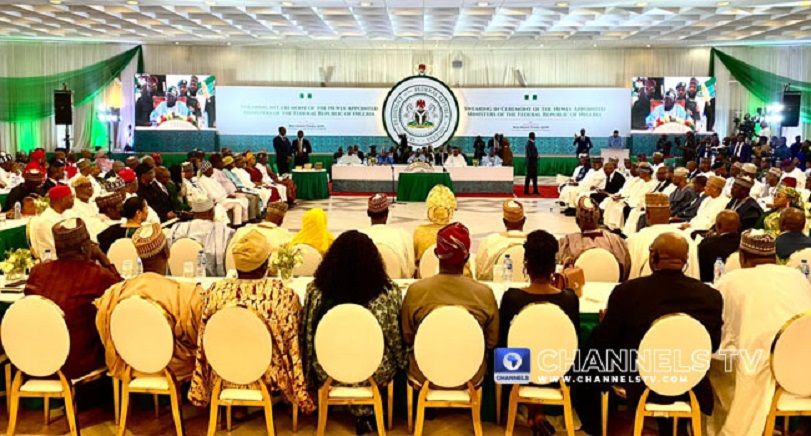
President Bola Tinubu, on Monday, August 21, swore in 46 Ministers at the State House Conference Center, Abuja.

Last week, President Tinubu released the portfolios for the appointees, including Mr Wale Edun (Finance and Coordinating Minister of the Economy), Mr Bosun Tijani (Communication, Innovation, and Digital Economy), Dr Muhmmad Ali Pate (Health and Coordinating Minister of Health and Social Welfare), former Rivers State governor Nyesom Wike in charge of the Ministry of Federal Capital Territory (FCT), and Mr Festus Keyamo (Aviation).

On Sunday, he made some changes as he redeployed the ex-Governor of Osun State, Mr Adegboyega Oyetola, from the Ministry of Transportation to the Ministry of Marine and Blue Economy. The President also redeployed Mr Abubakar Momoh from the Federal Ministry of Youth to the Federal Ministry of Niger Delta Development.

The swearing-in of the cabinet members today was attended by dignitaries such as Vice President, Mr Kashim Shettima, Senate President, Mr Godswill Akpabio, Speaker of the House Representatives, Mr Tajudeen Abass, and Secretary to the Government of the Federation, Mr George Akume.

The Ministers were sworn in in batches but were all inaugurated on Monday.

See the full list below:

  1. Minister of Communications, Innovation and Digital Economy, Bosun Tijani
  2. Minister of State, Environment and Ecological Management, Ishak Salaco
  3. Minister of Finance and Coordinating Minister of the Economy Wale Edun
  4. Minister of Marine and Blue Economy, Bunmi Tunji
  5. Minister of Power, Adedayo Adelabu
  6. Minister of State, Health and Social Welfare, Tunisia Alausa
  7. Minister of Solid Minerals Development, Dele Alake
  8. Minister of Tourism, Lola Ade-John
  9. Minister of Transportation, Adegboyega Oyetola
  10. Minister of Industry, Trade and Investment, Doris Anite
  11. Minister of Innovation Science and Technology, Uche Nnaji
  12. Minister of State, Labour and Employment, Nkiruka Onyejeocha
  13. Minister of Women Affairs, Uju Kennedy
  14. Minister of Works, David Umahi
  15. Minister of Aviation and Aerospace Development, Festus Keyamo
  16. Minister of Youth, Abubakar Momoh
  17. Minister of Humanitarian Affairs and Poverty Alleviation, Betta Edu
  18. Minister of State, Gas Resources, Ekperikpe Ekpo
  19. Minister of State, Petroleum Resources, Heineken Lokpobiri
  20. Minister of Sports Development, John Enoh
  21. Minister of Federal Capital Territory, Nyesom Wike
  22. Minister of Art, Culture and the Creative Economy, Hannatu Musawa
  23. Minister of Defence, Mohammed Badaru
  24. Minister of State Defence, Bello Matawalle
  25. Minister of State Education, Yusuf T. Sunumu
  26. Minister of Housing and Urban Development, Ahmed M. Dangiwa
  27. Minister of State, Housing and Urban Development, Abdullah T. Gwarzo
  28. Minister of Budget and Economic Planning, Atiku Bagudu
  29. Minister of State, Federal Capital Territory, Mairiga Mahmud
  30. Minister of State, Water Resources and Sanitation, Bello M. Goronyo
  31. Minister of Agriculture and Food Security, Abubakar Kyar
  32. Minister of Education, Tahir Maman
  33. Minister of Interior, Sa’Idu A. Alkali
  34. Minister of Foreign Affairs, Yusuf M. Tuggar
  35. Coordinating Minister of Health and Social Welfare, Ali Pate
  36. Minister of Police Affairs, Ibrahim Geidam
  37. Minister of State, Steel Development, U. Maigari Ahmadu
  38. Minister of Steel Development, Shuaibu A. Audu
  39. Minister of Information and National Orientation, Muhammed Idris
  40. Attorney General of the Federation and Minister of Justice, Lateef Fagbemi
  41. Minister of Labour and Employment, Simon B. Lalong
  42. Minister of State, Police Affairs, Imaan Sulaiman-Ibrahim
  43. Minister of Special Duties and Inter-Governmental Affairs, Zephaniah Jisalo
  44. Minister of Water Resources and Sanitation, Joseph Utsev
  45. Minister of State, Agriculture and Food Security, Aliyu Sabi Abdullahi
  46. Minister of Environment and Ecological Management, (Kaduna)

Adedapo Adesanya is a journalist, polymath, and connoisseur of everything art. When he is not writing, he has his nose buried in one of the many books or articles he has bookmarked or simply listening to good music with a bottle of beer or wine. He supports the greatest club in the world, Manchester United F.C.

Click to comment

Leave a Reply

Your email address will not be published. Required fields are marked *

General

FG, Honeywell Explore Sustainable Development Opportunities

Published

on

honeywell group

By Modupe Gbadeyanka

The federal government and the Honeywell Group are strengthening a partnership aimed at achieving sustainable development in Nigeria.

The company on Thursday held a meeting with the Minister of Interior, Mr Olubunmi Tunji-Ojo, in Abuja. Both parties explored ways to promote economic development, reaffirming the importance of public-private sector cooperation in advancing Nigeria’s development agenda and improving service delivery for citizens.

The Senior Adviser to the Honeywell Group, Mrs Oduwaye Nsidi-Sakiri, reaffirmed the organisation’s commitment to supporting national development through constructive engagement and collaboration.

“We commend the remarkable progress that has been made. These achievements are a reflection not only of leadership but also of the dedication and hard work of the entire team within the Ministry,” she said.

She explained that the visit reflected Honeywell Group’s longstanding tradition of maintaining proactive and constructive relationships with government institutions, regulatory agencies, and other key public-sector stakeholders. She further expressed the group’s willingness to explore opportunities for collaboration in support of government initiatives and national development objectives.

Also speaking, Honeywell Group Chief Operating Officer, Mrs Tomi Ayo-Tugbo, commended the Ministry for reforms that are delivering tangible improvements in the lives of Nigerians, reiterating the firm’s commitment to supporting the country’s growth and prosperity.

On his part, Mr Tunji-Ojo praised the company for its longstanding contributions to Nigeria’s economy and acknowledged the critical role of the private sector in driving economic growth, creating jobs, and supporting national development.

He further assured the delegation of the Ministry’s readiness to engage with stakeholders and collaborate with responsible corporate organisations in advancing initiatives that promote economic development, innovation, and improved service delivery.

The Minister emphasised that the reforms being implemented across the Ministry and its agencies are designed not only to improve operational efficiency but also to strengthen national security and enhance public confidence in government institutions.

“Our goal is to build institutions that work efficiently for the people. We are committed to creating systems that are transparent, technology-driven, and capable of delivering services in a manner that reflects the aspirations of a modern Nigeria,” he stated.

“The government cannot achieve sustainable development alone. Strong partnerships between the public and private sectors are essential to building a prosperous nation. We value organisations such as Honeywell Group that have consistently invested in Nigeria and contributed to the country’s growth over several decades,” Mr Tunji-Ojo added.

Continue Reading

General

FG Orders MDAs to Secure Funding Before Awarding Contracts

Published

on

project funding

By Adedapo Adesanya

The federal government has directed that no new public contracts should be awarded without first getting the funds, as part of efforts to improve project delivery across the country.

Director-General of the Bureau of Public Procurement (BPP), Mr Adebowale Adedokun, disclosed this on the sidelines of the Inaugural Hosting of The Procurement Evolution in Abuja on Thursday.

Mr Adedokun said President Bola Tinubu had approved measures to raise resources needed to settle outstanding obligations to contractors, describing timely payment as critical to an efficient procurement system.

“Mr President has given a directive on when funds should be raised to address the concerns of contractors who are yet to be paid. With this, procurement processes will be much better because payment is now tied to procurement.

“Meaning that no award will be further issued without resources or funding available. So these are the things that the President has asked us to do.”

The BPP boss said the government was also implementing 23 procurement reforms aimed at improving transparency, efficiency and value for money in public spending.

According to him, committees to drive the reforms will soon be inaugurated by the Secretary to the Government of the Federation (SGF).

He said the reforms were designed to ensure that Nigerians benefit directly through improved infrastructure, healthcare, education and better living conditions.

“The president wants Nigerians to feel the effects of this transformation by having good roads, good hospitals, good educational institutions, and a good living wage for all workers.”

The Secretary to the Government of the Federation (SGF), Mr George Akume, said public procurement remained central to the Tinubu administration’s Renewed Hope Agenda.

Mr Akume noted that ongoing reforms, including proposed amendments to the Public Procurement Act 2007, the Nigeria First Policy, Nigeria e-Marketplace initiative, community-based procurement and affirmative procurement programmes, were intended to strengthen local industries and promote economic inclusion.

The SGF, represented by Mr Abubakar Kana, Permanent Secretary, General Services Office, Office of the SGF, added that the reforms would enhance transparency, simplify procurement processes and leverage technology to improve service delivery and national development.

“As we move forward, our collective responsibility is very clear.

“We must ensure that procurement processes are simplified. without compromising accountability, that technology is fully leveraged to eliminate inefficiencies and that all stakeholders work collaboratively to achieve shared national goals.

“The federal government remains fully committed to supporting the Bureau of Public Procurement in driving these reforms and ensuring that public procurement becomes a catalyst for economic growth, infrastructure development and improved quality of life for all our citizens.”

Continue Reading

General

DisCos Collect N196bn in March, Miss N50bn of Billed Revenue

Published

on

Electricity Subsidy Q1 2024

By Adedapo Adesanya

Nigeria’s electricity distribution companies (DisCos) generated N196.13 billion in revenue in March 2026, despite billing customers a total of N246.43 billion during the month, according to the latest commercial performance report released by the Nigerian Electricity Regulatory Commission (NERC).

The figure represents a slight decline from the N196.68 billion collected in February, highlighting persistent challenges in revenue recovery across the power distribution segment, even as energy supplied to the grid continued to improve.

NERC’s March 2026 fact sheet showed that electricity billing rose by 1.71 per cent from N242.29 billion recorded in February, reflecting increased energy deliveries and customer charges. However, collection efficiency declined to 79.59 per cent from 81.17 per cent in the previous month, indicating that a significant portion of billed revenue remained uncollected.

The regulator disclosed that DisCos received 293.76 million kilowatt-hours of electricity during the review period, representing a 6.02 per cent increase compared to February. The development suggests a modest improvement in power availability across the distribution network.

Despite the increase in energy supplied, revenue recovery remains uneven across the industry. NERC reported that the average approved tariff for March stood at N124.30 per kilowatt-hour, while actual collections averaged ₦100.75 per kilowatt-hour, resulting in an overall revenue recovery efficiency of 81.05 per cent.

Among the eleven DisCos, Ikeja Electric emerged as the strongest performer, posting a revenue recovery efficiency of 99.30 per cent. Eko Electricity Distribution Company followed with 95.73 per cent, while Benin DisCo recorded 85.18 per cent.

At the lower end of the performance table, Kaduna Electric recorded the weakest recovery rate at 35.65 per cent. Jos DisCo and Yola DisCo also struggled, achieving recovery efficiencies of 53.53 per cent and 58.58 per cent, respectively.

Ikeja Electric also led in collection efficiency with 96.38 per cent, ahead of Benin DisCo at 90.97 per cent and Eko DisCo at 87.68 per cent. Kaduna, Jos and Yola remained the poorest performers in this category, underlining the persistent commercial and operational challenges facing power distributors in parts of northern Nigeria.

In terms of billing efficiency, Eko DisCo ranked first with 92.30 per cent, followed by Port Harcourt DisCo at 90.36 per cent and Ikeja Electric at 87.76 per cent. Yola DisCo recorded the lowest billing efficiency at 58.68 per cent.

The latest figures underscore the mixed realities within Nigeria’s power sector. While electricity supply and customer billing continue to improve, revenue collection remains a major obstacle to the financial sustainability of the industry.

Analysts note that stronger metering penetration, improved customer confidence, reduction in energy theft and more efficient collection systems will be critical if DisCos are to close the widening gap between electricity supplied, billed revenue and actual collections.

The March performance report comes as regulators and industry stakeholders intensify efforts to strengthen the commercial viability of the electricity market, attract fresh investment and improve service delivery across the country.

Continue Reading

Trending