Connect with us

Economy

Naira Plunges Amid FX Supply Constraints

Published

on

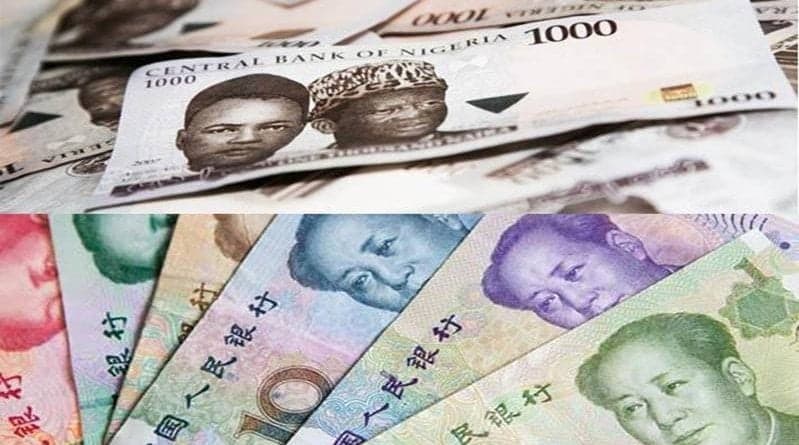
Naira-Yuan Currency Swap Deal

By Adedapo Adesanya

The Naira depreciated against the United States Dollar in the opening session of the week across the foreign exchange (FX) market segments on Monday, January 22 amid worsening forex supply constraints.

The local currency depleted against the greenback yesterday by N23.09 or 2.5 per cent in the Nigerian Autonomous Foreign Exchange Market (NAFEM) window to sell at N925.54/$1 compared with the preceding day’s N902.45/$1.

However, the Nigerian currency traded flat against the British Pound Sterling and the Euro during the trading session at N1,129.27/£1 and N969.69/€1, respectively.

The value of FX trades in the spot market decreased by 49.7 per cent or $72.56 million to $73.33 million from the $145.89 million achieved last Friday, according to data from the FMDQ Securities Exchange.

In the parallel market, the domestic currency lost N5 against the US Dollar on Monday to quote at N1,360$1 versus the preceding session’s exchange rate of N1,355/$1.

Also, in the peer-to-peer (P2P) section of the forex market, the Naira plunged against the Dollar during the session by N20 to trade at N1,357/$1 versus the preceding session’s N1,337/$1.

All indications point that the weakening of the Naira will continue depreciation in 2024, analysts at Standard and Poor’s (S&P) Global Ratings said.

This will be triggered by Nigeria’s broadly flat reserves which limit the supply of the much-needed foreign exchange (FX), adding that higher import costs, backlogs of FX transactions, and lower FX receipts stemming from oil exports will constrain growth in the country’s reserves.

In the digital currency market, Bitcoin’s price fell below $40,000, continuing a decline that began after the recent launch of spot Bitcoin exchange-traded funds (ETFs) in the US.

The outflows from Grayscale’s GBTC Bitcoin Trust have been notably large as investors exit positions to take profits after having been locked into the fund.

Yesterday, BTC slumped by 2.7 per cent to $39,991.38 and Ethereum (ETH) weakened by 3.3 per cent to $2,344.04, with Solana (SOL) falling by 5.3 per cent to $85.15.

Litecoin (LTC) went down by 4.8 per cent to $68.22, Dogecoin (DOGE) crashed by 3.4 per cent to $0.0808, and Cardano (ADA) slid by 3.3 per cent to trade at $0.4829.

In addition, Binance Coin (BNB) dropped 2.1 per cent to sell at $310.49, Ripple (XRP) depreciated by 1.9 per cent to trade at $0.5287, and US Dollar Tether (USDT) lost 0.02 per cent to settle at $0.999, while Binance USD (BUSD) remained unchanged at $1.00.


Adedapo Adesanya is a journalist, polymath, and connoisseur of everything art. When he is not writing, he has his nose buried in one of the many books or articles he has bookmarked or simply listening to good music with a bottle of beer or wine. He supports the greatest club in the world, Manchester United F.C.

Economy

Dangote Refinery Assures Steady Daily Supply of 75 million Litres of PMS, Others

Published

on

Fifth Crude Cargo Dangote Refinery

By Aduragbemi Omiyale

If the assurance from the Dangote Petroleum Refinery is anything to take to the bank, then consumers of petroleum products in Nigeria have nothing to worry about in terms of availability.

The refinery has assured that it has the capacity to supply to them on a daily basis about 75 million litres of premium motor spirit (PMS), otherwise known as petrol; 25 litres of automated gas oil (AGO), also known as diesel; and 20 litres of jet fuel.

Nigeria is estimated to consume about 50 million litres of petrol per day, 14 million litres of diesel, and four litres of aviation fuel.

Dangote Refinery in a statement said the availability of volumes above prevailing demand provides critical supply buffers, enhances market stability and reduces reliance on imports, particularly during periods of peak demand or logistical disruption.

“The management of Dangote Petroleum Refinery would like to reiterate our capability to supply the underlisted petroleum products of the highest international quality standard to marketers and stakeholders,” it said in a public notice.

Industry analysts noted that supplying above estimated consumption reduces the need for emergency imports, strengthens inventory cover, enhances the resilience of the domestic supply chain, and boosts the foreign exchange ecosystem, thereby fortifying the value of the Naira in the currency market.

Dangote Refinery has also reaffirmed its commitment to full regulatory compliance and continued cooperation with the Nigerian Midstream and Downstream Petroleum Regulatory Authority (NMDPRA), stating that its supply approach is aligned with ongoing efforts to ensure market stability and orderly downstream operations.

It said it remains fully engaged with regulators and industry stakeholders in support of Nigeria’s national energy security objectives, as the country deepens its transition from fuel import dependence to domestic refining. It added that it continues to work closely with market participants to ensure that the benefits of local refining, including reliable supply, competitive pricing and improved market discipline are delivered consistently to consumers nationwide.

Continue Reading

Economy

Sachet Alcohol Ban: NECA Demands Respect for Due Process

Published

on

NECA Adewale Smatt-Oyerinde

By Adedapo Adesanya

The Nigeria Employers’ Consultative Association (NECA) has expressed concern over the renewed enforcement of a ban on the production and sale of alcoholic beverages in sachets and small PET bottles by the National Agency for Food and Drug Administration and Control (NAFDAC).

The group’s director general, Mr Wale-Smatt Oyerinde, warned that the action of the agency could have adverse economic and governance consequences.

NECA is the organisation expressing worry of this issue after the Manufacturers Association of Nigeria (MAN) raised concerns about it earlier this week.

Mr Oyerinde said the enforcement contradicts a directive from the Office of the Secretary to the Government of the Federation dated December 15, 2025, which suspended the ban, as well as a March 14, 2024 resolution of the House of Representatives calling for restraint and broader stakeholder engagement.

The NECA chief said the continued enforcement is already disrupting legitimate businesses, unsettling ongoing investments, and putting thousands of jobs at risk, while weakening confidence in Nigeria’s regulatory environment.

According to Mr Oyerinde, regulation should be based on evidence, proportionality and the rule of law. He noted that the affected products were tested, registered and periodically revalidated under NAFDAC’s regulatory procedures, with alcohol content clearly labelled in line with internationally recognised Alcohol by Volume standards.

He added that underage drinking is primarily an enforcement issue at the retail level rather than a packaging issue, and called for stricter licensing, monitoring, and sanctions for erring retailers rather than a blanket ban on certain product formats.

NECA boss also warned that sachet and small-pack formats reflect affordability realities for many adult consumers, and that eliminating them could push demand into informal, unregulated markets, increasing public health risks and shrinking the formal economy.

He further expressed concern that enforcement efforts are focused on a regulated segment of the beverage industry while more dangerous illicit narcotics and abused pharmaceuticals continue to circulate widely among young people.

On the economic impact, NECA said the wines and spirits value chain supports significant direct and indirect employment across manufacturing, packaging, distribution, transportation, retail and agriculture.

It cautioned that sudden regulatory actions could threaten livelihoods, reduce government revenue and undermine investor confidence.

Addressing environmental concerns, NECA said plastic waste issues should be tackled through improved waste management, recycling systems and extended producer responsibility frameworks, rather than selective product bans.

Continue Reading

Economy

NASD OTC Index Drops 0.27% as Market Cap Slides to N2.167trn

Published

on

NASD securities exchange

By Adedapo Adesanya

The NASD Over-the-Counter (OTC) Securities Exchange lost 0.27 per cent on Thursday, January 29, weakening the Unlisted Security Index (NSI) by 9.79 points to 3,622.77 points from the previous session’s 3,632.56 points, as the market capitalisation recorded a N5.85 billion loss to end at N2.167 trillion compared with Wednesday’s closing value of N2.173 trillion.

Three securities were responsible for the downfall of the alternative stock market, with leaders being Okitipupa Plc, which shrank by N15.70 to end at N218.90 per unit versus the previous day’s N234.60 per unit. Afriland Properties Plc declined by 50 Kobo to close at N14.00 per share compared with the N14.50 per share it finished at midweek, and Food Concepts Plc dropped 9 Kobo to sell at N2.63 per unit versus N2.72 per unit.

Business Post reports that there were two price gainers yesterday led by Nipco Plc, which added N17.48 to its value to settle at N259.48 per share versus N242.00 per share, and Central Securities Clearing System (CSCS) Plc appreciated by 35 Kobo to N40.50 per unit from N40.15 per unit.

During the trading session, the volume of securities went down by 57.3 per cent to 1.9 million units from 4.7 million units, the value of securities decreased by 74.4 per cent to N13.4 million from N52.4 million, and the number of deals slipped by 50 per cent to 16 deals from 32 deals.

When the market closed for the day, CSCS Plc was still the most active stock by value on a year-to-date basis with 15.3 million units traded for N622.9 million, trailed by FrieslandCampina Wamco Nigeria Plc with 1.6 million units exchanged for N108.4 million, and Geo-Fluids Plc with 8.9 million units worth N60.4 million.

CSCS Plc was also the most active stock by volume on a year-to-date basis with 15.3 million units valued at N622.9 million, followed by Mass Telecom Innovation Plc with 10.1 million units sold for N4.1 million, and Geo-Fluids Plc with 8.9 million units transacted for N60.4 million.

Continue Reading

Trending