Connect with us

Brands/Products

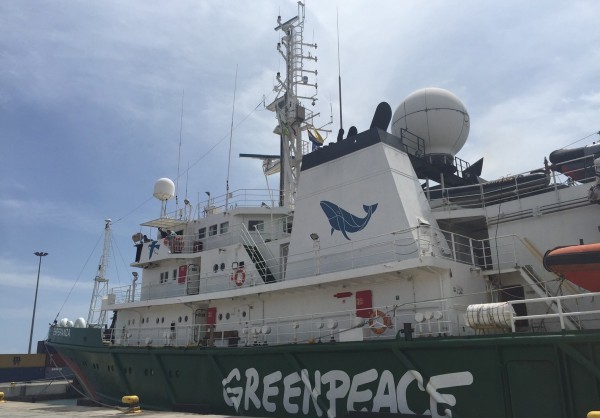
Greenpeace Ship, My Esperanza, Sails into West Africa Waters

Published

on

By Modupe Gbadeyanka

The Greenpeace ship called My Esperanza on Friday docked at the port of Praia in Cape Verde.

For 11 weeks, the Esperanza will sail the waters of six West Africa States – Cape Verde, Mauritania, Guinea Bissau, Guinea, Sierra Leone and Senegal to raise awareness on the state of fisheries through political events, public engagement and consultations with the West-African science community.

The ship tour named “The West Africa tour of hope” will provide an opportunity to make these countries’ voice on protecting their own sea and marine resources heard internationally.

“By bringing the ship to West Africa, Greenpeace seeks once again to reiterate its ultimate commitment in working with local communities and governments in addressing issues of overfishing and illegal fishing that have plagued the region for decades” said Greenpeace Africa Executive Director Njeri Kabeberi

The West African waters are among the richest in the world. Millions of people and local communities depend on them to survive.

However, the population in West Africa is growing and the fish stocks are declining as a result of fishing, climate change, pollution and destruction of critical habitats.

This situation is exacerbated by the lack of efficient fisheries management in the region, illegal, unregulated and undeclared fishing activities (IUU fishing) and the weakness of surveillance systems in most of the countries.

“Overfishing and illegal fishing in West African waters is a threat to food security, fish stocks and a healthy ocean. It is critical that the collaboration between states be reinforced to support a regional approach to better management of fisheries in West Africa”, said Ibrahima Cissé, Greenpeace Africa Senior Oceans Campaign Manager.

In the last 15 years, Greenpeace has documented and exposed how distant water fleets and illegal vessels have moved their fleets to West Africa after overexploiting fish stocks in their own waters.

Chinese, Russian and European fleets are among the most prominent in West Africa waters. Their activities have and continue to compromise the food security and livelihoods of coastal communities who largely depend on artisanal fishing.

More recently, the rapid growth of artisanal and industrial fishery without regulation or planning of their capacity has added to the problem.

“West Africa States will have to work together and act with a unified voice to safeguard their waters. A sustainable common management of resources, especially the small pelagic is a first step to guarantee fish stock for present and future generations” added Dr Cissé.

In the next two months, the Greenpeace vessel My Esperanza will work closely with local authorities to increase the sense of urgency required to deal with the current unsustainable approach to fisheries management and call for a strong Regional fisheries management system.


Modupe Gbadeyanka is a fast-rising journalist with Business Post Nigeria. Her passion for journalism is amazing. She is willing to learn more with a view to becoming one of the best pen-pushers in Nigeria. Her role models are the duo of CNN's Richard Quest and Christiane Amanpour.

Advertisement
Click to comment

Leave a Reply

Your email address will not be published. Required fields are marked *

Brands/Products

JMG Installs Solar Power Systems at Three NIPCO Fuel Stations

Published

on

JMG solar power systems NIPCO

By Aduragbemi Omiyale

Nigeria’s trusted hybrid and integrated electromechanical energy provider, JMG Limited, has completed the installation of solar power systems at three key fuel stations of NIPCO Plc.

The clean energy source was installed at NIPCO’s petrol dispensing outlets in Gwagwalada Abuja, Lekki Lagos, and Mpape Abuja.

This will help the organisation eliminate diesel reliance, and unlock more than N44 million in annual energy cost savings.

The installations feature advanced hybrid systems, combining solar arrays, lithium battery storage, and smart inverters to provide 24/7 energy for fuel pumps, lighting, and office operations. Each site has reported zero use of electricity or generator power since the systems were installed.

The three NIPCO stations now run on an advanced hybrid solar system that combines high‑efficiency PV panels, intelligent lithium‑battery storage and smart inverters.

Since commissioning, the sites have operated with zero grid or generator power, providing silent, clean, uninterrupted electricity for pumps, lighting and administration.

“We are proud to help NIPCO lead the energy transition at the retail level.

“The scalable architecture can be sized to each location and has already delivered significant savings, about 88,535 kWh/year, N44.4 million in annual cost savings and a 43.8‑tonne reduction in CO₂ emissions,” the Head of JMG’s Hybrid Solar Division, Mr Abbass Hussein, stated, adding that, “Collaborating with NIPCO on this initiative demonstrates a practical pathway for other firms to reduce both emissions and energy expenses.”

Also commenting, NIPCO’s Station Manager at Gwagwalada, Mr Idoko Jacob, said, “The stations have not relied on electricity or generator power on bright-weather days since commissioning. The solar systems fully meet our daily energy needs during such periods. On days with poor weather, we supplement the solar system with generator power to ensure uninterrupted operations.”

Business Post gathered that the NIPCO Gwagwalada Station has a solar output of 42,450 kWh/year, annual savings of N15.6 million, and CO₂ reduction of 15,332.76 kg/year, with a system installed consisting of a 20kW Deye LV Hybrid Inverter, 26.8kWp Solar PV, and 51.2kWh Lithium Battery Storage.

The NIPCO Lekki Station has a solar output of 3,635 kWh/year, annual savings of N12 million, and CO₂ reduction of 13,130.1 kg/year, with a system installed consisting of a 25kW Must Hybrid Inverter, 22.95kWp Solar PV, and 76.8kWh Lithium Battery Storage.

As for the NIPCO Mpape Station, it has a solar output of 42,450 kWh/year, annual savings of N16.8 million, and CO₂ reduction of 15,332.76 kg/year, with a system installed consisting of a 20kW Deye LV Hybrid Inverter, 26.8kWp Solar PV, and 61.44kWh Lithium Battery Storage.

Continue Reading

Brands/Products

MAGGI Unveils ‘Taste of Christmas’ Campaign

Published

on

MAGGI Taste of Christmas

MAGGI, the culinary brand from Nestlé Nigeria, has announced the launch of its festive campaign, Taste of Christmas, designed to celebrate the sights, sounds, and flavours that define the Nigerian Christmas experience.

Central to the campaign is a collaboration with Nigeria’s fast-rising pop star Qing Madi and the renowned Loud Urban Choir, resulting in a new Christmas anthem titled Taste of Christmas.

Now available across all major music streaming platforms, the song blends contemporary sound with cultural warmth, evoking the joy of family, togetherness, and shared meals that characterize the season.

Extending beyond music, the Taste of Christmas campaign will roll out a curated series of festive recipes and culinary inspiration over a 12-day period. The collection features creative twists such as Coco Bongus, alongside beloved Nigerian classics, encouraging families to explore new flavours while enjoying MAGGI’s trusted range of seasonings.

Commenting on the campaign, the Category Manager for Culinary at MAGGI, Ms Funmi Osineye, said, “Christmas is a time when family, culture, and shared experiences come alive. With the Taste of Christmas campaign, we set out to create a platform that resonates strongly with today’s young adults while still celebrating the warmth of home. Partnering with Qing Madi and The Loud Urban Choir allows us to connect music and food in a way that feels authentic, modern, and deeply Nigerian.”

The campaign further reflects MAGGI’s commitment to celebrating home-grown talent, nurturing culinary creativity, and strengthening the role of food as a unifying force in Nigerian homes.

Consumers can access festive recipes, campaign content, and the Taste of Christmas anthem on MAGGI’s digital platforms and social media channels. Conversations around the campaign can be followed using #MAGGIChristmas.

MAGGI is a leading culinary brand from Nestlé Nigeria, committed to inspiring better cooking habits and bringing families together through delicious, nutritious meals.

Continue Reading

Brands/Products

FG Suspension of Sachet Alcohol Ban Excites NECA

Published

on

sachet alcohol

By Modupe Gbadeyanka

The decision of the federal government to suspend the ban on alcohol produced in sachets has been welcomed by the Nigeria Employers’ Consultative Association (NECA).

The Director-General of the group, Mr Adewale-Smatt Oyerinde, described it as a right step in the right direction because it respects existing National Assembly resolutions and restores regulatory clarity.

Recall that recently, the Office of the Secretary to the Government of the Federation (OSGF) ordered the suspension of the policy due to concerns raised by the House of Representatives Committee on Food and Drugs Administration and Control.

In a statement, the NECA chief said the immediate suspension of all enforcement actions relating to the proposed ban on sachet alcohol and 200ml PET bottle products, pending the conclusion of consultations and the issuance of a final policy directive, was good for the industry and the economy.

According to him, the sachet and PET segment of the alcoholic beverage industry accounts for a significant portion of the estimated N800 billion invested in the sector and supports thousands of direct and indirect jobs in manufacturing, packaging, logistics, wholesale and retail.

He stressed that in an economy already struggling with high unemployment and rising business costs, abrupt policy measures that threaten existing jobs and legitimate investments would be counterproductive.

“We fully acknowledge the need to address public health concerns, especially regarding children and young people, but the solutions must be evidence-based and carefully designed so as not to drive activities into the informal and unregulated economy or encourage illicit products.

“We are looking forward to a deepened consultation to enable the protection of jobs, livelihoods and legitimate investments, etc., while also ensuring that public health objectives are effectively and sustainably achieved,” Mr Oyerinde said.

Continue Reading

Trending