Connect with us

Technology

5 AI-Powered Creative Tools To Help You Elevate Your Digital Advertising Campaigns

Published

on

AI-Powered Creative Tools

Artificial intelligence (AI) is revolutionising industries, including digital marketing, by enabling marketers to create targeted, engaging, and effective campaigns.

Last week Google Ads introduced a suite of new AI-powered tools that enhance creativity and performance, such as advanced reporting, AI-powered image editing, generative AI for asset creation, streamlined access, and seamless integrations with creative platforms.

These tools empower marketers to uncover hidden insights, unleash their creativity, accelerate content creation, simplify their workflow, and expand their creative network.

These new features build upon the foundation of Performance Max, providing marketers with even more tools to unleash their creativity and drive results.

5 Ways Google Ads is Transforming Creative Performance

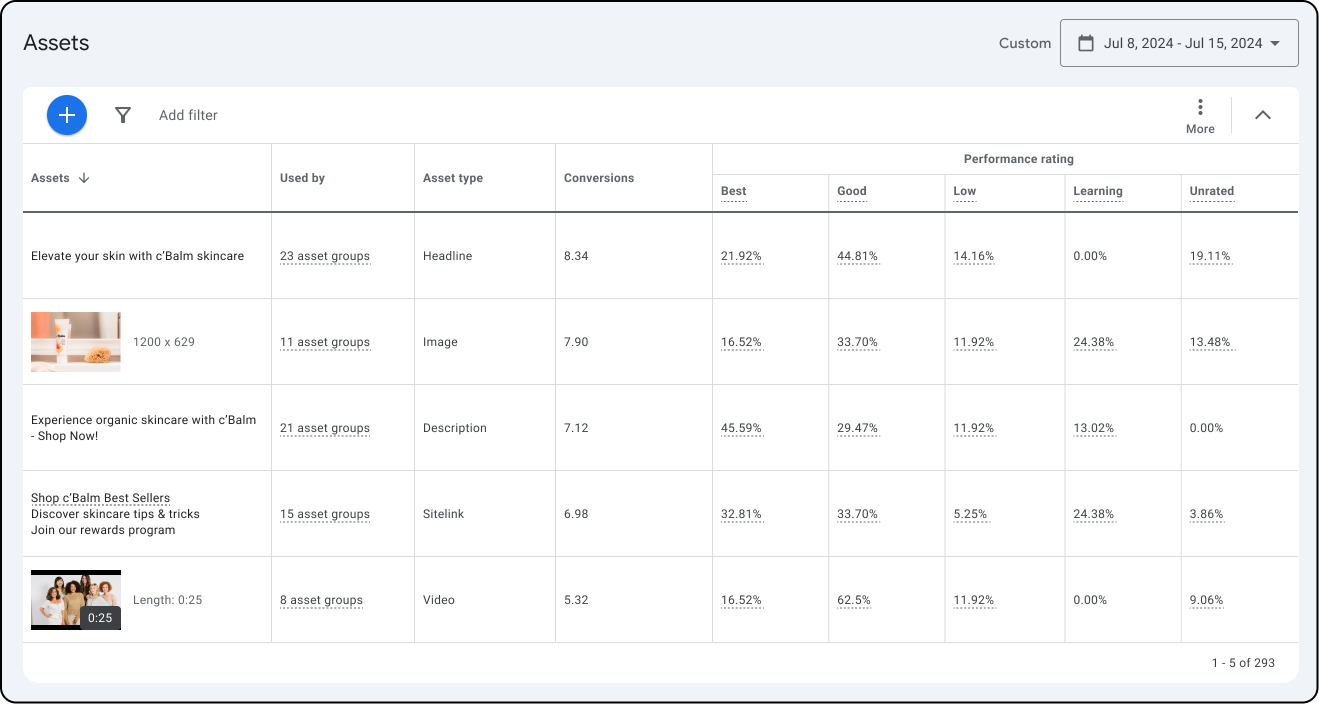
  1. Uncover Hidden Insights with Advanced Reporting: Ever wondered which of your ad creatives are truly hitting the mark? Now you can find out! Google Ads is introducing detailed conversion metrics right within your asset-level reporting for Performance Max campaigns. See exactly which images, videos, and headlines are driving the most valuable actions from your audience. Additionally, you can now track where your video ads are appearing on YouTube, ensuring your brand is showcased in suitable environments. If you spot something amiss, you have the power to exclude specific placements. This level of transparency puts you in control, allowing you to make data-driven decisions that optimise your campaigns for maximum impact. To access these reporting tools, navigate to the “Reports” section in your Google Ads account and select the relevant campaign.
  1. Unleash Your Creativity with AI-Powered Image Editing: Forget the hassle of outsourcing image edits or learning complex software. Google Ads now offers AI-powered image editing tools that put the power of creativity at your fingertips. Remove unwanted objects, add new elements, expand backgrounds, and even crop images to different aspect ratios, all with a few simple clicks. This empowers you to create a wider variety of eye-catching visuals, tailored to different platforms and audiences, without breaking the bank or slowing down your workflow. To try out these features, head to the “Assets” section of your Google Ads account and select the image you want to edit.

  1. Accelerate Asset Creation with Generative AI: Struggling to keep up with the demand for fresh creative content? Google Ads’ asset generation feature is here to help. Now available in App and Display campaigns, this powerful tool leverages AI to generate high-quality images in a flash. Simply provide a few prompts and let the AI do the heavy lifting, saving you valuable time and resources. You’ll also gain access to enhanced asset reporting for App campaigns, so you can track the performance of your AI-generated images and fine-tune your strategy. To explore asset generation, go to the “Create” menu in Google Ads and select “Assets.”
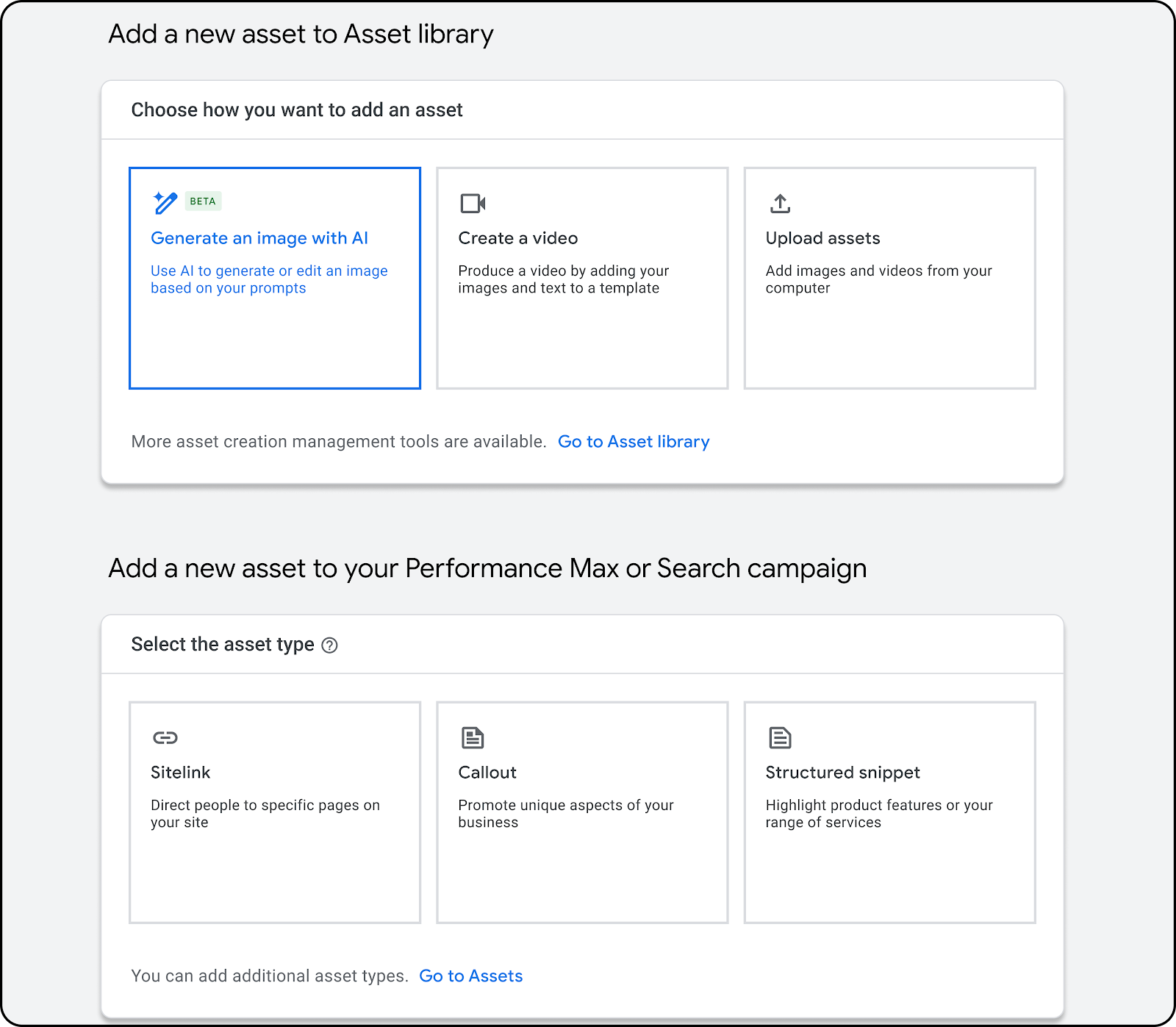
  1. Simplify Your Workflow with Streamlined Access: No more jumping through hoops to create and manage your assets. Google Ads has simplified the process, making it easier than ever to access essential tools. You can now generate images, create videos, and upload assets directly from the “Create” menu. This streamlined workflow saves you time and eliminates unnecessary clicks, allowing you to focus on what matters most – crafting compelling campaigns.

  2. Expand Your Creative Network with Seamless Integrations: Collaboration is key to success, but it can be challenging when your creative team uses different platforms. Google Ads has partnered with leading creative platforms like Canva, Smartly, and Pencil to bridge the gap. Typeface will now be joining the fold. This integration enables seamless implementation of assets built with Typeface directly into Google Ads campaigns. Now, teams can focus on their creative strengths, while marketers enjoy a smooth and efficient workflow.
Embrace the Power of Innovation

Google Ads is committed to providing marketers with the tools they need to thrive in the digital age. These new features, powered by AI and a focus on user experience, offer endless opportunities to elevate your campaigns, captivate your audience, and achieve your marketing goals.


Advertisement
Click to comment

Leave a Reply

Your email address will not be published. Required fields are marked *

Technology

Expert Reveals Top Cyber Threats Organisations Will Encounter in 2026

Published

on

Cyber Threats

By Adedapo Adesanya

Organisations in 2026 face a cybersecurity landscape markedly different from previous years, driven by rapid artificial intelligence adoption, entrenched remote work models, and increasingly interconnected digital systems, with experts warning that these shifts have expanded attack surfaces faster than many security teams can effectively monitor.

According to the World Economic Forum’s Global Cybersecurity Outlook 2026, AI-related vulnerabilities now rank among the most urgent concerns, with 87 per cent of cybersecurity professionals worldwide highlighting them as a top risk.

In a note shared with Business Post, Mr Danny Mitchell, Cybersecurity Writer at Heimdal, said artificial intelligence presents a “category shift” in cyber risk.

“Attackers are manipulating the logic systems that increasingly run critical business processes,” he explained, noting that AI models controlling loan decisions or infrastructure have become high-value targets. Machine learning systems can be poisoned with corrupted training data or manipulated through adversarial inputs, often without immediate detection.

Mr Mitchell also warned that AI-powered phishing and fraud are growing more sophisticated. Deepfake technology and advanced language models now produce convincing emails, voice calls and videos that evade traditional detection.

“The sophistication of modern phishing means organisations can no longer rely solely on employee awareness training,” he said, urging multi-channel verification for sensitive transactions.

Supply chain vulnerabilities remain another major threat. Modern software ecosystems rely on numerous vendors and open-source components, each representing a potential entry point.

“Most organisations lack complete visibility into their software supply chain,” Mr Mitchell said, adding that attackers frequently exploit trusted vendors or update mechanisms to bypass perimeter defences.

Meanwhile, unpatched software vulnerabilities continue to expose organisations to risk, as attackers use automated tools to scan for weaknesses within hours of public disclosure. Legacy systems and critical infrastructure are especially difficult to secure.

Ransomware operations have also evolved, with criminals spending weeks inside networks before launching attacks.

“Modern ransomware operations function like businesses,” Mitchell observed, employing double extortion tactics to maximise pressure on victims.

Mr Mitchell concluded that the common thread across 2026 threats is complexity, noting that organisations need to abandon the idea that they can defend against everything equally, as this approach spreads resources too thin and leaves critical assets exposed.

“You cannot protect what you don’t know exists,” he said, urging organisations to prioritise visibility, map dependencies, and focus resources on the most critical assets.

Continue Reading

Technology

NCC Begins Review of National Telecommunications Policy After 26 Years

Published

on

Nigerian Communications Commission NCC

By Adedapo Adesanya

The Nigerian Communications Commission (NCC) has commenced a comprehensive review of the National Telecommunications Policy 2000 (NTP), 26 years after its approval, citing rapid technological advancements and shifting market dynamics as the primary catalysts for the reform.

In a consultation paper released to the public, the commission said it is seeking input from stakeholders, including telecom operators, tech companies, legal experts, and the general public, on proposed revisions designed to reposition Nigeria’s telecommunications framework to match current digital demands. Submissions are expected by March 20, 2026.

The NTP 2000 marked a turning point in Nigeria’s telecom landscape. It replaced the 1998 policy, introducing full liberalisation and a unified regulatory framework under the NCC, and paved the way for the licensing of GSM operators such as MTN, Econet (now Airtel), and Globacom in 2001 and 2002.

Prior to the NTP, the sector was dominated by Nigerian Telecommunications Limited (NITEL), a government-owned monopoly plagued by obsolete equipment, low teledensity, and poor service. At the time, Nigeria had fewer than 400,000 telephone lines for the entire country.

However, the NCC noted that just as the 1998 policy was overtaken by global developments, the 2000 framework has become structurally misaligned with today’s telecom reality, which encompasses broadband, 5G networks, satellite internet, artificial intelligence, and a thriving digital economy worth billions of dollars.

“The rapid pace of technological change and emerging digital services necessitate a comprehensive update to ensure the policy continues to support economic growth while protecting critical infrastructure,” the Commission stated.

The review will target multiple chapters of the policy. Key revisions include: Enhancements on online safety, content moderation, digital services regulation, and improved internet exchange protocols; a modern framework for satellite harmonisation, coexistence with terrestrial networks, and clearer spectrum allocation to boost service quality, and policies to address fiscal support, reduce multiple taxation, and lower operational costs for operators.

The NCC is also proposing entirely new sections to the policy to address emerging priorities. Among the key initiatives are clear broadband objectives aimed at achieving 70 per cent national broadband penetration, with a focus on extending connectivity beyond urban centres to reach rural communities.

The review also seeks to formally recognise telecom infrastructure, including fibre optic cables and network masts, as Critical National Infrastructure to prevent vandalism and enhance security.

In addition, the commission is targeting the harmonisation of Right-of-Way charges across federal, state, and local governments, alongside the introduction of a one-stop permitting process for telecom deployment, designed to reduce bureaucratic delays and lower operational costs for operators.

According to the NCC, the review aims to make fast and affordable internet widely accessible. “The old framework was largely voice-centric. Today, data is the currency of the digital economy,” the commission said, highlighting the need to close the urban-rural broadband divide.

The consultation process is intended to gather diverse perspectives to ensure the updated policy reflects current technological trends, market realities, and consumer needs. By doing so, the NCC hopes to maintain the telecommunications sector’s role as a key driver of economic growth and digital inclusion.

Continue Reading

Technology

FG to Scrutinise MTN’s $2.2bn Full Take Over of IHS Towers

Published

on

IHS Towers

By Adedapo Adesanya

The Minister of Communications, Innovation and Digital Economy, Mr Bosun Tijani, says the Nigerian government is assessing MTN Group’s acquisition of IHS Towers to ensure the deal aligns with Nigeria’s telecommunications development goals.

On Tuesday, MTN Group said it has agreed to acquire the remaining 75.3 per cent stake in IHS Holding Limited in an all-cash deal valued at $2.2 billion. The deal will be funded through the rollover of MTN’s existing stake of around 24 per cent in IHS, as well as about $1.1 billion in cash from MTN, roughly $1.1 billion from IHS’s balance sheet, and the rollover of no more than existing IHS debt.

Mr Tijani, in a statement, said the administration of President Bola Tinubu has spent the past two years strengthening the telecom sector through policy clarity, regulatory support, and engagement with industry stakeholders, boosting investor confidence and sector performance.

“Recent financial results from key operators show improved profitability, increased investment in telecoms infrastructure, and operational stability across the sector,” he said.

“These gains reflect the resilience of the industry and the impact of government reforms.”

The minister added that telecommunications infrastructure is critical for national security, economic growth, financial services, innovation, and social inclusion.

“We will undertake a thorough assessment of this development with relevant regulatory authorities to review its impact on the sector,” Mr Tijani said.

He added that the review aims to ensure market consolidation or structural changes, protect consumers, safeguard investments, and preserve the long-term sustainability of the telecom industry.

Mr Tijani also said the government remains committed to maintaining a stable and forward-looking policy environment to keep Nigeria’s telecommunications sector strong and sustainable, in line with the administration’s broader digital economy vision.

Upon completion, the transaction will see MTN transition from being a minority shareholder in IHS to a full owner. It will also see IHS exit from the New York Stock Exchange and become a wholly owned subsidiary of MTN.

For MTN, the deal represents a decisive shift as data demand surges and digital infrastructure becomes increasingly strategic with a booming digitally-oriented youth population on the continent.

Continue Reading

Trending