Connect with us

General

Dangote Urges African Business Leaders to Drive Transformation

Published

on

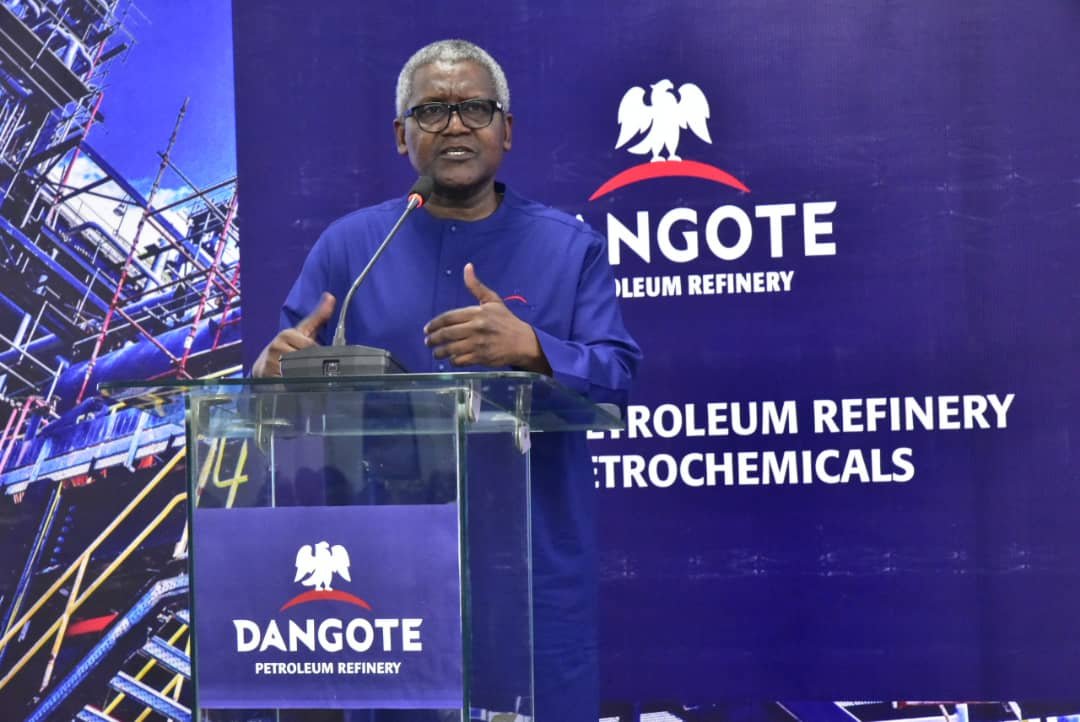
Dangote host media

By Adedapo Adesanya

The president of Dangote Group, Mr Aliko Dangote, has called on African business leaders to take the lead in transforming the continent.

According to a statement, the billionaire mogul made this stance while speaking at the just concluded African Renaissance Retreat held in Kigali, Rwanda.

Mr Dangote pointed out that despite significant challenges besetting Africa, its youthful population and abundant resources, including about 30 per cent of the world’s mineral reserves and the largest reserves of gold, cobalt, uranium, platinum, and diamonds, offer opportunities for substantial and inclusive growth.

The retreat was a high-level gathering to discuss issues and align development with the foremost entrepreneurs on the continent and the leaders of the largest pan-African companies including President Paul Kagame of Rwanda, former President Olusegun Obasanjo, former President Ellen Johnson Sirleaf, and former Prime Minister Hailemariam Dessalegn among others.

Mr Dangote, who initiated the retreat, noted that he had long contemplated bringing together a group of dedicated African business leaders to address the continent’s challenges, identify concrete solutions, and showcase Africa as a viable investment destination despite its obstacles.

“We have 65 per cent of the world’s arable land and 10 per cent of the planet’s internal renewable freshwater sources. Together, these present a myriad of opportunities for robust, inclusive growth that harness our abundant human potential and natural resources to increase prosperity, not just in Africa but across the globe,” he said.

Mr Dangote added that Africa is at a crucial inflexion point, with the world’s youngest and fastest-growing population, rapidly expanding cities, and a growing embrace of innovation and new technologies, including Artificial Intelligence.

He noted that despite dealing with multiple barriers such as visas, inconsistent change in government policies, inadequate technical talent, lack of critical infrastructure, foreign exchange crises, inflation, cost of capital and other conflicts of differing dimensions, the Dangote Group has expanded from Nigeria to 14 countries across the continent, spanning multiple sectors from cement to fertilizers, sugar to oil refineries, petrochemicals, agriculture and more.

“The good news is that despite these challenges, we have succeeded in building a pan-African Group that employs over 50,000 people and generates revenues that should exceed $30 billion by the end of 2025,” he said.

He emphasized that the objective of the retreat was to offer an opportunity for collective action in tackling various issues, including persistent conflicts, energy and food security, supply chain disruptions, the debt crisis, and access to long-term concessional funding for development.

“We are coming together not just as leaders in our respective institutions but as visionaries and catalysts for transforming our societies. It is our collective responsibility to play our role in transforming our continent. Nobody will do it for us but us – especially us in this room,” he noted.

He also cautioned that it is crucial for the leaders present to move beyond dialogue to decisive implementation and tangible impact.

Other participants at the retreat, which took place from September 6 to 8, included Ms Amina J. Mohammed, Deputy Secretary-General of the United Nations; Mr Benedict Oramah, President and Chairman of the Board of Directors of the African Export-Import Bank; former Liberian President, Mrs Ellen Johnson Sirleaf; Mr Adebayo Ogunlesi, Chairperson of Global Infrastructure Partners; former Ethiopian Prime Minister, Mr Hailemariam Dessalegn, Mrs Samaila Zubairu of the African Finance Corporation, Mr Makhtar Diop of IFC, and Mr Jeremy Awori, CEO of Ecobank Transnational Incorporated.


Adedapo Adesanya is a journalist, polymath, and connoisseur of everything art. When he is not writing, he has his nose buried in one of the many books or articles he has bookmarked or simply listening to good music with a bottle of beer or wine. He supports the greatest club in the world, Manchester United F.C.

General

Church Confirms Release Of 151 Abducted Members in Kaduna

Published

on

Cherubim and Seraphim Movement Church Worldwide

By Adedapo Adesanya

The Cherubim and Seraphim Movement Church Worldwide, Ayo Ni O, has confirmed the release and safe return of 151 of its members abducted from Iburu community in Kajuru Local Government Area of Kaduna State.

The abduction, which affected about 177 people, occurred on January 18, 2026. It was initially denied by the Nigeria Police Force and other government agencies, but was later confirmed.

In a statement issued by the Conference Secretary General of the church, Mr Anthony Olusesan Samaiye, it was disclosed that the release of the abducted persons was confirmed through reports from its liaison officers in Kaduna.

According to the statement, Mr Emmanuel Abiodun Adewale Alogbo (JP), described the release as a victory for faith, prayer and dialogue, noting that the breakthrough followed an emergency visit to Kaduna by its leadership and a series of high-level engagements aimed at securing the freedom of the abducted worshippers.

The Cherubim and Seraphim Church expressed gratitude to the Kaduna State government, particularly Governor Uba Sani, for what it described as his commitment to dialogue and the coordination of state resources that contributed to the successful outcome.

Special appreciation was also extended to the Governor’s Chief of Staff, Mr Sani Liman Kila, and the Senior Special Assistant on Religious Affairs (Christian Matters), Mr Ishaya Jangado, for facilitating engagement between the church and the state government.

The church noted that the incident demonstrated the importance of cooperation between religious leaders and government authorities in addressing security challenges and protecting citizens.

It also acknowledged prayers and support from the Christian Association of Nigeria (CAN), the Organisation of African Instituted Churches (OAIC), the international community and Christians worldwide.

While celebrating the release, the church said it was mindful of the trauma experienced by the victims and disclosed that its welfare and medical teams had been mobilised to provide psychosocial support and care to the affected members and their families.

The church called for sustained peace in Kaduna State and across Nigeria, urging authorities to continue efforts to ensure the safety of all citizens, regardless of religious affiliation.

Continue Reading

General

2027 Elections: I Won’t be Vice Presidential Candidate—Peter Obi Insists

Published

on

peter obi tax system

By Adedapo Adesanya

As activities for the 2027 general elections begin to take shape, the former presidential candidate of the Labour Party in the 2023 presidential poll, Mr Peter Obi, has again ruled out the possibility of contesting as a vice presidential candidate next year, saying he is contesting to be on the ballot.

Speaking ahead of the Abuja Municipal Area Council (AMAC) election in the Federal Capital Territory, he said, “You see this coming election, support us in AMAC; it will help me. Your support in AMAC is critical to our journey. I am involved and contesting the coming election as number one. When I come back, you will see. I assure you.”

Mr Obi vied for the 2023 presidency on the LP platform, emerging third overall behind Mr Atiku Abubakar and President Bola Tinubu.

In December 2025, he defected to the African Democratic Congress (ADC), where his teeming supporters popularly known as Obidients have urged him to only pursue the presidential ticket.

Mr Abubakar, who chose Mr Obi as his vice presidential candidate in the 2019 polls, is also a member of the ADC. The men finished in second and third places, respectively in the last presidential election, which President Tinubu won with 37 per cent of the votes.

Speaking at the campaign venue, Mr Obi emphasised to his supporters the importance of backing the ADC candidate in the AMAC election, noting that their support at the grassroots would go a long way in bolstering his national political journey.

The ADC coalition includes many former allies of Mr Tinubu, including Mr Nasir El Rufai, the former governor of Kaduna State; Mr David Mark, a former Senate President who is serving as the National Chairman of the party, and Mr Rauf Aregbesola, a former Osun Governor and currently the National Secretary of ADC.

The party will be hoping to emulate the success of the ruling All Progressives Congress (APC), which was formed by an alliance of opposition politicians (including Mr Abubakar) in 2013 and caused the ouster of former President Goodluck Jonathan, the first-ever defeat of an incumbent Nigerian president in 2015.

Continue Reading

General

CPPE Urges FG to Create Farm Price Stabilisation Plan for Food Security

Published

on

Price of Food

By Adedapo Adesanya

The Centre for the Promotion of Private Enterprise (CPPE) has called on the federal government to urgently establish a National Farm Price Stabilisation and Farmer Income Protection Framework to safeguard Nigeria’s long-term food security.

This was contained in a policy brief signed by the chief executive of the think tank, Mr Muda Yusuf, on Sunday.

The group warned that while recent import surges have lowered food prices to the delight of consumers, they have simultaneously inflicted severe financial losses on farmers and agricultural investors, creating what it described as “troubling trade-offs and unintended consequences.”

He advised that Nigeria cannot afford a policy regime that undermines confidence in agriculture, one of the country’s most strategic sectors and largest employers of labour.

“The welfare gains from cheaper food have been profound and should be acknowledged. However, the cost to farmers and other investors across the agricultural value chain is equally high and cannot be ignored,” Mr Yusuf stated.

The CPPE boss emphasised the urgent need to strike a sustainable balance between keeping food affordable for consumers and protecting farmers’ incomes, while safeguarding agricultural investment.

According to the policy document, recent import surges of staples such as rice, maize and soybeans have caused serious dislocations in the agricultural investment ecosystem, inflicting severe hardship on farmers and weakening production incentives.

“Although consumers have welcomed the decline in food prices, the long-term consequences are adverse: farmer incomes fall, production declines over time, investment confidence weakens, and the country risks returning to cycles of scarcity and higher prices,” the document warned.

The CPPE identified several structural factors driving recurring farm price collapses in Nigeria, beyond the immediate impact of food imports.

The think tank warned that harvest glut remains a major challenge, with many farmers harvesting the same crops within the same period, causing sudden oversupply. This is compounded by the limited availability of storage facilities, drying centres and cold-chain systems, which forces farmers to sell immediately regardless of market conditions.

The organisation said this is also affected by weak rural logistics, characterised by poor roads, insecurity, high transport costs, and limited aggregation hubs, which make it difficult to move produce efficiently from production zones to high-demand markets.

Continue Reading

Trending