Connect with us

World

Some Takeaways From BRICS Business Council Forum

Published

on

BRICS Business Council Forum

By Kestér Kenn Klomegâh

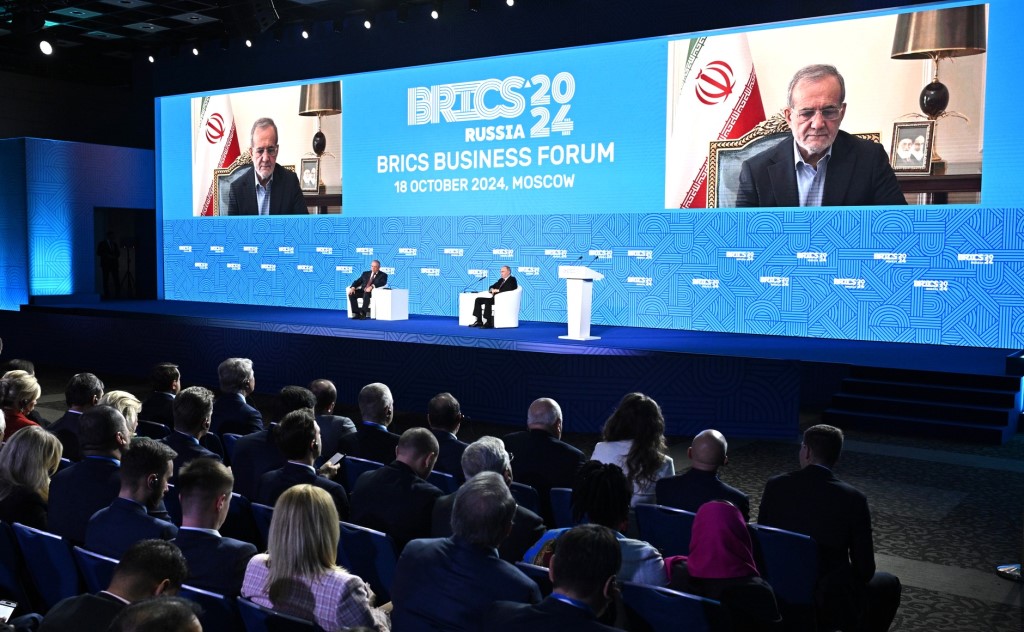
Russia hosted the BRICS+ Business Council Forum 2024 which primarily seeks to build an alternative economic world. The BRICS association comprises Brazil, Russia, India, China and South Africa, and now has enlarged to include Egypt, Ethiopia, Iran and the United Arab Emirates. It is therefore strongly considered a powerful counterweight to the West in global politics, economics and trade.

As Russia holds the rotating chairmanship this 2024, President Vladimir Putin addressed the plenary session of the BRICS+ Business Council which attracted over 1,000 representatives of the business community, including heads of companies, associations, unions of entrepreneurs, and chambers of commerce and industry from the BRICS countries.

Central Theme

The theme of Russia’s BRICS Chairmanship is Strengthening Multilateralism for Just Global Development and Security. This means advancing partnerships on three major tracks: politics and security, economy and finance, and cultural and humanitarian ties.

BRICS Role in Global Economy

BRICS’ role in the global economy is expected to grow and become the driver of global GDP growth in the future. The BRICS member states make up about a fourth of world exports of goods.

The association’s members dominate on many key markets, including energy, metals and food. BRICS+ has a combined GDP which is more than $60 trillion, and the joint share in the gross world product confidently exceeds the corresponding figure of the so-called Group of Seven and continues growing.

The BRICS member states account for over 40% of the growth of the global GDP in the past few decades. BRICS’ average economic growth rate is estimated at 4% this year. It is higher than in the G7 countries. It’s only 1.7% there. And the global rate will be 3.2%.

BRICS Single Currency

BRICS currency is not under consideration now due to differences in the structure and quality of the economies of the member states, but now one should focus on the use of national currencies, new financial instruments and the creation of an analogue of SWIFT.

In particular, the BRICS states are considering the possibility of using electronic instruments. There is a necessity to establish relations between the central banks and ensure a reliable exchange of financial information that is independent of those international instruments of international information exchange that introduce certain restrictions for political reasons and violate the principles of the global economy.

New Development Bank

It was established in 2015, as a development bank to operate as an alternative to a vast number of Western financial mechanisms. With a solid, powerful and efficient structure, it boasts a substantial capital base as well as a team of experienced professionals. Its start-up capital was $100 billion.

As far as developing countries are concerned, the NDB is supposed to support investment in several projects comparable to the IMF and the World Bank. It is envisioned to become a major investor in the largest technology and infrastructure projects in the BRICS space as well as the entire Global South.

Future Pathways

Moving forward, BRICS+ needs to focus on creating a seamless digital infrastructure among the association’s members. To this end, it is crucial to establish coordinated approaches among businesses, the public, and the relevant authorities regarding the use of biometrics and ensuring information security.

The primary focus is on developing and strengthening its platforms that ensure economic growth. In the near future, it is supposed to provide technological solutions, financial and investment mechanisms, the expansion of logistics, and so on.

BRICS+ Policy

The BRICS’ activities are not spearheaded against anyone. They are aimed at attaining the common goal of sustainable development and prosperity for our members. Supporting business activity and enterprise is a priority for the leaders of all BRICS countries.

Attaining the main goals includes ensuring progressive development, security and, ultimately, the well-being of member countries’ citizens. It is necessary to cooperate rather than to confront and take advantage of BRICS’ impressive capabilities – in particular, its large population and wealth of natural resources – which will bring maximum benefits to businesses and all citizens.

Conclusion

The association is building upon relevant development platforms, including communication channels, technological and educational standards, financial systems, payment tools and, of course, mechanisms for sustainable and long-term investment. In a nutshell, BRICS+ is consistently playing a significant role in the global economy, and its influence will undoubtedly increase in the future.


Advertisement
Click to comment

Leave a Reply

Your email address will not be published. Required fields are marked *

World

United States Congress Pursuing AGOA Extension

Published

on

African Growth and Opportunity Act AGOA

By Kestér Kenn Klomegâh

After the expiration of bilateral agreement on trade, the US Congress as well as African leaders, highly recognizing its significance, has been pursuing the extension of the African Growth and Opportunity Act (AGOA). The agreement, which allows duty-free access to American markets for African exporters, expired on September 30, 2025.

The US Congress is advancing a bill to revive and extend AGOA, but South Africa’s continued inclusion remains uncertain. The trade pact still has strong bipartisan support, with the House Ways and Means Committee approving it 37-3. However, US Trade Representative, Jamieson Greer, raised concerns about South Africa, citing tariffs and non-tariff barriers, and said the administration could consider excluding the country.

This threat puts at risk the duty-free access that has significantly benefited South African automotive, agricultural, and wine exports. The debate highlights how trade policy is becoming entangled with broader diplomatic tensions, casting uncertainty over a key pillar of US-Africa economic relations.

Nevertheless, South Africa continues to lobby for inclusion. South Africa trade summary records show that the US goods and services trade with South Africa estimated at $26.2 billion in 2024. The US and South Africa signed a Trade and Investment Framework Agreement (TIFA) as far back as in 2012.

The duty-free access for nearly 40 African countries has boosted development and fostered more equitable and sustainable growth in Africa. By design AGOA is a useful mechanism for improving accessibility to trade competitiveness, connectivity, and productivity. During these past 25 years, AGOA has been the cornerstone of US economic engagement with the countries of sub-Saharan Africa.

Key features and benefits of AGOA:

It’s worth reiterating here that during these past several years, AGOA has been the cornerstone of US economic engagement with the countries of sub-Saharan Africa. In this case, as AGOA is closely working with the African Continental Free Trade Area (AfCFTA) Secretariat and with the African Union (AU), trade professionals could primarily leverage various economic sectors and unwaveringly act as bridges between the United States and Africa.

* Duty-free Access: AGOA allows eligible products from sub-Saharan African countries to enter the US market without paying tariffs.

* Promotion of Economic Growth: The program encourages economic growth by providing incentives for African countries to open their economies and build free markets.

* Encouraging Economic Reforms: AGOA encourages economic and political reforms in eligible countries, including the rule of law and market-oriented policies.

* Increased Trade and Investment: The program aims to strengthen trade and investment ties between the United States and sub-Saharan Africa.

With the changing times, Africa is also building its muscles towards a new direction since the introduction of the African Continental Free Trade Area (AfCFTA), which was officially launched in July 2019.

In practical terms, trading under the AfCFTA commenced in January 2021. And the United States has prioritized the AfCFTA as one mechanism through which to strengthen its long-term relations with the continent. In the context of the crucial geopolitical changes, African leaders, corporate executives, and the entire business community are optimistic over the extension of AGOA, for mutually beneficial trade partnerships with the United States.

Worthy to say that AGOA, to a considerable degree, as a significant trade policy has played a crucial role in promoting economic growth and development in sub-Saharan Africa.

Continue Reading

World

Accelerating Intra-Africa Trade and Sustainable Development

Published

on

Intra-Africa Trade

By Kestér Kenn Klomegâh

Africa stands at the cusp of a transformative digital revolution. With the expansion of mobile connectivity, internet penetration, digital platforms, and financial technology, the continent’s digital economy is poised to become a significant driver of sustainable development, intra-Africa trade, job creation, and economic inclusion.

The African Union’s Agenda 2063, particularly Aspiration 1 (a prosperous Africa based on inclusive growth and sustainable development), highlights the importance of leveraging technology and innovation. The implementation of the African Continental Free Trade Area (AfCFTA) has opened a new chapter in market integration, creating opportunities to unlock the full potential of the digital economy across all sectors.

Despite remarkable progress, challenges persist. These include limited digital infrastructure, disparities in digital literacy, fragmented regulatory frameworks, inadequate access to financing for tech-based enterprises, and gender gaps in digital participation. Moreover, Africa must assert its digital sovereignty, build local data ecosystems, and secure cyber-infrastructure to thrive in a rapidly changing global digital landscape.

Against this backdrop, the 16th African Union Private Sector Forum provides a timely platform to explore and shape actionable strategies for harnessing Africa’s digital economy to accelerate intra-Africa trade and sustainable development.

The 16th High-Level AU Private Sector forum is set to take place in Djibouti, from the 14 to 16 December 2025, under the theme “Harnessing Africa’s Digital Economy and Innovation for Accelerating Intra-Africa Trade and Sustainable Development”

The three-day Forum will feature high-level plenaries, expert panels, breakout sessions, and networking opportunities. Each day will spotlight a core pillar of Africa’s digital transformation journey.

Day 1: Digital Economy and Trade Integration in Africa

Focus: Leveraging digital platforms and technologies to enhance trade integration and competitiveness under AfCFTA.

Day 2: Innovation, Fintech, and the Future of African Economies

Focus: Driving economic inclusion through fintech, innovation ecosystems, and youth entrepreneurship.

Day 3: Building Policy, Regulatory Frameworks, and Partnerships for Digital Growth

Focus: Creating an enabling environment for digital innovation and infrastructure through effective policy, governance, and partnerships.

To foster strategic dialogue and action-oriented collaboration among key stakeholders in Africa’s digital ecosystem, with the goal of leveraging digital economy and innovation to boost intra-Africa trade, accelerate economic transformation, and support inclusive, sustainable development.

* Promote Digital Trade: Identify mechanisms and policy actions to enable seamless cross-border digital commerce and integration under AfCFTA.

* Foster Innovation and Fintech: Advance inclusive fintech ecosystems and support innovation-driven entrepreneurship, especially among youth and women.

* Policy and Regulatory Harmonization: Build consensus on regional and continental digital regulatory frameworks to foster trust, security, and interoperability.

* Encourage Investment and Public-Private Partnerships: Strengthen collaboration between governments, private sector, and development partners to invest in digital infrastructure, R&D, and skills development.

* Advance Digital Inclusion and Sustainability: Ensure that digital transformation contributes to environmental sustainability and the empowerment of marginalized communities.

The AU Private Sector Forum has held several forums, with key recommendations. These recommendations provide valuable insights into the challenges and opportunities facing the African private sector and offer guidance for policymakers on how to support its growth and development.

Continue Reading

World

Russia’s Lukoil Losses Strategic Influence Across Africa

Published

on

Russias Lukoil

By Kestér Kenn Klomegâh

Lukoil, Russia’s energy giant, has seriously lost its grounds across Africa, due to United States sanctions. Sanctions have complicated the company’s potential continuity in operating its largest oil field projects, grappling its investment particularly in Republic of Ghana, Democratic Republic of Congo, and Federal Republic of Nigeria.

Reports indicated the sanctions are further dismantling most of Lukoil’s operations, causing significant staff layoffs in its offices worldwide. For instance, Lukoil’s significant upstream operations in the Middle East include a 75% stake in Iraq’s West Qurna 2 oilfield and a 60% stake in Iraq’s Block 10 development. In Egypt, the company holds stakes in various oilfields alongside local partners.

Lukoil has until December 13, 2025, to negotiate the sale of most of its international assets, including those in Asia, Africa and Latin America. It has already terminated several important agreements that were signed with international partners due to difficulties in circumventing the sanctions.

Reports said calculated efforts to diversify exploration business relations is turning extremely complex, and current at the cross-roads, Lukoil will have to ultimately give up existing contracts and agreements it had signed with external countries.

Lukoil’s website reports also pointed to reasons for abandoning oil and gas exploration and drilling project that it began in Sierra Leone.  According to those reports, Lukoil could withdraw from almost all of the projects in West Africa.

In addition to geopolitical sanctions, technical and geographical hitches, Lukoil noted on its website, an additional obstacles that “the African leadership and government policies always pose serious problems to operations in the region.” Similarly, the Kremlin-controlled Rosneft abandoned its interest in the southern Africa oil pipeline construction, negatively impacted on Angola, Mozambique, South Africa and Zimbabwe.

United States sanctions has hit Lukoil, one of the Russia’s biggest oil companies, like many other Russian companies, that has had a long history shuttling forth and back with declaration of business intentions or mere interests in tapping into oil and gas resources in Africa.

Continue Reading

Trending