World
African Media Practitioners Visit PhosAgro’s Volkhov Plant
By Kestér Kenn Klomegâh
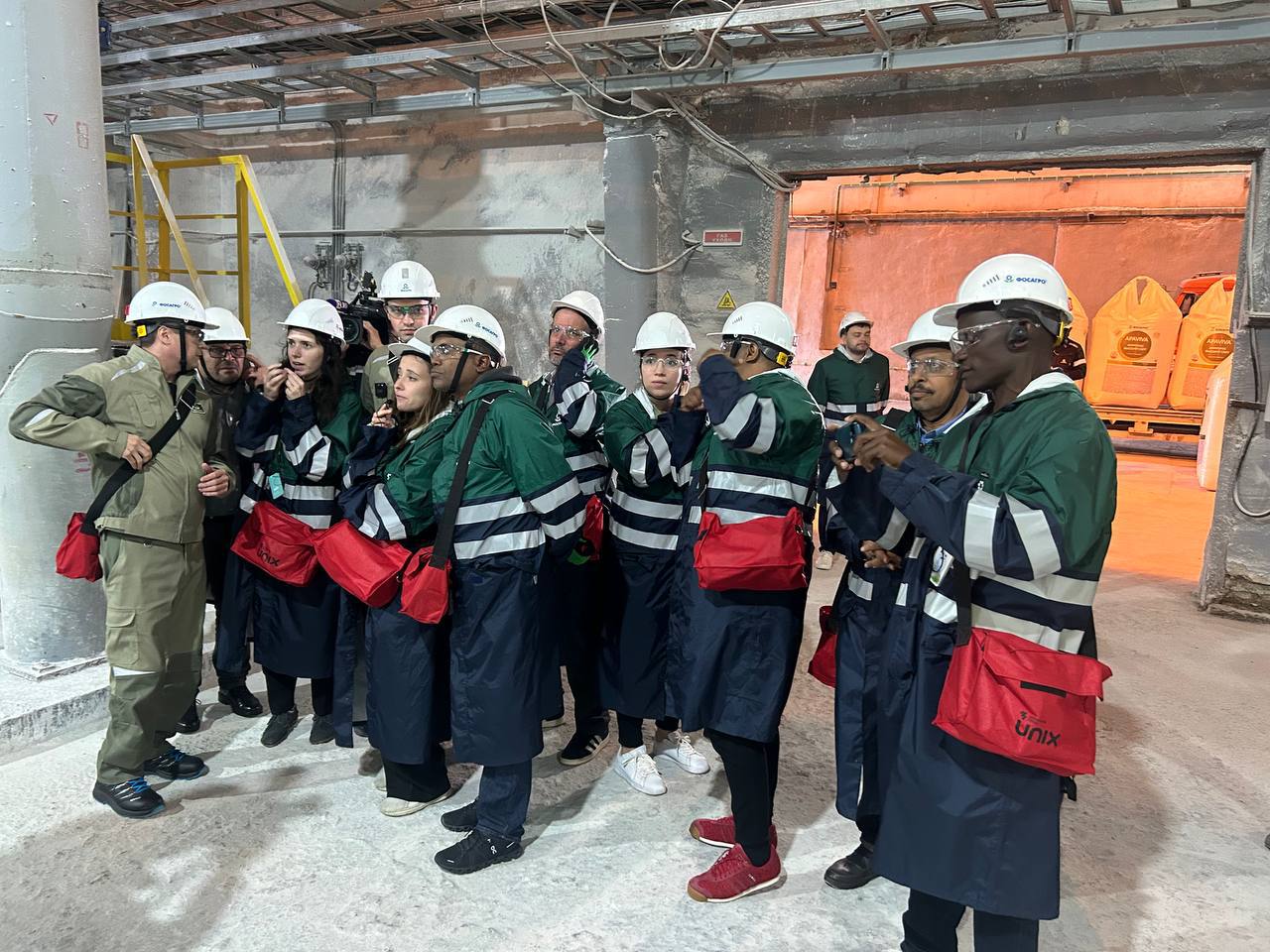
Journalists from leading African media visited PhosAgro’s Volkhov production complex. They took part in an extensive tour of the production and infrastructure facilities, including the plant’s upgraded phosphoric acid and mineral fertilizer production facilities, as well as the new SK-800 sulphuric acid plant and new energy facilities, which recycle process steam into electricity for the plant. During their meeting with Phosagro’s executives, the journalists learned more about the significant role that the Company plays in ensuring global food security and supporting humanitarian projects in Africa.
As PhosAgro’s First Deputy CEO, Siroj Loikov, noted during the briefing, PhosAgro not only continues to strengthen its position as the leader in terms of total supply of all mineral fertilizers to the priority Russian market, but also remains a key supplier of phosphate-based fertilizers to the countries of the Global South, including African countries. Over the past decade, PhosAgro’s exports have nearly doubled and achieved 8.6 million tonnes in 2024. Today, Africa is a key focus for the Company’s international growth strategy. PhosAgro supplies its products to 21 African countries. The top five African importers of the Company’s agrochemical products include South Africa, Côte d’Ivoire, Ethiopia, Morocco, and Mozambique. With its extensive product line, PhosAgro is well positioned to address the specific needs of African regions, offering customers the best solutions while also making a significant contribution to the continent’s food security.
“Over the past year, PhosAgro has increased its supplies to Africa by a third to a total of 740 thousand tonnes. Since 2018, there has been a more than sixfold increase. I am also pleased to inform you that the exports to Africa have continued to expand in the first half of 2025 and have increased by a third compared to the first half of 2024. Over the next five years, we expect to double our deliveries to the continent. The launch of our state-of-the-art production facilities in Volkhov enhances the Company’s capacity to export our products to Africa. The plant, with a production capacity of one million tonnes, is located near Baltic ports, which are focused on exporting products to friendly countries,” Siroj Loikov said.
PhosAgro’s partnership with Africa is not restricted to the supply of agrochemical products. PhosAgro is working closely with international organizations to implement humanitarian initiatives in Africa. As part of the Green Chemistry for Life programme, in partnership with UNESCO and the International Union of Pure and Applied Chemistry (IUPAC), the Company provides grants to young scientists studying the application of advanced chemical technologies in areas such as environmental protection, natural resource management and waste recycling. Over eight rounds of the programme, the international jury has reviewed over 1000 applications and awarded grants to 55 young researchers, including 15 talented African scientists from South Africa, Egypt, Kenya, Tunisia, Nigeria, Sudan and Zimbabwe. Furthermore, over 200 young African scientists have received stipends as part of the PhosAgro–IUPAC Summer Schools on Green Chemistry.
PhosAgro also became an official partner for the launch of the African Soil Laboratory Network (AFRILAB) as part of a joint project in collaboration with the United Nations Food and Agriculture Organization (FAO). AFRILAB currently has 220 laboratories across 54 countries, assessing the quality and safety of fertilizers and monitoring soil conditions. To date, more than 11,000 farmers from developing countries have already taken part in the project, including approximately 4,500 farmers from over 20 African countries. This year, the programme will be expanded.
Last year, PhosAgro also launched Pro Agro Lectorium, an international educational platform with learning resources available in English and Portuguese. Nearly 170 leading academicians and practitioners from around the world, including 9 speakers from African countries, have recorded more than 420 lectures on agricultural science and agrochemistry, crop production and livestock farming, innovation and digitalization in agriculture, economics and responsible agriculture. In collaboration with its African partners, PhosAgro is integrating its online platform into the educational process for African students. The platform is constantly expanding: nine cooperation agreements have already been signed with African universities. Nowadays, thousands of African farmers and students access new knowledge and information on this platform.
“We will continue working in close cooperation with scientists, businesses, government authorities, and international organizations, to create a strong foundation for Africa’s food and technological sovereignty,” Siroj Loikov concluded.
During their visit, the journalists toured the Fifteenth Element corporate museum and exhibition centre, visited classes of PhosAgro’s key social project — DROZD (Educated and Healthy Children of Russia) — which is aimed at providing children with free access to additional education, sports activities, spiritual and patriotic upbringing, learned about the plant’s history, and explored St Andrew’s Cathedral, which the Company built as part of its Spiritual Revival programme to promote cultural and spiritual values. The journalists thanked senior executives of PhosAgro and its Volkhov plant for inviting them.
World
Russia Renews Africa’s Strategic Action Plan
By Kestér Kenn Klomegâh
At the end of an extensive consultation with African foreign ministers, Russian Foreign Minister, Sergey Lavrov, has emphasized that Moscow would advance its economic engagement across Africa, admittedly outlining obstacles delaying the prompt implementation of several initiatives set forth in Strategic Action Plan (2023-2026) approved in St. Petersburg during the Russia-Africa Summit.
The second Ministerial Conference, by the Russian Foreign Ministry with support from Roscongress Foundation and the Arab Republic of Egypt, marked an important milestone towards raising bilateral investment and economic cooperation.
In Cairo, the capital city of the Arab Republic of Egypt, Lavrov read out the final resolution script, in a full-packed conference hall, and voiced strong confidence that Moscow would achieve its strategic economic goals with Africa, with support from the African Union (AU) and other Regional Economic blocs in the subsequent years. Despite the complexities posed by the Russia-Ukraine crisis, combined with geopolitical conditions inside the African continent, Moscow however reiterated its position to take serious steps in finding pragmatic prospects for mutual cooperation and improve multifaceted relations with Africa, distinctively in the different sectors: in trade, economic and investment spheres, education and culture, humanitarian and other promising areas.
The main event was the plenary session co-chaired by Russian Foreign Minister Sergey Lavrov and Egyptian Minister of Foreign Affairs, Emigration, and Egyptians Abroad Bashar Abdelathi. Welcome messages from Russian President Vladimir Putin and Egyptian President Abdelhak Sisi were read.
And broadly, the meeting participants compared notes on the most pressing issues on the international and Russian-African agendas, with a focus on the full implementation of the Russia-Africa Partnership Forum Action Plan for 2023-2026, approved at the second Russia-Africa Summit in St. Petersburg in 2023.
In addition, on the sidelines of the conference, Lavrov held talks with his African counterparts, and a number of bilateral documents were signed. A thematic event was held with the participation of Russian and African relevant agencies and organizations, aimed at unlocking the potential of trilateral Russia-Egypt-Africa cooperation in trade, economic, and educational spheres.
With changing times, Africa is rapidly becoming one of the key centers of a multipolar world order. It is experiencing a second awakening. Following their long-ago political independence, African countries are increasingly insisting on respect for their sovereignty and their right to independently manage their resources and destiny. Based on these conditions, it was concluded that Moscow begins an effective and comprehensive work on preparing a new three-year Cooperation and Joint Action Plan between Russia and Africa.
Moreover, these important areas of joint practical work are already detailed in the Joint Statement, which was unanimously approved and will serve as an important guideline for future work. According to reports, the Joint Statement reflects the progress of discussions on international and regional issues, as well as matters of global significance.
Following the conference, the Joint Statement adopted reflects shared approaches to addressing challenges and a mutual commitment to strengthening multifaceted cooperation with a view to ensuring high-quality preparation for the third Russia-Africa Summit in 2026.
On December 19-20, the Second Ministerial Conference of the Russia-Africa Partnership Forum was held in Cairo, Egypt. It was held for the first time on the African continent, attended by heads and representatives of the foreign policy ministries of 52 African states and the executive bodies of eight regional integration associations.
World
TikTok Signs Deal to Avoid US Ban
By Adedapo Adesanya
Social media platform, TikTok’s Chinese owner ByteDance has signed binding agreements with United States and global investors to operate its business in America.
Half of the joint venture will be owned by a group of investors, including Oracle, Silver Lake and the Emirati investment firm MGX, according to a memo sent by chief executive, Mr Shou Zi Chew.
The deal, which is set to close on January 22, 2026 would end years of efforts by the US government to force ByteDance to sell its US operations over national security concerns.
It is in line with a deal unveiled in September, when US President Donald Trump delayed the enforcement of a law that would ban the app unless it was sold.
In the memo, TikTok said the deal will enable “over 170 million Americans to continue discovering a world of endless possibilities as part of a vital global community”.
Under the agreement, ByteDance will retain 19.9 per cent of the business, while Oracle, Silver Lake and Abu Dhabi-based MGX will hold 15 per cent each.
Another 30.1 per cent will be held by affiliates of existing ByteDance investors, according to the memo.
The White House previously said that Oracle, which was co-founded by President Trump’s supporter Larry Ellison, will license TikTok’s recommendation algorithm as part of the deal.
The deal comes after a series of delays.
Business Post reported in April 2024 that the administration of President Joe Biden passed a law to ban the app over national security concerns, unless it was sold.
The law was set to go into effect on January 20, 2025 but was pushed back multiple times by President Trump, while his administration worked out a deal to transfer ownership.
President Trump said in September that he had spoken on the phone to China’s President Xi Jinping, who he said had given the deal the go ahead.
The platform’s future remained unclear after the leaders met face to face in October.
The app’s fate was clouded by ongoing tensions between the two nations on trade and other matters.
World
United States, Russia Resolving Trade Issues, Seeking New Business Opportunities
By Kestér Kenn Klomegâh
Despite the complexities posed by Russia-Ukraine crisis, United States has been taking conscious steps to improve commercial relations with Russia. Unsurprisingly, Russia, on the other hand, is also moving to restore and normalise its diplomacy, negotiating for direct connections of air-routes and passionate permission to return its diplomats back to Washington and New York.
In the latest developments, Kirill Dmitriev, Chief Executive Officer of the Russian Direct Investment Fund (RDIF), has been appointed as Russian President’s Special Envoy to United States. This marked an important milestone towards raising bilateral investment and economic cooperation. Russian President Vladimir Putin tasked him to exclusively promote business dialogue between the two countries, and further to negotiate for the return of U.S. business enterprises. According to authentic reports, United States businesses lost $300+ bn during this Russia-Ukraine crisis, while Russia’s estimated 1,500 diplomats were asked to return to Moscow.
Strategically in late November 2025, the American Chamber of Commerce in Russia (AmCham) has awarded Kirill Dmitriev, praised him for calculated efforts in promoting positive dialogue between the United States and Russia within the framework decreed by President Vladimir Putin. Chief Executive Officer of Russian Direct Investment Fund (RDIF) Kirill Dmitriev is the Special Representative of the Russian President for Economic Cooperation with Foreign Countries. Since his appointment, his primary focus has been on United States.
“Received an American Chamber of Commerce award ‘For leadership in fostering the US-Russia dialogue,’” Dmitriev wrote on his X page, in late November, 2025. According to Dmitriev, more than 150 US companies are currently operating in Russia, with more than 70% of them being present on the Russian market for over 25 years.
In addition, Chamber President Sergey Katyrin and American Chamber of Commerce in Russia (AmCham) President Robert Agee have also been discussing alternatives pathways to raise bilateral business cooperation. Both have held series of meetings throughout this year, indicating the the importance of sustaining relations as previously. Expectedly, the Roscongress Foundation has been offered its platforms during St. Petersburg International Economic (SPIEF) for the American Chamber of Commerce (AmCham).
On December 9, Sergey Katyrin and Robert Agee noted that, despite existing problems and non-economic obstacles, the business communities of Russia and the United States proceed from the necessity of maintaining professional dialogue. Despite the worsening geopolitical conditions, Sergey Katyrin and Robert Agee noted the importance of preserving stable channels of trade and pragmatic prospects for economic cooperation. These will further serve as a stabilizing factor and an instrument for building mutual trust at the level of business circles, industry associations, and the expert community.
The American Chamber of Commerce (AmCham) will be working in the system of the Chamber of Commerce and Industry (CCI) in the Russian Federation, which currently comprises 57,000 legal entities, 130 regional chambers and a combined network of representative offices covering more than 350 points of presence.
According to reports obtained by this article author from the AmCham, promising sectors for Russian-American economic cooperation include healthcare and the medical industry, civil aviation, communications/telecom, natural resource extraction, and energy/energy equipment. The United States and Russia have, more or less, agreed to continue coordinating their work to facilitate the formation of a more favorable environment for Russian and American businesses, reduce risks, and strengthen business ties. Following the American-Russian Dialogue, a joint statement and working documents were adopted.
-
Feature/OPED6 years agoDavos was Different this year
-
Travel/Tourism9 years ago
Lagos Seals Western Lodge Hotel In Ikorodu
-
Showbiz3 years agoEstranged Lover Releases Videos of Empress Njamah Bathing
-
Banking7 years agoSort Codes of GTBank Branches in Nigeria
-
Economy3 years agoSubsidy Removal: CNG at N130 Per Litre Cheaper Than Petrol—IPMAN
-
Banking3 years agoFirst Bank Announces Planned Downtime
-
Banking3 years agoSort Codes of UBA Branches in Nigeria
-
Sports3 years agoHighest Paid Nigerian Footballer – How Much Do Nigerian Footballers Earn