Economy
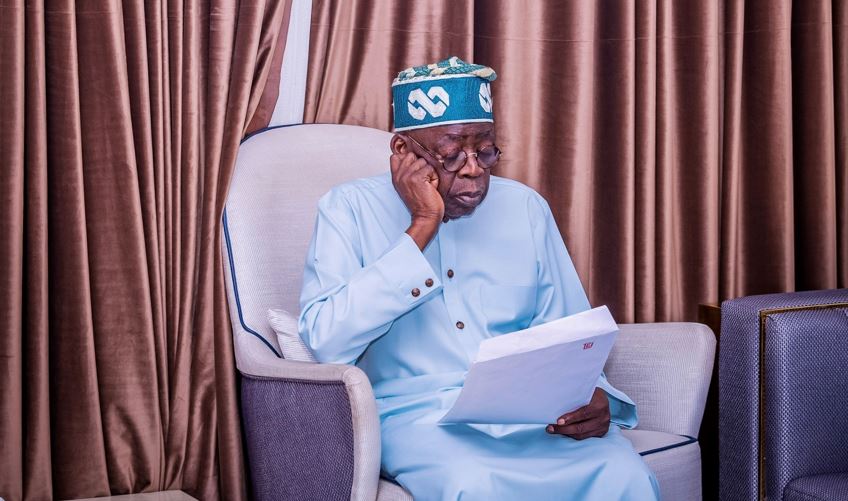
ADC Laments Tinubu’s “Dangerous Obsession With Borrowing”
By Aduragbemi Omiyale
The new major opposition political party in Nigeria, the African Democratic Congress (ADC), has accused the administration of President Bola Tinubu of “fiscal vandalism” because of its “dangerous obsession with borrowing.”
The group, in a statement signed by its National Publicity Secretary, Mr Bolaji Abdullahi, said the National Assembly is also not helping to checkmate the President on this borrowing spree.
The party, while reacting to the approval of the $21 billion foreign loan request of Mr Tinubu a few days ago, said the country’s public debt could go beyond N200 trillion before the end of 2025, with nothing to show for it, demanding a full disclosure of all loan agreements signed over the past 10 years, insisting that Nigerians have a right to know the terms, interest rates, payment timelines, and final recipients of the loans.
“The ADC is deeply concerned by the Tinubu administration’s dangerous obsession with borrowing.
“What Nigerians are witnessing, following the approval of a fresh $21 billion in foreign loans is nothing short of a calculated decision to mortgage the country’s future just to cover up the failures of today,” the opposition party stated.
It further said, “Under President Buhari, Nigeria borrowed an average of N4.7 trillion per year, and even that caused widespread concern. But under President Tinubu, borrowing has jumped to N49.8 trillion per year. In just two years, this administration has borrowed more than ten times what Buhari borrowed in the same timeframe.
“At this rate, Nigeria’s total public debt will crash through N200 trillion before the end of the year. We are speeding toward a financial cliff, and those in charge seem to have no brakes, thinking they can borrow their way out of economic problems that require more thoughtful actions and greater fiscal discipline.
“Supporters of this government like to argue that Tinubu’s borrowing is smaller in dollar terms, just $1.7 billion annually, compared to Buhari’s $4.15 billion. But that argument collapses the moment we look at the exchange rate.
“With the Naira now in free fall, again thanks to this administration’s poor police choices, these same loans are costing the country far more. When converted to Naira, Tinubu’s foreign borrowing amounts to N25.5 trillion every year, more than Buhari’s annual average of N2.2 trillion. What we are witnessing is the deepening of a debt trap created by economic mismanagement and a collapsed currency.”
“Over $35 billion has been borrowed from external lenders alone in the last decade of the APC. This is nearly 12 times more in just 10 years.
“Our debt to the World Bank has tripled. What we owe in Eurobonds has grown eleven times over. And now, this government wants to borrow even more, pushing our foreign debt ceiling to $67 billion.
“This reckless borrowing, repeated year after year, with no plan to repay it, and no effort to use it productively, will leave our children repaying debts that they did not incur or benefit from.
“The debts have continued to mount, but infrastructures have remained poor, universities are still grossly underfunded, hospitals are still ill-equipped and electricity supply are as poor as ever.
“So, what exactly are these loans used for? This is the question that Nigerians expect the National Assembly to ask. Instead, it has continued to approve these loans without asking the hard questions, without demanding a plan, and without standing up for the Nigerian people.
“According to the Association of Small Business Owners of Nigeria, the cost of Tinubu’s borrowing is already crushing the very backbone of our economy.
“Small businesses can no longer access credit. Investors are losing confidence and pulling out. And because over 60 percent of our national income is now used to service debt, the government is turning to ordinary Nigerian families and taxing them beyond their limits.
“While other countries are fighting to reduce their debts, the APC is taking out more loans. The recent devaluation of the naira should have reduced the need for external borrowing, but instead, the government has treated it as an excuse to borrow even more,” the statement said.
Economy
Unlisted Stock Investors’ Wealth Shrinks N30bn
By Adedapo Adesanya
The NASD Over-the-Counter (OTC) Securities Exchange recorded a loss of 1.13 per cent on Thursday, June 4, shrinking the market capitalisation by N30.03 billion to N2.630 trillion from N2.660 trillion on Wednesday.
Similarly, this brought down the NASD Unlisted Security Index (NSI) by 50.19 points to 4,396.08 points from the 4,446.27 points recorded a day earlier.
The loss was influenced by the overpowering of the bulls by the bears, after the bourse closed with two price gainers and three price losers, led by FrieslandCampina Wamco Nigeria Plc, which slumped by N20.03 to sell at N190.38 per unit compared with midweek’s N210.41 per unit. Food Concepts Plc declined by 25 Kobo to trade at N2.50 per share versus the previous day’s N3.00 per share, and Acorn Petroleum Plc crumbled by 2 Kobo to end at N1.32 per unit, in contrast to the preceding session’s N1.34 per unit.
For the gainers, Central Securities Clearing System (CSCS) Plc added N2.93 to close at N78.34 per share compared with the previous price of N75.41 per share, and Afriland Properties Plc gained 80 Kobo to settle at N16.80 per unit versus N16.00 per unit.
There was a slip in the volume of transactions yesterday by 46.8 per cent to 280,714 units from 527,221 units, as the value of trades dropped 66.5 per cent to N21.8 million from the preceding session’s N64.2 million, and the number of deals fell by 8.7 per cent to 42 deals from 46 deals.
Great Nigeria Insurance (GNI) Plc ended the session as the most traded stock by value on a year-to-date basis with 3.4 billion units worth N8.4 billion, followed by Infrastructure Credit Guarantee (Infracredit) Plc with 2.3 billion units sold for N6.5 billion, and CSCS Plc with 64.7 million units traded for N4.4 billion.
GNI Plc also finished the day as the most traded stock by volume on a year-to-date basis with 3.4 billion units valued at N8.4 billion, followed by Infracredit Plc with 2.3 billion units exchanged for N6.5 billion, and Resourcery Plc with 1.1 billion units transacted for N415.7 million.
Economy
McNichols, Eterna, Aradel Crash Stock Market by 0.37%
By Dipo Olowookere
The domestic stock market crashed by 0.37 per cent on Thursday as a result of the decline in the price of shares of McNichols, Eterna, Aradel Holdings, and others.
Business Post reports that investor sentiment remained weak after the Nigerian Exchange (NGX) Limited ended the session with 25 price gainers and 31 price losers, indicating a negative market breadth index.
McNichols lost 10.00 per cent to trade at N7.74, ABC Transport slipped by 9.88 per cent to N6.20, Eterna shrank by 9.85 per cent to N29.75, Aradel Holdings depreciated by 9.51 per cent to N1,749.90, and NPF Microfinance Bank contracted by 8.45 per cent to N5.20.
On the flip side, International Energy Insurance gained 10.00 per cent to close at N6.60, Omatek improved by 9.73 per cent to N2.03, Abbey Mortgage Bank surged by 9.68 per cent to N8.50, Cutix expanded by 9.66 per cent to N3.18, and John Holt grew by 7.79 per cent to N14.90.
As for the sectorial performance, the industrial goods and banking indices chalked up 0.54 per cent and 0.31 per cent, respectively. But the energy sector depleted by 4.90 per cent, the insurance counter tumbled by 0.58 per cent, and the consumer goods index slumped by 0.03 per cent.
As a result, the All-Share Index (ASI) dipped by 905.30 points to 242,227.31 points from 243,132.61 points, and the market capitalisation stumbled by N581 billion to N155.359 trillion from N155.940 trillion.
During the session, investors traded 588.5 million equities valued at N27.9 billion in 57,352 deals compared with the 923.0 million equities worth N42.3 billion transacted in 69,332 deals on Wednesday, showing a drop in the trading volume, value, and number of deals by 36.24 per cent, 34.04 per cent, and 17.28 per cent, respectively.
The most active equity yesterday was Access Holdings with 109.7 million units sold for N2.6 billion, FCMB traded 35.6 million units valued at N384.2 million, NGX Group transacted 28.1 million units worth N3.9 billion, Zenith Bank exchanged 26.9 million units for N3.3 billion, and Sterling Holdings recorded a turnover of 22.5 million units worth N176.1 million.
Economy
Naira Slips 0.1% to N1,358/$1 at Official FX Market
By Adedapo Adesanya
A 0.1 per cent or N1,49 loss was recorded by the Nigerian Naira against the United States Dollar in the Nigerian Autonomous Foreign Exchange Market (NAFEX) on Thursday, June 4, closing at N1,358.75/$1 compared with the previous day’s N1,347.26/$1.
In the same vein, the Naira depreciated against the Pound Sterling in the official FX market during the session by N5.39 to trade at N1,828.06/£1 versus Wednesday’s closing rate of N1,822.67/£1, but gained N6.75 against the Euro to sell at N1,574.83/€1 versus the preceding session’s N1,584.39/€1.
At the black market and GTBank FX desk, the local currency traded flat against the Dollar during the session at N1,375/$1 and N1,372/$1, respectively.
Data from the Central Bank of Nigeria (CBN) showed that NFEM interbank FX turnover contracted to $128.117 million in 121 deals on Thursday from $133.731 million the previous day.
On the positive side, Nigeria’s external reserves moved closer to a 2009 high of $50 billion, enhancing analysts’ confidence about the local currency outlook in the second half of 2026.
This improvement has been helped by heightened global uncertainty, which has reduced the incentive for importers and corporates to demand FX, as cautious trade weighs on import needs. Analysts estimate a $40 billion net FX position for the year, a projection anchored in oil windfall gains.
As for the cryptocurrency market, prices extended steep weekly losses as the broader artificial-intelligence trade that has driven global risk assets since 2026 faltered.
The sell-off was led by equity and currency markets, with semiconductor stocks, Asian indexes and several regional currencies sliding in a broad risk-off shift.
Persistent outflows from US spot Bitcoin ETFs and a rare BTC sale by Strategy have removed a key source of support, leaving markets focused on Friday’s US jobs report for clues on Federal Reserve policy and the fate of the AI trade. The most valued coin slipped 3.6 per cent to $61,914.58.
Cardano (ADA) plunged by 17.6 per cent to $0.1630, Solana (SOL) declined by 7.0 per cent to $65.69, Ethereum (ETH) slipped by 6.9 per cent to $1,666.13, Dogecoin (DOGE) went down by 6.5 per cent to $0.8445, and Ripple (XRP) crashed by 6.5 per cent to $1.11.
Further, Binance Coin (BNB) slumped by 4.3 per cent to $581.45, and TRON (TRX) dropped 1.9 per cent to sell at $0.3261, while the US Dollar Tether (USDT) and the US Dollar Coin (USDC) gained 0.01 per cent each to sell at $0.9990 and $0.9998, respectively.
-
Feature/OPED6 years agoDavos was Different this year
-
Travel/Tourism10 years ago
Lagos Seals Western Lodge Hotel In Ikorodu
-
Showbiz3 years agoEstranged Lover Releases Videos of Empress Njamah Bathing
-
Banking8 years agoSort Codes of GTBank Branches in Nigeria
-
Economy3 years agoSubsidy Removal: CNG at N130 Per Litre Cheaper Than Petrol—IPMAN
-
Banking3 years agoSort Codes of UBA Branches in Nigeria
-
Banking3 years agoFirst Bank Announces Planned Downtime
-
Sports3 years agoHighest Paid Nigerian Footballer – How Much Do Nigerian Footballers Earn