Connect with us

Feature/OPED

Oba of Lagos Rebuffs Ooni of Ife: Appraising the Aftereffects

Published

on

By Omoshola Deji

Civilization and modern forms of governance have drastically diminished the power and authority of monarchs. Fading, not faded, our hidden admiration for primordial values sustains the influence of monarchs on government and the governed.

Monarchs currently have no constitutional role, but their grassroots prominence generates patronage from virtually all holders of public office, industrialists and dignitaries. This patronage vindicates the presence of monarchs in social and state functions.

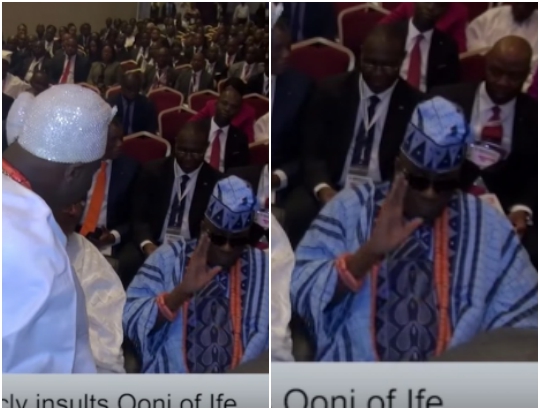
The Oba of Lagos, Rilwan Akiolu and the Ooni of Ife, Adeyeye Ogunwusi’s presence at a function recently produced a much-needed distraction. Just when Nigerians were ardently debating President Buhari’s healthiness and his ability to rule, the video of a royal discord between two Yoruba monarchs diverted public attention like an orchestrated political gimmick. Summarily, the public was enraged that the Oba of Lagos dare rebuff the Ooni of Ife.

Although different scholarly and historical account of the Yoruba race exists, the Ooni of Ife is widely acknowledged as the supreme Yoruba monarch. The Oba of Lagos is not rated among the leading monarchs. As ranked by the Alake of Egba, the top five royals in Yoruba land are the Ooni of Ife, the Alaafin of Oyo, the Oba of Benin, the Alake of Egba and the Awujale of Ijebu respectively. To bring you up to speed, a narration of what transpired in the viral video is necessary.

In accordance with the Yoruba regal heritage, some royal guards’ were eulogizing the Ooni while others hastily cleaned his reserved seat. Admiringly, people loosen their neck strings to catch a glimpse of the Ooni’s majestic entry to the occasion.

Humbly and commendably, Ooni Adeyeye exchanged pleasantries with a seated monarch and was he warmly welcomed. Upon approaching the Oba of Lagos, the Ooni, an earthly king of kings, was snubbed in the most absurd manner. He was publicly rebuffed like a mere slave or palace guard.

In shock, Nigerians, especially the Yoruba’s, couldn’t rationalize the courage behind Oba Akiolu’s action. Could it be because Oba Akiolu (74) is older than Ooni Adeyeye (42)? No, that’s not cogent! Similar to the police and army, the rank of a king’s ancestral dominion determines superiority, not age.

Frightened by the overwhelming public outrage and condemnation, Oba Akiolu issued a statement denying that he snubbed Ooni Adeyeye. One of the Lagos white cap chief, Lateef Ajose, proclaims that the snub is “the culturally acclaimed way of greeting by a Lagos monarch” and Oba Akiolu is “basically trying to revive the culture and tradition of ancient Lagos”.

This fabricated response dampens the spirit of Nigerians that, like politicians, monarchs are fast going political in reasoning, actions and reactions. The general feeling on social media was that Oba Akiolu’s damage control strategy of rationalizing insult as Lagos tradition was an afterthought. It is ignoble that rather than apologize, the Lagos monarch chose to diabolically wrap his wrongs around culture and tradition revival.

Appalling, his rhetoric magnetizes all the trappings of a political rejoinder. More to the point, the sharp snub and glaring hostility captured in the video negates Oba Akiolu’s defense.

Even if culture is to be revived, welcoming the Ooni at a public function should not be the take-off point. Indeed, there is more to it than meets the eye. On how many occasions has Oba Akiolu greeted dignitaries with a snub, especially in public, before the cameras? In this modern age, would he have welcomed President Trump or Queen Elizabeth to Lagos with such a hostile attitude and snub? Please recall that despite the fact that President Buhari is a Muslim and would not shake hands with his female aides, he cheerfully shook hands with the Queen of England and the Chancellor of Germany. Manifestly, the genuine reason of actions resides only in the mind of the actor.

Since Oba Akiolu’s guilefully redefines his unruly behaviour as cultural revival, examining his past deeds would be a credible means of determining whether he could have intentionally snubbed the Ooni or not. Based on facts in the public domain, unlike most Nigerian monarchs, Oba Akiolu is vocal, temperamental and politically sentimental.

In the heat of the 2015 gubernatorial election in Lagos State, the Eze Ndigbos (Igbo traditional rulers) in Lagos state paid a courtesy visit to Oba Akiolu. At the meeting, the monarch ordered all Igbos in Lagos state to vote for Akinwunmi Ambode, his anointed candidate. Vibrating with anger, Akiolu threatened that anyone who flouts his order would perish in the lagoon. The monarch boasted that he owns Lagos; he handpicked Ambode and; he (Ambode) must govern Lagos for eight years (two terms).

The national tabloids quoted Akiolu as saying “If anyone of you goes against Ambode who I picked, that is your end. If it doesn’t happen within seven days, just know that I am a bastard”.

The monarch further threatened that “I am not ready to beg you, if anyone of you, I swear in the name of God, goes against my wish that Ambode will be the next governor of Lagos State, the person is going to die inside this water”.

In a country of laws, it would be interesting to watch Oba Akiolu dump the Igbos into the lagoon if Ambode had not triumphed. You may term Akiolu’s statement a mere threat, but recall that a similar inciting statement made by the Zulu king, Goodwill Zwelithini, fuelled xenophobic attacks in South Africa.

Won’t Nigeria shatter if Ambode had lost the election and his supporters angrily began to murder the Igbos?

Before you resolve that Oba Akiolu’s action in 2015 was a mistake, please recall that he recently vowed at the inauguration of the Nigerian Women against Corruption Initiative that he would work against former vice president Atiku Abubakar’s presidential ambition. All things considered, Akiolu’s vow would have held water if Nigeria is limited to his kingdom.

Moreover, if Akiolu’s relentless attacks on Atiku were often credible and pro-masses, most Nigerians would have probably subscribed to his views, but, unfortunately, his rants were purely vengeance-seeking.

At a stakeholders meeting in Victoria Island, Lagos, Akiolu accused Atiku, Daura and other Peoples Democratic Party (PDP) stalwarts of facilitating his dismissal from the Nigeria Police Force in 2002. He argued that his dismissal from service was a plot to ensure the PDP wins the 2003 elections in Lagos State.

Evidently, Oba Akiolu is more of an electoral warrior and political godfather than monarch. Being human, most monarchs have their political preference, but are often careful not to appear politically biased. They strategically play safe, so that if their preferred candidate is not elected and power change hands, they (monarchs) can easily switch allegiance and dance to the new political rhythm.

In all likelihood, most of the individuals that Oba Akiolu had ridiculed with his ego and temper have tolerated him based on their respect for royalty.

For Akiolu, a less significant monarch and beneficiary of ‘royal immunity’, to now ridicule Ooni Ogunwusi, the overall leader of the Yoruba race, is unacceptable and condemnable. The catastrophic aftereffect of Akiolu’s snub is best presented in literal fiction (read slowly to grasp).

Once upon a time, there were three brothers that hardly agree on anything; they terribly hate themselves. By order of birth, James is the first born, Jack is second and Jude is the third/last born.

According to their culture and tradition, once a man dies, the immediate junior brother owns the corpse and determines how it would be buried. While working on his farm, James was bitten by a poisonous snake, he fell sick and died. By right, James’ corpse belongs to Jack and he has the liberty to bury it as he wish. Based on the never-ending hatred, Jack announced that James’ corpse be sliced and fed to the vultures. People persuaded Jack to have a rethink but he refused.

For the first time in that village, human flesh was sliced and fed to the vultures. Obviously, Jack thought he has perfectly humiliated his brother because of the hatred between them. Unfortunately for Jack, he has forgotten that such hatred also exists between him and Jude and he had indirectly taught Jude the best way to handle the corpse of hated brother.

The crucial message in this fiction is that we all must always use our discretion and power intelligently. Wise is the man who first orated that ‘what goes round comes round’. If Oba Akiolu fails to act cautiously and the powers-that-be fails to caution him, the law of Karma never fails.

Oba Akiolu must be reminded that today’s action is tomorrow’s history. He has set a bad example and indirectly taught other low-class monarchs that the best way to treat a revered monarch in public is to be rude. Therefore, no one should be surprised if a third class king from Ekiti State (best to use a PDP state) snubs or hiss at Oba Akiolu at a public event and later claim it is culture and tradition revival. To be honest, if the Sultan of Sokoto or the Obi of Onitsha snubs the Ooni of Ife in public, Oba Akiolu would most likely be the first to condemn such act and label it an insult to the Yoruba nation.

It is evident and non-negotiable that for Oba Akiolu to reclaim the admiration of Nigerians, especially that of the Yoruba extraction, he must melt his ego and apologize to the Ooni of Ife.

Arise, O compatriot Akiolu, humbleness call obey.

Omoshola Deji is a political and public affairs analyst. He wrote in via [email protected]

Dipo Olowookere is a journalist based in Nigeria that has passion for reporting business news stories. At his leisure time, he watches football and supports 3SC of Ibadan. Mr Olowookere can be reached via [email protected]

Click to comment

Leave a Reply

Your email address will not be published. Required fields are marked *

Feature/OPED

Nigerian Opposition: What You Have to Do

Published

on

Nigerian Opposition

By Prince Charles Dickson, PhD

“And Jesus said to Judas… what you are going to do, do quickly.”

There is a hard, almost rude lesson in that line. History does not wait for the timid to finish their committee meeting. Politics, especially Nigerian politics, is not kind to hesitation dressed as strategy. It rewards those who understand timing, nerve, structure, and the brutal arithmetic of power. That is where the Nigerian opposition now stands: not at the edge of impossibility, but at the edge of urgency.

The first truth is the one opposition politicians do not enjoy hearing at rallies where microphones are loud, and introspection is scarce. They are not getting it right. The evidence is not only in Tinubu’s strength, but in their own disorder. INEC said on February 5, 2026, that there were now 21 registered political parties and warned that persistent internal leadership crises within parties pose a serious threat to democratic consolidation. Eight days later, the commission formally released the notice and timetable for the 2027 general elections. In other words, this is no longer the season of abstract grumbling. The whistle has gone. The race is live.

Yet the opposition often behaves like students who entered the examination hall with righteous anger but forgot their pens. Too much of its energy is spent on lamentation, rumours, courtroom oxygen, personality feuds, and that old Nigerian hobby of mistaking noise for architecture. You cannot defeat an incumbent machine by forming a WhatsApp coalition of wounded egos and calling it national salvation. Voters may clap for drama, but they still ask the unromantic question: who is in charge, what is the plan, and why should we trust you with the keys?

Now comes the more uncomfortable truth. The opposition is not facing an ordinary incumbent. It is facing Bola Ahmed Tinubu, a man whose political DNA was forged in opposition. He is not merely benefiting from power; he understands opposition as craft, pressure, infiltration, timing, persistence, and theatre. In his June 12, 2025, Democracy Day speech, he taunted rivals by saying it was “a pleasure to witness” their disarray, while also reminding Nigerians that he once stood almost alone against an overbearing ruling machine. This was not casual banter. It was a warning shot from a politician who knows both the grammar of resistance and the machinery of incumbency.

That is why copying Tinubu’s old template will not be enough. Yes, the coalition instinct is understandable. In July 2025, major opposition figures, including Atiku Abubakar and Peter Obi, aligned under the ADC banner, presenting themselves as a bulwark against one-party drift, with David Mark as interim chairman. But here is the problem: Tinubu’s own coalition history worked not simply because men gathered in one room and glared at the ruling party. It worked because there was a disciplined merger logic, state-level anchoring, message coordination, and a ruthless understanding of elite bargaining. What the present opposition sometimes offers instead is photocopy politics with low toner: a coalition of convenience trying to frighten a man who practically wrote the Nigerian handbook on political accommodation, defection management, and patient conquest.

This is also why the opposition’s moral complaint, though not baseless, cannot be its only language. Yes, concerns about democratic shrinkage are real. Tinubu himself publicly denied that Nigeria is moving toward a one-party state, even as defections from opposition parties to the APC intensified and his own party welcomed them. But to say “democracy is in danger” is not yet the same thing as building a democratic alternative. Nigerians do not eat constitutional anxiety for breakfast. They want a credible opposition that can protect pluralism and still explain food prices, jobs, security, power supply, transport costs, and what exactly it would do on Monday morning after taking office.

On the government’s side, the picture is mixed enough to make both triumphalism and apocalypse look unserious. Reuters reported this week that the World Bank expects Nigeria’s economy to grow by about 4.2% in 2026, with external buffers improving and the debt-to-GDP ratio falling for the first time in a decade. Inflation had eased to 15.06% in February from roughly 33% in late 2024. Those are not imaginary numbers, and any fair-minded analysis must admit that Tinubu’s reforms have altered the macroeconomic conversation. But the same report warned that the Iran war has pushed fuel prices up by more than 50%, with obvious consequences for transport, food, and household pain. Add the continuing insecurity, underscored again this week by the killing of a Nigerian army general in Borno, and the government begins to look like a man who has repaired the roof but left half the house still flooding. That is not a collapse. It is not a command either. It is a meandering reform under political stress.

So, what must the opposition do, and do quickly? First, it must stop making Tinubu the only subject of the campaign. Anti-Tinubu is not a manifesto. It is a mood. Moods trend; structures win. Second, it must settle leadership questions early and publicly, because no voter wants to hire a rescue team still fighting over the steering wheel. Third, it needs an issue coalition, not just an elite coalition. Security, inflation, youth jobs, electricity, federalism, and institutional reform must become a coherent national offer, not a buffet of press conference talking points. Fourth, it must build from the states upward. Presidential romance without subnational organisation is political karaoke: loud, emotional, and usually off-key by the second verse.

Fifth, it must look seriously at the legal terrain. The Electoral Act 2026 has made party organisation even more central. PLAC notes that the new law tightens party registration rules, removes deemed registration, expands INEC’s regulatory discretion, and preserves the fact that candidates still need political parties as the vehicle for contesting most elective offices because independent candidacy is not permitted. In plain language, parties matter even more now. A fragmented opposition is therefore not just aesthetically untidy. It is strategically suicidal.

Still, there are dangers in the opposite direction, too. A desperate anti-Tinubu mega-bloc could become a cargo truck of incompatible ambitions. If all it offers is the promise to defeat one man, it may reproduce the same habits it condemns once power arrives. Nigeria does not need a ruling party so swollen that democracy gasps for air. But it also does not need an opposition whose only ideology is turn-by-turn revenge. The health of democracy lies somewhere between monopoly and mob. It requires competition with content, not merely competition with bitterness. Tinubu himself, in that same June 12 speech, defended multiparty politics even while mocking the opposition’s disorder. That irony should not be wasted. He has thrown them both an insult and an assignment.

So, yes, the opposition is right to worry. But worry is not a strategy. Outrage is not an organisation. The coalition is not coherent. And history is not sentimental. The man they are up against is ruthless, seasoned, and intimate with the dark arts of democratic combat. He knows the game. Some of his opponents are still learning the rules from old newspaper cuttings.

Which brings us back to the scripture. What you are going to do, do quickly. Not recklessly. Not hysterically. Quickly. Settle your house. Name your purpose. Offer something fresher than recycled indignation. Build a machine that is not merely anti-Tinubu but pro-Nigeria in a way ordinary Nigerians can feel in their pockets and in their pulse. Otherwise, the opposition will keep arriving at battle dressed in borrowed armour, only to discover that the tailor works for the man they came to unseat—May Nigeria win!

Continue Reading

Feature/OPED

The Digital Imperative for Women-Led Businesses in Nigeria

Published

on

Gloria Onosode FairMoney

By Gloria Onosode

Nigeria is targeting an ambitious $1 trillion economy by 2030. To achieve this, women-led businesses must transition from mere passive observers to primary growth drivers at the heart of the economy and strategic participants in their respective industries.

According to the National Bureau of Statistics (NBS), the increased ownership rate of MSMEs by women represents a significant contribution to economic growth and job creation. Digital empowerment for these enterprises must move from being a social responsibility or gender support initiative to contributing to broader economic development.

To reach the $1 trillion GDP milestone, women-led businesses must be positioned to operate at a macroeconomic scale. This requires moving beyond subsistence trading and into the digital value chain.  For instance, a fashion designer in Aba, through digital positioning, can access broader markets and commercial networks and thereby facilitate better record-keeping and data-driven decision-making, supporting improved financial record-keeping, which may be considered in credit assessments by financial institutions.

FairMoney Microfinance Bank (MFB), a bank licensed and regulated by the Central Bank of Nigeria, contributes to the digital transitioning of small businesses in Nigeria by providing tools specifically designed for the realities of the Nigerian entrepreneur. For women, whose businesses often fluctuate with seasonal demands or family needs, the ability to protect and grow capital is paramount. FairMoney MFB offers features that empower women to move from informal ‘under-the-mattress’ savings to digitised interest-bearing savings products. By embracing digital transition, tech-based saving platforms can enable business owners to set specific goals, such as purchasing new equipment,  saving towards business goals in a disciplined manner, while earning interest at applicable rates.

For that business owner who requires immediate liquidity, our flexible savings feature offers interest while allowing for withdrawal access that is subject to applicable terms and conditions to cover emergency restocks. For longer-term scaling, our fixed-term savings feature allows entrepreneurs to lock away funds for a fixed period and accrue interest based on product terms, subject to terms and conditions. By automating savings and providing interest at applicable rates, FairMoney MFB is designed to support financial planning and resilience over time for women-led SMEs.

Nigerian women are among the most entrepreneurial globally, consistently defying structural barriers to build enterprises from the ground up. According to the Small and Medium Enterprise Development Agency of Nigeria (SMEDAN), Nigeria has approximately 39.6 million nano, micro, small, and medium enterprises. Charles Odii, Director General at SMEDAN in 2024, also recently shared that approximately 72% of these enterprises are now classified as being owned or led by women. This is a significant jump from previous years, which hovered around 40–43%, largely due to the surge in ‘nano’ and ‘micro’ home-based businesses. These female-led enterprises are the primary engines of job creation and community stability.

Despite this drive, women entrepreneurs face a unique set of structural hurdles that stifle their ability to scale. The ‘financing gap’ remains the most formidable obstacle. The World Bank IFC Nigeria2Equal initiative reports that while Nigeria has one of the highest female entrepreneurship rates globally, the credit gap for these women is estimated at over 2.9 trillion Naira, forcing them into the ‘savings and family’ funding model.

The case for supporting these businesses extends beyond equity; it is rooted in the ‘multiplier effect’. Research demonstrates that women reinvest up to 90% of their income into their families and communities, specifically in education, healthcare, and nutrition. Supporting these enterprises is, therefore, a direct investment in Nigeria’s human capital.  By bringing these businesses into the formal sector, the accuracy of economic planning will be improved. When a woman-led SME flourishes, the benefits ripple across the entire socioeconomic landscape.

The future of the Nigerian economy is intrinsically tied to the success of its women. When we prioritise women-led businesses, we are not merely fulfilling a gender quota; we can contribute to unlocking economic potential across sectors. By bridging the digital gap and providing robust financial tools for saving and credit to women-led businesses,  Nigeria can begin to support the growth of micro-enterprises over time.  A $1 trillion Nigeria is not just a dream; it represents a significant opportunity that can be progressively realised by the resilient women entrepreneurs of our nation.

Gloria Onosode is the Director of Enterprise Sales at FairMoney Business

Continue Reading

Feature/OPED

Premium Entertainment Without the Premium Price Tag

Published

on

GOtv Logo

These days, surviving in Nigeria feels like a full-time job on its own.

Before the month even properly begins, salary has already been divided into transport, fuel, food, bills, subscriptions, and every other expense that somehow keeps increasing. For many 9–5ers, the routine has become painfully familiar: wake up early, battle traffic, survive the stress of work, battle traffic again, and get home completely drained, only to realise even the simple things that help you unwind now have to be carefully budgeted for.

Because in this economy, everybody is cutting costs. People are thinking twice before ordering food. They are postponing shopping plans. They are reducing unnecessary spending. And for many, one of the first things to go has been entertainment.

The same streaming platforms and premium subscriptions people once paid for without thinking have now become part of the “maybe next month” list. Not because people suddenly stopped loving movies, series, football, or reality TV, but because when inflation keeps rising, and fuel costs continue to affect everything, entertainment starts to feel like a luxury.

But that is exactly why affordability in entertainment matters now more than ever and why GOtv continues to stand out as a brand that genuinely keeps everyday Nigerians in mind.

Rather than assuming quality entertainment should only be accessible to people willing to spend heavily, GOtv has consistently positioned itself as a platform built with everyday Nigerians in mind, creating options that allow people to still enjoy premium entertainment without having to break the bank.

Take the GOtv Smallie package, for example.

For as low as ₦1,900 a month, subscribers get access to over 35 channels, including approximately 19 to 21 local channels, sports content, and 15+ channels across news, music, movies, lifestyle, kids, and general entertainment.

And for those who prefer longer payment plans, it is also available in:

  • Quarterly – ₦5,100

  • Annual – ₦15,000

What makes this even better is that, despite being the most affordable package, Smallie still offers something for everyone.

It is not one of those basic plans where you pay less and get almost nothing. Whether you are the family member who loves African movies, the sports enthusiast who never wants to miss a match, the parent looking for kids’ content, or the person who just wants background TV after a stressful day, there is something to watch.

And for viewers who want even more variety, GOtv has other packages across different price points:

  • GOtv Jinja – ₦3,900

  • GOtv Jolli – ₦5,800

  • GOtv Max – ₦8,500

  • GOtv Supa – ₦11,400

  • GOtv Supa Plus – ₦16,800

So, whether you’re going for the most affordable option or something with a more premium feel, there’s always a GOtv package that fits comfortably into different lifestyles and budgets.

At a time when everyday decisions are increasingly shaped by cost, GOtv quietly fills an important gap by keeping quality entertainment within reach for more people, because beyond the hustle, the traffic, the deadlines, and the constant pressure of trying to keep up with life in today’s economy, there is still a need for simple moments of joy and escape. Those small pauses in the day where you can switch off, relax, and just enjoy something light without overthinking it.

And that’s really the point: entertainment shouldn’t feel like another financial burden.

Continue Reading

Trending