Connect with us

Economy

Introducing the Relopay Crypto Card: Spend Your Digital Assets Like Cash

Published

on

relopay

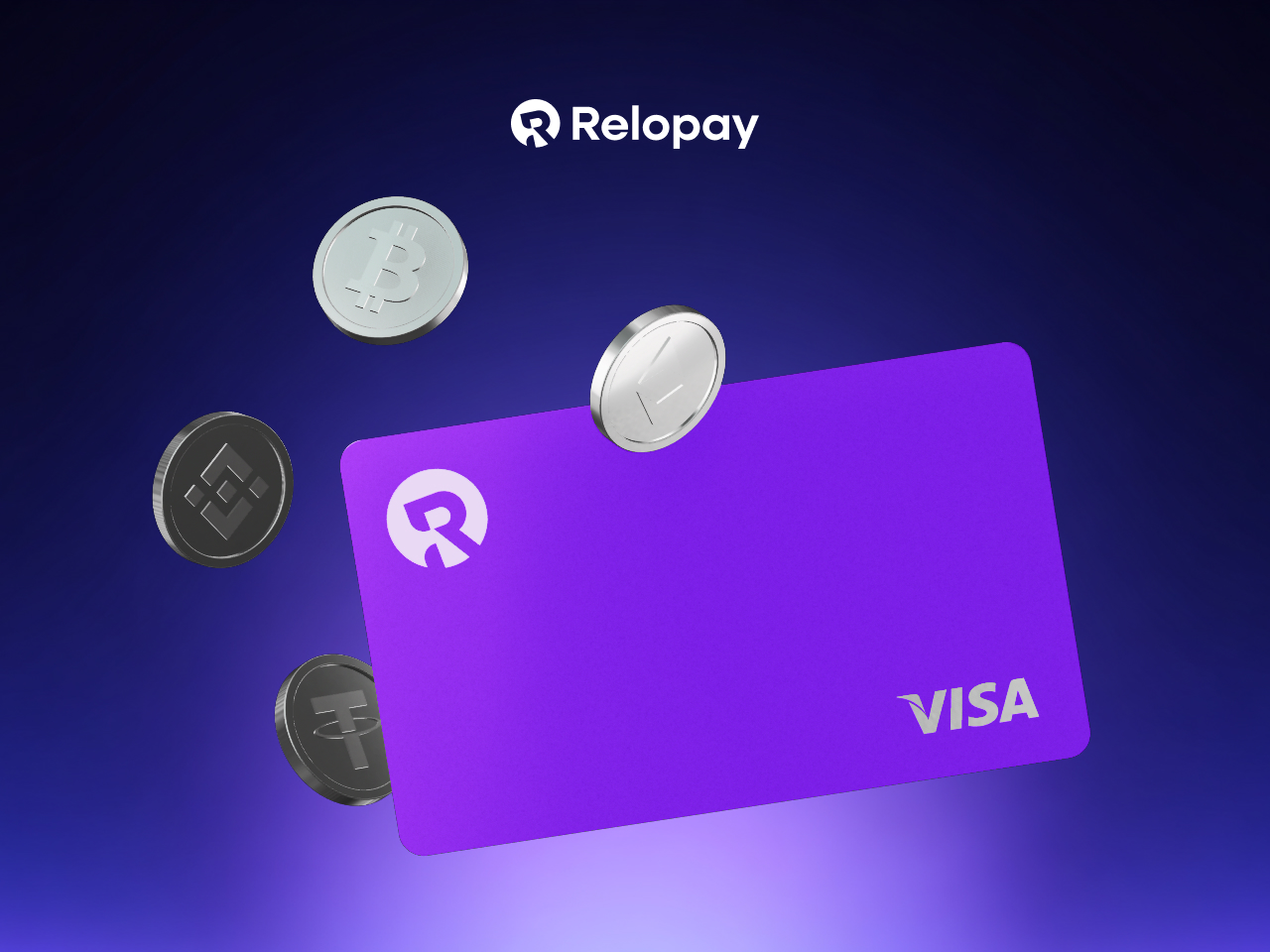
As cryptocurrencies increasingly shift from niche investments toward everyday tools, one breakthrough is making them truly spendable: crypto cards. With Relopay, users can instantly top up via Bitcoin, Ethereum, USDT, or other supported coins and spend them anywhere Visa cards are accepted. This blend of ease, security, and financial independence positions crypto cards as a powerful force in modern finance.

What Is a Crypto Card?

A crypto card functions like a traditional debit or credit card, but its funding source is your crypto wallet. When you pay, the card’s backend converts the crypto into fiat at the point of sale, so you never need to manually exchange beforehand. With Relopay, this process is fast and seamless, letting you shop globally using your digital holdings.

Why Are Crypto Cards Gaining Traction?

Three core advantages are fueling adoption: convenience, accessibility, and control.

  • Convenience: Transactions are processed instantly, without going through traditional bank rails or long delays.
  • Accessibility: You don’t need a conventional bank account to use a crypto-backed card.
  • Control: You retain control over your crypto holdings and spend them on your terms.

Relopay’s model underscores these benefits—top-ups, spending, and account management are all handled within their Telegram mini app and platform interface.

Instant Access to Your Crypto

One of the greatest strengths of crypto cards is enabling real-time spendability. Rather than locking your funds away on an exchange or in a cold wallet, a crypto card allows you to fluidly shift between holding and spending. Relopay supports instant issuance of virtual Visa cards and real-time balance top-ups.

Global Spending with No Borders

Because the card converts crypto to local fiat at checkout, Relopay cards work at over 130 million merchants worldwide—wherever Visa is accepted. This makes them ideal for travelers, remote workers, and users who want frictionless global access to their funds.

Security and Privacy

Relopay implements several layers of protection:

  • 3D Secure and PIN protections on transactions
  • Advanced encryption to safeguard user data
  • Limited identity verification for prepaid cards (no KYC required for certain prepaid usage)

By relying on blockchain transparency and tamper-resistant ledgers, the risk of fraud is reduced compared to traditional payment systems.

Fees, Limits & Use Constraints

While crypto cards offer flexibility, there are trade-offs and boundaries to consider:

  • Top-up Fee: 1% of amount
  • Crypto Conversion Fee: Around 1.9% when converting crypto to fiat during purchase
  • Transaction Fee: $1 per transaction, in addition to the conversion cost
  • Limits: Virtual cards are issued for 3 years, have a maximum balance of $4,000, and a monthly spending cap of $50,000
  • No Annual, Inactivity, or Cancellation Fees: Relopay waives these

Do note: different card types (virtual vs. prepaid) might have different KYC obligations or restrictions.

Potential Drawbacks to Keep in Mind

  • Volatility in your crypto holdings could reduce your purchasing power depending on timing
  • Some merchants and jurisdictions still lag in accepting crypto-based payments
  • Spending and balance caps might limit large or frequent transactions
  • Conversion and transaction fees can add up, especially with smaller payments

The Future of Crypto Cards

As blockchain infrastructure and crypto adoption evolve, we can anticipate:

  • Wider acceptance by major retailers
  • More competitive rewards programs (cashback in crypto, staking bonuses)
  • Deeper integration with DeFi (crypto lending, staking, yield generation)
  • All-in-one financial cards blending traditional and crypto services

Relopay is already pushing in that direction: by enabling instant issuance, low-fee top-ups, and global acceptance, it aims to redefine payments for Web3 users.

Final Thoughts

Crypto cards aren’t just another fintech novelty—they represent a shift in how money works. With Relopay, everyday spending with digital assets becomes practical and secure. Instant access, global usability, strong privacy, and transparent fees make crypto cards a compelling step toward a future where crypto becomes truly usable in daily life.


Dipo Olowookere is a journalist based in Nigeria that has passion for reporting business news stories. At his leisure time, he watches football and supports 3SC of Ibadan. Mr Olowookere can be reached via [email protected]

Advertisement
Click to comment

Leave a Reply

Your email address will not be published. Required fields are marked *

Economy

Food Concepts Return NASD OTC Exchange to Danger Zone

Published

on

NASD OTC exchange

By Adedapo Adesanya

Food Concepts Plc neutralized the gains recorded by three securities, returning the NASD Over-the-Counter (OTC) Securities Exchange into the negative territory with a 0.27 per cent loss on Thursday, December 4.

Yesterday, the share price of the parent company of Chicken Republic and PieXpress declined by 34 Kobo to sell at N3.15 per unit compared with the previous day’s N3.49 per unit.

This shrank the market capitalisation of the OTC bourse by N5.72 billion to N2.136 billion from N2.142 trillion and weakened the NASD Unlisted Security Index (NSI) by 9.57 points to 3,571.53 points from 3,581.10 points.

Business Post reports that Central Securities Clearing System (CSCS) Plc went down by 50 Kobo to N38.50 per share from N38.00 per share, FrieslandCampina Wamco Nigeria Plc gained 29 Kobo to sell at N55.79 per unit versus N55.50 per unit, and Geo-Fluids Plc added 5 Kobo to close at N4.60 per share compared with Wednesday’s closing price of N4.55 per share.

Trading data indicated that the volume of securities recorded at the session surged by 6,885.3 per cent to 4.3 million units from the 61,570 units posted a day earlier, the value of securities increased by 10,301.7 per cent to N947.2 million from N3.3 million, and the number of deals went up by 146.7 per cent to 37 deals from the 15 deals achieved in the previous trading session.

At the close of business, Infrastructure Credit Guarantee Company (InfraCredit) Plc was the most traded stock by value on a year-to-date basis with the sale of 5.8 billion units for N16.4 billion, trailed by Okitipupa Plc with 170.4 million units worth N8.0 billion, and Air Liquide Plc with 507.5 million units valued at N4.2 billion.

InfraCredit Plc also finished the session as the most traded stock by volume on a year-to-date basis with 5.8 billion units transacted for N16.4 billion, followed by Industrial and General Insurance (IGI) Plc with 1.2 billion units sold for N420.2 million, and Impresit Bakolori Plc with 536.9 million units traded for N524.9 million.

Continue Reading

Economy

Investors Gain N97bn from Local Equity Market

Published

on

Nigerian equity market

By Dipo Olowookere

The upward trend witnessed at the Nigerian Exchange (NGX) Limited in recent sessions continued on Thursday as it further improved by 0.10 per cent.

This was despite investor sentiment turning bearish after the local equity market ended with 23 price gainers and 28 price gainers, indicating a negative market breadth index.

UAC Nigeria gained 10.00 per cent to finish at N88.00, Morison Industries appreciated by 9.94 per cent to N3.54, Ecobank rose by 8.53 per cent to N36.90, and Coronation Insurance grew by 8.47 per cent to N2.56.

On the flip side, Ellah Lakes depreciated by 10.00 per cent to N13.14, Eunisell Nigeria also shed 10.00 per cent to finish at N72.90, Transcorp Hotels slipped by 9.95 per cent to N157.50, Omatek shrank by 9.23 per cent to N1.18, and Guinea Insurance dipped by 8.46 per cent to N1.19.

Yesterday, the All-Share Index (ASI) went up by 152.28 points to 145,476.15 points from 145,323.87 points and the market capitalisation chalked up N97 billion to finish at N92.726 trillion compared with the previous day’s N92.629 trillion.

Customs Street was bubbling with activities on Thursday, though the trading volume and value slightly went down, according to data.

A total of 1.9 billion stocks worth N19.2 billion exchanged hands in 23,369 deals during the session versus the N2.3 billion valued at N21.0 billion traded in 21,513 deals a day earlier.

This showed that the number of deals increased by 8.63 per cent, the volume of transactions depleted by 17.39 per cent, and the value of trades decreased by 8.57 per cent.

For another trading day, eTranzact led the activity chart with 1.6 billion units sold for N6.4 billion, Fidelity Bank traded 31.0 million units worth N589.3 million, GTCO exchanged 28.3 million units valued at N2.5 billion, Zenith Bank transacted 27.1 million units for N1.6 billion, and Ecobank traded 21.9 million units worth N744.3 million.

Continue Reading

Economy

Naira Loses 18 Kobo Against Dollar at Official Market, N5 at Black Market

Published

on

forex Black Market

By Adedapo Adesanya

The Naira marginally depreciated against the United States Dollar in the Nigerian Autonomous Foreign Exchange Market (NAFEM) on Thursday, December 4 amid renewed forex pressure associated with December.

At the official market yesterday, the Nigerian currency lost 0.01 per cent or 18 Kobo against the Dollar to close at N1,447.83/$1 compared with the previous day’s N1,447.65/$1.

It was not a different scenario with the local currency in the same market segment against the Pound Sterling as it further shed N15.43 to sell for N1,930.97/£1 versus Wednesday’s closing price of N1,925.08/£1 and declined against the Euro by 20 Kobo to finish at N1,688.74/€1 compared with the preceding session’s N1,688.54/€1.

Similarly, the Nigerian Naira lost N5 against the greenback in the black market to quote at N1,465/$1 compared with the previous day’s value of N1,460/$1 but closed flat against the Dollar at the GTBank FX counter at N1,453/$1.

Fluctuations in trading range is expected to continue during the festive season as traders expect the Nigerian currency to be stable, supported by intervention s by to the Central Bank of Nigeria (CBN)in the face of steady dollar demand.

Support is also expected in coming weeks as seasonal activities, particularly the stylised “Detty December” festivities, will see inflows that will give the Naira a boost after it depreciated mildly last month, according to a new report.

“As the festive Detty December season intensifies, inbound travel, tourism spending, and diaspora inflows are expected to provide moderate support for FX liquidity,” analysts at the research unit of FMDA said in its latest monthly report for November.

Traders cited by Reuters expect that the Naira will trade within a band of N1,443-N1,450 next week, buoyed by improved FX interventions by the apex bank.

Meanwhile, the crypto market was down as the US Federal Reserve’s preferred inflation gauge, core PCE, likely rose in September—moving in the wrong direction. However, volatility indices show no signs of major turbulence.

If the actual figure matches estimates, it would mark 55 straight months of inflation above the US central bank’s 2 per cent target. The sticky inflation would strengthen the hawkish policymakers, who are in favour of slower rate cuts.

Ripple (XRP) depreciated by 4.5 per cent to $2.08, Solana (SOL) went down by 3.8 per cent to $138.11, Litecoin (LTC) shrank by 3.1 per cent to $83.23, Dogecoin (DOGE) slid by 2.5 per cent to $0.1463, Cardano (ADA) declined by 2.1 per cent to $0.4368, Bitcoin (BTC) fell by 0.9 per cent to $91,975.45, Binance Coin (BNB) crumbled by 0.9 per cent to $899.41, and Ethereum (ETH) dropped by 0.7 per cent to $3,156.44, while the US Dollar Tether (USDT) and the US Dollar Coin (USDC) closed flat at $1.00 apiece.

Continue Reading

Trending