Connect with us

Feature/OPED

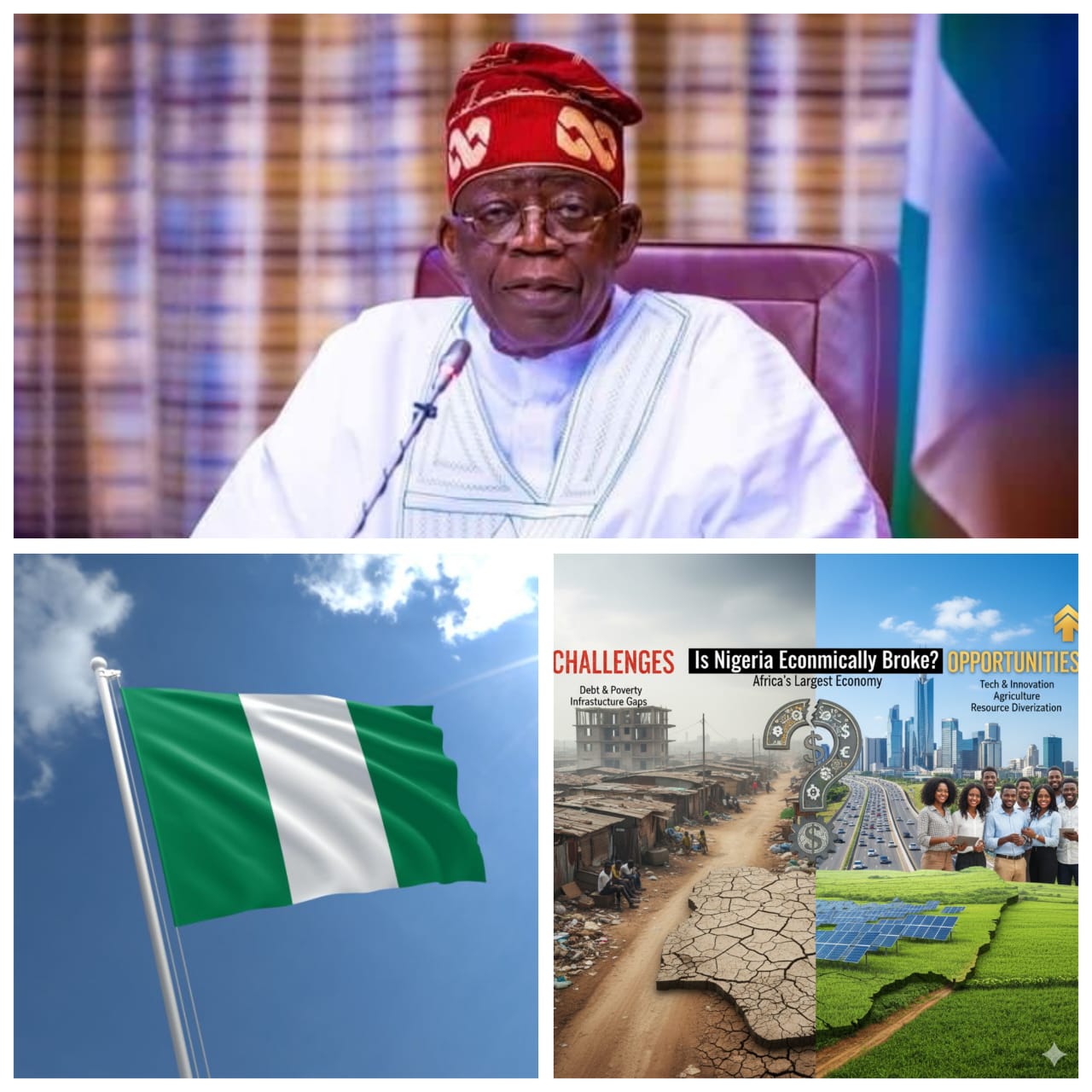
Is Nigeria Economically Broke? Challenges and Opportunities in Africa’s Largest Economy

Published

on

Is Nigeria Economically Broke

By Blaise Udunze

Is Nigeria, Africa’s largest economy, economically broke? It is a question no patriotic citizen wants to confront, yet one that confronts every Nigerian daily at the fuel pump, the market stall, the school gate, the hospital reception, and increasingly, in the national accounts. The country’s fiscal reality is no longer a debate in economic circles alone; it is a lived experience for millions and a gathering storm for future generations.

To understand the gravity of the nation’s situation, one must look beyond political speeches and interrogate Nigeria’s borrowing patterns, revenue profile/debt numbers, public spending, and the economic behavior of both federal and state governments under President Bola Ahmed Tinubu’s. administration. What emerges is a troubling picture as taxation is squeezing small businesses, borrowing is mortgaging the nation’s tomorrow, and shockingly, the trillions shared among federal, state, and local governments every month translate into little visible development. Nigeria’s books show figures, but her streets show a different reality.

Since President Bola Ahmed Tinubu assumed office in June 2023, Nigeria’s public debt has spiraled from N33.3 trillion to N152.4 trillion by mid-2025 which represents a staggering 348.6 percent increase in just two years. Economies do not collapse overnight; they weaken gradually, sending warning signs that only become obvious in hindsight. Nigeria is flashing all the red signals today. Between July and October 2025 alone, the government secured over $24.79 billion, €4 billion, ¥15 billion, N757 billion, and another $500 million in sukuk bonds. These figures, in a functional economy, should translate into expanded electricity capacity, world-class healthcare systems, vibrant industries, better roads, thriving SMEs, and export-oriented value chains. Instead, much of Nigeria’s real sector remains stagnant as energy is unstable, industrial output is weak, and infrastructure remains largely stuck in the realm of political promises.

Borrowing, in itself, is not the crime. Nations borrow to grow. Borrowing becomes a problem when the funds are not directed toward productive, self-liquidating projects capable of paying back the debt through increased economic activity. Nigeria borrows aggressively but produces too little. The loans are not translating into productivity or growth, which is why the debt-servicing burden continues to rise. Today, more than 90 percent of government revenue is spent on servicing old debts. In some quarters, debt servicing now consumes 25 percent of Nigeria’s entire annual revenue. This means that governance has been reduced to fiscal survival, with vital sectors such as education, healthcare, and industrialization competing for the crumbs left after creditors take their share.

Professor Uche Uwaleke of Nasarawa State University captured it aptly: “Nigeria’s debt service ratio is inimical to economic development… The opportunity cost for the country is high.” The tragedy is clear as the country has substituted borrowing for revenue and debt servicing for development. At the 2025 IMF and World Bank Meetings, global leaders lamented Africa’s growing debt, which has now exceeded $1.3 trillion. Sub-Saharan African governments spent over $89 billion servicing debts in 2025 alone. Yet Nigeria’s case stands out because of its size, population, weak industrial base, and persistent revenue leakages. Nigeria continues to borrow through Eurobonds, multilateral loans, bilateral facilities, and sukuk instruments, even without a corresponding rise in productivity. This raises a painful but necessary question: if these loans are development financing, where is the development?

Recently, the House of Representatives approved President Tinubu’s request to borrow $2.35 billion to finance part of the 2025 budget deficit. This is not borrowing to invest, it is borrowing to plug holes, pay salaries, and service existing debts. This is fiscal survivalism, not economic transformation. Countries that borrow to build infrastructure grow out of debt. Countries that borrow to fund recurrent expenditure sink deeper into it. Nigeria is drifting toward the latter.

The African Democratic Congress (ADC) bluntly accused the president of being “addicted to debts,” noting that if all requested loans for 2025 are approved, Nigeria’s debt stock could reach N193 trillion. The Debt Management Office confirmed the possibility. In the ADC’s words: “You cannot claim your house is in order while taking new loans to stop the roof from collapsing.” The loan in question was the N1.15 trillion request by President Tinubu to fund the 2025 budget deficit, which the Senate and House of Representatives gave their approval during last Wednesday’s plenary.

Despite government assurances that inflation is easing by recording 18.02 percent headline inflation and 16.87 percent food inflation, Nigerians feel no relief. Prices remain high, purchasing power continues to collapse, and businesses are shutting down. There is no statistical comfort in an empty dinner plate.

While federal borrowing continues to dominate conversations, an equally critical yet often ignored dimension lies at the state level. Since the fuel subsidy removal in June 2023, state governments have become quiet but major beneficiaries of the enlarged FAAC allocations as a feeding bottle.

NEITI and OAGF/NBS records show that between June 2023 and June 2025, FAAC distributed N25.65 trillion yet few Nigerians can point to commensurate development in their states. Roads remain terrible. State industries are dead. Capital projects are abandoned. Health and education sectors are underfunded. Internally generated revenue remains weak.

Many states have weaponized FAAC allocations into a system of dependence. They line up monthly for their share but fail to harness the natural resources, agricultural potential, tourism corridors, or industrial hubs available within their territories.

Nigeria’s fiscal health is not a function of what federal government collects alone, it is a function of what the states produce. Development is a chain; a weak link breaks the entire system. Many states have become consumption centers instead of production hubs, contributing significantly to the national productivity crisis. Until FAAC allocations are tied to measurable development outcomes, Nigeria will continue to share poverty, not prosperity.

All these realities force Nigerians to ask again if Nigeria is economically broke?

A country is economically broke:

  • when it borrows to survive rather than to grow;
  • when it spends the bulk of its income servicing old debts;
  • when its states depend on allocations instead of productivity;
  • when taxation cripples rather than empowers businesses; and
  • when development is measured by political speeches, not real outcomes.

By these metrics, Nigeria is edging dangerously close to fiscal insolvency, living on borrowed money and borrowed time.

Yet despite this troubling landscape, Nigeria’s economic prospects are not irredeemable. The country possesses immense opportunities that, if harnessed, could transform its economic future to becoming one of the most vibrant in the world.

  1. Diversification: Agriculture, Technology, and Services –

Nigeria’s over-reliance on oil remains its most dangerous economic vulnerability. Oil accounts for more than 90 percent of export earnings and over half of government revenue. A single fluctuation in global oil prices can destabilize the entire economy. Diversification is not optional; it is a national emergency.

Agriculture, however, offers a powerful alternative. With vast arable land, abundant labor, and high domestic demand, agriculture can drive food security, export expansion, and industrial value chains.

Technology stands as another frontier of opportunity. Nigeria’s youthful population, fast-rising digital economy, and growing tech hubs offer pathways for innovation, employment, and global competitiveness.

The services sector which consists of telecommunications, finance, logistics, entertainment, and tourism also holds massive potential to absorb millions of jobs and stimulate economic growth and reduce reliance on oil revenue.

  1. Job Creation and Youth Productivity:

Nigeria’s unemployment and underemployment rates remain dangerously high, particularly among young people. A productive youth population is an economic asset; an idle youth population is a socio-economic risk. Entrepreneurship support, industrial hubs, vocational training, and SME financing can unlock millions of new jobs.

  1. Infrastructure Development:

However, none of these sectors can thrive without addressing Nigeria’s infrastructural deficit. Poor power supply, crumbling roads, inefficient transport systems, and inconsistent regulatory policies continue to choke businesses. Infrastructure is the backbone of any modern economy; without it, productivity remains low regardless of potential.

  1. Governance, Transparency, and Anti-Corruption:

Governance and transparency play an equally critical role. Nigeria cannot build a productive economy on the foundation of corruption, mismanagement, and opaque financial practices. Strengthening institutions, enforcing accountability, digitizing public services, and ensuring full transparency in FAAC disbursements, budget execution, and loan utilization are essential steps toward restoring public trust and investor confidence. Transparency must become the norm not the exception.

The path to a resilient Nigerian economy requires a national reset in fiscal discipline. The following steps are critical:

–       Borrowing must be tied strictly to revenue-generating, self-liquidating projects.

–       Recurrent expenditure borrowing must stop.

–       Debt ceilings should be legally enforced.

–       States must be compelled to boost local productivity and mobilize internal revenue.

–       FAAC allocations should be linked to measurable development benchmarks.

–       Public finance transparency must be non-negotiable

–       Economic diversification must be pursued with urgency, not rhetoric.

Currently, Nigeria stands at an intercession. One path leads to deeper debt, economic stagnation, and a future where the next generation inherits nothing but liabilities. The other path leads to reform, productivity, innovation, and the emergence of a strong, resilient economy capable of withstanding global uncertainties.

So, is Nigeria economically broke? The uncomfortable truth is that Nigeria is not yet bankrupt but it is dangerously close. A nation cannot continue borrowing to survive, consuming more than it produces, or neglecting the engines of real growth. The time for action is now. Nigeria’s challenges are vast, but so are her opportunities. With discipline, transparency, and visionary leadership, Africa’s largest economy can still reclaim its promise and chart a sustainable path toward shared prosperity.

Blaise, a journalist and PR professional writes from Lagos, can be reached via: [email protected]

Advertisement
Click to comment

Leave a Reply

Your email address will not be published. Required fields are marked *

Feature/OPED

Why the Future of PR Depends on Healthier Client–Agency Partnerships

Published

on

Moliehi Molekoa Future of PR

By Moliehi Molekoa

The start of a new year often brings optimism, new strategies, and renewed ambition. However, for the public relations and reputation management industry, the past year ended not only with optimism but also with hard-earned clarity.

2025 was more than a challenging year. It was a reckoning and a stress test for operating models, procurement practices, and, most importantly, the foundation of client–agency partnerships. For the C-suite, this is not solely an agency issue.

The year revealed a more fundamental challenge: a partnership problem that, if left unaddressed, can easily erode the very reputations, trust, and resilience agencies are hired to protect. What has emerged is not disillusionment, but the need for a clearer understanding of where established ways of working no longer reflect the reality they are meant to support.

The uncomfortable truth we keep avoiding

Public relations agencies are businesses, not cost centres or expandable resources. They are not informal extensions of internal teams, lacking the protection, stability, or benefits those teams receive. They are businesses.

Yet, across markets, agencies are often expected to operate under conditions that would raise immediate concerns in any boardroom:

  • Unclear and constantly shifting scope

  • Short-term contracts paired with long-term expectations

  • Sixty-, ninety-, even 120-day payment terms

  • Procurement-led pricing pressure divorced from delivery realities

  • Pitch processes that consume months of senior talent time, often with no feedback, timelines, or accountability

If these conditions would concern you within your own organisation, they should also concern you regarding the partner responsible for your reputation.

Growth on paper, pressure in practice

On the surface, the industry appears healthy. Global market valuations continue to rise. Demand for reputation management, stakeholder engagement, crisis preparedness, and strategic counsel has never been higher.

However, beneath this top-line growth lies the uncomfortable reality: fewer than half of agencies expect meaningful profit growth, even as workloads increase and expectations rise.

This disconnect is significant. It indicates an industry being asked to deliver more across additional platforms, at greater speed, with deeper insight, and with higher risk exposure, all while absorbing increased commercial uncertainty.

For African agencies in particular, this pressure is intensified by factors such as volatile currencies, rising talent costs, fragile data infrastructure, and procurement models adopted from economies with fundamentally different conditions. This is not a complaint. It is reality.

This pressure is not one-sided. Many clients face constraints ranging from procurement mandates and short-term cost controls to internal capacity gaps, which increasingly shift responsibility outward. But pressure transfer is not the same as partnership, and left unmanaged, it creates long-term risk for both parties.

The pitching problem no one wants to own

Agencies are not anti-competition. Pitches sharpen thinking and drive excellence. What agencies increasingly challenge is how pitching is done.

Across markets, agencies participate in dozens of pitches each year, with success rates well below 20%. Senior leaders frequently invest unpaid hours, often with limited information, tight timelines, and evaluation criteria that prioritise cost over value.

And then, too often, dead silence, no feedback, no communication about delays, and a lack of decency in providing detailed feedback on the decision drivers.

In any other supplier relationship, this would not meet basic governance standards. In a profession built on intellectual capital, it suggests that expertise is undervalued.

This is also where independent pitch consultants become increasingly important and valuable if clients choose this route to help facilitate their pitch process. Their role in the process is not to advocate for agencies but to act as neutral custodians of fairness, realism, and governance. When used well, they help clients align ambition with timelines, scope, and budget, and ensure transparency and feedback that ultimately lead to better decision-making.

“More for less” is not a strategy

A particularly damaging expectation is the belief that agencies can sustainably deliver enterprise-level outcomes on limited budgets, often while dedicating nearly full-time senior resources. This is not efficiency. It is misalignment.

No executive would expect a business unit to thrive while under-resourced, overexposed, and cash-constrained. Yet agencies are often required to operate under these conditions while remaining accountable for outcomes that affect market confidence, stakeholder trust, and brand equity.

Here is a friendly reminder: reputation management is not a commodity. It is risk management.

It is value creation. It also requires investment that matches its significance.

A necessary reset

As leadership teams plan for growth, resilience, and relevance, there is both an opportunity and a responsibility to reset how agency partnerships are structured.

That reset looks like:

  • Contracts that balance flexibility and sustainability

  • Payment terms that reflect mutual dependency

  • Pitch processes that respect time, talent, and transparency for all parties

  • Scopes that align ambition with available budgets

  • Relationships based on professional parity rather than power imbalance

This reset also requires discipline on the agency side – clearer articulation of value, sharper scoping, and greater transparency about how senior expertise is deployed. Partnership is not protectionism; it is mutual accountability.

The Leadership Question That Matters

The question for the C-suite is quite simple:

If your agency mirrored your internal standards of governance, fairness, and accountability, would you still be comfortable with how the relationship is structured?

If the answer is no, then change is not only necessary but also strategic. Because strong brands are built on strong partnerships. Strong partnerships endure only when both sides are recognised, respected, and resourced as businesses in their own right.

The agencies that succeed and the brands that truly thrive will be those that recognise this early and act deliberately.

Moliehi Molekoa is the Managing Director of Magna Carta Reputation Management Consultants and PRISA Board Member

Continue Reading

Feature/OPED

Directing the Dual Workforce in the Age of AI Agents

Published

on

Linda Saunders Trusted AI

By Linda Saunders

We will be the last generation to work with all-human workforces. This is not a provocative soundbite but a statement of fact, one that signals a fundamental shift in how organisations operate and what leadership now demands. The challenge facing today’s leaders is not simply adopting new technology but architecting an entirely new operating model where humans and autonomous AI agents work in concert.

According to Salesforce 2025 CEO research, 99% of CEOs say they are prepared to integrate digital labor into their business, yet only 51% feel fully prepared to do so. This gap between awareness and readiness reveals the central tension of this moment: we recognise the transformation ahead but lack established frameworks for navigating it. The question is no longer whether AI agents will reshape work, but whether leaders can develop the new capabilities required to direct this dual workforce effectively.

The scale of change is already visible in the data. According to the latest CIO trends, AI implementation has surged 282% year over year, jumping from 11% to 42% of organisations deploying AI at scale. Meanwhile, the IDC estimates that digital labour will generate a global economic impact of $13 trillion by 2030, with their research suggesting that agentic AI tools could enhance productivity by taking on the equivalent of almost 23% of a full-time employee’s weekly workload.

With the majority of CEOs acknowledging that digital labor will transform their company structure entirely, and that implementing agents is critical for competing in today’s economic climate, the reality is that transformation is not coming, it’s already here, and it requires a fundamental change to the way we approach leadership.

The Director of the Dual Workforce

Traditional management models, built on hierarchies of human workers executing tasks under supervision, were designed for a different era. What is needed now might be called the Director of the dual workforce, a leader whose mandate is not to execute every task but to architect and oversee effective collaboration between human teams and autonomous digital labor. This role is governed by five core principles that define how AI agents should be structured, deployed and optimised within organisations.

Structure forms the foundation. Just as organisational charts define human roles and reporting lines, leaders must design clear frameworks for AI agents, defining their scope, establishing mandates and setting boundaries for their operation. This is particularly challenging given that the average enterprise uses 897 applications, only 29% of which are connected. Leaders must create coherent structures within fragmented technology landscapes as a strong data foundation is the most critical factor for successful AI implementation. Without proper structure, agents risk operating in silos or creating new inefficiencies rather than resolving existing ones.

Oversight translates structure into accountability. Leaders must establish clear performance metrics and conduct regular reviews of their digital workforce, applying the same rigour they bring to managing human teams. This becomes essential as organisations scale beyond pilot projects and we’ve seen a significant increase in companies moving from pilot to production, indicating that the shift from experimentation to operational deployment is accelerating. It’s also clear that structured approaches to agent deployment can deliver return on investment substantially faster than do-it-yourself methods whilst reducing costs, but only when proper oversight mechanisms are in place.

To ensure agents learn from trusted data and behave as intended before deployment, training and testing is required. Leaders bear responsibility for curating the knowledge base agents access and rigorously testing their behaviour before release. This addresses a critical challenge: leaders believe their most valuable insights are trapped in roughly 19% of company data that remains siloed. The quality of training directly impacts performance and properly trained agents can achieve 75% higher accuracy than those deployed without rigorous preparation.

Additionally, strategy determines where and how to deploy agent resources for competitive advantage. This requires identifying high-value, repetitive or complex processes where AI augmentation drives meaningful impact. Early adoption patterns reveal clear trends: according to the Salesforce Agentic Enterprise Index tracking the first half of 2025, organisations saw a 119% increase in agents created, with top use cases spanning sales, service and internal business operations. The same research shows employees are engaging with AI agents 65% more frequently, and conversations are running 35% longer, suggesting that strategic deployment is finding genuine utility rather than novelty value.

The critical role of observability

The fifth principle, to observe and track, has emerged as perhaps the most critical enabler for scaling AI deployments safely. This requires real-time visibility into agent behaviour and performance, creating transparency that builds trust and enables rapid optimisation.

Given the surge in AI implementation, leaders need unified views of their AI operations to scale securely. Success hinges on seamless integration into core systems rather than isolated projects, and agentic AI demands new skills, with the top three in demand being leadership, storytelling and change management. The ability to observe and track agent performance is what makes this integration possible, allowing leaders to identify issues quickly, demonstrate accountability and make informed decisions about scaling.

The shift towards dual workforce management is already reshaping executive priorities and relationships. CIOs now partner more closely with CEOs than any other C-suite peer, reflecting their changing and central role in technology-driven strategy. Meanwhile, recent CHRO research found that 80% of Chief Human Resources Officers believe that within five years, most workforces will combine humans and AI agents, with expected productivity gains of 30% and labour cost reductions of 19%. The financial perspective has also clearly shifted dramatically, with CFOs moving away from cautious experimentation toward actively integrating AI agents into how they assess value, measure return on investment, and define broader business outcomes.

Leading the transition

The current generation of leaders are the crucial architects who must design and lead this transition. The role of director of the dual workforce is not aspirational but necessary, grounded in principles that govern effective agent deployment. Success requires moving beyond viewing AI as a technical initiative to understanding it as an organisational transformation that touches every aspect of operations, from workflow design to performance management to strategic planning.

This transformation also demands new capabilities from leaders themselves. The skills that defined effective management in all-human workforces remain important but are no longer sufficient. Leaders must develop fluency in understanding agent capabilities and limitations, learn to design workflows that optimally divide labor between humans and machines, and cultivate the ability to measure and optimise performance across both types of workers. They must also navigate the human dimensions of this transition, helping employees understand how their roles evolve, ensuring that the benefits of productivity gains are distributed fairly, and maintaining organisational cultures that value human judgement and creativity even as routine tasks migrate to digital labor.

The responsibility to direct what comes next, to architect systems where human creativity, judgement and relationship-building combine with the scalability, consistency and analytical power of AI agents, rests with today’s leaders. The organisations that thrive will be those whose directors embrace this mandate, developing the structures, oversight mechanisms, training protocols, strategic frameworks and observability systems that allow dual workforces to deliver on their considerable promise.

Continue Reading

Feature/OPED

Energy Transition: Will Nigeria Go Green Only To Go Broke?

Published

on

energy transition plan

By Isah Kamisu Madachi

Nigeria has been preparing for a sustainable future beyond oil for years. At COP26 in the UK, the country announced its commitment to carbon neutrality by 2060. Shortly after the event, the Energy Transition Plan (ETP) was unveiled, the Climate Change Act 2021 was passed and signed into law, and an Energy Transition Office was created for the implementations. These were impressive efforts, and they truly speak highly of the seriousness of the federal government. However, beyond climate change stress, there’s an angle to look at this issue, because in practice, an important question in this conversation that needs to be answered is: how exactly will Nigeria’s economy be when oil finally stops paying the bills?

For decades, oil has been the backbone of public finance in Nigeria. It funds budgets, stabilises foreign exchange, supports states through monthly FAAC allocations, and quietly props up the naira. Even when production falls or prices fluctuate, the optimism has always been that oil will somehow carry Nigeria through the storms. It is even boldly acknowledged in the available policy document of the energy transition plan that global fossil fuel demand will decline. But it does not fully confront what that decline means for a country of roughly 230 million people whose economy is still largely structured around oil dollars.

Energy transition is often discussed from the angle of the emissions issue alone. However, for Nigeria, it is first an economic survival issue. Evidence already confirms that oil now contributes less to GDP than it used to, but it remains central to government revenue and foreign exchange earnings. When oil revenues drop, the effects are felt in budget shortfalls, rising debt, currency pressure, and inflation. Nigerians experienced this reality during periods of oil price crashes, from 2014 to the pandemic shock.

The Energy Transition Plan promises to lift 100 million Nigerians out of poverty, expand energy access, preserve jobs, and lead a fair transition in Africa. These are necessary goals for a future beyond fossil fuels. But this bold ambition alone does not replace revenue. If oil earnings shrink faster than alternative sources grow, the transition risks deepening fiscal stress rather than easing it. Without a clear post-oil revenue strategy tied directly to the transition, Nigeria may end up cleaner with the net-zero goals achieved, but poorer.

Jobs need to be considered, too. The plan recognises that employment in the oil sector will decline over time. What should be taken into consideration is where large-scale employment will come from. Renewable energy, of course, creates jobs, but not automatically, and not at the scale oil-related value chains once supported, unless deliberately designed to do so. Solar panels assembled abroad and imported into Nigeria will hardly replace lost oil jobs. Local manufacturing, large-scale skills development, and industrial policy are what make the difference, yet these remain weak links in Nigeria’s transition conversation.

The same problem is glaringly present in public finance. States that depend heavily on oil-derived allocations are already struggling to pay salaries, though with improvement after fuel subsidy removal. A future with less oil revenue will only worsen this unless states are supported to proactively build formidably productive local economies. Energy transition, if disconnected from economic diversification, could unintentionally widen inequality between regions and states and also exacerbate dependence on internal and external borrowing.

There is also the foreign exchange question. Oil export is still Nigeria’s main source of dollars. As global demand shifts and revenues decline, pressure on the naira will likely intensify unless non-oil exports rise in a dramatically meaningful way. However, Nigeria’s non-oil export base remains very narrow. Agriculture, solid minerals, manufacturing, and services are often mentioned, but rarely aligned with the Energy Transition Plan in a concrete and measurable way.

The core issue here is not about Nigeria wanting to transition, but that it wants to transition without rethinking how the economy earns, spends, and survives. Clean energy will not automatically fix public finance, stabilise the currency, or replace lost oil income and jobs. Those outcomes require deliberate and strategic economic choices that go beyond power generation and meeting emissions targets. Otherwise, the country will be walking into a future where oil is no longer dependable, yet nothing else has been built strongly enough to pay the bills as oil did.

Isah Kamisu Madachi is a policy analyst and development practitioner. He writes from Abuja and can be reached via [email protected]

Continue Reading

Trending