Economy
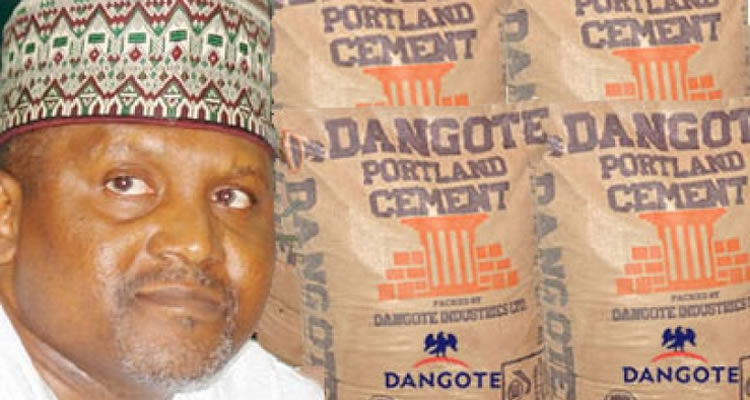
Dangote Cement Pays N144.8b Dividend to Shareholders

By Dipo Olowookere
At the Annual General Meeting (AGM) of Dangote Cement Plc, the pay-out of N144.8 billion dividend to its shareholders was approved, which represented N8.50k per share in contrast to N8 per share paid to them in the corresponding period of 2015.
This excited the shareholders, who could not hide their joy and were full of praise for the board, management and staff of Dangote Cement Plc for giving them good returns for the investments.
“We are very happy and pleased with this result. The year 2016 was very tough with the recession and fluctuation in the foreign exchange market which the Chairman also said affected their operations, but despite all these challenges, the company was still able to pay us a very good dividend, better than last year, and even gave us hope of better returns on our investments in the years to come. This is very commendable and it is only a company like Dangote Cement that can achieve this laudable feat,” President of Amiable Shareholders Association of Nigeria, Mr Festus Akano, enthused.
Also at the meeting held in Lagos, another shareholder, Mr Akin Akinwumi, from the Progressive Shareholders Association urged the management to give a bonus and a better dividend in 2017.
He appealed to the company to do all within its power to give bonus issue.
“We thank the management for giving us this dividend but we are appealing so strongly that bonus issue should also be considered. For some of us, we prefer a bonus to this dividend and we know it can be done,” Mr Akinwunmi said.
He expressed optimism on the pan African plants, especially now that the plants were contributing significantly to the turnover of the company.
“It is a statement of fact that we are lucky to be shareholders of this great company. If you see what our subsidiaries across Africa are contributing to the turnover, then you will understand what I am talking about. I am very happy and our members are upbeat for the future, knowing fully well that it will only get better,” he remarked.
On his part, the Group Chief Executive Officer of Dangote Cement, Mr Onne van der Weijde, revealed that the expansion strategy of the company yielded fruits last year when Nigeria was in recession as the plants across Africa contributed significantly to the company’s turnover.
“We can see how that strategy has helped us in a time that our main market of Nigeria is facing a recession, high inflation, lower consumer spending and a shortage of foreign currency to fund essential imports.
“But outside of Nigeria we’ve had operations that have now been running for more than a year and they are experiencing good growth and improving profitability, so we have managed to offset some of those topline pressures in Nigeria with revenue streams from countries in very different parts of the continent.
“Furthermore, those Pan-African operations are helping to generate foreign currency for the Group, so this shows how a long-term decision to diversify can help with a short-term pressure like an illiquid currency market in Nigeria,” he said.
During the meeting, it was disclosed that company’s strategy in every country of operations was to be the leader on costs, quality and service.
It was further revealed that Dangote Cement, during the period under review, built large, modern, highly efficient plants that combine the latest equipment from Europe, China and beyond to enable it make higher-quality cement at lower costs, thereby giving it strong competitive advantages.
Also, in the 2016 financial year, the cement sales volumes of the firm increased by 25.0 percent to nearly 23.6Mt. Of this, almost 14.8Mt was sold in the Nigerian market. Revenues increased by 25.1 per cent to N615.1B, of which 68.3 percent was generated in Nigeria (excluding eliminations) and 31.7 percent from Pan-African operations.
The firm’s earnings before interest, depreciation and amortisation (EBITDA) decreased only slightly, to N257.2 billion, with Pan-African operations contributing N26.5 billion, excluding central costs, while earnings per share increased by 4.5 percent to N11.34.
Economy
Customs Street Bleeds 1.44% as Lafarge Africa Leads Losers’ Chart
By Dipo Olowookere
Nigeria’s stock market further depleted by 1.44 per cent on Wednesday following panic sell-offs by investors, who are cutting down their exposure to local equities.
Business Post observed that profit-taking dominated Customs Street at midweek, with all the key sectors of the Nigerian Exchange (NGX) Limited closing in red.
The insurance space shed 2.76 per cent, the industrial goods index lost 1.55 per cent, the banking counter declined by 1.53 per cent, the consumer goods segment shrank by 0.28 per cent, and the energy sector weakened by 0.05 per cent.
As a result, the All-Share Index (ASI) contracted by 3,554.05 points to 243,132.61 points from 246,686.66 points, and the market capitalisation moderated by N2.279 trillion to N155.940 trillion from N158.219 trillion.
Lafarge Africa led the losers’ chart yesterday after it gave up 9.97 per cent to trade at N307.90, Zichis lost 9.82 per cent to close at N29.20, Learn Africa depreciated by 9.80 per cent to N11.50, John Holt crashed by 9.80 per cent to N13.80, and Consolidated Hallmark dipped by 8.84 per cent to N6.19.
On the flip side, Abbey Mortgage Bank topped the gainers’ log after it grew by 9.93 per cent to N7.75, International Energy Insurance appreciated by 9.89 per cent to N6.00, Tripple G gained 9.80 per cent to sell for N4.37, Universal Insurance expanded by 8.91 per cent to N1.10, and Royal Exchange improved by 7.14 per cent to N1.50.
A total of 17 stocks gained weight yesterday, while 43 stocks lost weight, indicating a negative market breadth index and weak investor sentiment. This has been the mood of the market since the beginning of this week.
Market participants transacted 923.0 million shares worth N42.3 billion in 69,332 deals on Wednesday, in contrast to the 718.8 million shares valued at N29.3 billion traded in 71,683 deals on Tuesday, representing a drop in the number of deals by 3.28 per cent, and a rise in the trading volume and value by 28.41 per cent and 44.37 per cent, respectively.
Sterling Holdings led the activity chart with 264.6 million units valued at N2.1 billion, Access Holdings traded 76.7 million units worth N1.8 billion, Linkage Assurance exchanged 55.1 million units for N99.2 million, VFD Group sold 35.5 million units worth N378.8 million, and Ellah Lakes transacted 33.1 million units valued at N334.3 million.
Economy
Oil Prices Rise 2% as Middle East Hostilities Escalate
By Adedapo Adesanya
Oil prices rose around 2 per cent on Wednesday as hostilities in the Middle East erupted anew and talks between Iran and the United States showed little progress.
Brent futures grew by $1.81 or 1.89 per cent to $97.81 per barrel, and the US West Texas Intermediate (WTI) crude climbed $2.26 or 2.41 per cent to $96.02 a barrel.
According to reports, Iran launched ballistic missiles toward regional neighbours Kuwait and Bahrain, killing one person and injuring dozens, while the US forces conducted strikes on Iran’s Qeshm Island.
Iranian drones and missiles struck Kuwait International Airport overnight, causing the country to immediately suspend air traffic, activate emergency procedures, and divert flights to alternative airports.
Iran’s Revolutionary Guard said the operation was retaliation for recent US military actions and warned that regional states supporting American operations could face further consequences. Kuwait hosts major US military facilities and serves as a key logistics hub for American operations across the Middle East, but until then had largely avoided becoming a direct target.
Following the overnight attack, the United Arab Emirates (UAE) called for a united Gulf stance.
Meanwhile, President Donald Trump said Iran had agreed not to have a nuclear weapon and that Supreme Leader Ayatollah Mojtaba Khamenei was involved in negotiations. He has insisted this week that discussions remain active and said a broader agreement could emerge within days, while Iranian officials have delivered contradictory messages.
Iranian Foreign Minister Abbas Araqchi said contacts with American representatives have not been cut off, but no progress has been made in the negotiations.
The prolonged closure of the Strait of Hormuz continues to bottleneck global energy supplies, driving sustained upward pressure on oil markets.
The International Energy Agency (IEA) has warned that global oil inventories could hit critical levels ahead of peak summer demand if stock draws continue at their current pace.
Crude oil inventories in the US decreased by 8.0 million barrels during the week ending May 29, according to data from the Energy Information Administration (EIA) released on Wednesday. The EIA’s data release follows figures by the American Petroleum Institute (API) that were released a day earlier, which reported that crude oil inventories saw a draw of 6.75 million barrels in the period.
Economy
CSCS Boss Shantali Says T+1 Settlement Targets Long-Term Capital Market Growth
By Adedapo Adesanya
The chief executive of the Central Securities Clearing System (CSCS) Plc, Mr Shehu Yahaya Shantali, says Nigeria’s shift to a T+1 settlement cycle goes beyond faster transactions and is intended to deepen long-term growth in the capital market.
Speaking at a ceremony marking the commencement of T+1 settlement in Lagos, Mr Shantali described the development as a strategic milestone that goes beyond faster transaction timelines to reinforce the market’s structural strength and future readiness.
According to him, the shortened settlement cycle reflects years of investment in infrastructure, technology, and stakeholder collaboration aimed at transforming Nigeria into a globally competitive investment destination.
Nigeria recently became the first market in Africa to adopt the T+1 framework, reducing the settlement period for securities transactions from two days to one.
According to the boss of the securities depository firm, the shortened settlement cycle reflects years of investment in infrastructure, technology, and stakeholder collaboration aimed at transforming Nigeria into a globally competitive investment destination.
“These investments are not solely for T+1 settlement but to position Nigeria’s capital market for sustained growth and longterm competitiveness,” he said.
The migration from T+1 settlement is expected to enhance liquidity, improve capital efficiency, and reduce counterparty risk across the market.
Mr Shantali explained that the T+1 transition represents the culmination of a decades-long evolution from a manual, paper-based system to a fully automated, technology-driven post-trade environment.
He recalled that investors previously waited several months to complete transactions under the old system, but successive reforms, including transitions to T+5, T+3, and T+2, steadily improved efficiency and market integrity.
The latest upgrade, he said, builds on extensive preparations undertaken over the past three years, including system enhancements, process optimisation, and market-wide readiness assessments coordinated by the SEC and industry stakeholders.
On his part, the Director-General of the Securities and Exchange Commission (SEC), Mr Emomotimi Agama, said the reform signals Nigeria’s readiness to compete at the highest levels of global finance, noting that the country transitioned from T+2 to T+1 within six months.
“The era of T+1 has begun,” Mr Agama said, adding that shorter settlement cycles are critical to attracting global capital and strengthening investor confidence.
He noted that leading markets such as the United States, Canada, and India have already adopted T+1 settlement, while several European markets are preparing to migrate, making Nigeria’s transition a crucial step in maintaining international relevance.
-
Feature/OPED6 years agoDavos was Different this year
-
Travel/Tourism10 years ago
Lagos Seals Western Lodge Hotel In Ikorodu
-
Showbiz3 years agoEstranged Lover Releases Videos of Empress Njamah Bathing
-
Banking8 years agoSort Codes of GTBank Branches in Nigeria
-
Economy3 years agoSubsidy Removal: CNG at N130 Per Litre Cheaper Than Petrol—IPMAN
-
Banking3 years agoSort Codes of UBA Branches in Nigeria
-
Banking3 years agoFirst Bank Announces Planned Downtime
-
Sports3 years agoHighest Paid Nigerian Footballer – How Much Do Nigerian Footballers Earn