Connect with us

Brands/Products

Reputation Economy: How Nigerian Brands Won and Lost Public Trust in 2025

Published

on

Reputation Economy

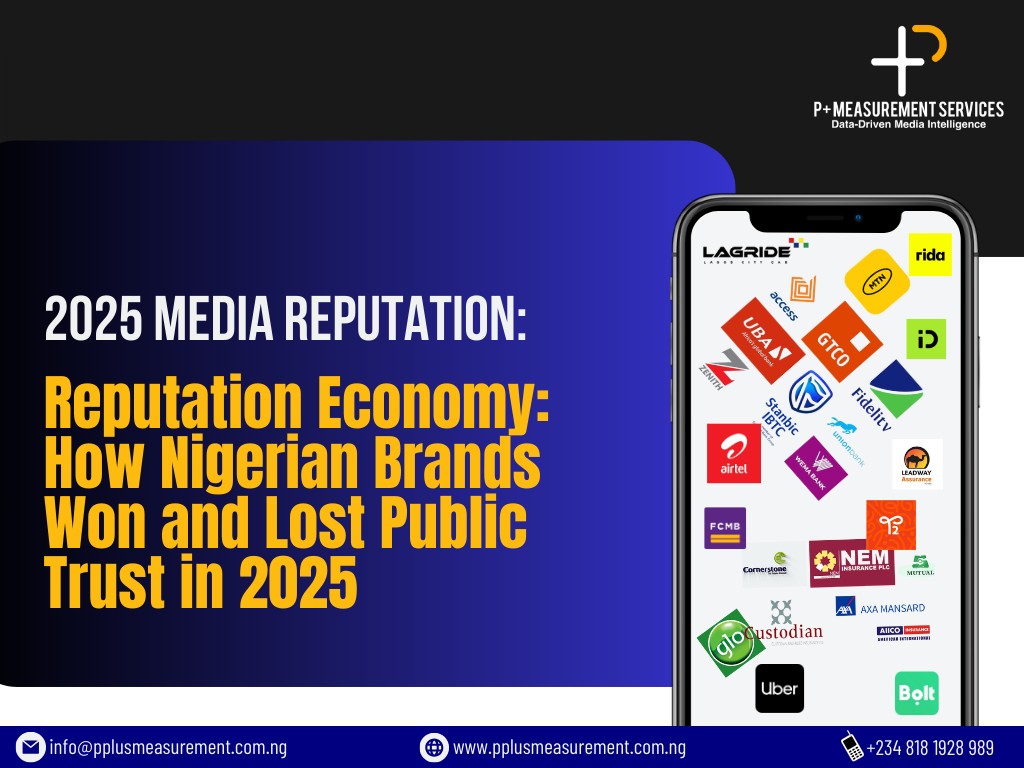
Nigeria’s leading independent media intelligence consultancy, P+ Measurement Services, has released its 2025 Industry Media Reputation Report, revealing that corporate reputation has emerged as one of the most decisive assets for Nigerian companies, rivaling financial performance and market share in shaping public trust.

The report analysed and audited thousands of print and online news reports published in 2025 across the banking, insurance, telecommunications, and e-hailing sectors. In total, coverage of 29 commercial banks, 13 insurance companies, five e-hailing platforms, and four telecommunications operators was examined to determine how corporate actions translated into public perception.

According to the findings, rising operational costs, currency pressures, regulatory scrutiny, labour relations, and service reliability now directly influence how brands are judged in the media and by stakeholders.

“Reputation is no longer a soft outcome of publicity. It is a measurable business asset shaped by corporate behaviour, governance quality, customer experience, and crisis response,” said a Senior Analyst at P+ Measurement Services, Ms Tumininu Balogun.

She added, “For more than a decade, we have been at the forefront of media intelligence in Nigeria. Our commitment to the PR and communications industry is to ensure that reliable media data and actionable insight are always available, so professionals can move beyond intuition and make truly data-driven decisions.”

E-Hailing Industry: Driver Relations Reshaped Corporate Reputation

The e-hailing sector recorded one of the clearest shifts in reputation dynamics in 2025, driven largely by labour policies and platform economics.

inDrive Nigeria led the sector with 39% of positive reputation share, following extensive media coverage of its decision to reduce driver commission to 0.1% during peak hours in Abuja. Bolt Nigeria followed with 32%, supported by reports on its electric tricycle deployment in Lagos. LagRide recorded 17%, driven by coverage of its electric vehicle infrastructure partnership, while Uber Nigeria accounted for 11% and Rida 1%.

On the negative reputation scale, Bolt recorded the highest share at 40%, linked to driver protests following fare reduction policies. Uber accounted for 29%, inDrive 20%, LagRide 8%, and Rida 3%, largely associated with reports on strike threats, platform reliability concerns, and driver earnings disputes.

The report notes that how platforms treat drivers has become as influential to reputation as rider experience.

Banking Industry: Profitability Confronted by Governance Risk

Among commercial banks, Stanbic IBTC recorded the strongest positive reputation position at 26%, driven by recognition as KPMG’s top retail bank. Zenith Bank followed with 22%, supported by dividend payout coverage. Fidelity Bank (19%), UBA (17%), and FirstBank (16%) gained positive reputation visibility through education initiatives, digital service upgrades, and branch automation projects.

However, reputational exposure remained significant. GTCO recorded the highest negative reputation share at 28%, followed by FirstBank at 26%, FCMB at 18%, and both UBA and Ecobank at 14%, mainly due to media reports concerning legal disputes, fraud investigations, and customer-related controversies.

The report highlights that in the banking sector, strong earnings and digital innovation strengthen reputation, but governance failures can rapidly undermine it.

Insurance Industry: Financial Stability and Data Protection Define Trust

In the insurance sector, AXA Mansard led positive reputation share with 36%, followed by Leadway Assurance (29%), AIICO (16%), NEM Insurance (11%), and SanlamAllianz (8%).

AXA Mansard also accounted for the highest negative reputation exposure at 68%, driven by reports of a significant decline in pre-tax profit. AIICO recorded 18%, Leadway 12%, and NEM 2%, largely connected to regulatory matters and data protection concerns, including coverage of customer data breaches.

The findings indicate that insurers are now judged as much by financial resilience and cybersecurity posture as by product offerings.

Telecommunications Industry: Infrastructure Investment Meets Rising Public Expectations

MTN Nigeria led positive reputation share with 47%, driven by infrastructure expansion narratives and innovation campaigns. Glo followed with 28%, Airtel Nigeria with 16%, and T2 (formerly 9mobile) with 9%, largely supported by its rebranding coverage.

On the negative reputation side, MTN recorded 44%, T2 31%, Glo 13%, and Airtel 12%, influenced by reports on service quality challenges and the Nigeria Labour Congress boycott directive targeting telecommunications operators.

The sector’s results suggest that while capital investment enhances visibility, network reliability and customer experience increasingly determine long-term reputation.

Reputation Has Become a Strategic Business Asset

Across all four industries, the report finds a consistent pattern: reputation in 2025 closely followed corporate behaviour.

Brands that demonstrated transparency, operational fairness, financial discipline, digital reliability, and customer focus were more likely to build positive public trust. Companies facing labour unrest, legal disputes, regulatory sanctions, data breaches, or service disruptions saw these issues rapidly reflected in their reputation profile.

For brand owners, investors, regulators, and communication professionals, the implication is clear: reputation is no longer managed only through messaging, but through measurable actions that are permanently recorded in the media ecosystem and searchable online.


Click to comment

Leave a Reply

Your email address will not be published. Required fields are marked *

Brands/Products

How Clearer Product Visuals Help Small e-Commerce Brands Look More Trustworthy

Published

on

clearer product visuals

A friend of mine runs a small online shop that sells handmade ceramics. Like many independent sellers, she does almost everything herself. She makes the products, photographs them and packs every order.

Hiring the professional photographer has never really fit her budget. So, she relies on her phone for product photography.

Her shop had been running smoothly, but the momentum behind sales seemed to have slowed. She wasn’t getting negative feedback, yet she felt more people were visiting the site than actually buying. She assumed pricing or competition was the problem, and asked me to take a look.

After spending some time browsing her store, one thing stood out right away.

Products themselves looked beautiful—the photos didn’t do them justice. 

Some images appeared slightly soft, while others had a warm yellow tint from indoor lighting. A few close-up shots didn’t capture the texture of the glaze that made each piece unique.

Once I pointed it out, she admitted she had noticed the same issues but didn’t think they mattered much.

Her view was simple: if the product was good, customers would see that eventually. But that is actually not true.

Why product visuals matter more than most sellers expect

When customers shop online, product photography carries most of the weight.

Shoppers typically decide in seconds whether to stay on a page or move on. The images that appear flat, inconsistent, or poorly lit can undermine trust in the entire store, regardless of how strong the actual products are.

Professional brands put a lot of money into product photography, and editing to keep every image looking consistent. Most independent sellers don’t have those resources. So, they depend on a phone camera, available daylight, and a simple home setup.

This was exactly the situation with my friend’s products. They looked great in real life, but put next to other products, her photos made them look like low-quality items.

Testing a different approach

Instead of reshooting everything, she started with what was already live on her site.

She picked a few product images that represented her main listings. Two were ceramic mugs taken on a cloudy day near a window. Lighting in these shots was flat, and the colors were greyish. The glazing, which appeared richer in reality, was somewhat less vivid in the photographs.

Another image was a bowl shot under warm kitchen lighting. That one had the opposite issue. The tone shifted too yellow, which made the white glaze look closer to cream instead of neutral white.

She ran the mug photos through Wink’s AI image enhancer to see if they could be improved without changing the actual product or reshooting anything.

There were no dramatic differences in a flashy way, but we noticed a change when the two were compared. There was an improvement in the balance of colors, and the grey tone decreased.

The surface texture of the glaze also became easier to see, which mattered because that texture is part of what makes handmade ceramics appealing.

The other bowl photo improved in a similar way.

The warm cast pulled back toward something neutral. Small details that were slightly lost before became easier to notice.

We first came across Wink while looking for simple tools that could help my friend improve the photos on her ceramic store without needing a full reshoot. The early results were good enough that she decided to update more of her product catalog.

A simple workflow that worked for her

Comparing the outcome of her efforts, she did not want to overthink things. She concentrated on the items which had the most clicks instead of trying to edit everything else.

First, she worked on the main pictures making the colors accurate without making anything blurry or dark because of improper lighting. Next, she improved several short videos in order for customers to see how the glaze looked.

Before replacing the images on her store, she compared the updated versions with the originals on both her phone and laptop. The changes were subtle, but the product pages felt much more consistent.

The biggest benefit wasn’t that the products suddenly looked different.

They looked more like they did in real life.

The handmade details were easier to see, the colors felt more accurate, and the overall presentation gave the store a more polished appearance. She also avoided spending another weekend photographing products she’d already shot once.

Who should actually try this

  • Etsy and Shopify sellers: If you take your own photos, this is the quickest upgrade you can make. Product pages look better. Ads look better. Social posts look better.
  • Dropshippers and POD brands: Supplier photos are often low-res or inconsistent. Clean them before use. Your store will look more original.
  • Marketers running UGC ads: Creator videos are gold, but often noisy or soft. Quick cleanup makes them ad-ready without a re-shoot.
  • Makers with archives: Have 2020 product photos that still get traffic? Enhance them instead of re-shooting discontinued SKUs. This isn’t for luxury brands with art directors. It’s for the rest of us.

The takeaway for small brands

Buyers don’t read first. They look.

If your visuals are blurry, dark, or inconsistent, you lose sales before the description loads. You don’t need a studio. You need your current assets to be clear.

Wink makes that practical. It took my “amateur” mug photo and made it professional enough to sell. No new gear. No learning curve.

Test it on your worst product image. For a small business without a studio or a large budget, that’s a practical improvement worth making.

Continue Reading

Brands/Products

5 Ways to Build Your Side Hustle in Nigeria with Gemini

Published

on

Gemini Spark

Nobody in Nigeria runs just one hustle. There’s the job that pays the bills, the small business that’s meant to be your way out, and a phone that never stops buzzing with “I’m interested, how much?” You’re the founder, the customer service, the person who chases the dispatch rider and the accountant, all before lunch. The dream is still there. It’s just buried under 47 unread messages and a spreadsheet you’ve been avoiding since March.

You don’t have to keep doing all of this by hand. AI has become the kind of co-founder most of us could never afford to hire, and Gemini can take the boring, heavy work off your plate so you can spend your time on the part that matters, building something people actually want to buy. You don’t need funding to start. Here are five ways to put it to work.

1. Take your idea from a dream to a business plan.

Starting a business often begins with a single idea, but managing the messy explosion of thoughts that follows can be tough. Instead of scattering your notes across different places, brain dump your idea into a notebook in the Gemini app. Process your thoughts out loud, then add links, files, and other reference materials. Gemini will structure your vision, creating a central command centre that grows alongside your business.

As your side hustle grows, graduate to business notebooks — a centralised hub to organise workflows and chats alongside your website and Google Business Profile. Grounded in your context, Gemini proactively surfaces critical action items, like unanswered customer questions, and recommends tailored updates to keep you ahead.

2. Research the Nigerian market in minutes.

Don’t just guess, know your audience. Use Gemini to generate reports on competitors in your specific city or industry. Gemini’s Deep Research feature compresses hours of work into minutes. (Think of it like a personal research assistant.) Ask it to generate a report on your competitors or markets you can target. It can browse hundreds of sources, track down facts and synthesise emerging trends, giving you professional analysis in a snap.

3. Define your brand aesthetic.

Nigerian Gen Zs are redefining success through creativity, and Gemini is the perfect partner to build a standout brand on any budget. Drop your products into high-end backdrops, craft eye-catching typography, or make your own cinematic video ads. You’ll have consistent, professional-grade visuals for web pages and social posts in seconds.

Connect apps like Canva to use the assets you made in Gemini in creative layouts or social drafts without switching workspaces. You can also use Pomelli from Google Labs to build your core Business DNA, and use this to create a comprehensive brand book or stand up a complete website in just a few clicks.

4. Put your logistics on autopilot.

Managing a side gig while studying or working full-time is a struggle. Use Gemini Spark to act as your personal AI agent that runs 24/7. You can set instructions like: “Whenever I get a WhatsApp or email inquiry about my services, extract the client’s details and store them in my tracker.” It handles the heavy lifting so you can focus on making sales.

Gemini Spark acts as your personal AI agent that runs in the background 24/7 — even when your laptop and phone are turned off. Instead of logging data manually, you can connect your tools and apps and let Spark handle the heavy lifting. For example, you can set an ongoing instruction, like: “Whenever I get an email asking about my services, automatically extract the client’s details, store them in my ‘Client Tracker’ Google Sheet, and create a new dedicated folder for them in Google Drive.”

Gemini Spark is available to Google AI Ultra subscribers globally.

5. Know when your price is right.

With fluctuating costs, pricing correctly is survival. Input your material costs, delivery fees, and platform charges into Gemini to find your break-even point. It can help you model different tiers to see how to maintain your bottom line while staying attractive to your local customers.

Once your business is up and running, you can transform your decisions by grounding them in real data. Just upload your spreadsheets to Gemini to uncover hidden trends, generate personalised recommendations, and build a custom, interactive tool that helps you visualise the impact of potential decisions on your bottom line.

Continue Reading

Brands/Products

Lagos Grocery Startup GoLemon Winds Down After Funding Struggles

Published

on

GoLemon

By Adedapo Adesanya

GoLemon, a Lagos-based grocery delivery startup known for offering bulk household shopping at prices below those of traditional supermarkets, has announced it is shutting down after failing to secure additional funding.

The company has stopped accepting new orders and will permanently close its customer support channels on August 2, bringing an end to a business that sought to make grocery shopping more affordable and convenient for Lagos residents.

In a farewell blog post titled Thank You, Lagos, the startup expressed gratitude to its customers, employees, investors and partners for supporting its journey.

“We set out to help Lagosians save money on groceries without sacrificing convenience, and every order, referral and message of encouragement made that mission worthwhile,” the company said in the statement.

GoLemon, which was founded in 2024, said it would honour outstanding customer obligations, including refunds where applicable, as it winds down operations.

The company added that the decision was not made lightly but followed months of efforts to secure fresh capital to sustain and grow the business.

Founded to tackle the high cost of grocery shopping in Nigeria, GoLemon differentiated itself by sourcing products in bulk and passing cost savings on to consumers while offering home delivery across Lagos.

The startup gained traction among households seeking an alternative to traditional supermarkets amid rising food inflation.

Despite attracting a loyal customer base, GoLemon said the increasingly difficult fundraising environment made it impossible to continue operating.

The closure underscores the growing challenges facing African startups as venture capital funding remains subdued and investors become more selective.

Several technology companies across the continent have been forced to scale back operations, merge with rivals or shut down entirely as they struggle to achieve profitability and raise follow-on funding. Recently, FoodCourt temporarily stopped operations as it couldn’t fulfil its debt obligations.

Before announcing its shutdown, GoLemon had continued expanding its services, including introducing next-day grocery delivery and promotional discounts aimed at growing its customer base. However, those efforts proved insufficient to overcome the funding constraints that ultimately led to the company’s closure.

Continue Reading