General
NIMASA Mulls Expansion of Nigeria’s Deep Blue Project
By Adedapo Adesanya
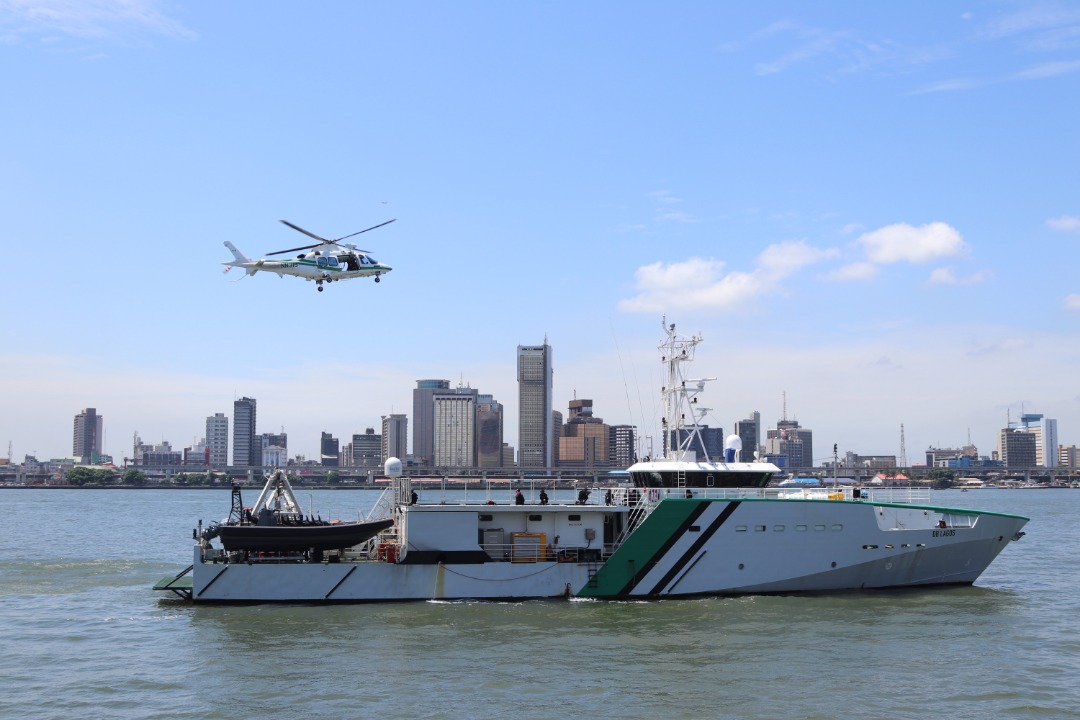
The Nigerian Maritime Administration and Safety Agency (NIMASA) is considering expanding the country’s Deep Blue Project due to its perceived success, with impact felt across the Gulf of Guinea, where it has helped to reduce piracy massively and gained global recognition, to ensure sustainability and greater impact.
The Director General of NIMASA, Mr Dayo Mobereola, made this known during his strategic visit to the Chief of Naval Staff, Vice Admiral Idi Abass, at the Naval Headquarters, Abuja.
Mr Mobereola, while commending the Navy for the harmonious collaboration with NIMASA and congratulating the CNS who had previously served as Maritime Guard Commander under the agency, called for continued partnership with the security outfit under his watch.
“It is important that we continue our partnership and strengthen our relationship. Our purpose here is to congratulate you and to discuss the benefits of the Deep Blue Project, how to sustain it, expand it, and increase its impact on the Gulf of Guinea.
“We are confident that we have the backing of the President, the Minister of Marine and Blue Economy, and the Nigerian Navy, hence, we are working towards presenting our proposal on the necessary improvements to be undertaken,” he stated.
The DG acknowledged the importance of the Deep Blue Project, noting that its impact resonates globally, with the International Maritime Organisation (IMO) commending it.
“The Deep Blue Project is vital, and countries around Africa and some other parts of the world are coming to copy our model. The IMO is asking how a civilian organisation was able to achieve this feat. It is therefore important that we continue to collaborate and do even better for greater sustainability,” he said.
Mr Mobereola also congratulated the Chief of Operations, Nigerian Navy, Rear Admiral Musa Katagum, who is joining the NIMASA governing board as the Navy’s representative.
On his part, the Chief of Naval Staff, Vice Admiral Idi Abass, while welcoming the NIMASA DG and his delegation, commended the Agency for the good work it is doing in the maritime sector and its continued support to the Nigerian Navy.
“Part of my command’s objective is to work in synergy with other agencies to achieve our goal as a country. We complement each other. We have no option but to collaborate and synergise.”
The Naval chief noted some concerns, which include the MoU between NIMASA and the Nigerian Navy, which has been in place since 2007 and should be revisited.
He also solicited for the Navy to be called upon for such needs as vessel repair, hydrographic surveys and chartings, stating the Navy’s capacity in handling such tasks.
The CNS also canvassed NIMASA’s assistance for wreck removal, particularly as the Navy gears towards its 70th Anniversary, where it looks forward to welcoming foreign ships.
He further commended NIMASA for its recent launch of the Cabotage Vessel Financing Fund (CVFF) Application Portal, noting that the organisation has come a long way in its planned disbursement of the fund.
General
FCCPC Calls for Stronger Product Safety Standards
By Adedapo Adesanya
The Federal Competition and Consumer Protection Commission (FCCPC) has tasked manufacturers, importers and service providers to prioritise product safety, warning that substandard goods threaten consumer trust and weaken Nigeria’s market system.
The commission issued the warning on Wednesday in Abuja on the back of the 2026 World Consumer Rights Day celebration and the 9th National Consumers Contest Awards, where regulators, industry stakeholders and consumer advocates gathered to review the state of consumer protection in the country.
The chief executive of the FCCPC, Mr Tunji Bello, said this year’s theme, Safe Products, Confident Consumers, highlights the direct connection between product safety and economic stability, adding that, “Where safety is uncertain, confidence declines. And where confidence declines, markets become weaker, less efficient, and less trustworthy.”
He expressed concern over persistent violations across sectors, noting that many products still fail to meet basic safety and quality benchmarks.
According to him, infractions include mislabelled goods, products that do not comply with minimum safety standards and, in some cases, deliberate disregard for regulatory requirements.
Mr Bello warned that such practices expose consumers to avoidable risks while creating unfair competition for businesses that comply with established rules.
Linking consumer protection to the federal government’s ongoing economic reforms under President Bola Ahmed Tinubu, Bello said strengthening regulatory compliance is essential to building transparent, investment-friendly markets.
“Consumer protection is a key part of that effort. Safe, reliable, and transparent markets support sustainable growth,” he said.
He reiterated that the Federal Competition and Consumer Protection Act (2018) guarantees consumers the right to safe, durable and fit-for-purpose products, stressing that businesses must promptly address safety concerns through product recalls, withdrawals and proper consumer notification.
The FCCPC boss warned that failure to comply, he warned, attracts regulatory sanctions.
Mr Bello disclosed that the FCCPC has expanded market surveillance operations, enhanced product testing capacity and intensified enforcement actions in priority sectors. He added that the Commission is strengthening collaboration with regulatory partners, including the Standards Organisation of Nigeria (SON) and the National Agency for Food and Drug Administration and Control (NAFDAC), to close enforcement gaps that allow unsafe products into the market.
Beyond enforcement measures, the FCCPC boss underscored the importance of consumer education, highlighting the role of the National Young Consumers Contest in promoting awareness and responsible purchasing behaviour among young Nigerians.
“Consumer protection is not only about enforcement. It is also about education, awareness, critical thinking, and responsible engagement,” Mr Bello said.
While clarifying that the FCCPC does not fix prices, he noted that transparency, fairness and adherence to safety standards remain fundamental to efficient market operations. He urged consumers to remain vigilant by examining products carefully and reporting unsafe or substandard goods.
The event drew participation from regulatory agencies, trade associations and media organisations, reinforcing calls for coordinated action to strengthen accountability across Nigeria’s marketplace.
“Safe and reliable markets depend on responsible business conduct, effective regulation, and informed consumer participation. That standard must be upheld consistently,” Mr Bello said.
General
$19k Bitcoin Fraud Gets Osamudiamen Ikilo Two-Year Imprisonment
By Modupe Gbadeyanka
One Mr Osamudiamen Philip Ikilo has been handed a two-year imprisonment for a Bitcoin fraud to the tune of $19,400.
He was found guilty and convicted of the crime by Justice W.I. Aziegbemhin of the Edo State High Court sitting in Benin City, the state capital.
Delivering the judgment on Monday, March 23, 2026, the judge sentenced Mr Ikilo to two years’ imprisonment without an option of fine.
The convict got into trouble when he offered to assist his victim, Ms Cynthia Imade Alile, to convert her 0.52092582 Bitcoin worth $19,400, but failed to remit the money after the conversion.
Ms Alile petitioned the Economic and Financial Crimes Commission (EFCC), which looked into the matter and brought him before the court for prosecution on a one-count charge of stealing.
“That you Osamudiamen Philip Ikilo (m) sometime in March 2024 within the jurisdiction of this court did steal Bitcoin worth the sum of $19,400 belonging to one Cynthia Imade Alile by fraudulently converting the said sum to your use, and thereby committed an offence contrary to Section 287 of the Criminal Law of Edo State Law 2022 and punishable under Section 294 of the same Law,” the charge read.
When the charge was read to him during arraignment by the EFCC, the defendant pleaded not guilty, setting the stage for trial.
In the course of the trial, prosecution counsel, A. S. Bala-Ribah, called two witnesses and also tendered documents which were admitted by the court. On his part, the defendant called two witnesses, including himself.
General
Court Affirms Seizure of $13m from Aisha Achimugu, Oceangate
By Adedapo Adesanya
Justice Emeka Nwite of the Federal High Court in Abuja has affirmed the final forfeiture of $13 million linked to a Lagos socialite, Ms Aisha Achimugu, and her company, Oceangate Engineering Oil & Gas Limited, to the federal government of Nigeria.
Delivering judgment, Justice Nwite held that the Economic and Financial Crimes Commission (EFCC) established that the foreign currency was proceeds of fraud and unlawful activities.
The judge further held that Oceangate Engineering Oil & Gas Limited failed to establish how it came by the money, saying the anti-money laundering agency satisfied all requirements for the funds to be classified as proceeds of fraud and to be forfeited to the appropriate authority.
He dismissed the claims that the $13 million was gifts received into the Oceangate Engineering Company by Ms Achimugu, adding that the woman never came to the court to show cause why the huge amount of money should not be forfeited to the government.
He held that no single person who gave the monetary gift to Aisha Achimugu to the tune of $13 million was called to testify.
The judge further held that the burden to establish genuine ownership of the money was not established by the applicant to counter the claims of the anti- graft agency that the money was the proceeds of fraud based on its investigation.
According to the judge, Oceangate Engineering Company did not show the business it undertook that fetched it the money, nor did it show whether any payment was made to it by any of its customers.
Justice Nwite had, on August 22, 2025, granted the anti-graft agency’s motion ex parte for an interim order forfeiting the sum of $13 million linked to Oceangate Ltd to the Federal Government over allegations that the fund was proceeds of unlawful activity.
The judge had then directed the commission to publish the order in a national daily for interested people to show cause within 14 days why the fund should not be permanently forfeited to the federal government.
-
Feature/OPED6 years agoDavos was Different this year
-
Travel/Tourism10 years ago
Lagos Seals Western Lodge Hotel In Ikorodu
-
Showbiz3 years agoEstranged Lover Releases Videos of Empress Njamah Bathing
-
Banking8 years agoSort Codes of GTBank Branches in Nigeria
-
Economy3 years agoSubsidy Removal: CNG at N130 Per Litre Cheaper Than Petrol—IPMAN
-
Banking3 years agoSort Codes of UBA Branches in Nigeria
-
Banking3 years agoFirst Bank Announces Planned Downtime
-
Sports3 years agoHighest Paid Nigerian Footballer – How Much Do Nigerian Footballers Earn