Connect with us

Feature/OPED

Iran-Israel-US Conflict and CBN’s FX Gains: A Stress Test for Nigeria’s Monetary Stability

Published

on

Nigeria’s Monetary Stability

By Blaise Udunze

At the 304th policy meeting held on Wednesday, the 25th February, the Central Bank of Nigeria’s (CBN) Monetary Policy Committee cut the rate by 50 basis points to 26.5 per cent from 27 per cent, which has been widely described as a cautious transition from prolonged tightening to calibrated easing. The CBN stated that the decision followed 11 consecutive months of disinflation. The economy witnessed headline inflation easing to 15.10 per cent in January 2026, and food inflation falling sharply to 8.89 per cent. Foreign reserves are climbing to $50.45 billion, their highest level in 13 years. The Purchasing Managers’ Index is holding at an expansionary 55.7 points.

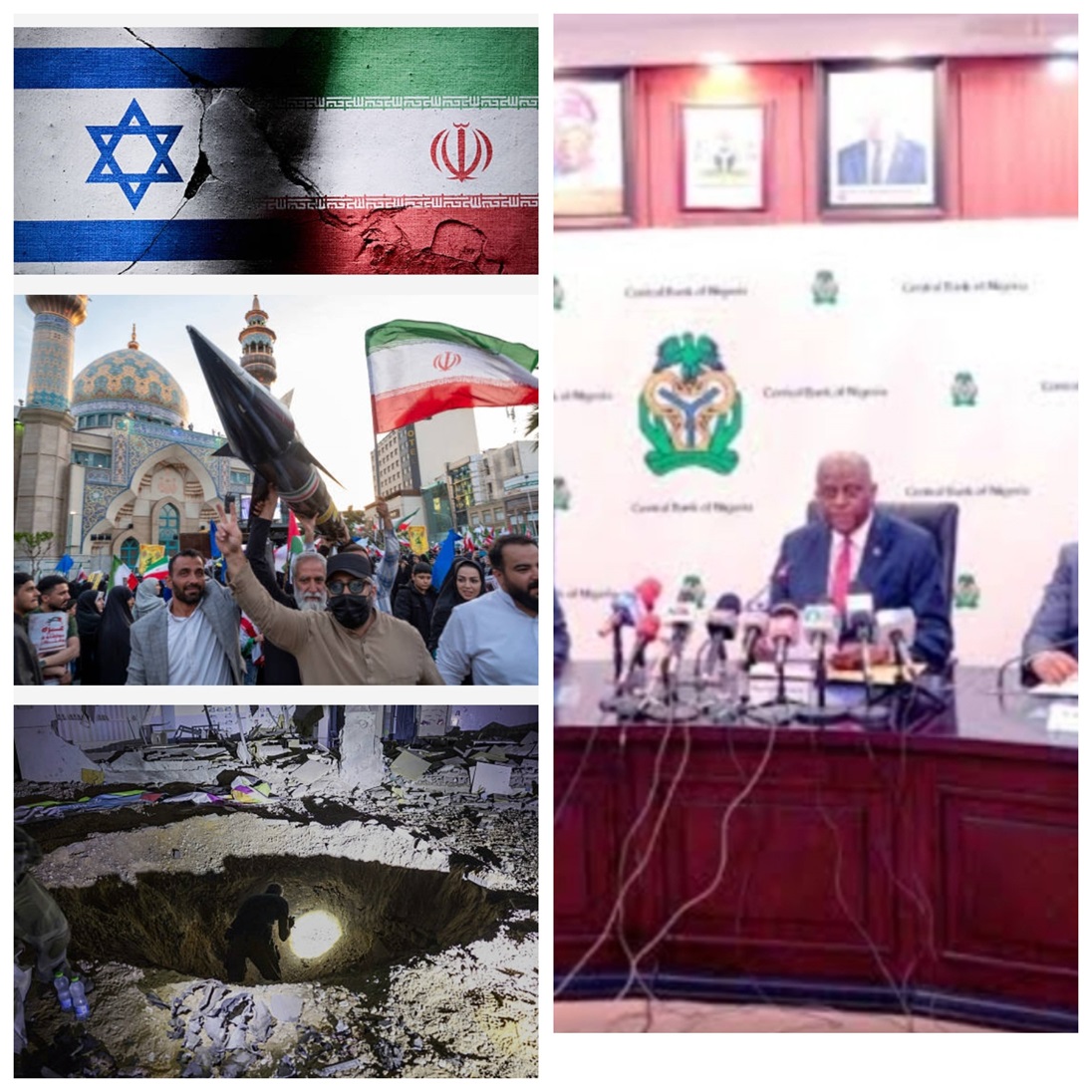
As reported in the paper, no doubt that the macroeconomic narrative appears encouraging. On a closer scrutiny, the sustainability of these gains is now being tested by forces far beyond the apex bank’s policy corridors. This is as a result of the clear, direct ripple effect of the escalating conflict between Iran and Israel, with direct military involvement from the United States, which has triggered one of the most significant geopolitical energy shocks in decades. For Nigeria, the timing is delicate. Just as the CBN signals confidence in disinflation and stability, global volatility threatens to complicate and possibly distort its monetary path.

The rate cut, though welcomed by many analysts, must be understood in context. Nigeria remains in an exceptionally high-rate environment. An MPR of 26.5 per cent is still restrictive by any standard. The Cash Reserve Ratio (CRR) remains elevated at 45 per cent for commercial banks, and this effectively sterilises nearly half of deposits, while liquidity ratios are tight, and lending rates to businesses often exceed 30 per cent once risk premiums are included. The adjustment is therefore incremental, not transformational.

The Director/CEO of the Centre for the Promotion of Private Enterprise (CPPE), Dr. Muda Yusuf, has repeatedly noted that Nigeria’s deeper challenge lies in weak monetary transmission. According to him, even when the benchmark rate falls, structural rigidities, high CRR, elevated deposit costs, macroeconomic uncertainty, and crowding-out from government borrowing prevent meaningful relief from reaching manufacturers, SMEs, agriculture, and other productive sectors. Monetary easing, without structural reform, risks becoming cosmetic. The point is that even before structural reforms take effect, the fact is that an external shock will first reshape the landscape.

The Iran-Israel conflict and US involvement have reignited fears in global energy markets. Joint U.S. and Israeli strikes on Iranian targets and retaliatory missile exchanges across the Gulf have unsettled oil traders. Brent crude, already rising in anticipation of escalation, surged toward $70-$75 per barrel and could climb higher if shipping through the Strait of Hormuz, through which nearly 20 per cent of global oil supplies pass, faces disruption. It is still an irony that a major crude exporter is also an importer of refined petroleum products.

Higher crude prices offer a theoretical windfall. For Nigeria’s economy, it is well known that oil remains its largest source of foreign exchange and accounts for roughly 50 per cent of government revenue. The good thing is that rising prices could boost reserves, improve forex liquidity, strengthen the naira, and ease fiscal pressures. In theory, this external cushion could support macroeconomic stability and reinforce the CBN’s easing posture.

However, the upside is constrained by structural weaknesses. Nigeria’s oil production remains below optimal capacity. A significant portion of crude exports is tied to long-term contracts, limiting immediate gains from spot price surges. As SB Morgen observed in its analysis, Nigeria’s “windfall” is volatile and limited by soft production performance.

More critically, Nigeria’s dependence on imported refined products exposes it to imported inflation. Rising global crude prices increase the cost of petrol, diesel, jet fuel and gas. With fuel subsidies removed, these increases are passed directly to consumers and businesses. Depot pump prices have already adjusted upward amid Middle East tensions.

Energy costs are a primary driver of Nigeria’s inflation, and this has remained sacrosanct. When fuel prices rise, transportation, logistics, food distribution, power generation, and manufacturing costs will definitely skyrocket, as well as the inflationary impulse spreads quickly through the economy. This will push households to face higher food and transportation costs. Businesses see shrinking margins. Real incomes erode.

Thus, the same oil shock that boosts government revenue may simultaneously reignite inflationary pressure, precisely at a moment when the CBN has begun cautiously easing policy.

This dynamic introduces a difficult policy dilemma, even as this could be for the fragile gains of the MPC. This is to say that if energy-driven inflation resurges, the CBN may be forced to pause or reverse its easing cycle. It is clearly spelt that high inflation typically compels tighter monetary conditions. As Yusuf warned, geopolitical headwinds that elevate inflation often push central banks toward higher interest rates. A renewed tightening would strain credit conditions further, undermining growth prospects.

There is also the risk of money supply expansion. Increased oil revenues, once monetised, can expand liquidity in the domestic system. Historically, surges in oil receipts have been associated with monetary growth, inflationary pressure, and exchange rate volatility. Without sterilisation discipline, a revenue boost could ironically destabilise macro fundamentals.

The exchange rate dimension compounds the complexity. Heightened geopolitical risk, just as it is currently playing out with the Iran-Israel conflict, often triggers global flight to safety. This will eventually lure investors to retreat to U.S. Treasuries and gold. Emerging markets face capital outflows. If it happens that foreign portfolio investors withdraw from Nigeria’s fixed-income market in response to global uncertainty, pressure on the naira could intensify.

Already, the CBN has demonstrated sensitivity to exchange rate dynamics by intervening to prevent excessive naira appreciation. A sharp rate cut in the midst of global volatility could destabilise carry trades and spur dollar demand. What should be known is that the 50-bps reduction reflects not just domestic disinflation, but global risk management such as geopolitical tensions, oil prices, and foreign investor sentiment.

Beyond macroeconomics, geopolitical implications carry security concerns. Analysts warn that a widening Middle East conflict could embolden extremist narratives across the Sahel and it directly has security consequences for Nigeria and the broader region. Groups such as Boko Haram and ISWAP may exploit anti-Western framing to recruit and mobilise more followers in the Sahel region, thereby giving the extremist groups new propaganda opportunities. The pebble fear is that a diversion of Western security resources away from West Africa could create regional vacuums. What the Nigerian economy will begin to experience is that security instability will disrupt agricultural output, logistics corridors, and investor confidence, feeding back into inflation and slow economic growth, and as ripple effects, the economy becomes weaker.

Nigeria’s diplomatic balancing act adds another layer of fragility because it is walking on a tactful tightrope. The country is trying not to upset anyone, but maintains cautious neutrality, urging restraint while preserving ties with Western allies and Middle Eastern partners. Yet rising tensions globally between major powers, including Russia and China, complicate the geopolitical chessboard. Invariably, this will have a direct impact as trade flows, remittances, and investment patterns may change unexpectedly, affecting Nigeria’s economy.

With the current conflict in the Middle East, the prospects for economic growth also face renewed strain or are under increased pressure. The stock markets in developed countries have been fluctuating a lot because people are worried that there will be problems with the energy supply. If the whole world does not grow fast, then people will use less oil over time. This means that the good things that happen to Nigeria because of oil prices will probably not last, and any extra money Nigeria gets from oil prices now will be lost. Nigeria will not get to keep the money from high oil prices for a long time. The oil prices will affect Nigeria. Then the effect will go away. One clear thing is that since Nigeria relies heavily on oil exports, this commodity dependence exposes the country to significant risk.

Meanwhile, Nigeria’s domestic fundamentals remain structurally challenged. The recapitalisation of banks, with 20 of 33 institutions meeting new capital thresholds, strengthens resilience, but does not guarantee credit expansion into productive sectors. Banks continue to prefer risk-free government securities over private lending in uncertain environments.

Fiscal discipline remains essential. Elevated debt service obligations absorb substantial revenue. Election-related spending poses upside inflation risks. This understanding must be adhered to, that without credible deficit reduction and revenue diversification, monetary easing may be undermined by fiscal expansion.

At the moment, given the current global and domestic uncertainties, the 50 per cent interest cut rate appears less like a pivot toward growth and more like a signal of cautious optimism under conditional stability. The policy decision is based on several key expectations with the assumptions that disinflation will persist, exchange rate stability will hold, and global conditions will not deteriorate dramatically.

But the Iran-Israel-U.S. conflict introduces uncertainty into all three assumptions, which is wrongly perceived as behind the rate cut that inflation will keep coming down, that the exchange rate will stay stable, and global conditions won’t worsen, are all undermined by the unfolding conflict.

If the global oil prices rise sharply and fuel becomes more expensive locally, overall prices in the economy could increase again, which means inflation could accelerate.  Another dangerous trend is that if foreign investors pull capital out of Nigeria, exchange rate stability could weaken, seeing the naira coming under pressure. If global growth slows, export earnings could decline. Each of these scenarios would constrain the CBN’s flexibility.

This is not to dismiss potential upsides. Higher oil prices, if production improves, could bolster reserves and moderate fiscal deficits. Forex liquidity could strengthen the naira. Investment in upstream oil and gas could gain momentum. Historically, crude price increases have correlated with improved GDP performance and stock market optimism in Nigeria.

Yet history also warns of volatility. A good example is during the 2022 Ukraine conflict, oil prices spiked above $100 per barrel, which created a potential revenue windfall for oil-exporting countries, but Nigeria struggled to translate that temporary advantage into sustained economic improvement. Inflation persisted. In the case of Nigeria, the deep-rooted systemic or structural weaknesses and inefficiency diluted the benefits that should have been gained.

The lesson is clear because temporary external windfalls or short-term luck cannot substitute for structural and deep internal economic reforms.

The point is that sustainable development demands diversification beyond oil, to strengthening multiple parts of its economy at the same time, such as improved refining capacity, infrastructure investment, agricultural security, logistics efficiency, and fiscal consolidation. Monetary policy, as the action taken by the CBN at the MPC meeting by adjusting interest rates or attempting to control money supply, can anchor expectations and moderate volatility, but it cannot build productive capacity; it will only help to reduce short-term economic swings.

The CBN’s decision to cut the interest rate appears cautious. It is not a bold shift but rather a small adjustment. This shows that the bank is being careful and optimistic about the economy. It also knows that there are still problems. The trouble in the Middle East, like the fighting that affects the oil supply, reminds the people in charge that Nigeria’s economy is closely tied to what happens with energy around the world. This includes things like inflation, the value of money, and how fast the economy grows.

Until structural reforms reduce dependence on volatile oil cycles and imported fuel, Nigeria’s monetary policy will remain reactive to external crises. To really make the economy strong and stable, Nigeria needs to make some changes.  It requires resilience against geopolitical storms.

The MPC has taken a step. Whether it marks a turning point depends less on 50 basis points and more on how Nigeria navigates a world increasingly defined by conflict-driven volatility.

Blaise, a journalist and PR professional, writes from Lagos and can be reached via: [email protected]

Click to comment

Leave a Reply

Your email address will not be published. Required fields are marked *

Feature/OPED

Creating Safer Digital Spaces is our Collective Responsibility

Published

on

Lilian Kariuki Safer Digital Spaces

By Lilian Kariuki

In the digital age, trust is our most valuable currency. Every click, comment, or share reflects a growing expectation that online spaces should be safe, fair, and accountable. When those expectations are not met, the consequences extend far beyond individual users, rippling through families, schools, and communities.

Across Africa, millions of young people now access the internet as a central part of their daily lives. It has become a portal for learning, creativity, entrepreneurship, and civic engagement. For many, the internet provides opportunities that were previously unimaginable: students can access global knowledge from a mobile device, young entrepreneurs can reach customers across borders, and Change Makers can share stories that would otherwise go unheard.

Alongside these opportunities, it is important to remember that online spaces also have their own challenges. With awareness and the right support, we can help ensure a positive and secure digital experience for everyone.

Safety online cannot be reactive; it must be proactive. It should be embedded in the design of policies, and reinforced by the guidance young people receive from parents, caregivers, educators, and communities. In practice, this means creating spaces where young people can explore, create, and learn with confidence, knowing that safeguards are in place and support is available when needed. It also requires equipping children with the skills to navigate digital spaces responsibly, evaluate information critically, and act with empathy.

This was one of the focus areas at the recently concluded TikTok Safer Internet Summit in Nairobi, where I had the privilege of speaking about the journey of successful collaboration in child online safety. The summit highlighted proactive steps TikTok is taking to engage teens responsibly and the importance of collaboration in shaping safety policies. The key takeaway was clear: creating safer digital spaces is a responsibility we all share, involving governments, civil society, educators, parents, and users themselves.

A key plus in such forums is the tangible advantage of big tech working closely with NGOs and regulators. These collaborations combine technological innovation and scale with on-the-ground expertise and policy insights. The result is practical progress that no single actor could achieve alone: building trust and amplifying impact tailored to Africa’s digitally vibrant community.

Africa presents unique opportunities and challenges in this regard. The region is experiencing some of the fastest rates of digital adoption in the world. Mobile-first connectivity allows young people to create, share, and connect like never before. Yet this rapid expansion has exposed gaps such as limited digital literacy, evolving child protection frameworks, and vulnerabilities to online exploitation. These challenges cannot be addressed by any single actor alone. Governments, civil society, educators, caregivers, and industry all have a role to play, and collaboration is essential.

Practical safety measures are critical, while platforms and policymakers must prioritise protections that are accessible, clear, and enforceable. Parents and caregivers must be aware of what children are doing online and equipped to guide them without restricting creativity or independence. Schools and governing bodies should integrate digital literacy into school curricula, teaching young people not only how to use technology but how to navigate it safely, ethically, and thoughtfully.

But online safety is about more than policies and tools; it’s also about culture. Every interaction online contributes to the environment in which children live. Respect, empathy, and accountability are as critical as any technical safeguard. When communities collectively uphold these values, digital spaces become not just safer but more supportive, inclusive, and empowering.

The stakes are high as young people who cannot trust the digital world may miss opportunities for education, entrepreneurship, and civic engagement. Families may hesitate to allow their children to access technology, and communities may struggle to harness the benefits of connectivity. But when trust is earned and safety is embedded, the digital world becomes a space for growth, creativity, and an opportunity for African voices and stories to be heard globally.

The future of digital Africa depends on the choices we make today. By treating online safety as a priority, not an afterthought, we can build spaces where young people can thrive, exploring, creating, and engaging without fear. If we act collectively, we can ensure that the digital world becomes a space that is not only innovative and open but safe, fair, and empowering for our future generations.

Lilian Kariuki is the Executive Director for Watoto Watch Network & Member of TikTok SSA Safety Advisory Council

Continue Reading

Feature/OPED

What Tech Leaders Should Know About IP Contract Strength

Published

on

software escrow services

Technology leaders operate at the intersection of innovation, risk, and long-term strategy. As organisations rely more heavily on proprietary platforms, custom software, and licensed technologies, intellectual property contracts become critical business instruments rather than routine legal documents. The strength of these contracts often determines how well a company can protect its innovations, maintain leverage in vendor relationships, and respond to unexpected disruptions.

Strong IP contracts do more than define ownership. They shape accountability, continuity, and trust between parties. For executives and decision makers, understanding what makes an IP agreement resilient is essential to safeguarding both current operations and future growth. Without careful attention, even advanced technology investments can become sources of vulnerability rather than competitive advantage.

Understanding the Role of Intellectual Property in Technology Strategy

Intellectual property sits at the core of most modern technology initiatives. Whether software is developed in-house, licensed from a third party, or built collaboratively, the associated IP defines who controls usage, modification, and distribution. Contracts must clearly reflect how this property aligns with broader business objectives rather than treating IP as a secondary concern.

Tech leaders should evaluate how critical a given technology is to daily operations and customer delivery. The more central the system, the stronger and more precise the IP protections must be. Ambiguous ownership language or overly restrictive licensing terms can limit scalability and innovation. When contracts mirror strategic priorities, they support flexibility rather than constrain it.

Clarity in Ownership and Licensing Provisions

One of the most common weaknesses in IP contracts is unclear ownership language. Agreements should explicitly define which party owns the underlying code, derivative works, and future enhancements. This clarity becomes especially important in custom development arrangements where responsibilities and contributions may overlap.

Licensing provisions must also specify scope, duration, and permitted use. Vague language around usage rights can lead to disputes or unexpected limitations as a business grows or enters new markets. Strong contracts anticipate change and outline how rights evolve alongside business expansion. This level of detail helps prevent costly renegotiations later.

Protecting Access and Continuity Rights

Beyond ownership, access to technology assets is a major concern for leadership teams. If a vendor relationship ends abruptly or a provider becomes unable to perform, access restrictions can disrupt operations. IP contracts should address these risks through well-defined continuity provisions.

In some cases, software escrow services are incorporated to support access to essential materials under specific conditions. While not required in every agreement, mechanisms like this reflect a broader principle of resilience. Tech leaders should ensure that contracts account for worst-case scenarios without undermining productive partnerships. Protection and collaboration are not mutually exclusive when agreements are thoughtfully structured.

Aligning IP Protections with Compliance and Governance

Regulatory compliance and internal governance standards increasingly influence how IP contracts are drafted and enforced. Industries subject to strict data, security, or operational requirements cannot rely on generic contract templates. IP provisions must align with regulatory obligations and internal risk management frameworks.

Leadership teams should collaborate with legal, compliance, and security stakeholders to ensure contracts reflect current standards. This includes addressing data handling, audit rights, and reporting obligations tied to intellectual property usage. When IP contracts support governance objectives, they reduce exposure and demonstrate due diligence to regulators and investors alike.

Managing Disputes and Enforcement Effectively

Even the strongest contracts cannot eliminate the possibility of disagreement. What distinguishes effective IP agreements is how disputes are managed when they arise. Clear dispute resolution clauses provide predictable processes that minimise disruption and preserve working relationships when possible.

Contracts should outline jurisdiction, governing law, and escalation procedures in plain language. Overly complex enforcement mechanisms can delay resolution and increase costs. For tech leaders, the goal is not to prepare for conflict but to ensure that disagreements do not derail core business functions. Well-designed enforcement terms contribute to operational stability.

Planning for Evolution and Innovation

Technology rarely remains static, and IP contracts must evolve accordingly. Agreements should address how updates, integrations, and new use cases are handled over time. Without these provisions, innovation may be slowed by uncertainty or restrictive terms.

Forward-looking contracts recognise that today’s solution may serve tomorrow’s expanded role. By defining how enhancements are owned, licensed, and shared, organisations encourage innovation while preserving control. Tech leaders who prioritise adaptability in IP agreements position their companies to respond confidently to change.

Conclusion

IP contract strength is a strategic concern that extends far beyond legal formalities. For technology leaders, these agreements influence resilience, innovation, and long-term value creation. By focusing on clarity, continuity, compliance, and adaptability, organisations can transform IP contracts into tools that support growth rather than obstacles that limit it. Strong agreements reflect thoughtful leadership and a clear vision for how technology powers the business forward.

Continue Reading

Feature/OPED

REVEALED: How Nigeria’s Energy Crisis is Driven by Debt and Global Forces

Published

on

Nigeria’s Energy Crisis

By Blaise Udunze

For months, Nigerians have argued in circles. Aliko Dangote has been blamed by default. They have accused his refinery of monopoly power, of greed, of manipulation. They have pointed out the rising price of petrol and demanded a villain.

When examined closely, the truth is uncomfortable, layered, and deeply geopolitical because the real story is not at the fuel pump, and this is what Nigerians have been missing unknowingly. The truth is that the real story is happening behind closed doors, across continents, inside financial systems most citizens never see, and the actors will prefer that the people are kept in the dark. And once you see it, the outrage shifts. The questions deepen. The implications expand far beyond Nigeria.

In October 2024, it was obvious that the world would have noticed that Nigeria made a move that should have dominated global headlines, but didn’t. Clearly, this was when the government of President Bola Tinubu introduced a quiet but radical policy, which is the Naira-for-Crude. The idea was simple and revolutionary. Nigeria, Africa’s largest oil producer, would allow domestic refineries to purchase crude oil in naira instead of U.S. dollars. On the surface, it looked like economic reform. In reality, it was something far more consequential. It was a challenge to the global financial order.

For decades, oil has been traded almost exclusively in dollars, reinforcing the dominance of the United States in global finance. By attempting to refine its own oil using its own currency, Nigeria was not just making a policy adjustment. It was testing the boundaries of economic sovereignty. And in today’s world, sovereignty, especially when it touches money, debt, and energy, comes with consequences.

What followed was not loud. There were no emergency broadcasts or dramatic policy reversals. Instead, the response was quiet, bureaucratic, and devastatingly effective just to undermine the processes. Nigeria produces over 1.5 million barrels of crude oil per day, though pushing for 3 million by 20230, yet when the Dangote Refinery requested 15 cargoes of crude for September 2024, what it received was only six from the Nigerian National Petroleum Company Ltd (NNPC), which means its yield for a refinery with such capacity will be low if nothing is done. Come to think of it, between January and August 2025, Nigerian refineries collectively requested 123 million barrels of domestic crude but received just 67 million, which by all indications showed a huge gap. It is a contradiction and at the same time, laughable that an oil-producing nation could not supply its own refinery with its own oil.

So, where was the crude going? The answer exposes a deeper, more uncomfortable truth about Nigeria’s economic reality. The crude was being sold on the international market for dollars. Those dollars were then used, almost immediately, to service Nigeria’s growing mountain of external debt. Loans owed to the same institutions, like the International Monetary Fund (IMF) and the World Bank, had to be paid, which are the same institutions applauding this government. Nigeria was not prioritising domestic industrialisation; it was prioritising debt repayment.

And the scale of that debt is no longer abstract. Nigeria’s total debt stock is now projected to rise from N155.1 trillion to N200 trillion, following an additional $6 billion loan request by President Tinubu, hurriedly approved by the Senate. At an exchange rate of N1,400 to the dollar, that single loan adds N8.4 trillion to a debt stock that already stood at N146.69 trillion at the end of 2025. This is not just a fiscal statistic. It is the central pressure shaping every major economic decision in the country.

On paper, the government can point to rising revenue, improving foreign exchange inflows, and stronger fiscal discipline as witnessed when the governor of the Central Bank of Nigeria, Olayemi Cardoso, always touted the foreign reserves growth. But a closer review of those numbers reveals a harsher reality. Nigeria is exporting its most valuable resource, converting it into dollars, and sending those dollars straight back out to creditors. The crude leaves. The dollars come in. The dollars leave again. And the cycle repeats.

This is not growth. This is a treadmill powered by debt. Let us not forget that in the middle of that treadmill sits a $20 billion refinery, built to solve Nigeria’s energy dependence, now trapped within the very system it was meant to escape.

By 2025, the contradiction had become impossible to ignore, which is a fact. This is because how can this be explained that the Dangote Refinery, designed to reduce reliance on imports, was increasingly dependent on them. The narrative is that in 2024, Nigeria imported 15 million barrels of crude from America, which is disheartening to mention the least. More troubling is that by 2025, that number surged to 41 million barrels, a 161 per cent increase. By mid-2025, approximately 60 per cent of the refinery’s feedstock was coming from American crude. As of early 2026, Nigerian crude accounted for only about 30 to 35 per cent, which was actually confirmed by Aliko Dangote.

The visible contradiction in this situation is that the refinery built to free Nigeria from dollar dependence was running largely on dollar-denominated imports. Not because the oil did not exist locally, but because the system, shaped by debt obligations and global financial structures, made it more practical to export crude for dollars than to refine it domestically, which leads us to several other covert concerns.

Faced with this troubling reality, there is one major issue that still needs to be answered. This is why Dangote pushed back by filing a N100 billion lawsuit against the NNPC and major oil marketers. He further accused the parties involved of failing to prioritise domestic refining. For a brief moment, one will think that the confrontation, as it appeared, was underway is one that could redefine the balance between state control and private industrial ambition, but these expectations never saw the light of day.

Yes, it never saw the light of day because on July 28, 2025, the lawsuit was quietly withdrawn. No press conferences. No public explanation. No confirmed settlement. Just silence.

There are only a few plausible or credible explanations. As a practice and well-known in the country, institutional pressure may have made continued confrontation untenable. A strategic compromise may have been reached behind closed doors. Or the realities of the system itself may have made victory impossible, regardless of the merits of the case. None of these scenarios suggests a system operating with full autonomy or aligned national interest. All of them point to constraints, political, economic, or structural, that extend far beyond a single company.

Then came the shock that changed everything.

On February 28, 2026, Iran closed the Strait of Hormuz, disrupting a channel through which roughly 20 per cent of the world’s oil supply flows. Prices surged past $100 per barrel. Global markets entered crisis mode. Supply chains are fractured. Countries dependent on Middle Eastern fuel suddenly had nowhere to turn.

And they turned to Nigeria. Nations like South Africa, Ghana, and Kenya began seeking fuel supplies from the Dangote Refinery. The same refinery that had been starved of crude, forced into dollar-denominated imports, and entangled in domestic disputes suddenly became the most strategically important energy asset on the African continent.

Nigeria did not plan for this. It did not negotiate for this. With this development, the world had no choice but to simply run out of options, and Lagos became the fallback.

And then, almost immediately, attention shifted. This swiftly prompted, in early 2026, a United States congressional report to recommend applying pressure on Nigeria’s trade relationships within Africa. Shortly after, on March 16, 2026, the United States launched a Section 301 trade investigation into multiple economies, including Nigeria. This is not a sanction, but it is the legal foundation for one. At the same time, the African Growth and Opportunity Act, which had provided duty-free access to U.S. markets for decades, was allowed to expire in 2025 without renewal.

The sequence is difficult to ignore. As Nigeria’s strategic importance rose, so did external scrutiny. As its potential for regional energy leadership increased, so did the instruments of economic pressure.

To understand why, you must look at the system itself. The global economy runs on the U.S. dollar, which the Iranian government tried to scuttle by implementing a policy that requires oil cargo tankers being transported via the Strait of Hormuz to be paid in Yuan. Most countries need dollars to trade, to import essential goods, and to access global markets. The infrastructure that enforces this is the SWIFT financial network, which connects banks across the world. Control over this system confers enormous power. Countries that step too far outside it risk exclusion, and exclusion, in modern terms, means economic paralysis.

Nigeria’s attempt to trade crude in naira was not just a policy experiment. It was a subtle deviation from a system that rewards compliance and punishes independence. The response was not military. It did not need to be. It was structural. Limit domestic supply. Reinforce dollar dependence. Ensure that even attempts at independence remain tethered to the existing order.

And all the while, the debt clock continues to tick. N155.1 trillion.

That number is not just a fiscal burden. It is leverage. It shapes policy. It influences decisions, and it also determines priorities, which tells you that when a nation is deeply indebted, its room to manoeuvre shrinks. In all of this, one thing that must be understood is that choices that might favour long-term sovereignty are often sacrificed for short-term stability. Debt does not just demand repayment. It demands alignment.

Back home, Nigerians remain focused on the most visible symptom, which is fuel prices. Unbeknownst to most Nigerians, they argue, protest, and assign blame while the forces shaping those prices include global currency systems, sovereign debt obligations, trade pressures, and geopolitical realignments. The price at the pump is not the cause. It is the consequence.

Nigeria now stands at an intersection defined not by scarcity, but by contradiction. What is more alarming is that it produces vast amounts of crude oil, yet struggles to supply its own refinery. It earns more in dollar terms, yet its citizens feel poorer. It builds infrastructure meant to ensure independence, yet operates within constraints that reinforce dependence. This is not a failure of resources, and this is because there is a conflict or tension between what Nigeria wants, which reflects its ambition and structure, and between sovereignty and obligation.

And so the questions remain, growing louder with each passing month and might force Nigerians, when pushed to the wall, to begin demanding answers. If Nigeria has the oil, why is it importing crude? Further to this dismay, more questions arise, such as, why is the refinery paying in dollars if Naira-for-crude exists? One will also be forced to ask if the lawsuit had merit, why was it withdrawn without explanation? If revenues are rising, why is hardship deepening? And if Nigeria is merely a developing economy with limited influence, why is it attracting this level of global attention?

These are not abstract questions. They are the pressure points of a system that extends far beyond Nigeria’s borders.

Because this story is no longer just about one country. The reality is that, perhaps unbeknownst to many, it is about the future of African economic independence. It is about the structure of global energy markets, the dominance of the dollar and the role of debt in shaping national destiny. Honestly, the question that comes to bear is that if Nigeria, with all its resources and scale, cannot fully align its production with its domestic needs, what does that imply for the rest of the continent?

The next time the conversation turns to petrol prices, something must shift. Because the number on the pump is not where this battle is being fought. It is being fought in allocation decisions, in debt negotiations, in regulatory frameworks, in international financial systems, and in quiet policy moves that rarely make headlines.

The Dangote Refinery is not just an industrial project. It is a test case. A test of whether a nation can truly control its own resources in a world where power is rarely exercised loudly, but always effectively. And right now, that test is still unfolding.

Blaise, a journalist and PR professional, writes from Lagos and can be reached via: [email protected]

Continue Reading

Trending