Economy
Nigeria’s Gold Holdings Rise to $3.5bn as CBN Diversifies Reserves
By Adedapo Adesanya
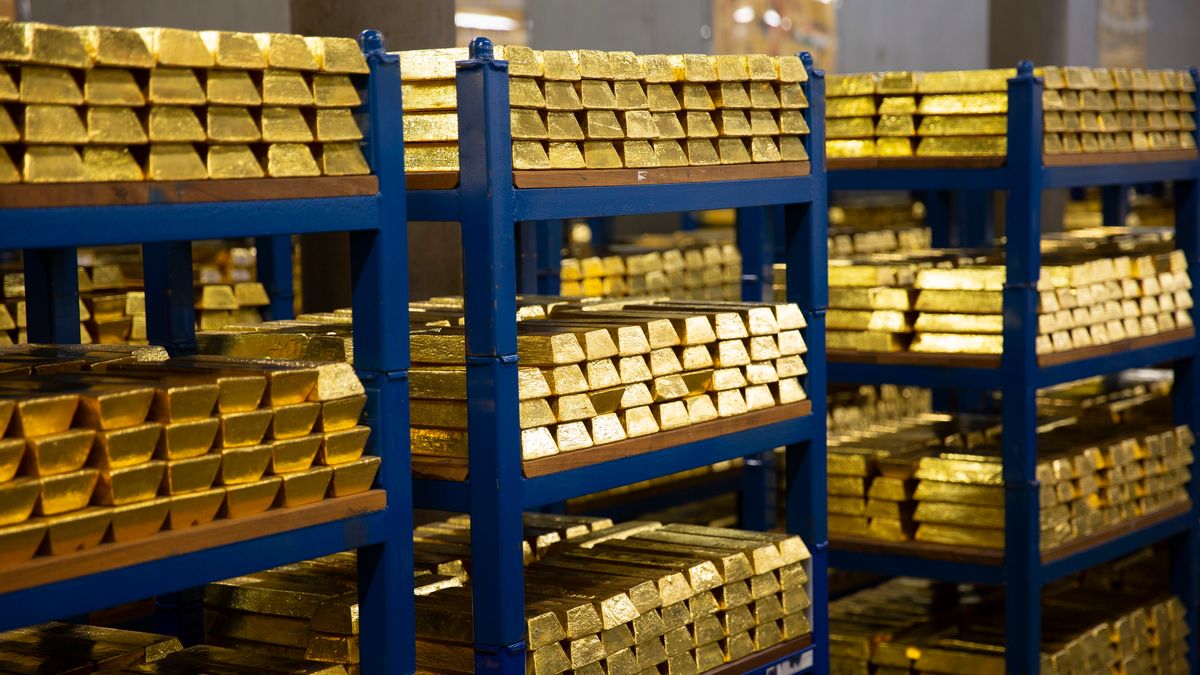
The Central Bank of Nigeria (CBN) said it has taken delivery of responsibly sourced gold refined to London Bullion Market Association (LBMA) Good Delivery standards into its foreign reserves, as part of its reserves diversification strategy.
The gold, sourced in Nigeria and aggregated by the Solid Minerals Development Fund (SMDF) through the National Gold Purchase Programme (NGPP), brings the CBN’s total gold holdings to $3.5 billion.
According to the CBN, the programme involves local miners and operates within a responsible sourcing framework aligned with the Organisation for Economic Co-operation and Development (OECD) Due Diligence Guidelines and the World Gold Council’s London Principles.
Speaking at the one-day Workshop on Strategies to Maximise the Economic Benefits of Minerals in Nigeria, the Governor of the apex bank, Mr Yemi Cardoso, disclosed that the lender acquired the monetary-grade gold in Naira at pricing linked to LBMA benchmarks, a structure designed to preserve Nigeria’s foreign exchange holdings while strengthening the nation’s gold reserves.
By purchasing domestically refined gold without deploying foreign currency, he said, the transaction enhances reserve accretion and supports broader macroeconomic stability objectives. Highlighting major shifts in global reserve management strategies, the CBN Governor noted their increasing importance amid rising global economic uncertainties.
He described the event as a reflection of Nigeria’s shared commitment to responsible and strategic management of its mineral resources. He emphasised that the workshop underscores the nation’s readiness to adapt to the realities of an evolving global economy, where resilience, diversification, and prudent governance have become increasingly vital.
He further explained that the session, convened by the CBN’s Corporate Secretariat and Reserve Management Departments, was designed to create a structured platform for engagement with key players in the gold sector and to deepen understanding of the industry’s current landscape, opportunities, and challenges across its value chain.
The governor noted that central banks around the world are prioritising economic resilience amid persistent geopolitical and market uncertainties.
He said gold has regained importance as a hedge against inflation and volatility, while other critical minerals are increasingly shaping global supply chains and advanced industrial development
Mr Cardoso emphasised that Nigeria’s immense natural and human resource potential can only be fully realised through prudence, strategic coordination, and long-term planning. He highlighted the need for strict adherence to internationally recognised standards, stressing that institutional credibility depends on strong governance frameworks.
On her part, the Executive Secretary of the Solid Minerals Development Fund (SMDF), Mrs Fatima Umaru Shinkafi, highlighted that the successful delivery of LBMA standard gold demonstrates the strength of the organisation’s formalisation framework and supply chain due diligence processes.
The World Gold Council’s Director of Central Banks and Public Policy, Ms Kurtulus Taskale Diamondopoulos, commended both the CBN and SMDF for designing the Nigerian Gold Purchase Programme (NGPP) in line with the twelve London Principles for responsible artisanal and small-scale gold sourcing.
She noted that the partnership between the CBN as sole off-taker and the SMDF as fiscal and supply chain manager offers a strong model for other countries seeking to strengthen similar programmes.
The President and CEO of the Africa Finance Corporation (AFC), Ms Samaila Zubairu, reaffirmed AFC’s commitment to financing and formalising Nigeria’s mineral sector, stressing the importance of accurate data and mineral processing infrastructure to attract investment, improve gold recovery, reduce environmental impact and support central bank purchases.
Also speaking, the Executive Vice Chairman of Kian Smith Gold Company, Ms Nere Emiko, underscored the urgent need for Nigeria to build strategic gold reserves and leverage commodity exchanges, noting the country’s low reserve levels relative to peers and calling for greater investment in exploration and transparency.
The Domestic Gold Purchase Programme forms part of the central bank’s broader strategy to enhance reserve quality, reduce external vulnerabilities, and position Nigeria’s mineral wealth as a pillar of long-term economic stability.
Economy
Naira Crashes to N1,370/$ at Official Market, N1,390/$1 at Black Market
By Adedapo Adesanya
The Naira again depreciated against the United States Dollar by N7.16 or 0.53 per cent in the Nigerian Autonomous Foreign Exchange Market (NAFEX) on Friday, June 19, to N1,370.46/$1 from the previous day’s N1,363.30/$1.
In the same vein, the Nigerian currency lost N9.07 against the Pound Sterling at the official market yesterday to trade at N1,814.76/£1 compared with Thursday’s closing price of N1,805.69/£1, and crashed against the Euro by N6.43 to settle at N1,571.50/€1 versus N1,565.07/€1.
Also, the Naira weakened against the greenback in the black market during the session by N5 to sell for N1,390/$1, in contrast to the preceding day’s N1,385/$1, and at the GTBank FX desk, it shed N3 to close at N1,376/$1 versus N1,373/$1.
The official market’s FX liquidity has been facing pressure over the last three trading sessions, contributing to a decline in the official exchange rate due to rising demand for foreign payments.
FX reserves rose to $51.03 billion, the highest level since January 20, 2009, according to data obtained from the Central Bank of Nigeria (CBN). The figure also represents the highest since the beginning of the year and under the administration of the current Governor of CBN, Mr Yemi Cardoso.
The latest figure underscores the steady strengthening of Nigeria’s external buffers, which continues to reinforce investor confidence in the Nigerian economy and support exchange rate stability.
Meanwhile, the cryptocurrency market was mixed, with Bitcoin (BTC) up by 0.8 per cent to $63,225.80 after trading activity was relatively subdued due to a US federal holiday, as the absence of stock and bond market activity led to quieter conditions across crypto markets, even though digital assets continue to trade around the clock.
Further, TRON (TRX) also gained 0.8 per cent to sell at $0.3230, Binance Coin (BNB) jumped 0.5 per cent to $579.84, and Ethereum (ETH) appreciated by 0.1 per cent to $1,704.23.
On the flip side, Ripple (XRP) declined by 0.9 per cent to $1.13, Cardano (ADA) shed 0.8 per cent to trade at $0.1611, Solana (SOL) fell by 0.1 per cent to $69.23, and Dogecoin (DOGE) slipped by 0.1 per cent to $0.0831, while the US Dollar Tether (USDT) and the US Dollar Coin (USDC) remained unchanged at $1.00 each.
Economy
Brent Rises to $80 as Israel, Hezbollah Agree Ceasefire
By Adedapo Adesanya
Brent crude gained 66 cents or 0.53 per cent to sell for $80.38 per barrel on Friday after Israel and Hezbollah agreed on a ceasefire in Lebanon, though Iran set conditions for using the vital Strait of Hormuz.
Also, the US West Texas Intermediate (WTI) crude was up 94 cents or 1.23 per cent to $77.54 per barrel, amid light trading volumes due to the US Juneteenth holiday.
In spite of Friday’s gains, Brent was down about 8 per cent week-over-week, reflecting a significant easing of supply concerns in the wake of the US-Iran deal to end the war.
Gulf producers were preparing to raise exports after Israel and Hezbollah agreed to a ceasefire, which began on Friday.
Israel and Hezbollah agreed to halt fighting in southern Lebanon after days of escalating clashes threatened to derail the fragile US-Iran peace process, reducing the risk that the first major test of the agreement would turn into its first major failure.
At least four tankers carrying crude, oil products and liquefied petroleum gas (LNG) entered the Strait of Hormuz on Friday, heading for Iraqi Gulf ports. However, despite the uptick in activity, Iran signalled tighter control over shipping.
Iran’s Persian Gulf Strait Authority said “no vessel is permitted to pass through the Strait of Hormuz without a valid passage permit issued by the PGSA”.
Concerns also remain as a planned meeting between Iranian and American officials in Switzerland on Friday was postponed, with arrangements underway for talks in the coming days.
Iran’s Foreign Ministry said the meeting was no longer urgent because a memorandum of understanding on ending the war had already been signed digitally between the two sides.
Analysts expect the deal to release more than 85 million barrels of oil stranded in the Middle East Gulf into global markets. The agreement also includes the lifting of US sanctions on Iranian oil, which would add more supply.
However, recovery in flows of supply that transits Hormuz and production after the US-Iran deal could take several months.
On the demand front, the Organisation of the Petroleum Exporting Countries (OPEC) said in its 2026 World Oil Outlook that world demand will rise to 113.3 million barrels per day in 2030 from 105.1 million barrels per day in 2025.
Economy
Nigeria’s Gross Foreign Reserves Hit 17-Year High of $51.04bn
By Aduragbemi Omiyale
The gross foreign reserves of Nigeria reached a 17-year high of $51.04 billion, data from the Central Bank of Nigeria (CBN) shows.
Business Post gathered from the apex bank’s website that this new feat was achieved on Thursday, June 18, 2026.
A day earlier, which was Wednesday, June 17, 2026, the amount in the country’s external reserves stood at $50.96 billion, indicating accretion of 0.16 per cent.
This latest development is expected to strengthen the value of the Nigerian Naira in the foreign exchange (FX) market.
It was observed that since the beginning of this month, the amount in the forex reserves has been building up gradually after an initial scare.
It is believed that inflows from crude oil sales have been boosting the reserves, though prices are expected to trend downward as a result of the ceasefire deals between the United States and Iran on Friday.
The price of crude oil has cooled to around $80 per barrel. It should further moderate to its level before February 28, 2026, when the bombardment of Iran started, which led to the death of the country’s 86-year-old Supreme Leader, Ayatollah Ali Khamenei.
-
Feature/OPED6 years agoDavos was Different this year
-
Travel/Tourism10 years ago
Lagos Seals Western Lodge Hotel In Ikorodu
-
Showbiz3 years agoEstranged Lover Releases Videos of Empress Njamah Bathing
-
Banking8 years agoSort Codes of GTBank Branches in Nigeria
-
Economy3 years agoSubsidy Removal: CNG at N130 Per Litre Cheaper Than Petrol—IPMAN
-
Banking3 years agoSort Codes of UBA Branches in Nigeria
-
Banking3 years agoFirst Bank Announces Planned Downtime
-
Sports3 years agoHighest Paid Nigerian Footballer – How Much Do Nigerian Footballers Earn