Connect with us

Feature/OPED

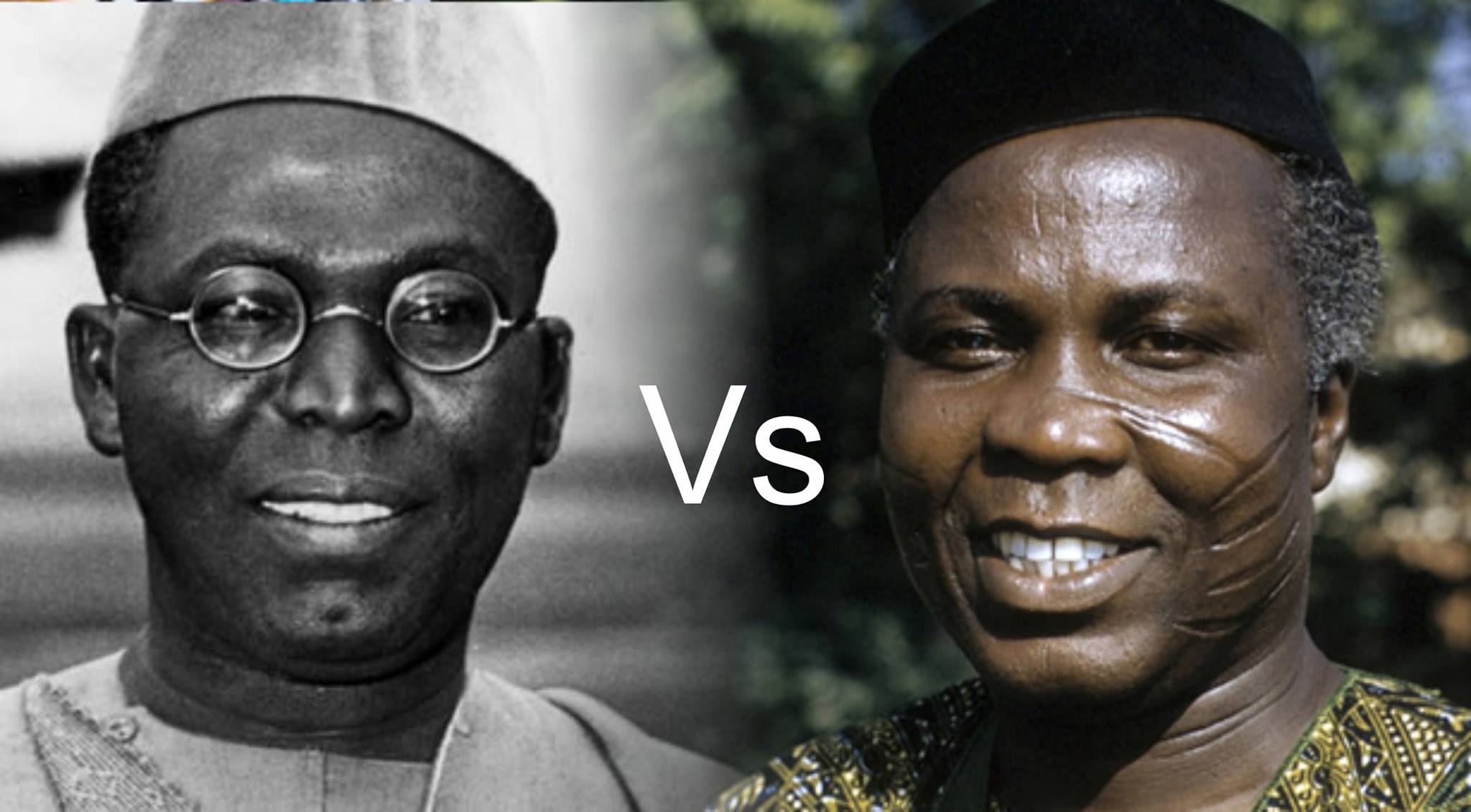
Akintola vs Awolowo, Opposition, and the One-Party Temptation

Published

on

awolowo akintola

By Prince Charles Dickson, PhD

Every generation of Nigerian politics likes to imagine that its quarrel is unprecedented, that its betrayals are original, that its intrigue is wearing a crown no earlier intrigue ever touched. But Nigerian politics is an old drummer. It changes songs, not rhythm. The names change. The costumes improve. The microphones get better. Yet the same questions keep returning like harmattan dust: What is opposition for? Is it a moral force, a strategic waiting room, or merely a branch office of the ruling instinct?

To ask that question seriously is to walk back into the haunted chamber of Awolowo and Akintola. What began as a struggle inside the Action Group was not just a disagreement between two brilliant men. It was a collision of political temperaments, ideological direction, ambition, and the larger architecture of power in Nigeria. Awolowo, who moved to the federal centre as opposition leader after 1959, was increasingly identified with a broader ideological project. Akintola, by contrast, came to embody a more conservative, region-focused and business-oriented current, and his openness to working with the Northern-dominated federal establishment deepened the rupture. By mid-1962, Awolowo’s camp had repudiated Akintola; the federal government declared a state of emergency in the Western Region and restored him in 1963. The bitterness of that split, and the wreckage that followed, helped poison the First Republic.

That is why the Awolowo-Akintola feud still matters. It was not gossip in an agbada. It was an early Nigerian lesson that opposition can die in two ways. It can be strangled from outside by a hostile ruling order. Or, more dangerously, it can decay from within, when conviction gives way to access, when strategy becomes personal survival, when party machinery becomes a theatre of ego. The Western crisis was, in that sense, not only about who should lead. It was about whether opposition should remain an instrument of principle or become a bargaining chip in the market of power.

Kano and Kaduna then enter the story like twin furnaces of northern political memory. Kano carries the old radical grammar of Aminu Kano, NEPU, Sawaba, talakawa politics, the language of emancipation rather than patronage. Oxford’s entry on Aminu Kano notes his struggle against corruption and oppression in the emirate order and his commitment to democratizing Northern Nigeria. The PRP’s own profile, lodged with INEC, explicitly roots itself in NEPU’s legacy and recalls that the PRP had two state governments in the Second Republic: Kaduna and Kano. In other words, both states are not accidental footnotes in the story of Nigerian opposition. They are ancestral terrain.

Then came 1999 and the Fourth Republic, with the PDP arriving not merely as a party but as a vast political weather system. Founded in 1998 and quickly becoming dominant, winning the presidency and legislative majorities in 1999 and retained national control for years. Opposition existed, yes, but it was fragmented, regional, underpowered, and often more symbolic than threatening. That era did not abolish opposition. It domesticated it.

The great interruption came in 2013, when the APC was formed through the merger of major opposition forces. That merger worked because it answered a Nigerian truth older than any campaign slogan: power rarely yields to scattered complaint. It yields to a disciplined coalition. The APC emerged from the merger of ACN, CPC, ANPP, and part of APGA, and in 2015, Buhari’s victory marked the first time an incumbent was defeated and the first inter-party transfer of power in Nigeria’s post-independence history. Reuters described it plainly as a historic democratic transfer. For a brief moment, opposition in Nigeria looked like more than lamentation. It looked like a ladder.

But even that victory carried a warning label. The problem with Nigerian opposition is that once it wins, it often stops being opposition in spirit and becomes merely the next landlord in the same building. An academic review of Nigeria’s democratic journey notes that the APC and PDP share many structural defects, and even cites the broader judgment that little distinguishes the two main parties because both are fluid elite networks with weak ideology. That diagnosis is painful because it explains so much. In Nigeria, opposition too often opposes only until the gates open. After that, the vocabulary changes, but the appetite stays the same.

This is where Kano and Kaduna become especially revealing from 1999 till now. Kano has repeatedly shown a willingness to defy neat national binaries, and in the 2023 election, it backed Rabiu Kwankwaso of the NNPP in the presidential race while also electing Abba Kabir Yusuf of the NNPP as governor. Kaduna told a different but equally interesting story: it voted Atiku Abubakar of the PDP in the presidential contest, yet elected APC’s Uba Sani as governor. CDD West Africa described the 2023 election as unusually fragmented, noting that all four major presidential contenders won at least one state and that states like Kano, Lagos, and Rivers split among three different parties. So, Kano and Kaduna have not been passive spectators in the Nigerian democratic drama. They have been laboratories of resistance, fragmentation, coalition, and contradiction.

And now we arrive at the present crossroads, where the phrase “one-party state” is no longer a tavern exaggeration but a live political argument. Reuters reported in May 2025 that the APC endorsed President Tinubu for a second term while the opposition was widely seen as too divided and weak to mount a serious challenge, with high-profile defections strengthening the ruling party. AP later reported Tinubu’s denial that Nigeria was being turned into a one-party state, even as several governors and federal lawmakers had left opposition parties for the APC. By February 2026, major opposition leaders, including Atiku, Peter Obi, and Amaechi, were jointly rejecting the new Electoral Act, calling it anti-democratic and warning that it could help install a one-party order. Tinubu, for his part, has continued to insist that democracy requires room for the minority to speak.

So, is Nigeria now a one-party state? Not formally. Not yet. There are still multiple parties, multiple ambitions, multiple resentments, and multiple routes to elite reassembly. But that is not the only question that matters. A country can avoid the legal shell of one-party rule and still drift into the political culture of one-party dominance. That drift happens when the ruling party becomes the default shelter for frightened politicians, when defections replace debate, when opposition parties become war zones of internal ego, and when citizens begin to see parties not as platforms of principle but as bus stops for the next powerful convoy. The danger is less a constitutional decree than a democratic evaporation.

This is why the ghosts of Awolowo and Akintola are still standing by the roadside, watching us. Their quarrel warned that opposition without internal discipline can collapse into treachery, and that power at the centre always knows how to exploit a divided house. Kano reminds us that opposition can spring from social memory, from the stubborn dignity of people who do not always vote as ordered. Kaduna reminds us that politics is rarely simple, that a state can host both establishment power and insurgent sentiment in the same electoral season. And the Fourth Republic reminds us that opposition in Nigeria only works when it is more than noise, more than wounded ambition, more than a coalition of temporarily unemployed strongmen.

The real Nigerian danger, then, is not that one party will conquer the entire country by brilliance alone. It is that the opposition will continue to fail by habit. If opposition is only a queue for access, then the ruling party will keep eating its rivals one defection at a time. If, however, opposition rediscovers ideology, internal democracy, regional credibility, and the courage to look different from what it condemns, then the old republic may still whisper a useful lesson into the new one.

Awolowo and Akintola were not just fighting over a party. They were fighting over the soul of the political alternative in Nigeria. That battle never ended—May Nigeria win!


Click to comment

Leave a Reply

Your email address will not be published. Required fields are marked *

Feature/OPED

What Dangote’s Reported $40bn Private-Placement Valuation Could Mean for Nigerian Investors, NGX

Published

on

Dangote refinery petrol production

Dangote Petroleum Refinery could become an unusually large part of Nigeria’s stock market if its eventual IPO valuation is close to the roughly $40 billion implied by a recent private placement.

EBC Financial Group (EBC) highlights that this would value the refinery at about N54.63 trillion, using the Central Bank of Nigeria (CBN) Nigerian Foreign Exchange Market rate of N1,365.6856 per USD on August 7. Against the N158.513 trillion value of companies listed on the Nigerian Exchange (NGX) on the same date, adding the refinery at that value would produce a market worth about N213.14 trillion, with Dangote Refinery accounting for 25.6%.

This scenario assumes the full $40 billion equity value is reflected in NGX market capitalisation and other listed company values remain unchanged. At that size, movements in the company could become highly visible across the Nigerian equity market, although its actual influence on NGX indices may depend on the shares available for public trading and the relevant index rules.

David Precious, Senior Market Analyst at EBC Financial Group, said: “If Dangote Refinery entered the Nigerian Exchange at close to a $40 billion valuation, it could account for roughly one-quarter of the resulting NGX market value. If that valuation is difficult to support, few shares are available for public trading, or investors need to reduce other Nigerian holdings to participate, the effects could extend across Nigeria’s equity market, including existing NGX-listed companies and their shareholders.”

A Private Transaction Can Indicate Value, but Public Investors Need Financial Evidence

Based on the private transaction, $40 billion provides an indication of Dangote Refinery’s value, but it does not establish the eventual IPO price. Details published on August 4 said a $2.5 billion private placement for a 6% stake implied a valuation of roughly $40 billion. The proposed initial public offering (IPO) was reported to target about $5 billion, while the eventual IPO valuation and percentage offered to the public were not disclosed. This is important as a private transaction may produce a different valuation from the price a broad group of public investors is prepared to accept.

For context, public equity market values cited alongside the transaction were about $12 billion for Türkiye’s Tupras and $16 billion for US-listed HF Sinclair. The Dangote figure is about 3.3 times Tupras and 2.5 times HF Sinclair. They are not direct comparisons because profitability, debt, operations and growth plans differ. The gap nevertheless increases the need for audited earnings, cash flow, debt and investment plans that explain what supports the higher valuation.

The reported $5 billion fundraising target is equivalent to about N6.83 trillion at the August 7 exchange rate, or approximately 4.3% of the N158.513 trillion existing NGX market value. Proposed $5 billion raise. If new Nigerian or foreign money funds the offer, the pool of capital invested in Nigerian equities could expand. If investors sell current holdings to participate, capital could instead move away from other listed companies.

Publicly Tradable Shares and New Investment Could Shape the Wider Market Impact

NGX rules show why total company value does not tell investors how much stock they can actually trade. Main Board companies can qualify through either 20% public ownership held by at least 300 shareholders or publicly tradable shares worth at least N20 billion. The Premium Board value alternative is N40 billion. Holdings controlled by promoters, directors and close relatives, government, or strategic investors owning at least 5% are excluded from qualifying public shares.

This means a company worth tens of trillions of naira could still have a much smaller amount of stock available for regular trading if ownership remains concentrated. The key issue is therefore how much of Dangote Refinery becomes accessible to public investors and how widely those shares are held.

Regional investment could also affect the outcome. Details published on 4 August indicated engagement involving South Africa, Kenya, Egypt, Ghana and Rwanda, including possible Kenyan participation of up to $500 million, although no allocations were confirmed. The Johannesburg Stock Exchange separately said Dangote Group had shown strong intent to pursue a South African listing after Nigeria. Regional participation in the Nigerian offer could bring new capital directly into Nigerian equities. A later South African listing could broaden access but would not itself increase money raised through the Nigerian IPO.

Pension funds face the same question of capital allocation. The National Pension Commission (PenCom) waived the usual existence, profitability and dividend requirements so Pension Fund Administrators can consider the IPO, while retaining internal investment policies, risk-management requirements and duties to contributors and retirees. PenCom Circular on Dangote Refiner. PenCom states that the dispensation is exceptional, one-off and specific to this proposed IPO.

Pension funds held N5.907 trillion in domestic ordinary shares at the end of June, compared with the offer’s approximately N6.83 trillion equivalent. This does not imply pension funds would finance the offer. It shows why managers must consider exposure to one company and whether participation requires reducing other investments.

Precious added, “Dangote being listed could become a turning point for Nigeria’s equity market if it brings wider public ownership and additional African capital. Investors still need clear evidence supporting the valuation, clarity on how much of the company they can trade and an explanation of where the money raised will go. Those answers will determine whether the listing expands the Nigerian equity market or concentrates more investment around one company.”

An approved prospectus should clarify the valuation, shares offered, public ownership and use of proceeds. The Securities and Exchange Commission (SEC) said on June 23 that no IPO application had then been filed or approved and ordered unauthorised pre-marketing to stop. Details published on 4 August later said an IPO application had been submitted, with regulatory approval expected in the following weeks. Until final terms are disclosed, the test for Nigeria is whether the listing combines a supportable valuation with broad public ownership and genuinely additional investment.

Continue Reading

Feature/OPED

Moving the Stablecoin Conversation From Hype to Utility in Africa’s Next Payments Evolution

Published

on

Rajat Mishra Onafriq

By Rajat Mishra

For much of the past decade, discussions around stablecoins have been dominated by cryptocurrency speculation. Increasingly, however, stablecoins are emerging as practical financial infrastructure for moving money across borders, managing liquidity and improving payment efficiency.

The real opportunity lies not in choosing between traditional finance and digital assets, but in building an integrated financial ecosystem where both work together to improve efficiency, broaden financial access and deepen economic connectivity across the continent.

Despite significant advances in financial inclusion and digital payments, moving money across African borders remains far more difficult than it should be. Businesses continue to face challenges when making cross-border payments. Fragmented payment networks, multiple intermediaries, and lengthy settlement processes increase costs and create operational inefficiencies.

Remittance providers, the specialised financial services that millions rely on to send money home, face many of the same structural challenges. These providers play a critical role across the continent. In fact, 19 of Africa’s 54 countries receive remittance inflows equivalent to at least 4% of their GDP. Yet Africa remains the world’s most expensive region to send money to.

These challenges are not a reflection of remittance providers themselves, but of the fragmented banking and settlement infrastructure underpinning international money movement. Financial institutions must often manage liquidity across multiple disconnected currency markets while relying on complex correspondent banking networks and clearing systems. The result is higher costs, slower settlements, and capital that remains unnecessarily locked up.

One of the most immediate opportunities for stablecoins lies in improving cross-border settlement. Consider a Kenyan business importing goods from South Africa. Under traditional settlement models, payments often pass through multiple correspondent banking relationships, involve several foreign exchange conversions, and can take days before funds reach the intended recipient.

Stablecoin-enabled settlement rails have the potential to reduce much of this friction by enabling value to move more efficiently between financial institutions across markets. The result can be shorter settlement times, greater transparency and improved predictability for businesses operating across borders.

The benefits extend well beyond businesses. For millions of Africans working abroad, remittances remain a financial lifeline, helping families pay school fees, healthcare costs and daily living expenses. Yet sending money home often involves navigating a complex chain of money transfer operators, correspondent banks, and local payout partners, with each additional layer introducing costs and delays.

Stablecoins can help streamline the backend movement of funds between institutional participants, reducing settlement costs and improving efficiency across the value chain.

For end users, the advantage is simplicity. Recipients do not need to interact with, or even understand stablecoins directly. They continue to receive money through familiar, trusted channels, whether a local bank account or mobile money wallet, only faster and at a lower cost.

Beyond payments, stablecoins also address one of the less visible but most significant challenges in cross-border finance: liquidity management. Financial institutions operating across multiple markets must constantly ensure they have sufficient funds in the right currency, in the right jurisdiction and at the right time. Today, this often requires pre-funding accounts across multiple countries, a costly practice that traps large amounts of capital and limits financial flexibility.

Stablecoins introduce a new model for moving value across borders in near real time, enabling institutions to manage liquidity dynamically as demand arises. This can reduce the need for large pre-funded balances, improve treasury efficiency and free up capital that can be deployed more productively. Ultimately, these efficiencies can translate into faster settlements, lower costs, and better services for businesses and consumers alike.

However, the true value of stablecoins will not come from isolated blockchain networks operating independently of existing financial systems. Their long-term impact will depend on how effectively they integrate with banks, mobile money platforms, payment service providers and existing payment infrastructure. Interoperability will be critical to ensuring payment flows move seamlessly between systems, markets and currencies. The goal should be to strengthen and modernise today’s payment ecosystem, not replace it.

From experiment to infrastructure: what global moves are telling us

Some of the clearest signals that stablecoins are moving from experimentation to infrastructure are coming from card networks. Mastercard’s reported agreement to acquire BVNK, valued at up to $1.8 billion, points to a strategic investment in the settlement layer connecting stablecoin rails with traditional banking and reflects growing institutional confidence in stablecoin-enabled cross-border payments.

Visa’s expansion of stablecoin-backed cards through Stripe’s Bridge to more than 100 countries reflects a complementary strategy. Rather than acquiring infrastructure outright, Visa is leveraging its existing global network as the final distribution layer for stablecoin-funded payments.

The inclusion of African markets is particularly significant. It signals growing confidence that stablecoin-backed payment instruments can operate alongside, and in some cases complement, the mobile money ecosystems that already dominate wallet-based payments across much of the continent.

Taken together, these developments point to a broader shift. Card payment networks are moving from observing the stablecoin conversation to investing directly in the infrastructure that underpins it. For Africa, the implication is not that stablecoins will replace existing payment rails, but that success will increasingly belong to institutions capable of orchestrating multiple settlement rails – cards, bank transfers, mobile money and stablecoins- within a unified, interoperable ecosystem. Local market expertise, regulatory relationships and last-mile distribution will remain decisive competitive advantages.

Building for scale through trust and regulation

But despite their potential, stablecoins cannot operate outside the boundaries of regulated financial systems. Their long-term viability across Africa depends on clear regulatory frameworks, robust compliance standards and trusted infrastructure that supports transparency, risk management and consumer protection.

We are already seeing this evolution. In markets such as South Africa, institutions facilitating cross-border settlements must navigate increasingly sophisticated regulatory requirements, including approvals for certain offshore crypto-related activities. Globally, initiatives such as the OECD’s Crypto-Asset Reporting Framework (CARF) and expanded Travel Rule obligations are raising expectations around reporting, tax transparency and compliance.

These developments reinforce a simple reality: stablecoin infrastructure does not reduce compliance obligations. It raises the bar for governance, transparency and institutional risk management. The objective is not to bypass regulation, but to build interoperable payment systems that can innovate confidently within it.

From the edges to the plumbing

The stablecoin conversation is steadily moving beyond speculation and towards practical implementation. What once sat at the edges of the payments debate is becoming part of the plumbing of cross-border finance rather than a parallel system to it.

The question is no longer whether stablecoins have a role to play in payments. The question is where they deliver the greatest value. In Africa, that value is increasingly clear: faster settlement, improved liquidity efficiency and more connected cross-border commerce. The winners will not be those that replace existing financial systems, but those that successfully connect stablecoin rails with the banks, mobile money networks and payment providers that already power the continent’s economy.

For pan-African payment networks such as Onafriq, the priority is ensuring that emerging technologies complement the financial infrastructure businesses and consumers already trust, rather than introducing new layers of complexity.

The opportunity lies in connecting stablecoin settlement with banks, mobile money networks and payment providers, ensuring the benefits of this new infrastructure deliver tangible outcomes for African businesses and consumers.

Rajat Mishra is the CPO for Network Product & Deputy Group CPIO at Onafriq

Continue Reading

Feature/OPED

The Quiet Strength of Kaduna’s Fiscal Discipline and Public Finance

Published

on

Kaduna's Fiscal Discipline

By Sani Abdulrazak, PhD

The irony in governance is that the projects that capture public imagination are often the least difficult to appreciate. A newly commissioned road, a modern school, a renovated hospital or a flyover bridge speaks for itself. Fiscal discipline does not. Yet, behind every lasting development lies an often-overlooked virtue: the prudent management of public resources. Governments are judged ultimately not by the abundance of their income but by the wisdom of their choices in spending that income. Though prosperity is desirable as we all know, we have to admit that stewardship is equally indispensable. When public finance is guided by discipline rather than expediency, governments create not only projects but also the confidence that today’s development will not become tomorrow’s burden.

It is against this backdrop that Kaduna State’s fiscal journey deserves careful reflection.

Governor Uba Sani assumed office in May 2023 at a time when the state, and by extension the country’s economic landscape, was anything but forgiving. The removal of fuel subsidy, exchange-rate volatility, persistent inflation, and rising debt-service obligations placed unprecedented pressure on governments at every level. States were confronted with a difficult reality: revenues were uncertain, the demands of citizens were increasing, and the cost of delivering public services was rising sharply. In such circumstances, leadership is tested less by ambition than by restraint. The challenge is not merely to spend, but to spend wisely.

One of the defining features of Kaduna’s public finance strategy has been its emphasis on fiscal prudence. The evolution of Kaduna’s budgets illustrates this approach. The approved 2023 budget stood at approximately ₦376 billion, with about 64 per cent allocated to capital expenditure. By 2026, the state’s budget had expanded to approximately ₦985.9 billion, with nearly 71 per cent earmarked for capital projects. While a larger budget does not automatically translate into better governance, the increasing share devoted to capital expenditure suggests an intention to invest more heavily in assets capable of generating long-term social and economic value.

It is important to note that Kaduna’s fiscal philosophy appears to rest on the belief that sustainable development cannot be separated from responsible financial management. Whether this approach ultimately delivers all the expected outcomes will be judged by history. But the effort to align expenditure with development priorities represents a significant dimension of governance, one that often receives less public attention than it deserves.

Like most Nigerian states, Kaduna relies on a combination of statutory allocations from the Federation Account and internally generated revenue (IGR).  Available fiscal reports indicate that Kaduna has continued efforts to strengthen its internally generated revenue through reforms in tax administration and improved collection mechanisms. While revenue generation alone is not evidence of economic prosperity, it provides government with greater fiscal flexibility and resilience, particularly during periods of national economic uncertainty. Equally important is the principle that expanding the revenue base should not be confused with imposing heavier burdens on taxpayers. The more sustainable path lies in improving efficiency, reducing leakages, and encouraging economic activity that naturally broadens the tax net.

Another pertinently salient aspect of Kaduna’s fiscal approach that deserves attention is the administration’s stated commitment to avoiding new borrowing while continuing to service inherited debt obligations. In a federation where public borrowing has become a common instrument for financing development, such a position reflects a cautious philosophy of public finance. According to official statements, the government has prioritised meeting existing debt commitments while financing new projects through budgetary allocations, statutory revenues, and other available funding sources rather than contracting fresh loans. The most overlooked measure of fiscal discipline is not the size of a budget or even the amount of revenue collected. It is the willingness of a government to treat public funds as a trust rather than an entitlement. Financial prudence is rarely dramatic, but it is often decisive. It is the quiet habit of making difficult choices today so that tomorrow’s opportunities are not compromised by yesterday’s excesses.

There is, pertinently, external evidence to suggest that Kaduna’s emphasis on fiscal discipline is not merely a government narrative. In the 2025 Transparency and Integrity Index of the Centre for Fiscal Transparency and Public Integrity (CeFTPI), Kaduna ranked first among Nigeria’s 36 states for the second consecutive year, scoring 49.08 per cent and recording the country’s highest score; 80 per cent, in the Control of Corruption variable. The assessment covered fiscal transparency, open procurement, human resources, control of corruption and citizen engagement.  This was not an isolated recognition. In the 2024 edition, Kaduna again ranked first among the states, ahead of Kano and Kogi, while in the 2023 Transparency and Integrity Index it placed second nationally with 59.7 per cent.

More recently, the 2025 Phillips Consulting State Performance Index placed Kaduna third among the 36 states and awarded it an Excellent Four-Star rating, with fiscal management among the areas assessed.  These assessments do not, by themselves, prove that every naira has been optimally spent, nor do they erase the challenges confronting the state. They do, however, provide an important independent corroboration that Kaduna’s efforts in transparency, accountability and public-sector financial management have been noticed beyond the corridors of government. In public finance, therefore, such external assessments are worth considering.

Yet, no appraisal of public finance can be complete without acknowledging its limits. Fiscal discipline, however commendable, is not a panacea for every economic challenge. Kaduna, like every other state in Nigeria, operates within a national macroeconomic environment over which it has limited control. Inflation continues to erode purchasing power, businesses contend with high operating costs, exchange-rate volatility affects production and investment, and many households still struggle with the rising cost of living. These realities remind us that sound state finances cannot, by themselves, insulate citizens from broader economic shocks.

This distinction is important because it separates governance from circumstance. A prudent administration may not be able to determine the value of the naira or the global price of commodities, but it can determine how efficiently public resources are managed, how transparently budgets are implemented, and how wisely limited revenues are allocated. In that sense, fiscal discipline should not be judged by whether every economic hardship disappears, but by whether government responds to those hardships with responsibility and not recklessness.

Kaduna’s experience suggests an appreciation of this responsibility. The emphasis on capital investment, efforts to strengthen internally generated revenue, and the administration’s declared preference for avoiding new borrowing while servicing inherited obligations point to a philosophy that values sustainability over expediency. These choices contribute to a financial culture that seeks to preserve the state’s capacity to invest, grow, and respond to future challenges.

That is not to suggest that the work is complete. Public finance is never a finished project; it is a continuous exercise in adaptation. As Kaduna’s economy evolves, expectations will also rightly rise; citizens will demand greater efficiency in service delivery, stronger budget implementation, improved transparency, broader private-sector participation, and measurable improvements in living standards. Fiscal discipline must therefore remain dynamic, ensuring that every naira spent delivers the greatest possible public value.

Prudent financial management remains the quiet strength of Kaduna’s fiscal discipline and public finance. It is a strength that is rarely seen or acknowledged by the majority; the strength to prioritise sustainability over excess and fiscal adventurism. It is important to note that the loudest achievements may command today’s headlines, but it is often the quiet virtues- prudence, discipline, accountability, and foresight- that shape tomorrow’s verdict. In public finance, as in life, the strongest foundations are rarely the most visible, yet they are almost always the most enduring.

Sani Abdulrazak, PhD, is a writer, researcher and public affairs analyst based in Zaria, Kaduna State.

Continue Reading