Feature/OPED
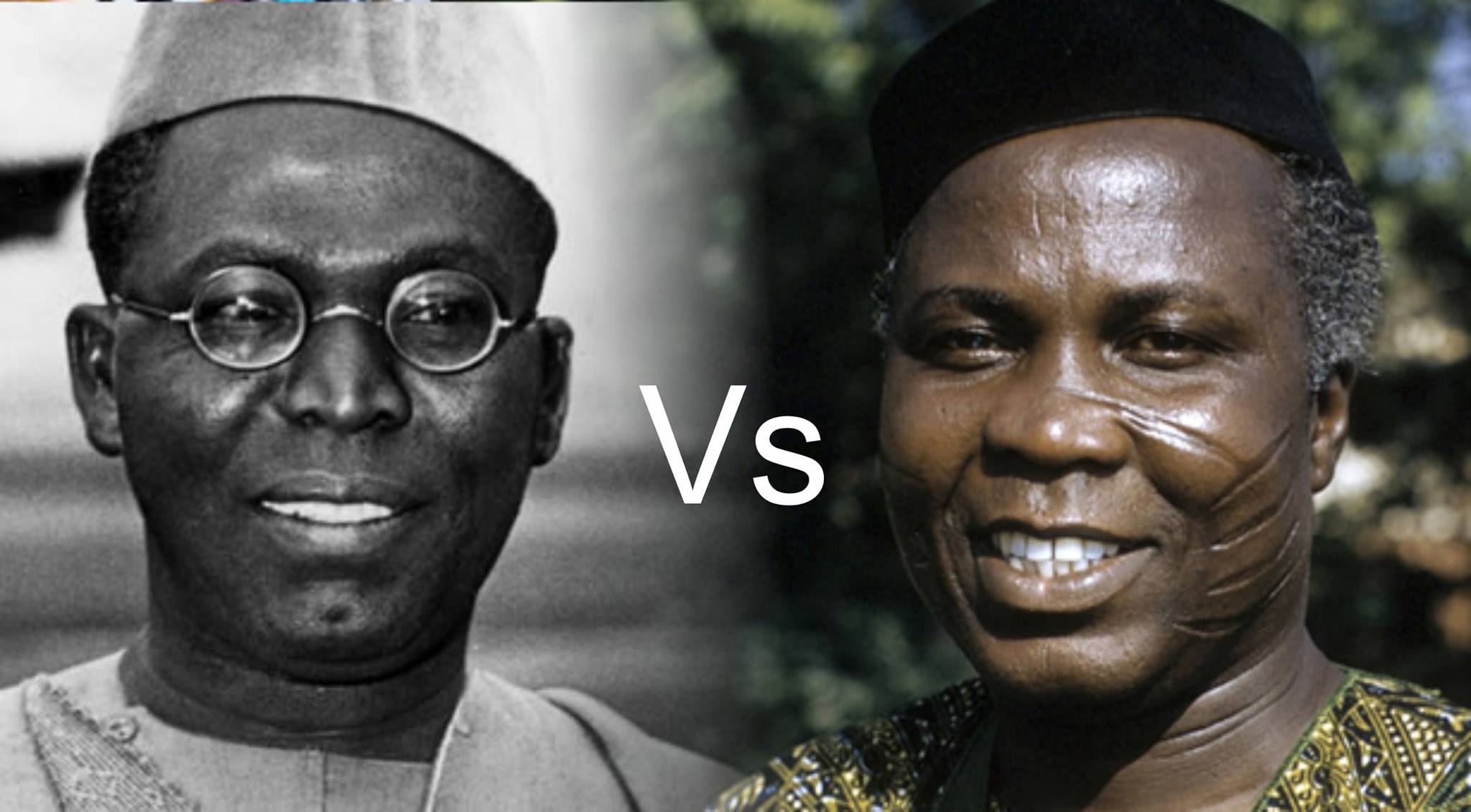
Akintola vs Awolowo, Opposition, and the One-Party Temptation
By Prince Charles Dickson, PhD
Every generation of Nigerian politics likes to imagine that its quarrel is unprecedented, that its betrayals are original, that its intrigue is wearing a crown no earlier intrigue ever touched. But Nigerian politics is an old drummer. It changes songs, not rhythm. The names change. The costumes improve. The microphones get better. Yet the same questions keep returning like harmattan dust: What is opposition for? Is it a moral force, a strategic waiting room, or merely a branch office of the ruling instinct?
To ask that question seriously is to walk back into the haunted chamber of Awolowo and Akintola. What began as a struggle inside the Action Group was not just a disagreement between two brilliant men. It was a collision of political temperaments, ideological direction, ambition, and the larger architecture of power in Nigeria. Awolowo, who moved to the federal centre as opposition leader after 1959, was increasingly identified with a broader ideological project. Akintola, by contrast, came to embody a more conservative, region-focused and business-oriented current, and his openness to working with the Northern-dominated federal establishment deepened the rupture. By mid-1962, Awolowo’s camp had repudiated Akintola; the federal government declared a state of emergency in the Western Region and restored him in 1963. The bitterness of that split, and the wreckage that followed, helped poison the First Republic.
That is why the Awolowo-Akintola feud still matters. It was not gossip in an agbada. It was an early Nigerian lesson that opposition can die in two ways. It can be strangled from outside by a hostile ruling order. Or, more dangerously, it can decay from within, when conviction gives way to access, when strategy becomes personal survival, when party machinery becomes a theatre of ego. The Western crisis was, in that sense, not only about who should lead. It was about whether opposition should remain an instrument of principle or become a bargaining chip in the market of power.
Kano and Kaduna then enter the story like twin furnaces of northern political memory. Kano carries the old radical grammar of Aminu Kano, NEPU, Sawaba, talakawa politics, the language of emancipation rather than patronage. Oxford’s entry on Aminu Kano notes his struggle against corruption and oppression in the emirate order and his commitment to democratizing Northern Nigeria. The PRP’s own profile, lodged with INEC, explicitly roots itself in NEPU’s legacy and recalls that the PRP had two state governments in the Second Republic: Kaduna and Kano. In other words, both states are not accidental footnotes in the story of Nigerian opposition. They are ancestral terrain.
Then came 1999 and the Fourth Republic, with the PDP arriving not merely as a party but as a vast political weather system. Founded in 1998 and quickly becoming dominant, winning the presidency and legislative majorities in 1999 and retained national control for years. Opposition existed, yes, but it was fragmented, regional, underpowered, and often more symbolic than threatening. That era did not abolish opposition. It domesticated it.
The great interruption came in 2013, when the APC was formed through the merger of major opposition forces. That merger worked because it answered a Nigerian truth older than any campaign slogan: power rarely yields to scattered complaint. It yields to a disciplined coalition. The APC emerged from the merger of ACN, CPC, ANPP, and part of APGA, and in 2015, Buhari’s victory marked the first time an incumbent was defeated and the first inter-party transfer of power in Nigeria’s post-independence history. Reuters described it plainly as a historic democratic transfer. For a brief moment, opposition in Nigeria looked like more than lamentation. It looked like a ladder.
But even that victory carried a warning label. The problem with Nigerian opposition is that once it wins, it often stops being opposition in spirit and becomes merely the next landlord in the same building. An academic review of Nigeria’s democratic journey notes that the APC and PDP share many structural defects, and even cites the broader judgment that little distinguishes the two main parties because both are fluid elite networks with weak ideology. That diagnosis is painful because it explains so much. In Nigeria, opposition too often opposes only until the gates open. After that, the vocabulary changes, but the appetite stays the same.
This is where Kano and Kaduna become especially revealing from 1999 till now. Kano has repeatedly shown a willingness to defy neat national binaries, and in the 2023 election, it backed Rabiu Kwankwaso of the NNPP in the presidential race while also electing Abba Kabir Yusuf of the NNPP as governor. Kaduna told a different but equally interesting story: it voted Atiku Abubakar of the PDP in the presidential contest, yet elected APC’s Uba Sani as governor. CDD West Africa described the 2023 election as unusually fragmented, noting that all four major presidential contenders won at least one state and that states like Kano, Lagos, and Rivers split among three different parties. So, Kano and Kaduna have not been passive spectators in the Nigerian democratic drama. They have been laboratories of resistance, fragmentation, coalition, and contradiction.
And now we arrive at the present crossroads, where the phrase “one-party state” is no longer a tavern exaggeration but a live political argument. Reuters reported in May 2025 that the APC endorsed President Tinubu for a second term while the opposition was widely seen as too divided and weak to mount a serious challenge, with high-profile defections strengthening the ruling party. AP later reported Tinubu’s denial that Nigeria was being turned into a one-party state, even as several governors and federal lawmakers had left opposition parties for the APC. By February 2026, major opposition leaders, including Atiku, Peter Obi, and Amaechi, were jointly rejecting the new Electoral Act, calling it anti-democratic and warning that it could help install a one-party order. Tinubu, for his part, has continued to insist that democracy requires room for the minority to speak.
So, is Nigeria now a one-party state? Not formally. Not yet. There are still multiple parties, multiple ambitions, multiple resentments, and multiple routes to elite reassembly. But that is not the only question that matters. A country can avoid the legal shell of one-party rule and still drift into the political culture of one-party dominance. That drift happens when the ruling party becomes the default shelter for frightened politicians, when defections replace debate, when opposition parties become war zones of internal ego, and when citizens begin to see parties not as platforms of principle but as bus stops for the next powerful convoy. The danger is less a constitutional decree than a democratic evaporation.
This is why the ghosts of Awolowo and Akintola are still standing by the roadside, watching us. Their quarrel warned that opposition without internal discipline can collapse into treachery, and that power at the centre always knows how to exploit a divided house. Kano reminds us that opposition can spring from social memory, from the stubborn dignity of people who do not always vote as ordered. Kaduna reminds us that politics is rarely simple, that a state can host both establishment power and insurgent sentiment in the same electoral season. And the Fourth Republic reminds us that opposition in Nigeria only works when it is more than noise, more than wounded ambition, more than a coalition of temporarily unemployed strongmen.
The real Nigerian danger, then, is not that one party will conquer the entire country by brilliance alone. It is that the opposition will continue to fail by habit. If opposition is only a queue for access, then the ruling party will keep eating its rivals one defection at a time. If, however, opposition rediscovers ideology, internal democracy, regional credibility, and the courage to look different from what it condemns, then the old republic may still whisper a useful lesson into the new one.
Awolowo and Akintola were not just fighting over a party. They were fighting over the soul of the political alternative in Nigeria. That battle never ended—May Nigeria win!
Feature/OPED
A Generation Under Siege as Nigeria’s Drug Crisis Deepens
By Blaise Udunze
This piece speaks directly to the current consciousness of many Nigerians as some crises erupt with noise, explosions of violence, economic shocks, political upheavals and then some unfold quietly, steadily, almost invisibly, until their consequences become impossible to ignore.
Nigeria today is living through the latter. Today, this hardly or rarely dominates the front pages of newspapers with the same sustained urgency. Still, the truth is that it depends on whether it is reshaping communities, distorting futures, and hollowing out the very foundation of the nation’s promise.
With the rate at which drug abuse has festered among young Nigerians, it is no longer a social concern. It is a national emergency, silent, systemic, and dangerously underestimated.
The big picture of a bright future led by the youth of today and leaders of tomorrow is gradually fading away, thanks to the menace of drugs. Unfortunately, it is a national problem linked to all other criminal activities, but the system does not consider it critical. A generation of people is gradually being wiped out. The implications of these are too dire even to contemplate.
It is now alarming, as the numbers alone are staggering. Looking closely at the report by the United Nations Office on Drugs and Crime reveals that 14.4 per cent of Nigerians between the ages of 15 and 64, roughly 14.3 million people, use psychoactive substances, nearly three times the global average. Even more troubling, which calls for public concern, is that one in five of these users suffers from drug-related disorders requiring urgent treatment. The implication is clear since this is not casual use; it is a deepening public health crisis.
To many Nigerians, these statistics, as revealed, appear alarming, but the underlying fact is that they are only a scratch on the surface of a much darker reality, which the eyes cannot see.
Across Lagos, Kano, Onitsha, and countless towns in between, drug abuse is no longer hidden. It is visible in motor parks where tramadol is sold as casually as bottled water, in university hostels where “home mixes” circulate as social currency, and in street corners where teenagers inhale toxic concoctions in search of escape. Substances that were once tightly regulated, codeine, opioids, and benzodiazepines, are now frighteningly accessible. Others, far more dangerous, are improvised through mixtures of gutter water, chemicals, and pharmaceuticals designed not for healing, but for oblivion.
What is emerging is not just a culture of drug use, but an ecosystem of addiction.
Let us consider the disturbing normalisation of concoctions like “Omi Gutter” (gutter water) or “Jiko”, lethal blends of tramadol, codeine, cannabis, and other substances, just to mention a few. The fear in all of this is that these are not isolated experiments; they are part of a growing subculture among young people seeking relief from pressures they can neither articulate nor escape. Let us see the irony from the point that the deaths incurred from overdoses, seizures, and organ failure are increasingly reported, yet rarely provoke sustained national outrage.
This silence is part of the problem, and what society has failed to recognise is that they are yet to understand the scale of the crisis; one must go beyond the streets and into the systems that have failed to contain it.
What must be known today is that Nigeria’s drug epidemic is deeply intertwined with a mental health crisis that remains largely unaddressed, which appears difficult to deal with because the system’s attention is divided by other trivialities. According to the World Health Organisation, one in four Nigerians, an estimated 50 million people, suffer from some form of mental illness. This is such a fearful trend, whilst among adolescents, the situation is even more fragile. Today, the trend in Nigeria, globally, is also on record that 14 per cent of young people experience mental health challenges, with suicide ranking among the leading causes of death for those aged 15 to 29.
In Nigeria, however, these issues are compounded by stigma, neglect, and systemic absence.
A study conducted in a Borstal Institution in North-Central Nigeria found that 82.5 per cent of adolescent boys had psychiatric disorders. The breakdown actually revealed that disruptive behaviour disorders accounted for 40.8 per cent, substance use disorders 15.8 per cent, anxiety disorders 14.2 per cent, psychosis 6.7 per cent, and mood disorders five per cent. These are not marginal figures; they point to a generation grappling with profound psychological distress.
Many of these boys, according to the timely warning from Professor Olurotimi Coker of the Lagos State University Teaching Hospital, which he revealed, is that they suffer in silence. This, he discloses, is constrained by societal expectations that equate vulnerability with weakness. In a culture where young men are expected to “be strong,” emotional struggles are buried, not addressed. Drugs, in this context, become both refuge and rebellion, a way to cope, to escape, and sometimes, to belong.
The tragedy is that what begins as coping often ends in captivity. The clear fact, which the system must not ignore, is that the crisis does not exist in isolation, yes! because it feeds into and is fed by Nigeria’s broader challenges of insecurity and alongside economic instability. Research by scholars from Chukwuemeka Odumegwu Ojukwu University highlights a dangerous nexus between substance abuse and national security. Drug trafficking networks do not merely distribute substances; they sustain criminal economies, fund violent groups, and perpetuate cycles of instability.
A review of some of the developments will drive us to the activities in the Lake Chad Basin, for instance, an open secret is that insurgent groups such as Boko Haram and Islamic State West Africa Province have been linked to drug trafficking operations. According to regional security analyses, these groups rely on narcotics, from tramadol to cocaine, to finance operations, recruit fighters, and embolden combatants. The use of drugs to suppress fear and heighten aggression among fighters underscores a chilling reality, which obviously shows that Nigeria’s drug crisis is not just a health issue; it is a security threat. To confirm this, only recently, during an interview with Arise TV, General Christopher Musa, the Minister of Defence, concurred that when many of these terrorists are arrested, they are often found to be under the influence of drugs.” He stated that they use different substances, including injectables, which affect their thinking and reduce their fear or sense of pain. In General Musa’s words: “You are dealing with somebody whose mind is made up that if he dies, he doesn’t care. Most times when we arrest them, they are on drugs, so they don’t care, they don’t even feel it, they have Injectables, you get them with all those drugs. So that is how they operate.”
This convergence of addiction and violence creates a vicious cycle. History has shown that drugs fuel crime; crime sustains drug networks, and for this reason, young people, caught in the middle, are both victims and instruments, recruited as couriers, enforcers, and, in some cases, political thugs. One recent example that occurred earlier this month is that of a teenager aged 15 named Tijjani. He was arrested by the Nigerian Army in connection with the Boko Haram deadly attack on military positions in Borno that claimed the life of Brigadier-General Oseni Braimah and other soldiers.
In the political space, history offers a warning because it brings to mind the scenario that played out during the 2011 post-election violence in Nigeria, which claimed over 800 lives in just three days, with the same pattern occurring in the 2023 elections. What Nigerians must know is that these trends expose how easily unemployed, disillusioned youths can be mobilised for violence. In most cases, this happens under the influence of substances, and of concern is that similar patterns are re-emerging currently, raising urgent questions about the future of Nigeria’s democracy.
At the same time, economic realities continue to deepen vulnerability. Youth unemployment and underemployment remain persistently high despite the official rate currently at 5 per cent, which appears to be low under the newer methodology, while the alternative estimate was around 22 per cent in 2025, leaving millions in limbo today. The fact is that, regrettably, for many, the promise of education has not translated into opportunity. As a matter of fact, in many homes, degrees hang on walls, but jobs remain elusive. And that is why, in this vacuum, drugs offer something the system does not in the case of temporary relief from frustration, anxiety, and stagnation.
Even more alarming is how early exposure begins.
A quick look at some reports in Nigeria reveals that hardly any month passed in 2021 without any significant cases of vast amounts of drugs seized at the import gateways in Nigeria or a Nigerian caught abroad with a large consignment of drugs being smuggled into another country. These seizures have shed light on how the work of trafficking networks is facilitated by a range of actors, including alleged businesspeople, politicians, celebrities, and students. Nigeria’s porous borders, weak institutions, corrupt practices, political patronage, poverty, and ethnic identities enable traffickers to avoid detection by the formal security apparatus. There are even times when the conventional security apparatus itself provides cover for traffickers, giving rise to legitimate concerns about the ability of criminal networks and illicit drug monies to infiltrate security and government agencies, transform or influence the motivations of its members, reorient objectives towards the spoils of drug trafficking activity, thus undermining the democratic processes. Still on the supply side is the new availability of cheap opioids in the open market under different brand names.
In Lagos State alone, a 2024 study by the combined team of the National Drug Law Enforcement Agency (NDLEA) and the Federal Ministry of Education found an alarming fact that 13.6 per cent of secondary school students had experimented with drugs, while 6.9 per cent were active users. Unbeknownst to most Nigerians is the fact that these figures represent not just experimentation, but a pipeline into long-term dependency.
This is also confirmed by the Chairman/Chief Executive Officer of the National Drug Law Enforcement Agency (NDLEA), Buba Marwa, who said substance abuse had moved beyond the streets and was now a growing problem within lecture halls and campuses when he spoke on “High Today, Lost Tomorrow: The Real Cost of Drug Abuse on Campus.” Marwa, who further raised concerns over the increasing use of social media platforms for drug distribution, as well as the involvement of students in trafficking, stated that the drug scene had evolved from the use of traditional substances, like cannabis, to more dangerous synthetic opioids and designer drugs, such as Colorado, Loud, and Methamphetamine.
It is more fearful to know that beyond the university students, children as young as 12 are being introduced to substances not through sophisticated cartels, but through peers, neighbourhood influences, and easy market access. Drugs that require prescriptions are sold openly in markets and motor parks, often cheaper than a soft drink. A sachet of tramadol can cost as little as N100.
One surprising revelation is that some of the more dangerous substances, such as petrol fumes, glue, sewage mixtures, are used freely because they are costless. It is now understood that this is not merely a matter of accessibility, but a systemic failure.
Law enforcement efforts, while significant, remain insufficient relative to the scale of the problem, as large-scale numbers of drugs have found their way into society. They can still claim to have succeeded as the National Drug Law Enforcement Agency said to have recorded notable successes, though, with over 57,000 arrests, more than 10,000 convictions, and nearly 10 million kilograms of seized drugs in recent years. Even with these records, it is glaring that society has continued to witness thousands of addicts being rehabilitated, and millions of students have been reached through advocacy campaigns.
Yet, as described earlier, these achievements, though commendable, are dwarfed by the magnitude of the crisis, which gives no room for law enforcement to make any holistic claims of sanitising the system. Seeing the sheer volume of drug inflows, from heroin in Asia, cocaine from South America, cannabis from North Africa, and synthetic drugs from Europe, suggests a system under siege. Enforcement alone cannot outpace demand.
And demand, in Nigeria today, is expanding. Nowhere is the human cost more visible than among the homeless youth population. Along the Oshodi rail corridor in Lagos, thousands of young people live in precarious and questionable conditions, sleeping under bridges and railway platforms, exposed daily to drugs, violence, and exploitation, as they carelessly lose their lives, and some have spent years, even decades, in these environments. Sincerely, there must be this understanding that for many, addiction is both a cause and a consequence of their circumstances.
Some struggling segments of people in society can be linked to broader socio-economic and systemic failures that are associated with widening inequality, lack of social housing, inadequate education, and the absence of structured rehabilitation programs. Another aspect of this that can’t be left out and should be addressed expeditiously is that these vulnerable youths are reportedly recruited into political violence, reinforcing a dangerous cycle of neglect and exploitation, and it must be established that it has become a norm in society.
This is where the conversation must shift, from individual responsibility to systemic accountability.
Drug abuse in Nigeria is not simply about bad choices, as most people perceive it; it is about limited choices if properly looked into. Just as well said, the trend shows that it is about a young man who takes tramadol to endure the physical strain of daily labour, and continues using it long after the pain is gone because addiction has taken hold. Sometimes, it can also be about a teenager who experiments out of curiosity and eventually finds herself trapped in dependency. It is about a boy who cannot and is unable to express or confront his emotional pain, so he copes by suppressing or numbing it instead, while also looking at a society that has normalised survival at the expense of well-being.
The policy response, however, has yet to match the urgency of the crisis, and with this challenge, it will be said that Nigeria lacks a fully integrated national strategy that connects drug prevention, mental health care, education reform, and economic inclusion.
The consequence is a reactive system in a crisis that demands prevention. What would a meaningful response look like?
First, it would reframe drug abuse as a public health emergency. This means prioritising treatment, rehabilitation, and prevention alongside enforcement. Addiction must be treated as a medical condition, not merely a criminal offence.
Second, it would integrate mental health into primary healthcare. Access to counselling, therapy, and early intervention must be expanded, particularly for young people. Schools, communities, and digital platforms should become entry points for support, not just discipline.
Third, it would invest in education reform that goes beyond academics. When this is done, life skills, emotional intelligence, and drug awareness must be embedded in curricula. Students need tools to navigate pressure, not just pass exams.
Fourth, it would address economic exclusion. Job creation, vocational training, and entrepreneurship support must be scaled to match the size of Nigeria’s youth population. Opportunity is one of the most powerful antidotes to despair.
Fifth, it would strengthen community-based interventions. Families, religious institutions, and local leaders must be empowered to recognise early warning signs and provide support. Addiction is rarely an individual battle; it is a collective one.
Finally, it would demand accountability. Data must guide policy, and outcomes must be measured. Good intentions are no substitute for measurable impact.
Nigeria stands at a defining moment and must be aware that its youth population remains its greatest asset but also its greatest risk. The fear today that should be in the heart of many and must suffice as a warning is that a generation lost to addiction is not just a social tragedy; it is a national failure.
The warning signs are already here in the statistics, in the streets, in the stories that rarely make headlines. The question is whether the country is willing to listen. Because silence, in this case, is not neutrality. It is complicity.
And if this silent emergency continues unchecked, Nigeria may soon discover that what it is losing is not just its youth but its future.
Feature/OPED
Creating Safer Digital Spaces is our Collective Responsibility
By Lilian Kariuki
In the digital age, trust is our most valuable currency. Every click, comment, or share reflects a growing expectation that online spaces should be safe, fair, and accountable. When those expectations are not met, the consequences extend far beyond individual users, rippling through families, schools, and communities.
Across Africa, millions of young people now access the internet as a central part of their daily lives. It has become a portal for learning, creativity, entrepreneurship, and civic engagement. For many, the internet provides opportunities that were previously unimaginable: students can access global knowledge from a mobile device, young entrepreneurs can reach customers across borders, and Change Makers can share stories that would otherwise go unheard.
Alongside these opportunities, it is important to remember that online spaces also have their own challenges. With awareness and the right support, we can help ensure a positive and secure digital experience for everyone.
Safety online cannot be reactive; it must be proactive. It should be embedded in the design of policies, and reinforced by the guidance young people receive from parents, caregivers, educators, and communities. In practice, this means creating spaces where young people can explore, create, and learn with confidence, knowing that safeguards are in place and support is available when needed. It also requires equipping children with the skills to navigate digital spaces responsibly, evaluate information critically, and act with empathy.
This was one of the focus areas at the recently concluded TikTok Safer Internet Summit in Nairobi, where I had the privilege of speaking about the journey of successful collaboration in child online safety. The summit highlighted proactive steps TikTok is taking to engage teens responsibly and the importance of collaboration in shaping safety policies. The key takeaway was clear: creating safer digital spaces is a responsibility we all share, involving governments, civil society, educators, parents, and users themselves.
A key plus in such forums is the tangible advantage of big tech working closely with NGOs and regulators. These collaborations combine technological innovation and scale with on-the-ground expertise and policy insights. The result is practical progress that no single actor could achieve alone: building trust and amplifying impact tailored to Africa’s digitally vibrant community.
Africa presents unique opportunities and challenges in this regard. The region is experiencing some of the fastest rates of digital adoption in the world. Mobile-first connectivity allows young people to create, share, and connect like never before. Yet this rapid expansion has exposed gaps such as limited digital literacy, evolving child protection frameworks, and vulnerabilities to online exploitation. These challenges cannot be addressed by any single actor alone. Governments, civil society, educators, caregivers, and industry all have a role to play, and collaboration is essential.
Practical safety measures are critical, while platforms and policymakers must prioritise protections that are accessible, clear, and enforceable. Parents and caregivers must be aware of what children are doing online and equipped to guide them without restricting creativity or independence. Schools and governing bodies should integrate digital literacy into school curricula, teaching young people not only how to use technology but how to navigate it safely, ethically, and thoughtfully.
But online safety is about more than policies and tools; it’s also about culture. Every interaction online contributes to the environment in which children live. Respect, empathy, and accountability are as critical as any technical safeguard. When communities collectively uphold these values, digital spaces become not just safer but more supportive, inclusive, and empowering.
The stakes are high as young people who cannot trust the digital world may miss opportunities for education, entrepreneurship, and civic engagement. Families may hesitate to allow their children to access technology, and communities may struggle to harness the benefits of connectivity. But when trust is earned and safety is embedded, the digital world becomes a space for growth, creativity, and an opportunity for African voices and stories to be heard globally.
The future of digital Africa depends on the choices we make today. By treating online safety as a priority, not an afterthought, we can build spaces where young people can thrive, exploring, creating, and engaging without fear. If we act collectively, we can ensure that the digital world becomes a space that is not only innovative and open but safe, fair, and empowering for our future generations.
Lilian Kariuki is the Executive Director for Watoto Watch Network & Member of TikTok SSA Safety Advisory Council
Feature/OPED
What Tech Leaders Should Know About IP Contract Strength
Technology leaders operate at the intersection of innovation, risk, and long-term strategy. As organisations rely more heavily on proprietary platforms, custom software, and licensed technologies, intellectual property contracts become critical business instruments rather than routine legal documents. The strength of these contracts often determines how well a company can protect its innovations, maintain leverage in vendor relationships, and respond to unexpected disruptions.
Strong IP contracts do more than define ownership. They shape accountability, continuity, and trust between parties. For executives and decision makers, understanding what makes an IP agreement resilient is essential to safeguarding both current operations and future growth. Without careful attention, even advanced technology investments can become sources of vulnerability rather than competitive advantage.
Understanding the Role of Intellectual Property in Technology Strategy
Intellectual property sits at the core of most modern technology initiatives. Whether software is developed in-house, licensed from a third party, or built collaboratively, the associated IP defines who controls usage, modification, and distribution. Contracts must clearly reflect how this property aligns with broader business objectives rather than treating IP as a secondary concern.
Tech leaders should evaluate how critical a given technology is to daily operations and customer delivery. The more central the system, the stronger and more precise the IP protections must be. Ambiguous ownership language or overly restrictive licensing terms can limit scalability and innovation. When contracts mirror strategic priorities, they support flexibility rather than constrain it.
Clarity in Ownership and Licensing Provisions
One of the most common weaknesses in IP contracts is unclear ownership language. Agreements should explicitly define which party owns the underlying code, derivative works, and future enhancements. This clarity becomes especially important in custom development arrangements where responsibilities and contributions may overlap.
Licensing provisions must also specify scope, duration, and permitted use. Vague language around usage rights can lead to disputes or unexpected limitations as a business grows or enters new markets. Strong contracts anticipate change and outline how rights evolve alongside business expansion. This level of detail helps prevent costly renegotiations later.
Protecting Access and Continuity Rights
Beyond ownership, access to technology assets is a major concern for leadership teams. If a vendor relationship ends abruptly or a provider becomes unable to perform, access restrictions can disrupt operations. IP contracts should address these risks through well-defined continuity provisions.
In some cases, software escrow services are incorporated to support access to essential materials under specific conditions. While not required in every agreement, mechanisms like this reflect a broader principle of resilience. Tech leaders should ensure that contracts account for worst-case scenarios without undermining productive partnerships. Protection and collaboration are not mutually exclusive when agreements are thoughtfully structured.
Aligning IP Protections with Compliance and Governance
Regulatory compliance and internal governance standards increasingly influence how IP contracts are drafted and enforced. Industries subject to strict data, security, or operational requirements cannot rely on generic contract templates. IP provisions must align with regulatory obligations and internal risk management frameworks.
Leadership teams should collaborate with legal, compliance, and security stakeholders to ensure contracts reflect current standards. This includes addressing data handling, audit rights, and reporting obligations tied to intellectual property usage. When IP contracts support governance objectives, they reduce exposure and demonstrate due diligence to regulators and investors alike.
Managing Disputes and Enforcement Effectively
Even the strongest contracts cannot eliminate the possibility of disagreement. What distinguishes effective IP agreements is how disputes are managed when they arise. Clear dispute resolution clauses provide predictable processes that minimise disruption and preserve working relationships when possible.
Contracts should outline jurisdiction, governing law, and escalation procedures in plain language. Overly complex enforcement mechanisms can delay resolution and increase costs. For tech leaders, the goal is not to prepare for conflict but to ensure that disagreements do not derail core business functions. Well-designed enforcement terms contribute to operational stability.
Planning for Evolution and Innovation
Technology rarely remains static, and IP contracts must evolve accordingly. Agreements should address how updates, integrations, and new use cases are handled over time. Without these provisions, innovation may be slowed by uncertainty or restrictive terms.
Forward-looking contracts recognise that today’s solution may serve tomorrow’s expanded role. By defining how enhancements are owned, licensed, and shared, organisations encourage innovation while preserving control. Tech leaders who prioritise adaptability in IP agreements position their companies to respond confidently to change.
Conclusion
IP contract strength is a strategic concern that extends far beyond legal formalities. For technology leaders, these agreements influence resilience, innovation, and long-term value creation. By focusing on clarity, continuity, compliance, and adaptability, organisations can transform IP contracts into tools that support growth rather than obstacles that limit it. Strong agreements reflect thoughtful leadership and a clear vision for how technology powers the business forward.
-
Feature/OPED6 years agoDavos was Different this year
-
Travel/Tourism10 years ago
Lagos Seals Western Lodge Hotel In Ikorodu
-
Showbiz3 years agoEstranged Lover Releases Videos of Empress Njamah Bathing
-
Banking8 years agoSort Codes of GTBank Branches in Nigeria
-
Economy3 years agoSubsidy Removal: CNG at N130 Per Litre Cheaper Than Petrol—IPMAN
-
Banking3 years agoSort Codes of UBA Branches in Nigeria
-
Banking3 years agoFirst Bank Announces Planned Downtime
-
Sports3 years agoHighest Paid Nigerian Footballer – How Much Do Nigerian Footballers Earn