

Connect with us

General

Edo Assembly Gets New Speaker as Blessing Agbebaku Quits

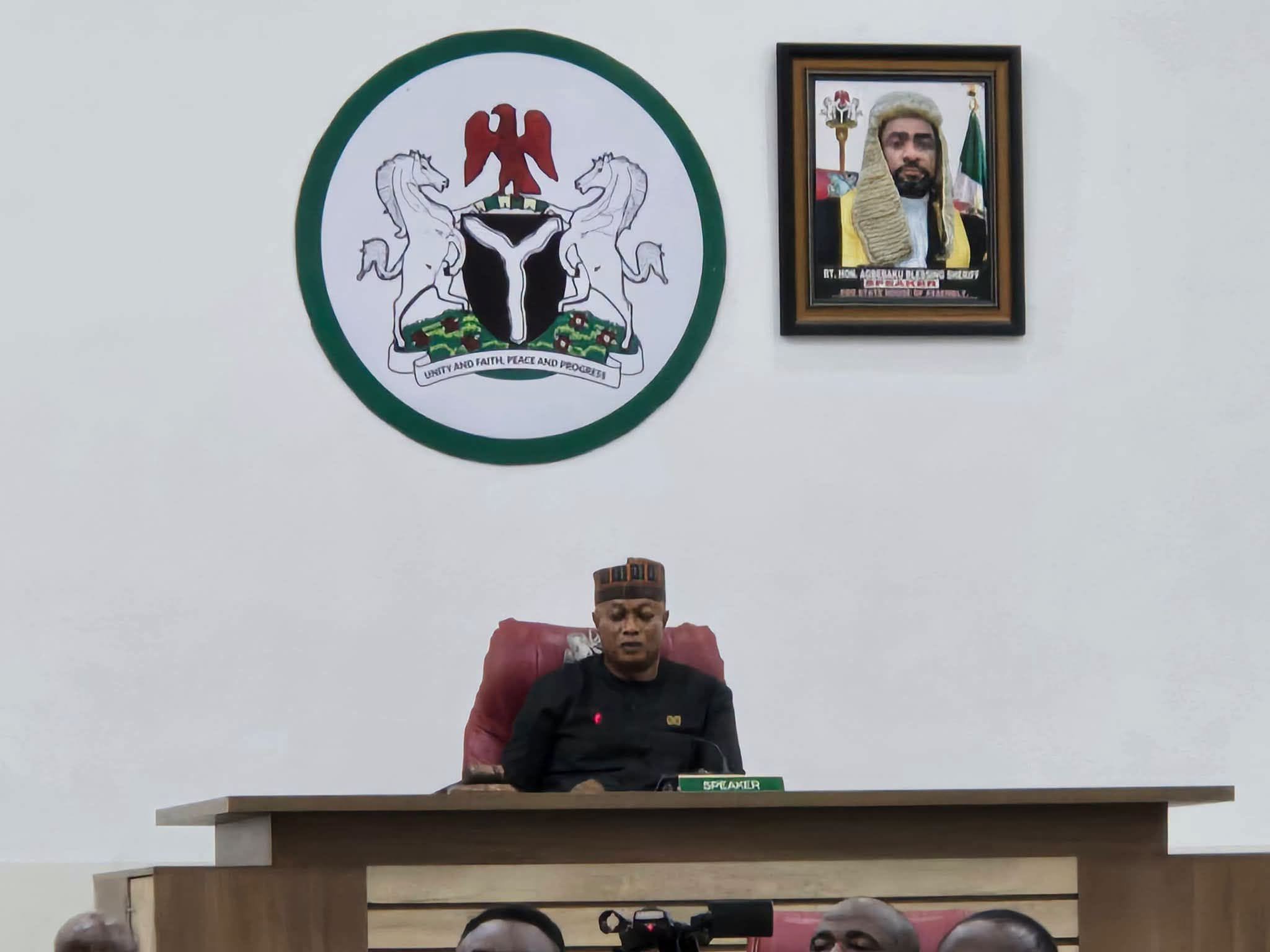
By Dipo Olowookere A new Speaker has emerged for the Edo State House of Assembly, and he is Mr Osamwonyi Atu, representing Orhionmwon East constituency. His assumption of office followed the resignation of Mr Blessing Agbebaku, representing Owan West Constituency, on Monday. The leadership change in the legislative arm of government in Edo State was […]

Published

on

Edo Assembly Osamwonyi Atu

By Dipo Olowookere

A new Speaker has emerged for the Edo State House of Assembly, and he is Mr Yekini Oisayemoje, representing Akoko Edo Constituency II.

His assumption of office followed the resignation of Mr Blessing Agbebaku, representing Owan West Constituency, on Monday.

The leadership change in the legislative arm of government in Edo State was not what was seen coming too soon.

This development, according to observers, could further restructure the political dynamics within the state’s tier of government.

According to reports, Mr Agbebaku decided to step down from the exalted position because he suspects he could be impeached as Speaker, and to avert denting his political image, he quickly resigned.

The lawmaker was elected as the Speaker of the Edo State House of Assembly in June 2023 under the platform of the People’s Democratic Party (PDP), but in 2025, he defected to the All Progressives Congress (APC), a party of the Governor of Edo State, Mr Monday Okpebholo.

There have been speculations that he may still be loyal to the immediate past governor of Edo State, Mr Godwin Obaseki. This may have prompted rumours of his purported impeachment.


Dipo Olowookere is a journalist based in Nigeria that has passion for reporting business news stories. At his leisure time, he watches football and supports 3SC of Ibadan. Mr Olowookere can be reached via [email protected]

Click to comment

Leave a Reply

Your email address will not be published. Required fields are marked *

General

NSDC Targets 2m Tonnes Local Sugar Production Under New Master Plan

Published

on

price of sugar

By Adedapo Adesanya

The National Sugar Development Council (NSDC) has unveiled plans to accelerate Nigeria’s journey to sugar self-sufficiency, with a target of producing about two million metric tonnes of sugar locally under the Nigeria Sugar Master Plan (NSMP) 2.0.

NSDC Executive Secretary and Chief Executive Officer, Mr Kamar Bakrin, disclosed this when he received members of the Abuja Chapter of the Chartered Institute of Directors (CIoD) at the Council’s headquarters in Abuja.

Mr Bakrin described NSMP 2.0 as an “acceleration mandate” designed to compress Nigeria’s timeline to sugar self-sufficiency and reduce the country’s dependence on imported sugar.

Nigeria currently consumes about 1.8 million metric tonnes of sugar annually, while approximately $1 billion is spent on sugar imports each year.

The NSDC said increasing local production would help retain this value within the Nigerian economy while creating jobs, supporting rural development, saving foreign exchange and driving industrialisation.

Mr Bakrin said the council’s ambition goes beyond sugar production, noting that sugarcane can also support the production of ethanol, animal feed and electricity, thereby creating a broader bio-industrial ecosystem.

He identified governance and implementation as major challenges facing the sector, saying Nigeria has adequate policies but has struggled with effective execution.

The council is also strengthening the Backwards Integration Programme (BIP), noting that companies seeking import quotas must demonstrate genuine commitment to the integration programme, while major refiners are required to submit audited production commitments linked to their quotas.

He said the organisation plans to use satellite imagery and physical inspections to verify activities at project sites and enforce compliance.

Continue Reading

General

CNPP Commends Osun Voters, Urges Nigerians to Defy Intimidation Ahead Of 2027

Published

on

Conference of Nigeria Political Parties CNPP

By Modupe Gbadeyanka

Electorates in Osun State have been applauded for demonstrating remarkable resilience, courage and determination in exercising their constitutional right to vote despite the atmosphere of tension, intimidation and violence that preceded the governorship election on Saturday, August 15, 2026.

This commendation came from the Conference of Nigeria Political Parties (CNPP) through a statement signed by its Deputy National Publicity Secretary, Mr James Ezema.

CNPP is the umbrella body of registered political parties and political associations in Nigeria.

In the statement issued on Sunday, the group noted that the Osun governorship poll offers an important lesson for Nigerians as the country prepares for the 2027 general elections.

The organisation said the reported killings and other violent incidents in the build-up to the election made the courage of Osun voters even more significant, noting that the decision of citizens to turn out and participate in the electoral process demonstrated that intimidation must not be allowed to determine who governs the people.

“Osun State has once again reminded Nigerians that democracy belongs to the people and that the ballot remains one of the most powerful instruments available to citizens for determining who governs them.

“The resilience of the people of Osun State, who refused to be intimidated or driven away from the polling units by the atmosphere of violence and fear that preceded the election, deserves commendation.

“Those who seek to intimidate voters understand one fundamental weakness of democracy: when citizens refuse to participate, they create a vacuum that can be exploited by those who seek to manipulate the electoral process.

“Therefore, ahead of the 2027 general elections, Nigerians must emulate the courage demonstrated by Osun voters. Refusal to vote does not punish politicians; rather, it opens the door and clears the stage for those who may seek to rig elections or impose unpopular leadership,” the CNPP stated.

INEC Must Improve on Osun Performance

The CNPP also commended the Independent National Electoral Commission (INEC) for what it described as a generally improved level of neutrality in the conduct of the Osun governorship election.

However, it emphasised that the electoral commission must not regard the Osun experience as the destination, but as a foundation upon which greater transparency, efficiency and credibility must be built ahead of the 2027 general elections.

The CNPP particularly called on INEC to improve the speed and transparency of results management and ensure the early and consistent uploading of polling-unit results on its election results portal.

“INEC must understand that in today’s Nigeria, information does not wait. When authentic results are delayed, unverified figures immediately fill the vacuum.

“Such a situation can generate unnecessary suspicion, fuel conspiracy theories and create fertile ground for the circulation of fake results, which can become a recipe for violence.

“INEC must therefore ensure that results are uploaded promptly, transparently and consistently in accordance with its established procedures. Nigerians should not have to rely on social media speculation or unofficial result sheets when the electoral commission has an official results platform,” the CNPP said.

Fix BVAS and Other Electronic Malfunctions

The CNPP further urged INEC to conduct a comprehensive technical review of the biometric accreditation systems and other electronic devices deployed during the Osun election.

The organisation said reports of malfunctioning equipment and difficulties experienced with biometric and electronic systems should not be dismissed as isolated technical inconveniences.

According to the CNPP, every malfunction that prevents or delays a legitimate voter from exercising his or her franchise has the potential to undermine public confidence in the electoral process.

Political Violence Must End

The group condemned electoral violence, intimidation, threats and attacks against voters, political opponents, electoral officials and other stakeholders, urging politicians and their supporters to understand that electoral victory obtained through violence or intimidation cannot produce a stable democracy.

Need for Electoral Offences Tribunals

As part of broader reforms required to strengthen Nigeria’s democratic institutions, the CNPP called for the immediate establishment of Federal and State Electoral Offences Tribunals dedicated to handling cases arising from electoral violence, intimidation, vote buying, destruction of electoral materials, manipulation of electoral processes and other breaches of the Electoral Act and related laws.

“The electoral process cannot be strengthened merely by changing voting technology. We must also strengthen the institutions that punish those who violate electoral laws.

“We need specialised Electoral Offences Tribunals at the federal and state levels with the capacity to investigate, prosecute and swiftly determine cases arising from electoral offences.

“Where perpetrators know that electoral violence and other violations will attract immediate and certain consequences, the incentive to deploy violence as a political strategy will be significantly reduced,” the CNPP said.

2027 Should Not Be About Political Gang-Up

The CNPP cautioned opposition political parties and political actors against reducing the 2027 political contest to a mere exercise in political arithmetic, coalition-building or opposition gang-up.

“What Nigerians need ahead of the 2027 general elections is not political gang-up for its own sake.

“Nigerians need a transparent, free, fair and credible electoral system capable of faithfully delivering the popular wishes of the electorate.

“Coalitions, consensus and mergers are legitimate democratic practices. Political parties have every right to negotiate, realign and form alliances. But none of these should distract attention from the fundamental issue: the integrity of the electoral process,” the CNPP said.

Continue Reading

General

El-Rufai Files Fresh N10bn Suit Against ICPC Over Alleged Denial Of Family Access

Published

on

icpc el rufai

By Adedapo Adesanya

Embattled former Governor of Kaduna State, Mr Nasir El-Rufai, has filed a fresh N10 billion suit against the Independent Corrupt Practices and Other Related Offences Commission (ICPC) over the alleged denial of access to his wife and son while in custody.

The suit, filed by his lawyer, Mr Ubong Akpan, also lists the Chairman of the ICPC and the Attorney-General of the Federation (AGF) as the second and third defendants.

The originating motion, marked FHC/ABJ/CS/1852/2026, was filed at the Federal High Court in Abuja on August 13, 2026.

Mr El-Rufai is asking the court to declare that his fundamental rights under Part IV of the 1999 Constitution, as amended, remain valid and enforceable despite his detention by the commission.

According to the suit, the former governor alleged that the ICPC repeatedly prevented his wife, Mrs Aichatou Asabe, and his son, Mr Abba El-Rufai, from seeing him while he was in custody.

He contends that the alleged denial of access deprived him of the opportunity to receive food, medication and other necessities from his family without any lawful justification or court order.

Mr El-Rufai argued that the alleged actions violated rights guaranteed under Sections 34 and 37 of the Constitution, as well as Articles 5 and 18 of the African Charter on Human and Peoples’ Rights.

He further alleged that ICPC officers physically restrained and intimidated his wife and son on July 7, describing the incident as an unlawful interference with his spousal and filial relationships.

The former governor is asking the court to declare that the alleged treatment breached his constitutional rights to dignity of the person and private and family life. He is also seeking a declaration that the continued denial of access to his family members without lawful authority is unconstitutional, illegal, null and void.

Continue Reading
