Connect with us

Auto

New Dawn In Oyeyemi’s FRSC

Published

on

Olayemi Boboye Oyeyemi FRSC

By Brown Justice

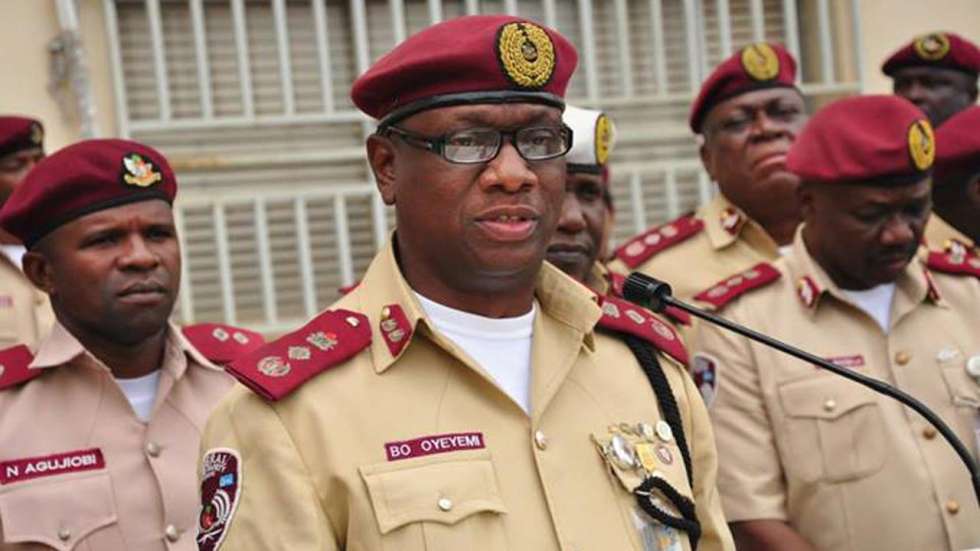
As the first officer of the Federal Road Safety Corps (FRSC) to lead the organization as Corps Marshal and Chief Executive Officer, Dr Olayemi Boboye Oyeyemi has made everyone proud in the country.

Appointed in 2014, Dr Oyeyemi has been able to change both the look and the negative perception held about FRSC by Nigerians. The Corps now has acceptable image and status as well as appreciative position in the hearts and minds of Nigerians.

Dr Oyeyemi is a man who not only made integrity his watchwords at the Corps, but has also demonstrated it in no small measures. He institutionalized integrity at FRSC by making sure those officers and men of the Corps abide by the practice.

Being a visionary leader himself, Dr Oyeyemi introduced far reaching measures and policies that made FRSC what it is today. Take for example, the recent inauguration of the National Road Safety Advisory Council as part of the activities to mark the 29th anniversary of the Corps since its establishment in February 1988.

Honestly speaking, since its establishment 29 years ago, they had never been anyone who got the FRSC closer to its core mandate of making Nigeria’s highways safe for motorists and other road users as well as educating motorists and members of the public on the importance of discipline on the highways like Dr Oyeyemi.

At the risk of sounding too sycophantic, let it be on records that the introduction and enforcements of the speed limiting device by Dr Oyeyemi has drastically reduced the rates of road accidents and carnages on our highways.

Before the introduction of speed limiter to vehicle users especially to commercial vehicles by FRSC, speed limits violations by motorists alone accounted for 50.8 percent of the total road crashes recorded in the country between 2013 and 2015.

Nigerians can now see why the usual crashes and deaths normally associated with the yuletide season were drastically reduced last year.

As a regulating agency of the Federal Government, the FRSC under the headship of Dr. Oyeyemi has ingeniously device means of detecting vehicles without speed limiting device installations in them; because not using it is an offence violating section 152 sub-section 4 of the National Road Traffic Regulations Act of 2012. The section reads: ”A person cannot drive a vehicle that is not fitted with speed limiter on any public road.

Therefore, as a regulating and enforcing agency of the state, the FRSC Act of 2007 empowers it to make the use of speed limiting device mandatory on all vehicles plying Nigerian roads, no matter the status of motorists or persons in the society.

The successful execution of the ongoing tyre campaigns by FRSC under Dr Oyeyemi is very remarkable. According to the helmsman, ”Motorists now know that tyres expire. My focus is to raise the awareness and save more lives!”

Other far reaching successes achieved by the Oyeyemi-led FRSC includes but not limited to the ongoing campaigns against overloading by motorists as well as excellence in road traffic management. These two successes alone have worked the wonders of saving even the vehicle owners the burden of frequently taking their vehicles to mechanics as well as giving comforts to passengers.

Others successes are; the introduction of physical fitness exercise for personnel and the introduction of monthly 6-kilometer walking and jogging exercise for officers and men of the corps. The idea behind this is to ensure that personnel are both mentally and physically fit to carry out their functions. This is because exercise itself is a way of refreshing the mind and body of personnel for the various challenges some stubborn motorists may pose to them.

Nevertheless, Dr Boboye Oyeyemi was born on November 26, 1960. He subsequently started his formal education which has taken him to the nation’s citadel of learning.

Today, Dr Oyeyemi is a PhD holder from the University of Nigeria Nsukka. He is also a graduate of the Harvard University School of Government as well as the Royal Institutes for Public Administration in London.

In appreciation of his selfless services to Nigeria, President Muhammadu Buhari in 2015 conferred on him the National Productivity Order of Merit Award. He is also a holder of another national honour known as Member of the Order of Federal Republic MFR.

Similarly, his service to the nation has won him many national and international honours and awards. Some of them includes; Corps Marshal and Chief Executive Award, American Medal of Honour Award by the American Biographical Institute, USA.

Others are; Best Performing Head of Department Award from 2009-2013, Certified Distinguished Administrator Award by Institute of Corporate Administration.

Finally, Dr Oyeyemi should be commended by all Nigerians for leading the FRSC to become the first enforcement agency to be ISO 9001:2008 Certified in Africa.

Mr Brown Justice wrote from Benue State.

Modupe Gbadeyanka is a fast-rising journalist with Business Post Nigeria. Her passion for journalism is amazing. She is willing to learn more with a view to becoming one of the best pen-pushers in Nigeria. Her role models are the duo of CNN's Richard Quest and Christiane Amanpour.

Auto

Mixed Reactions Over Nigeria’s Ban on Importation of Accidented Vehicles

Published

on

import accidented cars nigeria

By Modupe Gbadeyanka

Reactions have continued to trail the decision of the federal government to stop the importation of accidented vehicles into Nigeria by car dealers and others.

On Tuesday, the government declared that it would no longer accept the importation of vehicles without prior certification, noting that it was worried at the influx of substandard automobiles into the country.

The Minister of State for Industry, Trade, and Investment, Mr John Enoh, said the no certification, no entry policy tagged the Standard Organisation of Nigeria–National Automotive Design and Development Council Vehicle Conformity Assessment Programme was now fully implemented with immediate effect, noting that any vehicle that fails to meet the requirements would be denied entry into the country.

“I want to clarify again that this is not a proposal or a pilot. This has become government policy and takes immediate effect upon commencement,” he declared at a meeting in Abuja, stressing that vehicles coming into the nation must obtain pre-shipment certification.

“So, the endorsement integrates vehicle safety into Nigeria’s economic policy framework. It aligns fiscal instruments, foreign exchange import financing, and revenue systems with safety and standards objectives.

“It also strengthens the long-standing work of the Standard Organisation of Nigeria and NADDC within a coordinated whole-of-government approach.

“I think that with effect from the commencement of this SON-NADDC VehCAP, all new and used vehicles and automotive products entering Nigeria must obtain pre-shipment certification on that VehCAP before form M approval, before customs valuation, before power processing, before import clearance, and before market entry,” he stated.

“No vehicle or automotive product shall be imported, cleared, registered or licensed without valid certification. Any non-compliant import shall be subject to refusal of clearance, seizure, or sanctions under applicable laws,” he added.

Mr Enoh disclosed that, “We did not arrive here by accident. Too many Nigerians have died from accidents caused by vehicles that fell short of required standards. Nigeria deserves better, and this government is determined to deliver better.”

While he admitted that some Nigerians may not be able to afford new vehicles, the government cannot fold its arms and allow its citizens to die because of substandard cars.

“I think that without taking an extreme position, we must find a middle ground. There are economic challenges, there is purchasing power, and there is also the capacity of local assemblers to meet demand.

“But at the very minimum, if we adhere strictly to existing regulations, such as limits on the age of imported vehicles, our problem will not be nearly as bad as it is,” he said.

“A vehicle that is non-compliant at the federal level must not be registered at the state level. For the FCCPC, you are expected to treat VehCAP certification as a baseline for consumer protection enforcement for vehicles. State governments, because we run a federation with federal units, state governments are expected to align vehicle registration systems with VehCAP requirements. Most importantly, let me acknowledge the very profound role that was played by the Minister of Finance and Coordinating Minister of the Economy, Wale Edun, for approving the VehCAP initiative,” he warned.

While some Nigerians applaud this initiative, others believe citizens would be exploited by government officials and make the price of fairly used cars more expensive. Some dealers have been accused of bringing in accidented cars, refurbishing them and selling to unsuspecting customers at exorbitant prices.

Continue Reading

Auto

LASPA Threatens Computer Village Touts Over Illegal Parking Extortion

Published

on

Computer Village Touts

By Aduragbemi Omiyale

Individuals and syndicates involved in illegal parking extortion at the Computer Village area of Ikeja have been warned to desist or face the full weight of the law.

This caution was given by the General Manager of the Lagos State Parking Authority (LASPA), Mrs Adebisi Adelabu, in a statement.

She said her organisation has uncovered a racket where fraudsters, working in collaboration with touts, are illegally collecting parking fees of up to N1,000 from motorists under false pretences.

Mrs Adelabu further revealed that some operatives of the Lagos Central Business District (CBD), in Ikeja, often clamp down on the illegally parked vehicles, either removing their number plates or arranging for the vehicles to be towed away, making vehicle owners pay a significant fine to recover both their vehicles and license plates.

She emphasised that the management and regulation of parking within the Ikeja business district, Computer Village and the entire state is not within the statutory purview of the CBD or any group of touts but rests exclusively with LASPA.

“We are aware of these fraudulent activities, and we want to make it clear that LASPA is the only government body legally mandated to oversee parking in Lagos State,” she said.

Continuing, the GM of LASPA condemned these illicit activities in the strongest terms, describing them as a disservice to the public and an embarrassment to the efforts of the state government at creating a seamless and orderly parking ecosystem.

The management of LASPA therefore urged all perpetrators engaged in illegal parking activities to stop immediately, adding that the Authority has revamped its monitoring and enforcement operations in the Computer Village and the State environs.

While stressing that anyone engaging in illegal parking activities will be arrested and prosecuted without leniency, Mrs Adelabu advised Lagos motorists and visitors to the Computer Village area to remain vigilant and patronise only LASPA-registered parking operators with valid identification and receipts.

The general public was also urged to report any suspected individuals or groups engaging in illegal parking operating in LASPA.

Continue Reading

Auto

Passengers Lament as Uber, Bolt Drivers Strike in Lagos

Published

on

Uber Technologies System Nigeria Limited

By Dipo Olowookere

Rising operational costs and declining earnings have forced drivers of ride-haling platforms like Uber and Bolt to embark on a three-day warning strike in Lagos.

This situation has not gone down well with their customers in the metropolis, who have expressed frustration over the strike.

“Though I am not happy with the action of the drivers, I feel for them because they operate in a harsh environment,” a customer of Bolt, Mr Seyi Adeniji, said.

When Business Post checked the Uber app on Monday morning to book a ride from Egbeda to Megida Ayobo, both in the Alimosho Local Government Area of Lagos State, it was functional, but with fewer drivers available for pick-up, with prices ranging from N5,200 on Uber X to N7,400.

One of the drivers, who spoke with this newspaper but begged for anonymity, said efforts by them for improved packages have failed.

It was gathered that when nothing concrete came out from talks with operators of the platforms, drivers, under the aegis of the Amalgamated Union of App-Based Transporters of Nigeria (AUATON), Lagos State Chapter, decided to begin a warning strike from March 16 to 18, 2026, to further press home their demands.

They want an immediate review of ride fares to reflect current economic conditions. They also seek a cut in commission charges by ride-hailing companies, and want the introduction of a guaranteed minimum trip fare.

The drivers have asked for insurance coverage, an end to unjust deactivation of driver accounts without proper investigation, and greater transparency in how fares and commissions are calculated.

In addition, they want improved safety protections for drivers through better rider-verification systems, emergency panic buttons, and faster response mechanisms in cases of security threats.

According to a statement from the spokesman of the organisation, Mr Steven Iwindoye, many drivers are struggling to remain financially viable due to increasing fuel prices, vehicle maintenance costs, inflation and other living expenses, while fare structures on ride-hailing platforms have remained largely unchanged.

“Drivers operating on platforms such as Uber, Bolt, inDrive and Lagride continue to face rising operational costs, including the high price of fuel, vehicle maintenance, inflation and daily living expenses.

“Unfortunately, the fare structures and policies of these companies have not been adjusted to reflect these economic realities,” the statement said.

It was stressed that many drivers now work extremely long hours yet still struggle to earn a sustainable income, clarifying that, “This strike is not intended to punish commuters but to demand fair treatment, economic sustainability and safety protections for the drivers who power the ride-hailing industry.”

Continue Reading

Trending