Economy
The Uphill Battle for IGR Collection
By FBNQuest Research
Our look today at state governments’ internally generated revenue (IGR) shows a decline in the aggregate collection from N801 billion to N756 billion in 2015.
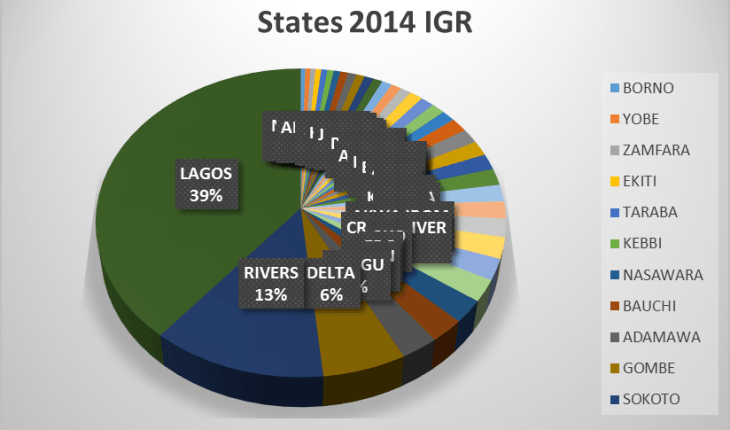
Collection as a proportion of total revenue improved but perhaps the more important trend is that a minority of states is moving away from the rest.
Both Ogun and Enugu joined Lagos in achieving a ratio for IGR/total revenue above 50 percent in 2015. One other state (Rivers) managed 40 percent, three 30 percent (Kano, Oyo and Abia) and five 20 percent.
We are working with the data provided in the CBN annual reports, and sourced from the states themselves as well as the office of accountant-general of the federation.
Although not the most recent data, we stick with the CBN series for the sake of historical comparisons
States’ own figures quoted in the local media may not always be consistent with the CBN series. Enugu is reporting IGR of N12.4 billion in H1 2017, compared with a statutory allocation for the same period of N13.4 billion and IGR of N14 billion for 2016 (12 months).
The narrative from the Enugu state government is that it has been rewarded for prudent management and cooperation between its various collection agencies.
Others have chosen different routes to generate wealth and employment. Kaduna is privatizing state-owned companies, selling state housing and borrowing from the World Bank, having already overhauled its revenue service.
An alternative is borrowing from government bodies, an example being a N4bn MoU signed by Ebonyi state government and the Bank of Industry.
States have received a one-off boost from the Paris/London club refunds for overpayments dating back to 2005.
A first distribution of N523 billion was made in December, conditional upon an undertaking by the states to allocate 50 percent of receipts for salaries and pensions, and a second of N244 billion has followed.
Delta State has pledged to disburse half its latest refund accordingly, with the balance for priority projects and the payment of contractors. Some distributions by states have attracted negative comments.
Mr Babatunde Fowler, chairman of the Federal Inland Revenue Service and of the Joint Tax Board, has called upon state governments to devolve more authority to their revenue agencies. We endorse his call, which requires state governors to take a broader view of their obligations.
While a minority of states is ahead of the field in racing terms, more than one third (13) collected less than 10 percent of total revenue in 2015. These are not all states one would regard as resource-less and impoverished.
Economy
BNB Price Reflects Changing Dynamics in the Digital Asset Market
Economy
NASD Unlisted Security Index Crosses 4,000-point Benchmark Again
By Adedapo Adesanya
The NASD Over-the-Counter (OTC) Securities Exchange achieved a milestone on Friday, April 24, 2026, after five securities on the platform helped with a 1.85 per cent growth.
Data showed that the NASD Unlisted Security Index (NSI) again crossed the 4,000-point benchmark yesterday.
The index chalked up 73.64 points during the trading day to close at 4,052.59 points compared with the preceding session’s 3,978.95 points, while the market capitalisation added N5.38 billion to finish at N2.424 trillion versus Thursday’s closing value of N2.380 trillion.
The price gainers were led by Okitipupa Plc, which grew by N25.00 to sell at N305.00 per share compared with the previous price of N280.00 per share. Central Securities Clearing System (CSCS) Plc gained N6.92 to close at N76.26 per unit versus N69.34 per unit, Afriland Properties Plc appreciated by N1.00 to N17.00 per share from N18.00 per share, FrieslandCampina Wamco Nigeria Plc improved by 55 Kobo to N99.55 per unit from N99.00 per unit, and Food Concepts Plc increased by 5 Kobo to N2.70 per share from N2.65 per share.
However, there was a price loser, MRS Oil, which dipped by N21.75 to N195.75 per unit from N217.50 per unit.
During the final session of the week, the value of securities jumped 75.2 per cent to N41.3 million from N23.6 million units, and the number of deals expanded by 62.9 per cent to 44 deals from 27 deals, while the volume of securities declined marginally by 0.9 per cent to 447,403 units from 451,522 units.
At the close of trades, Great Nigeria Insurance (GNI) Plc was the most traded stock by volume (year-to-date) with 3.4 billion units worth N8.4 billion, trailed by Resourcery Plc with 1.1 billion units valued at N415.7 million, and Infrastructure Guarantee Credit Plc with 400 million units traded for N1.2 billion.
GNI was also the most active stock by value (year-to-date) with 3.4 billion units sold for N8.4 billion, followed by CSCS Plc with 59.6 million units transacted for N4.0 billion, and Okitipupa Plc with 27.8 million units exchanged for N1.9 billion.
Economy
Naira Slips to N1,358/$1 as FX Reserves, Policy Uncertainty Concerns
By Adedapo Adesanya
It was not a good day for the Nigerian Naira in the currency market on Friday, April 24, as its value depreciated against the major foreign currencies at the close of transactions.
In the Nigerian Autonomous Foreign Exchange Market (NAFEX), it lost N4.53 or 0.33 per cent against the United States Dollar yesterday to trade at N1,358.44/$1, in contrast to the N1,353.91/$1 it was exchanged on Thursday.
Equally, the domestic currency slipped against the Pound Sterling in the official market during the session by N8.14 to close at N1,834.02/£1, compared with the previous rate of N1,825.88/£1 and dropped N8.01 against the Euro to sell at N1,590.73/€1 versus N1,582.72/€1.
Also, the Naira depreciated against the US Dollar at the GTBank FX desk on Friday by N4 to quote at N1,370/$1 compared with the previous session’s N1,366/$1, and at the parallel market, it depleted by N5 to settle at N1,380/$1 versus the preceding day’s N1,375/$1.
Data published by the Central Bank of Nigeria (CBN) indicated that NFEM interbank turnover surged to N43.562 million across 68 deals, up from N28.117 million the previous day.
Despite the CBN’s reassurance that the recent drop in external reserves is not worrisome, the market remains unsettled by persistent concerns over liquidity constraints, policy transparency, and weakening confidence in Nigeria’s FX market as gross reserves continue to decline to $48.4 billion.
The outlook for the Dollar appears supported by broader macro risks, including elevated oil prices tied to the tanker traffic disruptions in the Strait of Hormuz and a continued US-Iran standoff over ceasefire negotiations.
A look at the digital currency market showed that investors are sitting on the edge as the US Dollar rebounded amid geopolitical and inflation risks despite continued inflows into US spot bitcoin Exchange Traded Funds (ETFs).
Solana (SOL) rose by 1.2 per cent to sell $86.45, Cardano (ADA) appreciated by 1.1 per cent to $0.2517, Dogecoin (DOGE) grew by 0.9 per cent to $0.0989, Ripple (XRP) improved by 0.3 per cent to $1.43, Ethereum (ETH) soared by 0.2 per cent to $2,316.83, and Binance Coin (BNB) chalked up 0.1 per cent to sell for $637.44.
However, TRON (TRX) depreciated by 1.3 per cent to $0.3235, and Bitcoin (BTC) lost 0.2 per cent to close at $77,562.27, while the US Dollar Tether (USDT) and the US Dollar Coin (USDC) closed flat at $1.00 each.
-
Feature/OPED6 years agoDavos was Different this year
-
Travel/Tourism10 years ago
Lagos Seals Western Lodge Hotel In Ikorodu
-
Showbiz3 years agoEstranged Lover Releases Videos of Empress Njamah Bathing
-
Banking8 years agoSort Codes of GTBank Branches in Nigeria
-
Economy3 years agoSubsidy Removal: CNG at N130 Per Litre Cheaper Than Petrol—IPMAN
-
Banking3 years agoSort Codes of UBA Branches in Nigeria
-
Banking3 years agoFirst Bank Announces Planned Downtime
-
Sports3 years agoHighest Paid Nigerian Footballer – How Much Do Nigerian Footballers Earn