Connect with us

Economy

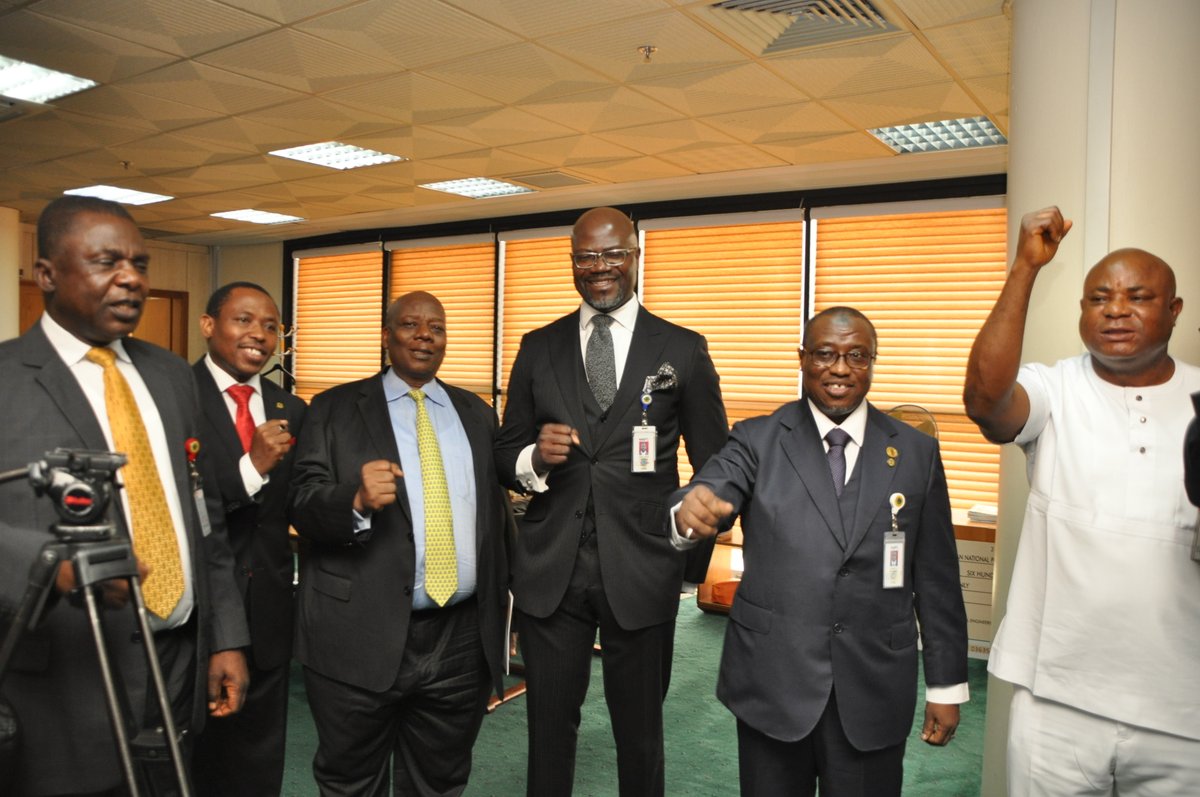
NUPENG, PENGASSAN Throw Weight Behind Baru

Published

on

By Dipo Olowookere

Two key unions in the petroleum industry in Nigeria; the Petroleum and Natural Gas Senior Staff Association of Nigeria (PENGASSAN), and the Nigeria Union of Petroleum and Natural Gas Workers (NUPENG), have pledged unalloyed support for the transformation stride of the Group Managing Director of the Nigerian National Petroleum Corporation (NNPC), Dr Maikanti Baru.

The two bodies, at a solidarity visit to the GMD yesterday, expressed support for Mr Baru, saying they have confidence in his leadership style.

The unions’ visit came on the heels of the recent controversies over a letter the Minister of State for Petroleum Resources, Dr Ibe Kachikwu, forwarded to the President alleging non-adherence to due process by the Management of NNPC in some contract administration.

National President of PENGASSAN, Comrade Francis Johnson, said the unions and their members considered it appropriate to rally round the GMD and the NNPC Management to pledge their support.

Comrade Johnson said the unions’ support for the GMD was based on his ability to walk his talk since assuming office last year.

“The National body of PENGASSAN and all the NNPC in-house unions are here today to show our support for you. You have brought stability to the NNPC and we are happy today that staff morale is high.

“You were Chairman of NNPC Anti-Corruption Committee for over five years and that was what informed your appointment as GMD of NNPC.

“Today, all the bullets you are taking are on behalf of members of staff. We will continue to pray for you, God will continue to guide and shield you,” Comrade Johnson assured.

The PENGASSAN President called on Nigerians to be cautious of their comments on the controversy, adding that any wrong information was capable of discouraging investors from the oil and gas industry which is the highest foreign exchange earner.

The NNPC Group Chairman of PENGASSAN, Comrade Sale Abdullahi, who also spoke during the visit to the GMD, stated that their concern had to do with the need to protect not only the GMD but the NNPC as an institution.

He noted that Dr Baru had streamlined the processes and procedures in the Corporation leading to the full restructuring which was beginning to yield positive results.

“Today, the GMD and NNPC Management receive inputs from staff and this gesture by Dr. Baru has given members of staff a sense of belonging. Today, our inputs are being implemented and we are highly motivated,” Comrade Abdullahi stated.

Supporting these positions, the Group Chairman of NNPC NUPENG, Comrade Udofia Odudu Benjamin, said the unions would continue to pray for divine guidance for Dr Baru and the entire NNPC management.

Earlier, the Chairman of NNPC Corporate Headquarters Chapter of PENGASSAN, Comrade Mathew Duru, reiterated the continued support of the unions for the Dr Baru-led management.

“We just want to tell the GMD from the bottom of our hearts that we are with him and the Top Management; that we are behind the GMD who has done very well in turning the fortunes of the corporation around,” the union leader stated.

He said since Dr Baru assumed office, he had succeeded in clearing the air of uncertainty that prevailed in the corporation because of visionless reforms that left NNPC on the brink of collapse.

He also said the GMD succeeded in resolving the NNPC Pension challenge that had led to disenchantment among staff.

“We are with you. We want to let you know that you are not an orphan”, Mr Matthew emphasized.

Responding, Dr Baru dismissed the allegations of award of contracts without regard to due process as unfounded and unfortunate.

He explained that as a former chairman of the NNPC Anti-Corruption Committee, he would be the last person to breach the procurement process by disregarding extant laws and rules.

The GMD said both the NNPC Act and Public Procurement Act vested procurement powers on the NNPC Tenders Board, the President and the Federal Executive Council (FEC) depending on the cost threshold, stressing that the NNPC Board had no role whatsoever in the process.

“I know for those of you who are following what we are doing here, you know that there’s no money lost and no process has been breached. Our contracting process is perfect and we will continue to follow the process. The NNPC Board has no role, I repeat, has no role as far as the contracting process is concerned,” Dr Baru emphasized, adding that the NNPC Tenders Board was made up of the GMD as Chairman and the Group Executive Directors as members.

On the crude term contract and the DSDP agreements, he explained: “These are not contract as such, they are essentially pre-qualification of off-takers of crude oil and in the case of DSDP, of those that will take crude and give us products in return. So there is no value to them. But humongous figures have been put forward mainly to incite the public, it is most unfortunate”.

On the allegation of lop-sided promotions, the GMD asked the union leaders if their members felt disenchanted to which the unionists chorused a resounding “no”.

He urged the union leaders to enlighten their members on the facts and encourage them to go about their duties without distraction.


Dipo Olowookere is a journalist based in Nigeria that has passion for reporting business news stories. At his leisure time, he watches football and supports 3SC of Ibadan. Mr Olowookere can be reached via [email protected]

Economy

Nigeria Records Five-Year Peak in Oil Output at 1.71mbpd

Published

on

crude oil output

By Adedapo Adesanya

Nigeria’s oil production recorded a five-year high of 1.71 million barrels per day, marking a significant rebound for the country’s upstream sector amid renewed efforts to restore output and improve operational stability.

The latest figure, released by Nigerian National Petroleum Company (NNPC) Limited, covers the period from April 2025 to April 2026 and underscores a steady recovery in crude production after years of disruptions caused by theft, pipeline vandalism and underinvestment.

According to the chief executive of the national oil company, Mr Bayo Ojulari, the performance reflects measurable progress across the company’s upstream, gas and downstream operations, with production gains supported by improved asset management and stronger field performance.

Within its exploration and production business, NNPC recorded a peak daily output of 365,000 barrels in December 2025, the highest level ever achieved by its upstream subsidiary. The company also advanced key contractual reforms, including revised production-sharing terms for deepwater assets aimed at unlocking additional gas reserves.

Nigeria’s gas ambitions are also gaining traction. Gas supply rose to 7.5 billion standard cubic feet per day in 2025, driven by major infrastructure milestones such as the River Niger crossing on the Ajaokuta-Kaduna-Kano pipeline and the commissioning of the Assa North-Ohaji South gas processing plant.

These investments are beginning to strengthen domestic gas utilisation. New supply agreements with major industrial consumers, including Dangote Refinery, Dangote Fertiliser and Dangote Cement, are expected to deepen gas penetration across manufacturing and power generation.

On the downstream front, NNPC has continued crude supply to Dangote Refinery under the crude-for-naira arrangement, a policy designed to reduce foreign exchange demand, support local refining and improve fuel market stability. The company also reaffirmed its 7.25 per cent equity stake in the refinery as part of its long-term energy security strategy.

Financially, the national oil company said it has resumed full monthly remittances to the Federation Account since July 2025. It has also reinstated regular performance reporting and held its first earnings call, moves widely seen as part of a broader push towards greater transparency and corporate accountability.

Despite the progress, challenges remain. Crude theft, pipeline outages and infrastructure bottlenecks continue to threaten production stability. Sustaining this recovery will depend on stronger security, reliable infrastructure and policy consistency as Nigeria seeks to maximise the benefits of rising domestic refining capacity.

Continue Reading

Economy

UAE to Leave OPEC May 1

Published

on

Nigeria OPEC

By Adedapo Adesanya

The United ‌Arab Emirates has announced its decision to quit the Organisation of the Petroleum Exporting Countries (OPEC) to focus on national interests.

This dealt ⁠a heavy ⁠blow to the oil-exporting group at a time when the US-Israel war on Iran had caused ⁠a historic energy shock and rattled the global economy.

The move, which will take effect on May 1, 2026, reflects “the UAE’s long-term strategic and economic vision and evolving energy profile”, a statement carried by state media said on Tuesday.

“During our time in the organisation, we made significant contributions and even greater sacrifices for the benefit of all,” it added. “However, the time has come to focus our efforts on what our national interest dictates.”

The loss of the UAE, a longstanding OPEC member, could create disarray and weaken the oil cartel, which has usually sought to show a united ⁠front despite internal disagreements over a range of issues from geopolitics to production quotas.

UAE Energy Minister Suhail Mohamed al-Mazrouei said the decision was taken after a careful look at the regional power’s energy strategies.

“This is a policy decision. It has been done after a careful look at current and future policies related to the level of production,” the minister said.

OPEC’s Gulf producers have already been struggling to ship exports through the Strait of Hormuz, a ‌narrow chokepoint between Iran and Oman through which a fifth of the world’s crude oil and liquefied natural gas supplies normally pass, because of threats and attacks against vessels during the war.

The UAE had been a member of OPEC first through its emirate of Abu Dhabi in 1967 and later when it became its own country in 1971.

The oil cartel, based in Vienna, has seen some of its market power wane as the US has increased its production of crude oil in recent years.

Additionally, the UAE and Saudi Arabia have increasingly competed over economic issues and regional politics, particularly in the Red Sea area.

The two countries had joined a coalition to fight against Yemen’s Iran-backed Houthis in 2015. However, that coalition broke down into recriminations in late December when Saudi Arabia bombed what it described as a weapons shipment bound for Yemeni separatists backed by the UAE.

Continue Reading

Economy

NASD OTC Exchange Inches Up 0.03% as CSCS Outshines Four Price Decliners

Published

on

Nigerian OTC securities exchange

By Adedapo Adesanya

Central Securities Clearing System (CSCS) Plc bested four price decliners on the NASD Over-the-Counter (OTC) Securities Exchange on Monday, April 27. The alternative stock market opened the week bullish during the session with a 0.03 per cent uptick.

According to data, the security depository company added N2.61 to its share price to close at N76.26 per unit compared with the preceding session’s N78.87 per unit.

As a result, the market capitalisation of the platform increased by N820 million to N2.425 trillion from N2.424 trillion, and the NASD Unlisted Security Index (NSI) gained 1.38 points to finish at 4,053.97 points compared with the 4,052.58 points it ended last Friday.

The four price losers were led by NASD Plc, which slumped by N3.80 to sell at N34.70 per share versus N38.50 per share. FrieslandCampina Wamco Nigeria Plc fell by N1.45 to N98.10 per unit from N99.55 per unit, Food Concepts Plc slid by 27 Kobo to N2.43 per share from N2.70 per share, and Geo-Fluids Plc dipped by 9 Kobo to N2.91 per unit from N3.00 per unit.

The value of securities transacted by market participants went down by 82.0 per cent to N7.4 million from N41.3 million units, the volume of securities declined by 28.5 per cent to 319,831 units from 447,403 units, and the number of deals dropped by 34.1 per cent to 29 deals from 44 deals.

Great Nigeria Insurance (GNI) Plc was the most active stock by value on a year-to-date basis with 3.4 billion units worth N8.4 billion, followed by CSCS Plc with 59.6 million units sold for N4.0 billion, and Okitipupa Plc with 27.8 million units exchanged for N1.9 billion.

Also, GNI Plc was the most traded stock by volume on a year-to-date basis with 3.4 billion units valued at N8.4 billion, followed by Resourcery Plc with 1.1 billion units traded for N415.7 million, and Infrastructure Guarantee Credit Plc with a turnover of 400 million units worth N1.2 billion.

Continue Reading

Trending